Newport Family 1766-1820
Religious Persecution
|
|
Three years after the treaty of 1688 was signed, Parliament passed its "Act for the Better Securing of the Government against Papists." This act reinforced some of the earlier penal laws that the local justices ignored, and it also created newer measures to restrict Catholic opportunities in Ireland. Under this policy, Catholics could no longer hold weapons, their participation in Parliament would be outlawed, and Catholics' rights to inherit land was severely restrained. The inheritance laws disallowed Catholics to hold property, and its measures were so restrictive that it forced Catholic heiresses to marry Protestant men to ensure that Protestants would control their marital property. These laws discriminated against Catholics whom the Irish Protestants believed were the cause of their misfortunes, in much the same way that 20th century American Ku Klux Klan members believe that Jews and Blacks caused their personal financial problems. How embedded the Protestant's belief that Papists caused their problems can be seen by narratives written during this period. When Irish Protestant farms produced less output it was because their Catholic farm laborers were too lazy. If the demand for cattle was low, it was because Catholic Europe was seeking other outlets to buy cattle. If England was at war, the English speculated that the Roman Catholic church inspired its genesis. The 1766 Religious Census By the mid 1700s, authorities decided to keep track of the Catholic Church’s activities. In 1766, the Irish Parliament ordered all Church of Ireland ministers in their respective parishes to prepare a list of householders and their religious affiliation (church of Ireland, Catholic or Presbyterian). In addition the ministers were required to include information about any Catholic priests or friars active in the area. The work was done in the spring of the year with varying degrees of diligence. Some ministers made a numerical summary listing only total numbers for each religion in the parish. Others took great care, making the list townland by townland, showing the name of each householder and his religion. Still others fell somewhere in between; e.g., listing only the Catholics or omitting the townland. The genealogical value of this list is two-fold. One is the discovery of an ancestor's religion, or what he stated to be his religion at the time; the other is the confirmation of the presence of an individual or a family surname in a particular place. Our Ancient Ancestors The 1766 Census shows some interesting things about our heritage. There are about 190 Ryan family units in Newport Parish, and because of the large number of households with this surname, it is difficult to determine which family we trace our ancestry. On the other hand, it is easier to make connections with our other Newport relatives. 250 years ago there were only two Hill families: Edward and Patrick Hill. According to Irish naming conventions, the first born male was named after his father’s father, therefore, it is safe to say that we link directly to Edward. While there were a number of Caseys in Newport Parish, only two Casey households were Roman Catholic. While we can't say which one is our direct ancestor, we are led to believe that both families we share a common ancestry. The McDonalds were fairly numerous, if you consider 10 households a large number. As for the Campbells, there were no families living in Newport Parish in 1766. Although there were many Campbells living in County Tipperary, only two families were Catholic. Based on geography, we believe we are directly related to the Campbells living near Tipperary Town, as this parish is adjacent to Newport Parish. The Boneys are the easiest of all - only one Bone (Boney) listed in this census. |
The 1766 Census Records - Records of "Papists" Only (Roman Catholics)
 |
|
How are Relatives Lived in the early 1800s The majority of Irish Catholics lived very simple lives, and after the 'Penal Laws' made it illegal to own a horse above five pounds or inherit land many of the Irish were driven into poverty. Their typical home was of crude proportions, and held together by finely heated mud. The roof was built of thatch that consisted of any material they could find. There were few windows, and the most important part of this home was the fireplace. This hearth provided heat during the winter, and it was used to prepare the Irish dinner that usually consisted of potatoes and milk. The fireside also provided household comfort as the family gathered around its fire, after work in the field was completed. The farmer produced all food from the lands he farmed, and the size of his crop depended upon the size of his family. Wheat, oats and potatoes were raised for the family's meals, while flax combined with wool was raised to produce yarn. Because the penal laws made it difficult for Catholics to accumulate wealth or own property, very few 'papists' lived openly among the ranks of the wealthy. In 1640, the Catholics possessed nearly 60 percent of the land in Ireland; however, by 1690 ownership had been reduced to 22 percent. As more confiscations of disputed land titles continued, Irish Catholics could only claim 14 per cent ownership of land in the early 1700s. Even this figure slowly eroded because the Penal Codes forced many to become renters as the 18th century progressed. Many Irish peasants leased land from the landowners at set rentals, generally between one pound and two pounds per acre. In Tipperary, three classes of citizens evolved. The first class formed the landlords, sometimes referred to as the church lords because they were predominantly Protestant and preserved by the Protestant clergy. The landlords were often described as middlemen and responsible for setting high rents and collecting rents from their obedient tenants. The second class were the tenants of the land,, and often referred to as "bog farmers." These 'bog farmers' including others of Gaelic descent were usually described as the 'mere Irish' by British documents, and they generally rented 20 to 40 acres. Finally the third class were the laborers, and this group encompassed many occupational types such as servants, general laborers to the landlord, and shopkeepers. Many in this class were descendants of farmers, but because the family holding could not be split into smaller segments, many ventured into other trades outside of farming. The latter two classes were predominantly Catholic in its composition. |
Click to Enlarge |
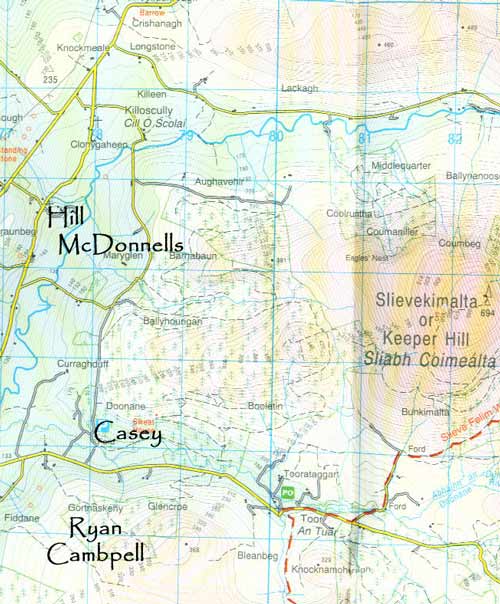
The Hills and McDonnells It was clear that the Hill and McDonald families had a long relationship with one another. There appeared to be a heavy concentration of both families in Killoscully, notably in Guaranbeg townland (half the name appears to the left of "Hill"). As noted earlier, there were only two Hill families in Newport Parish 25 years earlier, so any references we find of the Hill family should have some historical interest to our families. The families listed below most likely are distant relatives to our family tree. The map to your left shows that, in the early 1800s, our ancestors lived fairly close to each other. It is possible that all these families attended the same church, which was located in Curragduff. |
|||||||||
|