Brule County History


Brule County Relatives
Kimball, South Dakota
1947 Historical Compilation
Smith & Ryan Connections
Introduction
The following was taken from an article titled, “A Short History of Brule County’, which was compiled by the South Dakota State Historical Society in 1947. It was published in a book titled “South Dakota Historical Collections; Volume XXIII” by the State Publishing Company in Pierre, South Dakota. Some of the pictures you will see later come from the same book. Others were found on the internet. None of this was edited for content and appears as found in the original writing. Some of what you will read has appeared before because it was reprinted in other books. Much of what you will see though is new information not already found elsewhere on the website.

In the Beginning…
The Missouri River Trail comes into Brule County near the southwest corner of School Section 36 in America Township, here was probably located the first roadhouse in the county. This building was constructed of logs, stone and sod. The proprietor’s name was Papineau. This probably was not his real name as Papineau was a name often given to a person who was addicted to the use of what the Indians called “firewater,” and had about the same meaning. (Page 4) (Editor’s note: This is not family related; however, I thought it was amusing.)

The first pastor of the Catholic Church was Father Stephen in about 1884, when Father Flanigan took charge. They held services in a home until they built their church. The Farells, Gavins, Walshes, Ryans, Conleys, Irish John Smiths and Purcells were early attendants and their families still go. Father O’Flaherity was very much loved by his parishioners and during World War I he was a chaplain and was killed while attending the soldiers. Father O’Gorman was the next minister. One night the church burned down because of defective wiring and Father O’Gorman led in the building of a larger church with a complete basement where they hold their suppers and in which they also have a recreation room. Father O’Gorman died in 1846 and Father Conley is the present pastor. The membership is 700. (Page 25)
The following Brule County Atlas dated 1884 is found on page 10 of this book.

KEY TO MAP – Triangle: School 1884. Round dot: School 1911. Cross: Church 1911. Double Cross: Cemetery 1911. The numbers locate the names of persons appearing on Andrea’s 1884 Atlas of Brule County: 1. W. S. Willis; 2. Warren Dye; 3. E. B. Taft; 4. D. Ryan; 5. J. W. Orcutt; 6. T. A. French; 7. R. J. Andrews; 8. A. L. Clark; 9. A. J. Kellam; 10. J. A. King; 11. C.C. Morrow; 12. T. A. French; 13. Stearns; 14. P. G. Carroll; 15. A. Inglis; 16. J. W. Long; 17. J. Stolte; 18. R. J. Andrews; 19. H. S. Phillips; 20. J. S. White; 21. D. Warner; 22. J. W. Orcutt; 23. E. P. Ochsner; 24. Capt. C. J. Maynard; 25. B. F. Ochsner; 26. Rev. J. B. Taylor; 27. D. Wanner; 28. D. Warner; 29. Judge J. B. Long; 30. J. W. Orcutt; 31. E. B. Taft; 32. L. Richards; 33. D. G. Grippen; 34. E. M. Bond; 35. R. J. Andrews; 36. Capt. J. R. Lowe; 37. D. E. Garmine; 38. J. Waugh; 39. J. W. Cook; 40. A. H. Stuart; 41. J. E. Cone; 42. S. W. Sedgwich
(Editor’s note: In this early map we do not see any Smith or Ryan ancestral names.)
World War I
When Colonel Charles H. Englesby organized the 1st South Dakota Cavalry in the summer for service in World War I, Captain Quirk again organized a unit, Troop L, which unit represented Kimball in World War I. (page 35)
**** Picture: Troop L – Kimball South Dakota (Page 35) ****
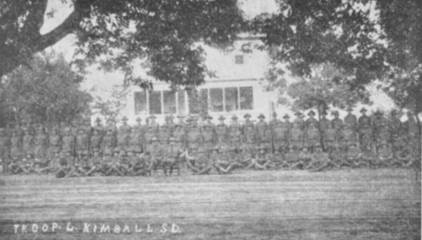
Editor’s note: Many of our relatives served their country during this Great War. Relatives from Brule County who served include the following:
Name Family Relationship
Will Ryan Son of Batt and Eliza Ryan. Will died in France during WWI from the Spanish Flu.
John C. Smith Son of Irish John and Susan Smith.
Patrick Smith Son of Patrick and Louisa Smith of Scotland, Cousins to the Irish John Smith Family. Lived with Irish John during this time.
Joe Quillen Son of Margaret and John Quillen. Margaret is daughter of Mary and John Boney. Mary Boney is Batt Ryan’s sister.
Batt Ryan -> Francis S. Ryan -> Helen Ruth Ryan Smith -> Smith siblings.
Chamberlain

The Catholic Church was built in the early nineties. The Liefermans, Healeys, Dusseaus, Duvals and Rigneys attended. The Catholics bought the Indian School from the Government and established a school for Catholic boys right north of Chamberlain. This became Columbus College and was later moved to Sioux Falls. Father Burns was there a long time and now Father Syire is in charge. John Lieferman is the clerk. (Page 53) (Editor’s note: This section was added because some of our relatives may have attended Columbus College. The Catholic Church was built in the Eighteen Nineties and not the Nineteen Nineties.)

Tragedy in Brule County
In September 1925 one of the tragedies of Brule County occurred when Steve Hedge, a stranger, bummed a ride with E. D. Miller, (brother-n-law to R. P. England, a contractor) who was driving a truck west of Chamberlain. In a short time Hedge pulled a gun on Miller and ordered him to turn over his money which Miller reluctantly did and Hedge got out of the truck. After going a short distance Miller turned around and went back to Chamberlain and reported to the authorities. It being Sunday, the sheriff, Frank Richards, was at his home in Kimball, so the deputy, James J. Boney went down to the river’s bank to look for Hedge and when Boney demanded that Hedge surrender, Hedge shot and mortally wounded Boney. Meantime several other men hearing the shot organized a posse and surrounded the brush, demanding that Hedge surrender, which he did when he knew he was trapped. While this was going on some men took Boney to the Sanitorium and notified his family. Boney lived only a few hours. The authorities knew if the news got out about Boney’s death the enraged men would have strung Hedge up then and there so they didn’t give out the news until Hedge was safely landed in jail. He was brought to trial and received a life sentence. He died in prison about ten years ago. (Page 58)
(Editor’s Note: James Boney’s mother was Mary Ryan Boney. Mary Ryan Boney was Bartholomew Ryan’s sister. Batt Ryan -> Francis S. Ryan -> Helen Ruth Ryan Smith -> Smith siblings.)

Cleveland Township
In the fall of 1880 John Glass journeyed from his home at Hampston, Iowa, to Mitchell, South Dakota, where the Land Office for this territory was located, and there filed upon the southwest quarter of Section 30, after having first looked the country over. This was probably the first filing in Cleveland township. In the spring of 1881 he came to his claim after building a shanty lived there long enough to establish residence. Then in the spring of 1882 he brought his family, which consisted of his wife and two children, Milo and Jennie, and also his wife’s parents, Joseph Cleveland and his wife. Mr. Cleveland filed on a claim in the same section as Mr. Glass. (Page 91)
The following is a list of the people who took up land in Cleveland Township and received Patents from the Government (Pages 92 – 93):
|
Section 1 Olas F. Nielson Charles Brown John P. Fernquist America A. Odell |
Section 2 Hugh Brady Mike E. Brady Thomas Ryan* George G. Brady John M. Brady |
Section 3 Wm. J. Conley Heirs of Sally M. Flaherty V. F. Wellner Benth N. Twedt |
Section 4 John D. Reed Vencel Sladek Heirs of Hervon G. Mogen John Ashley Carrie S. Dahlin Barbara Worel |
|
Section 5 Anton Pederson Bjorgal T. Reine Heirs of Emma F. Bierce Hans G. Weme |
Section 6 Thomas Larson John A. Anderson Abraham Olson Heirs of Olle Bryangelsen |
Section 7 Cicero Wesner Julia Everson James Murray Milo A. Glass |
Section 8 Louis S. Nielson Ludvig Ronereim Louis Pederson Katherine Sunstrom |
|
Section 9 Frank Hloucha Vincil Sladek Matthias Achen Melvin Conley |
Section 10 Hannah Wellner Harry Burnes James R. Collins Mary M. Wellner |
Section 11 Dennis Brady James Brady George R. Landon |
Section 12 Heirs of Robert E. Lytle Patrick H. Brady Anne Quillen Otto Biedrman |
|
Section 13 John P. Soderquist Kate M. Brchan Thomas Quillen Anna M. Sunason |
Section 14 Herman Biederman Heirs of John Brady Thomas T. Ashley Lewis Ashley |
Section 15 Ellen Hyland Thomas Brady Ellen Ashley Frank Tomshek |
Section 17 Margaret Hill John A. Anderson Thomas Conley John Ketelhut |
|
Section 18 Heirs of Anne Brady Harry R. Sanborn Thomas Dudacek Frank G. Dudacek |
Section 19 Hinrich Ficken Joseh Dudacek Anna C. Olson Emil R. Olson |
Section 20 William Goetsch Carl G. Olson Jennie A. Glass Peter N. Thompson |
Section 21 Otto A. Sharping Charles Goetsch Richard Griffin Ella N. Ashley |
|
Section 22 Heirs of Charles J. Ashley William C. Ashley Vincent F. Wellner Vincent J. Juelfs |
Section 23 John Tomsik Arthur W. Ashley Mary Tomshek Albert Brood |
Section 24 Joseph Ballard Patrick Powers Frank Richardson Andrew Boney |
Section 25 Lydia A. Aldrich, Guardian George B. Voss John Boney Frank Weitzel |
|
Section 26 Joseph Stocks Louis B. Nickols Mary B. Drury Henry Drury |
Section 27 Henry R. Debruin Arthur Scott Austin Boynton |
Section 28 Thomas Griffin Phoebe Robinson William A. Scott Wilson K. Tener |
Section 29 Samuel E. Carey Andrew Thompson George W. Woods Anna Hadenfeldt |
|
Section 30 Ashman D. Sacket Joseph Cleveland John Shanks John Glass |
Section 31 Marshall M. Richards Charles Youhill John Griffin Emma S. Smith |
Section 32 James D. Clark Thomas Griffin Patrick E. Murphy Thomas Killfeather |
Section 33 William A. Scott Eliza A. Daziel Lena Somers Lena Archer |
|
Section 34 John R. Miller John B. Rice Charles Peterson John W. Myers |
Section 35 Anna R. Wolf John H. Wolf Joseph Knight |
|
|
- (Editor’s Note: We are not sure how or if Thomas Ryan is related to our own family. The Thomas Ryan family names appear side by side with the John Boney family in the 1900 US Census. Thomas lived in Tipperary before moving to America.)
- Margaret Hill was Elizabeth (Hill) Ryan’s mother. Elizabeth, or Liza, married Bartholomew “Batty” Ryan. Margaret Hill had another daughter who lived in Brule County. This daughter was named Margaret Fitzgerald. Margaret lived with her daughter’s family, Michael and Catherine Smith. Michael Smith was Irish John Smith’s son.
When the time came for naming the township John Griffin suggested that it be named after the oldest man which was Joseph Cleveland and so it became Cleveland Township. (Page 94)
Waldro Township
When, during the summer of 1883, the settlers of this township met at the home of O. M. Jones to discuss the matter of organizing it, they voted to name the township, Jones, in honor of the man in whose house they were meeting, he being one of the most prominent citizens. He objected, but agreed that if they wanted to do him honor it should be named after his mother whose maiden name was Waldro. A petition to that effect was sent to the County Commissioners and on October 2, 1883, the petition was granted and Waldro Township became a reality. (Page 97)

The following is a list of the people who took up land in Waldro Township and received patents from the Government (Pages 98 – 99):
|
Section 1 Charles W. Watts Richard Loney John S. Cabeen Wm. Richardson Stella Lawson |
Section 2 Fannie M. Pope John W. Woodman Robert A. Bames Michael Kelly Samuel E. Pope |
Section 3 Michael Walsh Wilfried F. Brightman Patrick Quirk Franklin Whipkey |
Section 4 Mary A. Witmore Charles Fralick James W. Fagan Daniel Rooney
|
|
Section 5 Viola T. Davids Henry W. Hinsichs Robert Davids Wm. G. Richards Sarah A. Brush |
Section 6 Moses C. Felker Lydia Jika Charles H. Davis Frank Zicka
|
Section 7 Albert Stocks Harmon D. Hager William G. Pink Serena Lyman |
Section 8 Carroll A. Harlow John Fox Isaac P. Nedrow Daniel Clancy |
|
Section 9 John W. Miller Walter A. Newton William Miller John J. Keefe |
Section 10 Elmer A. Benedict Samuel Miler DeWitt C. McConnell |
Section 11 Wm. M. Norton Ed. M. Harriman John M. Barns Emma C. Hollinger |
Section 12 John M. Moore William M. Norton Reuben G. Wilson Mamie L. Taft |
|
Section 13 Tillie G. Gilbert Edson B. Taft Michael Reed Mamie L. Taft |
Section 14 Richard R. Taylor Carrier Bell Silas A. Thompson Sidney B. Potter |
Section 15 Henry C. Wallace James Rait George Richardson James Campbell |
Section 17 William Dickman William T. Hager Frank S. Easton Ranson B. Pattee |
|
Section 18 Alfred J. Anderson Orren A. Forbes Heirs of Phillip Quillin Henry Adolph |
Section 19 Peter W. Niebuhr Frank Richardson Frank Vlasak Robert Richardson Heirs of William Landon |
Section 20 Lewis A. Upton Vincent D. Roberts Robert Lytle Rebecca Stocks |
Section 21 Burdette F. Humphrey Thomas Byrne Elizabeth Field Pitt W. Smith |
|
Section 22 Isaac P. Potter William A. Shultz Clayton P. Shiner |
Section 23 Frank D. Humphrey Henry C. Mason George E. Smith Dennie Ryan |
Section 24 John Reed Edson B. Taft James M. Hicks Martha Daines |
Section 25 Charlie P. Leavitt Chester G. Goodell Charles S. Pierce Everett A. Stewart |
|
Section 26 Lewis H. Lake William A. Tucker James W. Smith |
Section 27 Melancton B. Shiner Frank Luckeye Andrew I. Gregory Melvina A. Robertson |
Section 28 William H. Curtiss James W. Smith Jacob C. Uekley Albert H. DePello |
Section 29 Elmer J. Wells John Lytle Albert H. DePell Irving A. Weeks |
|
Section 30 John R. Stocks Thomas Quillen Robert Richardson James J. Smith William F. Kane |
Section 31 John B. Phelan Patrick Purcell Thomas Conley John Ryan |
Section 32 Martin Shortell Levi M. Howdshell George G. Bray Freeland Newman |
Section 33 Walter S. Jones Wm. H. Oschner James P. Beebe Lizzie Jones |
|
Section 34 Gideon E. Newman Oliver M. Johnes John Hamilton Arbella R. Jones |
Section 35 Edwin Newman George W. Sowers Margaret E. Currens Ellen E. Stover |
|
|
(Editor’s Note: The two spellings for Quillen/Quillin are as they appear in this book.)
This township was settled mostly by Civil War Veterans and were a very enterprising people. (Page 99)
The Reservation joined Waldro Township but the Indians never gave the settlers any trouble. (Page 100)
Kimball Township

This township was named from the town which was located within its borders, the town receiving its name from an officer of the railroad, Edward P. D. Kimball, who in turn was one of the first to obtain title by Patent to land in the township.
(Editor’s Note: Many of our relatives and ancestors lived within this Township; however, none appear to have received an original Patent from the Government. There was Patent granted to one James Ryan in Section 12. Bartholomew (Batty) Ryan’s brother, James, lived in Brule County many years ago. Is this person James Ryan’s brother? More research is underway.)

Smith Township
*** Picture: Batt Ryan and Wife, Eliza (Page 119) **** (Batt & Eliza Ryan -> Francis S. Ryan -> Helen Ruth Ryan Smith -> Smith Siblings)
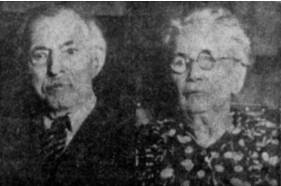
The township was named after Owen Smith the first actual settler and one of the prominent men in the pioneer days. Mr. Smith together with Batt Ryan and Aaron Doty did much toward getting things started in this township and helped make it one of the finest and most friendly neighborhoods in the county.
Mr. and Mrs. Batt Ryan and their family came to Smith Township at an early date, and Mr. Ryan was on both the school board and the township board for years. Their only daughter, Ethel married Jack Verschoor of Mitchell. One son, William was killed in World War I, Ed died at home. Leo lives on the old homestead, John lives in Nebraska, and Frank has worked for years in the Kimball post office and was made post master when Bud Richards died. Frank had four sons in World War II, and a daughter Mary Rita was a Wave. Although all of his boys were across and in action none of them were wounded and all five children came home to celebrate the occasion the middle of the summer. His boys names were Jack, Will, Neil and James. (Pages 119 – 120)
(Editor’s Note: We heard tales Jack was wounded in World War II. According to our mother, Ruth Ryan Smith, Jack wouldn’t tell anyone where he was wounded.)

The first man to prove up on his claim was James H. Bell, who on June 16, 1882, became the owner of the Southwest Quarter of Section 1. The following is a list of the people who took up land in Smith Township and received Patents from the Government:
|
Section 1 Andrew Boney Phillip Klinkel Batt Ryan James Bell |
Section 2 Henry T. Wilson James W. Smith Albert C. Shane |
Section 3 Edward F. Douglas Thomas Archer Owen Smith Sanford Poston |
Section 4 Thomas Archer Jerry Cavanaugh Mary B. Drewry Alphonzo G. Kellam |
|
Section 5 Terry Cavanaugh Heirs of Anna E Paige Frank Griswold Patrick Oakes |
Section 6 Chester B. Dike Abial Dike Zilpha Cubertson Will D. Camery |
Section 7 Edward Hathaway William P. Henderson Esdras Manseau
|
Section 8 Virgil A. Fitch James J. Boney Niels Arndthanson Ole Reirson
|
|
Section 9 Lucy Griswold Casper Anderson John J. Moyford Andrew Andreson |
Section 10 Robert Stewart Joseph P. Smith John W. Talbot Herbert F. Baker Frederick Storm |
Section 11 John A. Wellner James W. Lawless Aaron Doughty James Spears |
Section 12 William L. McCreary Dan Bartholomew Sarah L. Loughridge Edward Shortell |
|
Section 13 Charles Raish Frances Dooley Sabra E. P. Ames |
Section 14 Aaron Doughty Hugh F. L. Burton Michael Friehwirth Daniel D. Wheaton |
Section 15 John W. Talbot Herbert F. Baker William C. Stanbery William E. Gorman Mary Evenson |
Section 17 Julia Everson John A. Roberts William J. Burnett Hellik Severson |
|
Section 18 William E. Weston Manson Wilson Even Hallekson John L. Eicholtz |
Section 19 Andrew Halleckson William T. Gibson John H. Hanson Amos Connaway |
Section 20 Frank Korzan Christopher Halleckson Anna M. Krattebol John Williamson |
Section 21 Nils Rindy Tames Hanson Lewis Pederson Mary Hom |
|
Section 22 John McCarty William L. McCreary William Dunkel Vandeline Kautman Mattias A. Petricka |
Section 23 Frederich Storm Hannah C. Farmer Carl Pitan Timothy B. Turpett |
Section 24 Helen C. McDonald Frederick W. Storm John N. Van Horn Albert Gruel |
Section 25 Martin M. Smith Franklin B. Spatz Peter Larson |
|
Section 26 John C. Victoria Frank Victoria Abraham Tunnison |
Section 27 William Dunkel Vandeline Kautman John Svitak Frank Kautman Stephen Kowash |
Section 28 Frank Havel Thomas Cahoj Anton Urba Scott Hayes |
Section 29 Sofie Tonnerson John A. Anderson Ole Williamson Gilbert Satrang James A. Langan |
|
Section 30 John A. Johnson Ole Williamson Frank Meister Barney Langon Oluf Olson |
Section 31 Belle Williamson William B. Wilder Jr. Foster Williamson Peter Olson |
Section 32 Andrew Satrang Hugh Langan Edmund G. Oliver Mons Knudsen |
Section 33 Ingvald J. Fredlund Frank Wagner Fred L. Herrick |
|
Section 34 Joseph Adamek Joseph Mikish Frank Wagner Mike Stepon |
Section 35 Charles Dunkel Joseph Kosohry Elizabeth Dunkel Matthias Korzan |
|
|
Mr. Ryan, Mr. Smith and Mr. Doty saw to the building of a school house in their neighborhood which was the first one in the township. It was built near the Doty home and took the name Doty School which it still retains. Etta Doty, daughter of Aaron, was the first teacher and Ed and John Ryan, Oney, Margaret, Alice and Joe Smith, V. Wellner and Bert Doty were among the first pupils. (Page 121)
The neighbors met often at the school house for sociable times, the ladies serving lunches or cake and ice cream and the men visiting and discussing events of the times. Among those who took part were the Dotys, the McGrearys, the Ryans, the Smiths, the Boneys and the Andersons. (Page 121)
The Boney family consisted of the parents and daughters, Kate, Ella, Agnes, Nora, Ann and Margaret, and sons, Andrew, John and James. The last named was later killed by an outlaw, while discharging his duty as a County Sheriff. (Pages 121 – 122)
Aaron Doty and Martin Smith were on the township board with Batt Ryan as clerk for many years and Mr. Ryan also was on the school board with Casper Anderson for twenty years and the affairs of the township were handled in a very careful manner. (Page 122)
There were many prairie fires but when one started the whole neighborhood turned out to fight it. One started near the west side of the township and after burning a barn for Owen Smith and one for Mr. Bickner it traveled east until a crowd of men from Kimball checked it just before it reached the Batt Ryan buildings, it then took a southerly course and ran down into Highland Township where it was finally subdued. (Page 122)
Brule Township
The early settlement of this township dates back to the coming of the people in the early ‘70’s and the starting of Brule City, which was the first permanent settlement in the county, and from which town the township received its name. An Act of the Legislature of January 1875, which established Brule County, named Brule City as the county seat, and it remained until the town was abandoned. (Page 127)
The following is a list of the people who took up land in Brule Township and received Patents from the Government (Page 129).
|
Section 1 Peter A. Froostad Mary H. Cummerford August Gilbert Andrew J. Grenelle |
Section 2 Robert H. Somers Mary H. Cummerford Heirs of Mary Anne West William E. Shane Julius Nilson |
Section 3 Philip H. gray Alexander Inglis Minnie E. Sears Addie Hardt |
Section 4 Alex Inglis Henry L. Wilrodt** William H. Troth Charles C. Pease |
|
Section 5 Charles A. Audley Albert S. Smith William D. Church Dennis Church |
Section 6 Alphonzo G. Kellam Ebenezer W. Skerry William A. Murray William H. Troth |
Section 7 Andrew J. Davidson Andrew C. Oustad Boswell Hickey Thomas A. Clark |
Section 8 Charles Cummerford Ira B. Drake William D. Church Sophia Larson |
|
Section 9 Samuel Dusseau Calvin Griswold Phillip R. Hardt Jacob Jurgenson |
Section 10 Edward A. Glenn Claissa S. Lewis Charles H. Lewis William R. Lewis |
Section 11 A. L. Minar Guardian James A. Wells William Minar William V. Lucas |
Section 12 John J. Curtis Sandford J. Moyer Dennis C. Carroll William C. Carroll |
|
Section 13 Nathan Claphan John Reed Jerimah Crowley Catherine Crowley |
Section 14 Charles H. Williams William H. Place John Crowley Alexander McGovern |
Section 15 Charles H. Noel William H. Hollister Jr. Joel M. Long |
Section 17 Henry Hanson John August Larson John Stanage Jr. John A. Larson |
|
Section 18 Mohlon J. Bolser Boswell Hickey Tonnes C. Qustad William Lawson Andrew C. Austin Hans P. Dahl |
Section 19 Heirs of John Lawson Andrew C. Austad Hans P. Dahl Charles Lorenzen |
Section 20 Charles H. Church Olaf Olson Robert W. McHale Lewis Ingersol |
Section 21 Anders G. Schujulstad C. H. Dahlbert David Matthew Philemon Wicks
|
|
Section 22 Edward Sawdey John W. Long James G. Mangen Eliza Hume |
Section 23 Mary Crowley James Slater Elizabeth H. Martin William Gilbert |
Section 24 Catherine Crowley F. B. McCann John T. McNicholas Godfrey F. Feckes |
Section 25 Melville H. Vinyard Samuel W. Sherill Louis C. Bode Amos W. Sherill |
** (Editor’s Note: In this section of the book the last name is spelled Wilrodt and not Willrodt.)
Grandview Township
This had been part of Ola Township but when a difference of opinion arose as to whether or not Ola Township should organize or remain unorganized the eastern part wanted to organize while those in the western part wished to remain unorganized so they withdrew from Ola Township and became Grand View. (Page 133)
Amos Frey was calling on L. H. Willrodt to discuss the matter and they walked to the top of the knoll at the wets of the house. As they looked at the river a short distance to the west and then at the beautiful country to the east where they stood Mr. Fry remarked that it certainly was a “grand view.” This gave Mr. Willrodt and idea and he said “Let us call the new township Grand View,” and so it was named. (Page 133)
There were three instructors in a school in Davenport, Iowa who talked the matter over and decided to go west. They were John Arp, Conrad Kruse and L. H. Willrodt. Mr. Willrodt was the first to start and intended to go to Nebraska but while on the way he came across a copy of the Brule City Times published by Charles Collins, and this gave such a glowing account of the city and country around that Mr. Willrodt changed his route and came to Mitchell, then to the Nelson House at Red Lake, and from there to Brule City. When he came to the river bottom where the city was supposed to be located he and his driver could see nothing and decided to stop and enquire. Some small buildings stood near by where they made inquiry and they told that they were already in Brule City. The fine city described in the “Times” was not to be seen and the two mile boulevard which had also been described was the road from Spalding store to the Collins’ claim shanty where the paper was printed. However the railroad was to be built and in July, 1880, Mr. Willrodt filed on land on the prairie six miles away. He completed two rooms in his barn for a dwelling in which he and his family lived until the present home was built. His buildings and grounds have attracted attention for fifty years. (Pages 133 – 134)
Mr. Kruse was killed in an accident with a run-away team a few years later, but Mr. Arp built up a fine home where he raised his family, and like Mr. Willrodt, lived to a ripe old age. These three men, together with others of their kind, were the foundation of one of the most intellectual and prosperous communities in the county. (Page 134)
The following is a list of the people who took up land in Grand View Township and received patents from the Government. (Pages 134 – 135)
|
Section 1 Amos Fry Mary P. Seely Claus H. Sievers John Arp |
Section 2 William E. Thomas C. Hanson Claus Arp Anna Willrodt |
Section 3 Adolph Hanson Clarence E. Haviland Conrad Kruse Fred Mohr |
Section 4 James Worwick Adolph Hanson Asa M. Haviland Jacob Jurgenson Ernest Routier |
|
Section 5 Charles A. Robbins Stephen C. Perry John G. Chalker Julia Bracket |
Section 6 Seth Taylor |
Section 8 Arthur Mead Jens Peterson John Williams |
Section 9 Daniel D. Miller Frank W. Baker Luther S. Johnson Emil J. C. Burgner |
|
Section 10 Conrad Kruse Wilson F. Bartlett Lorenze Henry Willrodt* Luther S. Johnson |
Section 11 Fred Mohr Oliver P. Cordill John Arp |
Section 12 James Crow Christian C. Manz Alfred M. Goff Heirs of Casper Foster |
Section 13 Frank Walter Lorenz H. Willrodt* Royal P. Hubbard |
|
Section 14 Claus Arp Charles H. Lewis Charles Bice Sr. Peter K. Hanson |
Section 15 John Sandford Heirs of Electa A. Darling Andrew J. Rosebvein |
Section 17 Harrie Darling William H. Cordill
|
Section 22 Louis Smith Frank E. Bice Charles H. Bice |
|
Section 23 Peter Stuhr William Mohr James R. Crew Gustav Christie Arthur R. Ingersoll |
Section 24 Carols H. Goff Benjamin A. Serles Charles M. Bice James M. Crow Joseph M. Greene |
Section 25 Bert Logan Heirs of Charles Gardner Lewis Thompson George Bliss |
Section 26 Edward A. Sickles Preston R. Ware Wilhelm Otto Sarah E. Chadcayne |
|
Section 27 Henry Buchanan Frank Artune |
Section 28 William H. Cordill Minnie O. Cordill |
Section 34 George C. Woods |
Section 35 Minnie V. Peterson Albert J. Woods Edward A. Priebe Alfred W. Powell William J. Priebe |
* Lorenze and Lorenz are spellings as they appear in this short history.
While he (John Q. Anderson) owned a large ranch in Brule County his largest ranches were in Buffalo County near Ft. Thompson and his wife who was Clara L. Willrodt, daughter of Senator L. H. Willrodt, of Grandview Township, operated trading post at Fort Thompson while J. Q. was looking after his ranches. (Page 135)
In the fall of 1882 a school house was built on the C. C. Mans land and school was held during the fall and winter. Fred Haskins being the school teacher. Among the pupils were Ira, Isaac, George and Ethel Fry, Frank and Stanley Bice, Mabel and Wilbur Seely, and Joe Somers. The next teachers were Miss Scales, Victoria Montis, Clara Willrodt and others joined the list. (page 136)
Ola Township
The following list of the people who took up land received Patents (Pages 137 – 139):
|
Section 1 Frank Geppert Nels Anderson Joseph T. Rockwell Mary Anderson |
Section 2 Hans O. Berg Frank Geppert Frank Andrea Eliza Geppert |
Section 3 John Novotny O. E. Anderson Frank Casteel Wenzel Andrea |
Section 4 Alice L. Dickerson Aslog Johnson Theodore Franske Henry Franske |
|
Section 6 James P. Larson August Peter Tams James P. Larson Carl Franske |
Section 5 Thomas A. Brakke Joachim Leithoff James P. Larson Carl Franske |
Section 7 Christ Larson Sophia Larson Charles Hamack George F. Schair |
Section 8 Andrew William Priebe Fred Palm George J. Pretzer William Pretzer |
|
Section 9 John Maresh Wenzel Andrea Wenzed Krouchek Joseph Petrak |
Section 10 Charlie H. McBride Herman Heinrich John Leifermann Joseph Slaby |
Section 11 Frank Andrea Christopher T. Jordan Joseph Tusek George Liefermann |
Section 12 Eliza Geppert Frank Geppert Adolph A. Geppert |
|
Section 13 Anna Nemes James Nemes John Masek Joseph Kudy |
Section 14 Ignal Pitter Wenzel Pahik John Kostka Jr. Jacob Krejci |
Section 15 Frank Danesh Joseph Schauel John Talich Henry T. Powell |
Section 17 William Pretzer Williams Behrens John G. Behrens George M. Anderson |
|
Section 18 George M. Anderson Charles D. Hubbard Barbara Ann Anderson |
Section 19 Dinehart Rynerson Cyrus H. Clark Oliver E. Clark |
Section 20 Claus Behrens Otto Kaping Fred Henriech Cyrus H. Clark |
Section 22 John Kouska Mary Ann L. Bairey John W. Bairey |
|
Section 21 Frederick L. Willrodt Swan Swanson Gust A. Anderson |
Section 23 Squaire F. Hendee Joseph Krejci Herman Henrich Henry Block |
Section 24 Barbara H. Lancha John Kostka Jr. John Schauil Frank Kostka |
Section 25 Joseph Masek Fremont Schumaker John Masek James Spevacek |
|
Section 26 Gottlieb Henriech John G. Gien Jan Urban Jr. Jan Kott |
Section 27 Daniel N. Bairey George F. Bairey George Bairey |
Section 28 Gust A. Anderson Magnus Nilson Elling Knudson Henrich A. Ammatson |
Section 29 Fred Henrich Ella Henrich Frank Henrich Rendal S. Stiles |
|
Section 30 George Anderson Cyrus N. Clark George I. Clark Fred Haskins |
Section 31 Fred Hashkins John Ellsworth Daniel A. Shutt William H. Clink John Powell |
Section 32 Henry Reiner Rendell C. Stiles Anetta Olson Franics N. Harding |
Section 33 Swan Swanson Anders N. Anderson Carl Schumaker Anton Knutson |
|
Section 34 Ruth M. Bairey Heirs of Brita Swanson Alonzo Darrow Ole Carlson
|
Section 35 Dan N. Bairey Jan Urban Sr. Thomas Housek Gan Housek |
|
|
Mr. Clark built a large barn and the young people decided to put on the “Ten Nights in a Bar Room” to help Mr. Mohr, who was laid up with a broken leg. They used Mr. Clark’s barn. Alice and May Clark, Clara Willrodt, Jennie Bairey, Frank Bice, Roy Anderson, Frank Bairey, Frank Hockersmith, Adolph Hansen and Henry and Annie Willrodt took part. They worked two months and the people came from Bijou Hills, Pukwana and Chamberlain to see the play. They cleared $67.00 which paid Mr. Mohr’s taxes and interest on his home. (Page 139)
Henry Willrodt, George Clark, the Pretzers, the Powells and the Behms boys all had good driving horses and took great pride in competing with each other. Their harnesses were decorated with celluloid rings. (Page 139)
Highland Township (Pages 146 – 151)
The township was given this name on account of its surface being higher than the surrounding townships, especially those to the south and east, which to a great extent were covered with lakes.
In those early days it seemed that there was too much water in Brule County, and the Highland Township inhabitants considered themselves favored in not having so many lakes, but even then the first settlers often built their shanties or houses on their highest ground in order to lessen the danger of being flooded out. Spring Lake in the northeast corner and Snow Lake in the southern part of the township looked like real lakes but like the smaller ones finally dried up, and the thought of having too much water were only the thoughts of the early settlers.
John Bressler, was one of the first to build a good house. It was a one-and-half-story, frame house and was built on the northwest quarter of section 25, and was on high land, high enough so that it could be seen from nearly all parts of the township. This not only served as a home for the Bresslers, but was used for town meetings and elections until school houses were built, which was in 1885.
The township was settled for the most part with young men and women, quite a number of them being school teachers who practiced their profession while holding down their claims, at least those who were fortunate enough to get a school. Some of the men brought oxen with them and those who did not bought a pair as soon as they had money enough. A pair of oxen generally sold at about $75.00. Horses were out of the question but the oxen, though slow, handled a breaking plow in good shape and soon small patches of breaking made their appearances, these were planted to crops and soon each claim holder began to think that he was a little short of a millionaire. “Irish” John Smith, who brought a fine family with him, had also among his possessions three horses. This put Mr. Smith in a class by himself as the horses were the envy of the whole neighborhood.
Hugh Craft, then a young man of 21 years, drove his ox team through from Iowa. He came with a caravan of covered wagons which thinned out as they came west, each driver falling out of line as he reached his desired location so that Hugh was the only one to come to Highland Township. Many others followed and soon there was some one on nearly every quarter.
The first to obtain a Patent to land in this township was Franklin S. Warner who on October 26, 1882, became the owner of the northwest quarter of Section 10. The following is a list of the people who took up land in Highland Township and received Patents from the Government:
|
Section 1 Marion Hemphill John Costelle Albert D. Ward Edgar H. Weld |
Section 2 Adam Wolbert Emory Van Pater Alfred P. Doerschalg Robert J. Gillin |
Section 3 Edward Herbst Frederick W. Busco Adolph Skinrod John G. Sullivan |
Section 4 Timothy S. Farrell Charles H. Hough Franz F. Biedermann |
|
Section 5 John A. McGregor Isaac P. Horr James O. York Helen O. York |
Section 6 Joseph Sickart John Saukup Washington A. Gilmore Joseph Svoboda |
Section 7 W. H. Madizon Joseph A. Mucha Silas R. Nugen Jr. Joseph Korzan |
Section 8 Eli B. Huffman Thomas O. Marrow John L. Johnson William H. Stuver |
|
Section 9 John Smith Laura A. Hough Peter R. Dunlap |
Section 10 Henry Duclos Franklin S. Warner A.F. Duclos |
Section 11 Samuel E. Alden Sarah J. Sheldon John Moore |
Section 12 George Boyd Samuel B. Smith James M. Hudson Mathias Marty |
|
Section 13 Thomas B. Wetherell John Rules Horatio S. Dunlap Frank Zuka |
Section 14 John Brown Martin McMahon Robert Barr |
Section 15 Chris Weisflock John Bressler Belle Jacobson Chancy A. Gifford |
Section 17 Silas R. Nugen Sarah Stuver George A. Stuver Henry W. Stricker |
|
Section 18 Frank P. Rozum John Maresh Mathias Kub |
Section 19 Frank Matoushek Mathew Toomey Henry Gullickson Joseph Motoushek |
Section 20 Henry Earl Lysander W. Tulleys Russel B. Tulleys |
Section 21 Tobias Weisflock Hannah E. Travel Hugh D. Craft Lizzie D. Craft |
|
Section 22 William T. Steed John Kruse Robert E. Brown
|
Section 23 Harmon H. Hiatt Robert Barr Amos Hiatt Mattie S. Hiatt |
Section 24 Joseph Zingler Jesse Hiatt Joseph Donda
|
Section 25 John R. Bennett Fletcher Moore William J. Martin Nathan Snow |
|
Section 26 John Zenzsheim John W. Rabenan John Spry William Clements Irene Leverich |
Section 27 Vencel Kuchera James Kurchera John B. Bryan August Wurst |
Section 28 James Carter Thomas A. Brakke Lloyd Butt Vincent Vlasak
|
Section 29 Bryan M. Coffee Robert Stewart Edward O. Craft Asa Roberts |
|
Section 30 Andrew O. Skinrood Frank Matoushek John Matoushek |
Section 31 Jospeh Talish Wenzel Kapinos Wenzel Junek Edward Sawdey |
Section 32 Daniel P. Roberts Wenzel Junek Joseph Vasku Frank Coyle |
Section 33 William C. Bone Heirs of Leo Peterson Kimball McCready Joseph Bone |
|
Section 34 Honore Galvin Mons Johnson James Gavin Ahyman Morean |
Section 35 William Clements Paul Ashley Severin Tobiasen Charles H. Bradley |
|
|