

Irish John Smith Family Archives
The War of 1861 (American Civil War)
Family Lore:
1. ‘Irish’ John Smith was 16 years old when he volunteered for military service.
2. This was related to a later John Smith by his uncles and aunts, who were children of ‘Irish’ John Smith. ‘Irish’ John was wounded seriously in the left shoulder. For three days and 3 nights he laid in a hedgerow, covered over by his buddies. A wagon was sent out to pick up his remains. Private John Smith arose and said, “I will not die in rebel territory”.
3. Maggots infested his wound as he lay in the hedgerow, which probably cleaned his wound.
The following was written by ‘Irish’ John’s grandson, John W. Smith, on July 4, 1976.
“It was from here (Cross Plains) that Private John Smith enlisted in the Civil War. He gave his age as 19 years and he was one of the youngest in his Company. He was inducted into Company G, 29th Regiment, Madison, Wisconsin for a three year hitch on August 15, 1862. The officer who signed him up was First Lieutenant O. Mohr. He was a German as were almost all of the men of the 29th.
A very good record was had on all the young men who enlisted for 3 years as did Private John Smith. He trained for less than a month at Camp Randall. I asked where it was and I was told it was the present football stadium at the University of Wisconsin.
Private John Smith, a young kid, went by railroad to Helena, Arkansas. This was on the Mississippi River in Arkansas. From there he went by boat to the State of Mississippi.
Private John Smith was mobilized, together with others and was under the command of General Sherman, on his way to the sea. The first engagement of Company G (the farm boys from Wisconsin) was at Champion Hill, Mississippi.
Private John Smith with Company G was in the front at Champion Hill. On their left was a regiment from Indiana. There were four gun emplacements that were holding the hill for the rebels. The Wisconsin Regiment were the skirmishers. In other words they were the infantry of the Civil War.
Private John Smith was probably hit with grape shot, as this was what they were shooting. The official records state that John Smith spent 18 months in the army hospital after being hit in the left shoulder. I know all of the cousins have seen the picture of “Grandpa Smith” with the hole in his left shoulder.
The Regiment, after Private John Smith was wounded, went on to defeat the 35th regiment from Alabama. It fought at Vicksburg and Jackson, Mississippi. The Colonel commanding the Wisconsin Regiment subsequently became Attorney General of Wisconsin.
The official records show Private John Smith was one of 11 of his company wounded at Champion Hill. Five were killed.”
********************************************
Company G, 29th Wisconsin Regiment (Cross Plains Volunteers)
The Wisconsin Volunteers knew of Old Abe pictured on the left. Old Abe was the mascot for the Wisconsin Iron Brigade, one of the more famous fighting units in the US Civil War. Old Abe flew overhead as the Iron Brigade battled the Rebels below.
No doubt ‘Irish’ John knew many of his fighting buddies before the war.
These were the other men from Cross Plains, Wisconsin, who volunteered to serve in Company G:
1 Oscar Mohr, 1st Lieutenant (later Captain)
2 Julius Schroeter, Second Lieutenant
3 Paulus Braun, Private
4 Henry Cornell, Private (wounded at Sabine Cross, prisoner of war)
5 Frederick Daemer, Private
6 Henry Friedericks, Private
7 Ludwig Giaricelli, Private (only one to desert from the unit)
8 John Jocham, Private (died November 1863 from disease)
9 William Martin, Private (died November 1863 from disease)
10 Christian Meyer, Corporal (wounded Sabine Cross, prisoner of war)
11 Joseph Reeder, Private (wounded at Champion’s Hill, died August 1863)
12 Jacob Steinmetz, Private (wounded twice May 1, 1863, at Port Gibson)
‘Irish’ John Smith’s Military Service:
John Smith volunteered for military service on August 15, 1862; however, he was not mustered into service until November 27, 1862. He was given a $25.00 bounty for volunteering. No doubt this was big money for the time. Many a young lad volunteered for adventure and an excuse to leave home to see other parts of the country. Life on the farm could be boring.
Frederick C. Festner from Madison was this company’s first captain. He resigned in April 1863 due to a disability. Originally, Company G was known as Captain Festner’s Company. His company went to Helena, Arkansas initially. From there it engaged in various operations into the interior of the state with expeditions up to White River, Arkansas, to Friars Point, Mississippi, and finally to Yazoo Pass, Mississippi. To say that Champion Hill was the first battle Company G saw is not entirely correct. John Smith left Helena on April 10, crossing the Mississippi River below Vicksburg, Mississippi. He took part in the battle of Fort Gibson on May 1 and then engaged the enemy again at Champion Hill on May 16. The battle of Fort Gibson was a minor engagement. Champion Hill, also known as the ‘Hill of Death’, was referred to as the Battle of Baker’s Creek by Confederate forces.
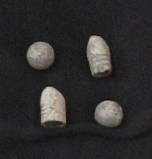
‘Irish’ John Smith was critically wounded during the battle of Champion Hill. A Minnie Ball hit him in the left shoulder above the lung. We have no way of verifying if he lay in a ditch for three days; however, he was found at Champion Hill Hospital. This was a field hospital which may or may not have been under Union control. At Champion Hill, as other battle sites, it was not unusual to see a Union and Confederate field hospital within shouting distance. On June 6, 1863, Private John Smith was paroled by the Confederates and was returned to Union forces. ‘Parole’ was commonly used by both sides early in the war. Instead of housing captured soldiers, both sides would parole them. By convention this meant these soldiers could not fight again and were supposed to go home.
The following picture shows a panoramic view of Vicksburg, Mississippi, as it appeared at the turn of the twentieth century. It topography was ideal for Rebel defenses.

During this time Private Smith could possibly have been listed as missing in action. Before the war ‘Irish’ John lived with the John Bryan family in Cross Plains Township. Upon hearing of John’s condition Mr. Bryan sent a letter to Oscar Mohr, who was an officer in Company G. Lieutenant Mohr sent the following letter to John Bryan. I left the spelling and grammar mistakes as they appeared in his letter.
***********************************
Oscar Mohr Letter
Campaign of Vicksburg, June 23, 1863
Mr John Bryan
Pine Bluff Wi
Dear Sir
Yesterday, I came in Receipt of your esteemed lines of the 13th. You are
anxious to know how John Smith is getting on - and instead of being able of
giving you satisfactory information I must say I am in the same predicament you
are in. We left Champion Hill a few days after the battle - the wounded
remained there in Hospital in charge of Surgeons and Nurses detailed for the
purpose. I did for our boys all I could and left a man from our Company to
attend to them in addition to the Nurses. About two weeks ago they were removed
up the river probably all to Memphis lo I was not able to see any of them.
John was wounded in the left shoulder - the Doctor who went with the men to the
river tells me that he was getting on pretty well and your now expecting to hear
from John from Memphis Hospital every day. From some of them I heard already -
read a letter yesterday.
I'll write to you again as soon as I'll receive reliable information - in the
mean time I can assure you that he is out of all danger. During their
stay at Champion Hill our men were all paroled by the Rebels.
You have heard of the doings of the 29th and the hardships we have gone through
- John Smith bore his part without a murmur and fought like a Lion - he never
flinched. He is a good and brave soldier and I am the more sorry for
the misfortune which befell him. With my best respects for yourself and other
Cross Plains friends.
Yours very truly,
Oscar Mohr
1st Lieut (rest can't read)
P.S. We are progressing here slowly - digging day and night towards the Enemy's
works. We are in our Rifle Pits within from 10 to 25 yards from the Rebel forts
- they don't disturb us much. Our Pickets come at nights' occasionally within a
yard of theirs - get a look, run, pleasantly without firing at each other -
frequently communicating together. I can't beliefe we can ever take the place
by shelling. They have their holes in which
to hide themselves. Best for all that we will have the place and before long,
too.
OM
*****************************************

******************************************
 Brief
History of Champion Hill
Brief
History of Champion Hill
Battle
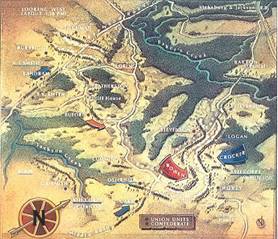
This was a decisive battle of the Vicksburg Campaign which began at 7:00 a.m. on May 16, 1863. Three Confederate divisions were deployed in a three-mile long battle line on a ridge overlooking Jackson Creek. Union forces were marching down the Jackson Road toward the unprotected flanks of the Confederate line. The Rebel forces shifted their defensive line and fought the Union forces near the Champion house.
Major General U.S. Grant ordered his 10,000 men on the Jackson Road to move forward with flags flying. The Union line extended beyond the original Confederate defensive line and the Rebel Commander, Pemberton, shifted his lines to meet the enemy in battle. By 11:30 a.m. the Federal troops raised a cheer and stormed the crest of the hill in an intense battle. The tide of battle shifted many times throughout the day until finally the Union forces overtook Champion Hill and routed the enemy. Federal combat strength: 32,000. Casualties: 2,441. Confederate combat strength: 22,000. Casualties: 3,840.