

Smith Library and Archives
THE MOVE TO DAKOTA
Family lore suggests John Smith made his way to Dakota Territory in 1882. If it was in 1882 it must have been very late in 1882 since he saw two different doctors this year. The first record dated September 20, 1882, shows his post office address as Bear Valley. On November 1, 1882, several doctors examined ‘Irish’ John at Madison, Wisconsin. This is what they had to say about the nature of the wound: ‘We find a bad wound of the left shoulder ball entered three and a half inches below and to the right of the point of left shoulder, just over the sub-clavian artery, passed through the axillary space and made its exit at a corresponding point on the back four (4) inches below and to the right of the above mentioned point. There are very deep attachments of the skin and fascias of the arm is almost nothing from the shoulder owing to the adhesion and contraction of the tissues.”
John stated that he was 39 years old and that he weighed 160 pounds. He reported he was 5 feet 7 ½ inches in height.
By the way, all doctors reported that he was shot in the front and not in the back.
His pension increased from $8.00 a month to $12.00 a month as of November 1, 1882. Such riches would tempt any man to consider homesteading in the Dakota Territory.
*************************************
The Great Dakota Land Boom
Family Lore:
1. ‘Irish’ John Smith moved to Dakota Territory sometime in 1882 and his family moved to Dakota Territory a year later.
2. John and Susan had either twelve or thirteen children. John’s obituary mentions twelve; however, Susan’s obituary mentions thirteen children born to this union.
3. One day ‘Irish’ John noticed railroad Surveyors were on his land. These Surveyors came out to claim the land for the railroad and John told them they were wrongfully claiming legally held land. The Surveyors ignored him. John went back to his home and grabbed his gun. With gun in hand ‘Irish’ John told them if they did get off his property he would shoot them. The Surveyors left and John took the shotgun and threw it into a ditch where it remained for many years.
What we know:
In the 1880s thousands of people headed to Dakota Territory seeking their fortune. This was known as the Great Dakota Land Boom. 160 acres were given free to anyone who agreed to farm the land for five years. This was still wild territory. In 1882 thousands of buffalo were slaughtered, Indians still roamed freely in much of Dakota Territory, weather was unpredictable and the mosquitoes could eat you alive. Indians still roamed Brule County and traveled freely among the settlers. The winter of 1886 was harsh and countless numbers of cattle perished as a result. The Catholics had no regular organization at the time but mass was held once a month by Father Flanigan. Kimball itself was a thriving community with many businesses.
John Smith moved to Brule County in 1882 and homesteaded property in Highland Township. The Township earned its name from the fact that it was geographically higher than the surrounding Townships. We know he homesteaded here at this time because the General Land Office contains deeds (primarily patents) on land issued to pioneer settlers. Two claims were issued to ‘Irish’ John during this time period. The first entry listed below is the original homestead claim made by 'Irish' John. By 1890 the Great Dakota Boom was over and many farmers who survived starting buying or obtaining land abandoned by the less fortunate. The second entry appears to be a sale cash entry for land at the end of the land boom period. Another claim in 1895 lists John Smith; however, it is probably a different John Smith as it is listed as a timber claim. This third claim probably is near the Missouri River.
NAME MERIDIAN TWP RANGE SECTION ACREAGE TYPE CASETYPE DOCID DATE
SMITH JOHN 05 102 N 068 W 009 160 251101 PA 5666 06/30/1886
SMITH JOHN 05 102 N 068 W 009 160 272002 PA 15294 08/21/1890
Also, on December 18, 1886 ‘Irish’ John applied for an increase in his pension,
which was later denied. The pension form was notarized in Kimball, Dakota
Territory. This document shows him residing in Brule County in Highland
Township.
‘Irish’ John was also a member of the Grand Army of the Republic (GAR). Reno Post 35 was chartered on October 15, 1883. Family lore suggests ‘Irish’ John frequently visited the old Civil War veterans in Brule County and looked forward to these visits.
Kimball was laid out in September 1880, and for a time was known as Siding No. 48. Afterward it was called Andover, and then later it became known as Kimball. Kimball got its name in honor of one of the engineers of the Chicago, Milwaukee & St Paul Railway. The first business to open was a grocery. By 1883 Kimball had several hotels, a bank, hardware store, grain elevator, lawyers and a variety of other smaller stores that met the needs of the local population. ‘Irish’ John would have seen Kimball in its formative years and it would have appeared to him to have been a boom town.
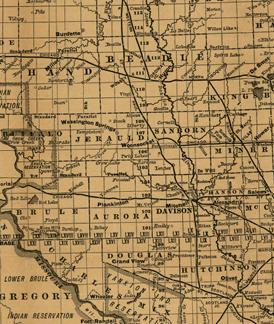
The map below shows Brule County as it looked in 1886. The land west of the Missouri River was deemed as Indian land and is shown that way on the map. The rail lines actually stopped in Chamberlain and went no further west. During this time period countless numbers of pioneer wagons trekked the high grasses of Dakota to Brule County.
The Great Blizzard of 1888
On January 12, 1888, a massive blizzard hit the country’s midsection from North Dakota to Texas. This was the start of the Great Blizzard of 1888, which is also known as the Children’s Blizzard because so many children died. Most of these 200 deaths were in Nebraska. We do not know what the Smith family did during this time, but assume they stayed holed up in their home until it blew over. Reports in Brule County indicated the storm struck about 9 a.m. The Blizzard came up suddenly and it surprised men working in fields and surprised children attending school. It was reported in one Brule County farm that many chickens had their feet frozen so badly they lost them, and later walked around on stubs. Thirty-five people from South Dakota lost their lives during this massive storm.
Blizzards come and go on the plains. Pioneers at the time could remember storms with colder temperatures and storms with greater amounts of snow. What made this blizzard so deadly was the combination of gale force winds, blinding snow and rapidly falling temperatures that caught so many people off guard. The storm itself lasted nearly a day. Old timers in the 1960s could still recall the storm of 1888 with all its fury and death.
South Dakota entered the Union as the 40th state on November 2, 1889. In 1890 hundreds of Sioux are massacred at Wounded Knee Creek.
John’s Declining Health
In 1899 he tried again to get an increase in his disability pension because his disability was getting worse. At that time he stated, “My arm is stiff. I cannot raise my arm and I cannot use it much in manual labor. It is practically useless for work. I am a farmer.” He mentioned that it was painful to move is arm. Although 56 years old he only weighed 160 pounds, and we could only do light chores. His muscles were flabby and his palms were soft. This was the first time his medical records show his eye color as blue.
In 1905 one of the official documents stated his birth year was 1844, and that he was 61 years old. The doctors who examined him wrote that he “looks like a man in poor health, is emaciated, and anemic, skin soft moist and elastic, muscles flabby, and tongue coated white”. At 160 pounds this skinny Irishman must have looked undernourished and ready for the grave.
Meanwhile Back in Wisconsin…
The following information is taken from the 1880 US Federal Census. The census was taken for inhabitants of the township of Bear Creek in the County of Sauk, State of Wisconsin. The census would have shown all people who were residents of Sauk County on June 1, 1880.
In this census William and Catharine are still married; however, it appears they have a young boy living with them by the name of David Carr. Apparently, Catharine and William have legal custody of this young lad, who is listed as their ‘Ward’. David’s parents were both born in Ireland. William and David work on the farm, and Catharine keeps house. This census states that Catharine was either disabled or bedridden, but does not indicate the extent or nature of her disability.
Household:
|
Name |
Relation |
Marital Status |
Gender |
Race |
Age |
Birthplace |
Occupation |
Father's Birthplace |
Mother's Birthplace |
|
Self |
M |
Male |
W |
55 |
IRE |
Farmer |
IRE |
IRE |
|
|
Wife |
M |
Female |
W |
60 |
IRE |
Keeping House |
IRE |
IRE |
|
|
Ward |
S |
Male |
W |
12 |
WI |
Works On Farm |
IRE |
IRE |
Birthdays and Birth Years were not important to most Irish. In this latest census, Catharine is listed as 60 years old. This would suggest she was born in 1820. Her age changed over the years as the following census records suggest:
|
Name |
Census Year |
Age |
Possible Birth Year |
|
Catharine Smith |
1850 |
31 |
1819 |
|
Catharine Rooney |
1860 |
25 |
1835 |
|
Catharine Rooney |
1870 |
45 |
1825 |
|
Catharine Rooney |
1880 |
60 |
1820 |
As she grew older, Catharine’s age appeared closer to what she first indicated in the 1850 census. It is possible she was even older than indicated in any census. For some people age is a very personal issue. I am reminded of this fact whenever I think of Grandmother Mary (Turgeon) Smith. She insisted she was 29 years old until the day she died.
The following information is taken from the 1880 US Federal Census and shows the McPhillips family. Again, this census information is for Bear Creek Township which is part of Sauk County, Wisconsin.
|
Name |
Relationship |
Age |
Occupation |
Possible Birth Year |
|
Mike McPhillips |
Head |
55 |
Farmer |
1825 |
|
Mary McPhillips |
Wife |
53 |
Keeping House |
1827 |
|
John McPhillips |
Son |
20 |
Farm Laborer |
1860 |
|
Owney McPhillips |
Son |
12 |
Farm Laborer |
1868 |
The 1880 census also showed the following information for Patrick McPhillips and family. Patrick may have been Susan’s older brother. At this time it appears Patrick was living near Spring Green, Wisconsin and no longer in Bear Creek Township.
|
Name |
Relationship |
Age |
Birthplace |
Occupation |
|
Patrick McPhillips |
Head |
24 |
Ireland |
Farmer or Farmer Laborer |
|
Catharine McPhillips |
Wife |
23 |
Wisconsin |
Keeping House |
By the end of the nineteenth century Irish John’s mother, brother and mother-in-law had died. Owen’s gravestone says he was born on October 15, 1845, and left this world on March 27, 1894. The Diocese of La Crosse, Wisconsin, could not verify Owen Smith had ever been a priest. We suspect this was a family story handed down to hide Owen’s disability.
We do not know where Owen, Catharine or Bridget were in 1890 since the census records are unavailable. Most of the 1890 US Census Records were destroyed in a basement fire in the Commerce Building. Some 1890 records still exist but nothing for Wisconsin.
Catharine Rooney passed away several years later on February 21, 1896. An engraving on both Catharine and Owen’s gravestones indicate they were both Irish and appear to be a similar inscription. From the cemetery description it appears that Owen and Catharine are buried near each other, and quite possibly next to each other. William Rooney remarried within a year of Catharine’s death. His second wife was named Mary Huebsch. All these people are buried in Saint Mary’s Cemetery in Keyesville, Wisconsin. St. Mary’s Catholic Church was the family church.
It is possible Susan’s mother, Mary McPhillips, is buried in this cemetery. There is a Mary McPhillips listed who died on October 22, 1886, at the age of 60 years. Her tombstone indicates she was born in 1826, and a sidebar in the cemetery register indicates her husband’s name was Michael. The birth year is approximately close to what she indicated in the previous census. If this is Susan’s mother, then where is Michael’s grave? This may be an oversight; however, he is not listed as being buried in this cemetery.
We find a Michael McPhillips still living in 1900 and his name appears in the US Census. Then he was living with Patrick McPhillips and his family. The following information is taken from the 1900 US Federal Census. The census was taken for inhabitants of the township of Bear Creek Township in the County of Sauk, State of Wisconsin. The census was taken on June 14, 1900. Although this census asked similar questions as other previous censuses, one question does stand out. This census asked what year this person immigrated to the USA. According to Susan Smith’s obituary, she immigrated to America ten years after she was born. That would either be 1867 or 1868.
|
Name |
Relationship |
Birthdates |
Where Born |
Immigrant Date |
Occupation |
|
McPhillips, Patrick |
Head |
Feb 1855 |
Ireland |
1868 |
Farmer |
|
McPhillips, Kate |
Wife |
June 1859 |
Wisconsin |
|
|
|
McPhillips, Mamie |
Daughter |
Aug 1881 |
Wisconsin |
|
At School |
|
McPhillips, James |
Son |
July 1882 |
Wisconsin |
|
Farm Laborer |
|
McPhillips, Anne |
Daughter |
July 1884 |
Wisconsin |
|
At School |
|
McPhillips, Lillie |
Daughter |
Sept 1886 |
Wisconsin |
|
At School |
|
McPhillips, Leo |
Son |
January 1891 |
Wisconsin |
|
At school |
|
McPhillips, Rose |
Daughter |
July 1892 |
Wisconsin |
|
At school |
|
McPhillips, Susan |
Daughter |
July 1896 |
Wisconsin |
|
|
|
McPhillips, Genevieve |
Daughter |
July 1899 |
Wisconsin |
|
|
|
McPhillips, Michael |
Father |
April 1823 |
Ireland |
1868 |
|
Some of the first names in this census are unreadable and sometimes the ‘e’ looks like an ‘r’. This last census was enumerated by H. G. Ellifson. One of the attendees at Susan Smith’s funeral was Mrs. Henry G. Ellifson, who is described as one of Susan’s nieces.
Is this Susan’s father who is listed in the 1900 US Census for Wisconsin? A number of McPhillips are buried in St. Margaret’s cemetery in Kimball, South Dakota. Later on we explore the McPhillips who are buried in Kimball.