The McGonigle Records
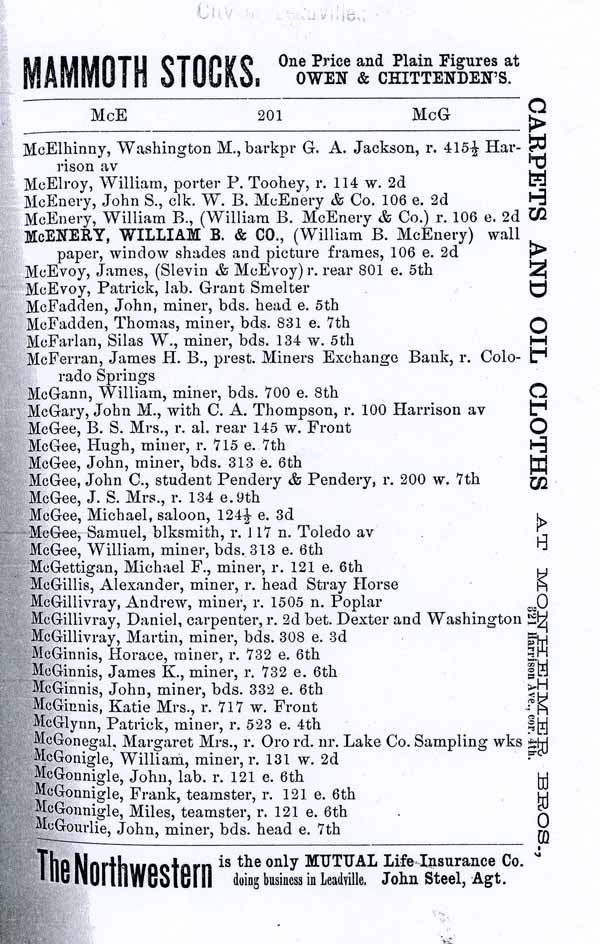
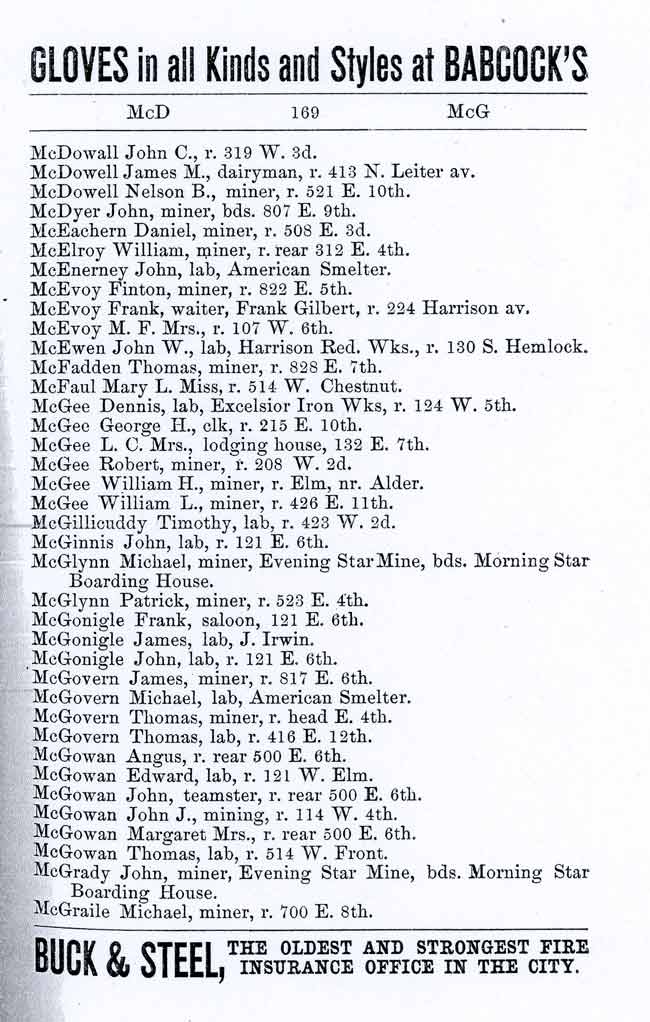
1881 is the first year that we see Frank and family members in Leadville. At this point we can't tell exactly when they arrived in the California Gulch (between Central City and Leadville), but we believe it was in 1879 as this is the year when most had arrived in the territory. We don't see the newlyweds in Illinois in the 1880 census (Frank and Kate were married in 1875), and a story about the family surviving a forest fire (will discuss later) seems to point to 1879 as the year they arrived in the Silver fields...we also don't see them living inside Leadville until the 1881 register was published. This suggests they moved into Leadville sometime between the 1880 and 1881 Leadville City Register publishing dates.
|
1881 Leadville City Register.
Mary Rita indicated that her grandfather Frank McGonigle had owned his
own dray business hauling ore from the mine to the Smelters. This
was a fairly lucrative operation, and a number of resourceful men earned
enough money to start other enterprises, such as general stores and
saloons. Haulage costs varied by distance and could range from
fifty cents a ton to $2.50 a ton. It wasn't an easy job, as the
driver had to load and unload the ore, in addition to hauling the ore.
On average, a two man team could haul 17,000 pounds a day, and produced
more income than working in the mine at $1 to $3 a day. The Leadville Register shows that he was a teamster in 1881. In addition, Miles also was shown to be a teamster in that year. The other McGonigle relatives show they were miners or laborers (generally working in one of the smelting operations in Leadville-but doesn't show which Smelter) |
|||||||||
|
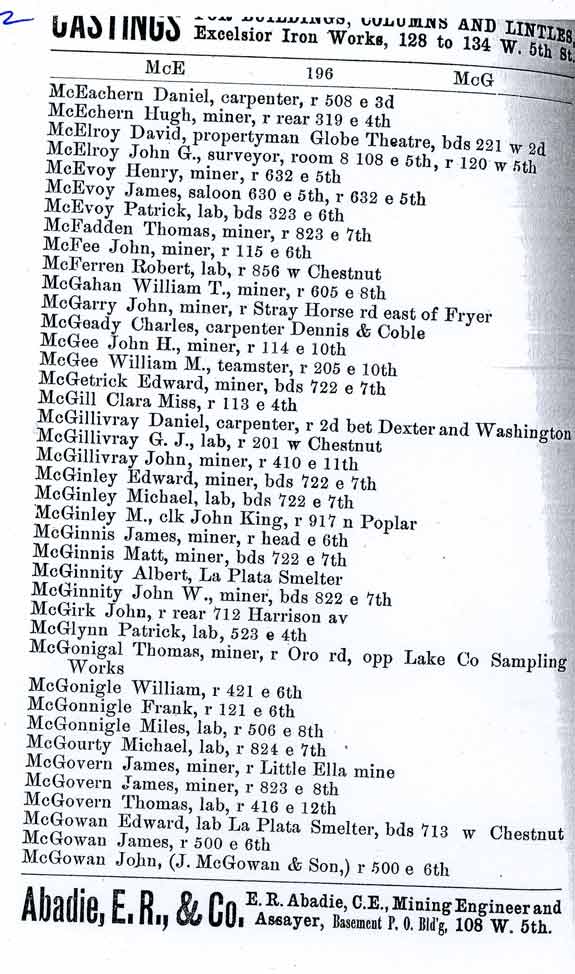
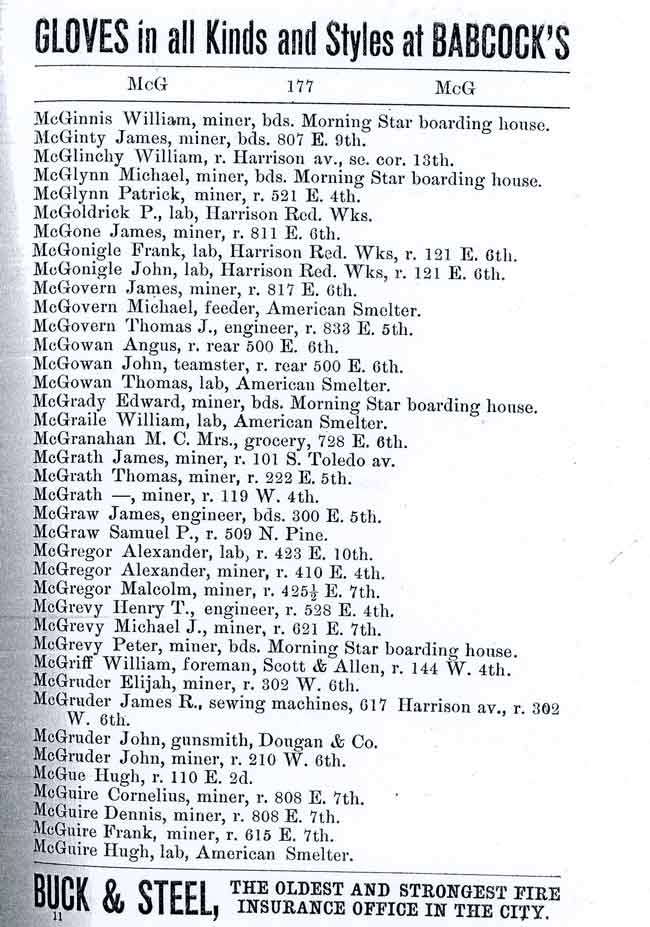
1882 Leadville City Register. It doesn't show what business Frank was in, but we can assume that he was still in the dray business. This register is interesting for several reasons: (1) it shows that several brothers had changed jobs and (2) Thomas McGonigle appears again in the register. A year earlier his wife is shown in the register (Mrs. Margaret McGonigle), but not her husband, Thomas. We also see both Thomas (age 42) and Margaret in the 1880 Leadville Registers, and they appear to be the first McGonigles in the territory, along with a Mary McGonegal, age 18. We are not certain of their linkage with our family. | |||||||||
|
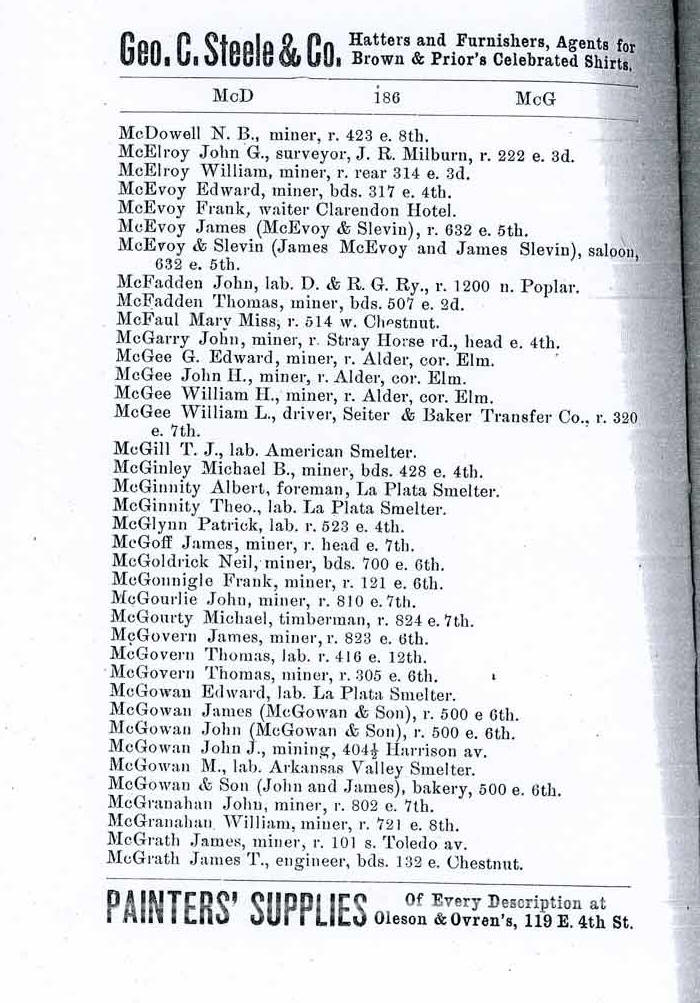
1883 Leadville City Register.
This census showed that Frank McGonigle was the only one left in
Leadville. By this time, he was no longer working as a operator of
a dray team. He is now employed as a miner. Mom and Mary
Rita both indicated that their grandmother, Kate, ran a boarding house
out of their home. This, coupled with Frank's earnings, most
likely provided a fairly decent living for the McGonigles. There were few women in early Leadville, and men paid a premium to eat a meal cooked by a woman. They didn't especially care for "men's cooking", and paid extra for home cooked meals and a good place to stay. A boarder could pay anywhere from $7 to $15 a week. |
|||||||||
|
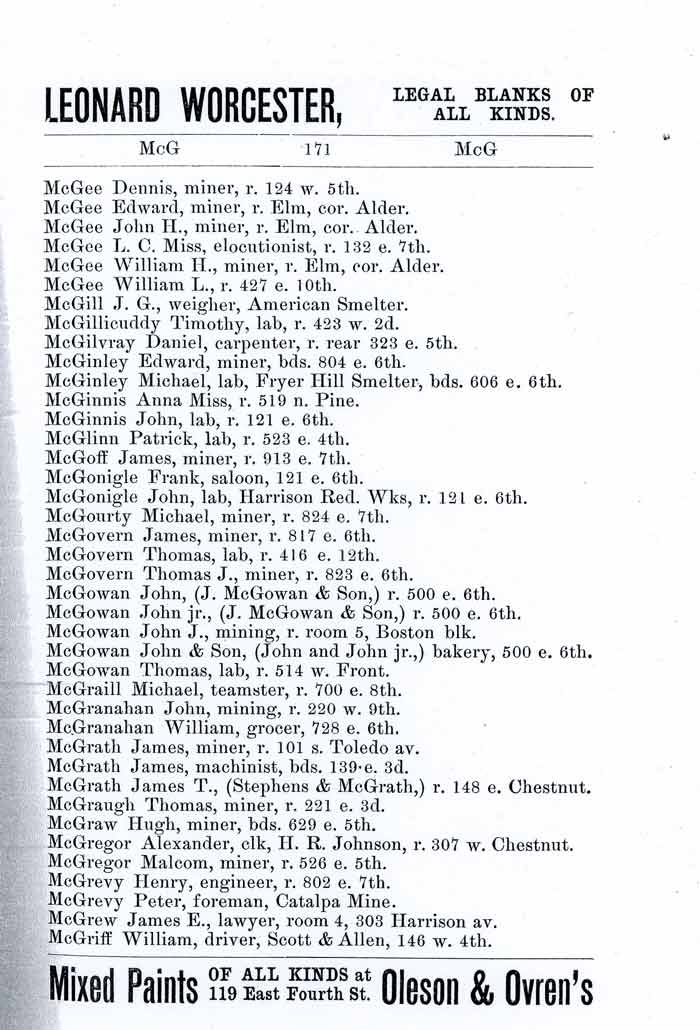
1884 Leadville City Register.
In this year, Frank McGonigle is shown as a Saloon Keeper. His
saloon was located at 121 East 6th Street - the same address where his
family lived, and Kate kept a boarding house. Saloon Keeping,
along with dry goods operations, was a very lucrative business, as they
often times provided "grub stakes" to miners. Mom used to tell us
how her grandfather did just this, although we don't know if there was
any wealth generated from these grub stakes. Mary Rita mentioned
that Frank assisted his cousin, Ed Brennan, in the saloon business; but
we don't see an "Ed Brennan" in this business at any time between 1880
to 1890. Other historical resources show Frank as the
saloonkeeper, as well. Owning a saloon was a good way for developing wealth. A good bartender, in the 1880s, could earn up to $100 per month; which was significantly better than a miner earning top wages of $3/day, 6 days a week, 12 hours/day. More important, a saloon keeper earned significantly more than a good bartender. John McGonigle appears again in the register - working for the Harrison Reduction Works. Harrison was a division of St. Louis Smelting; and will play an important part in our family's history, as well. |
|||||||||
|
1885 Leadville City Register. Frank McGonigle is still working as a saloon keeper at 121 East 6th Street. John continues to work for the Harrison Reduction Works. A common practice in the saloon business in 1880's Leadville was that the patron should not expect change back, if the change was less than 25 cents. It was expected that a patron would consume enough alcohol to "eat up" the quarter, which was roughly two alcoholic beverages (10 cents apiece). John lives at the same residence as Frank and Kate. | |||||||||
|
1886 Leadville City Register.
Frank no longer is shown as a "saloon keeper". It shows that both
he and his brother, John, work for the Harrison Reduction Works.
We don't know what type of work he performed with this company, but we
do know that it was hard work based on information provided to us.
|
|||||||||
| 1887 Leadville City Register. The McGonigles no longer appear in the Leadville City Registers. Family history suggests that Kate gave Frank an ultimatum: that the family leaves Leadville or she will take the children back to Illinois by herself. There is some irony here. It was during this time that many people made money working the mines, prospecting or providing a service (general store, saloon, etc.). In the 1890s, the silver industry slumped, and many lost their fortunes overnight. Unemployment in Leadville was high, and the town lost over 20,000 people before the century had ended. So whatever money the McGonigles made, they were able to take home with them before the crash. | ||||||||||
Other Documents of Interest
Click to Enlarge |
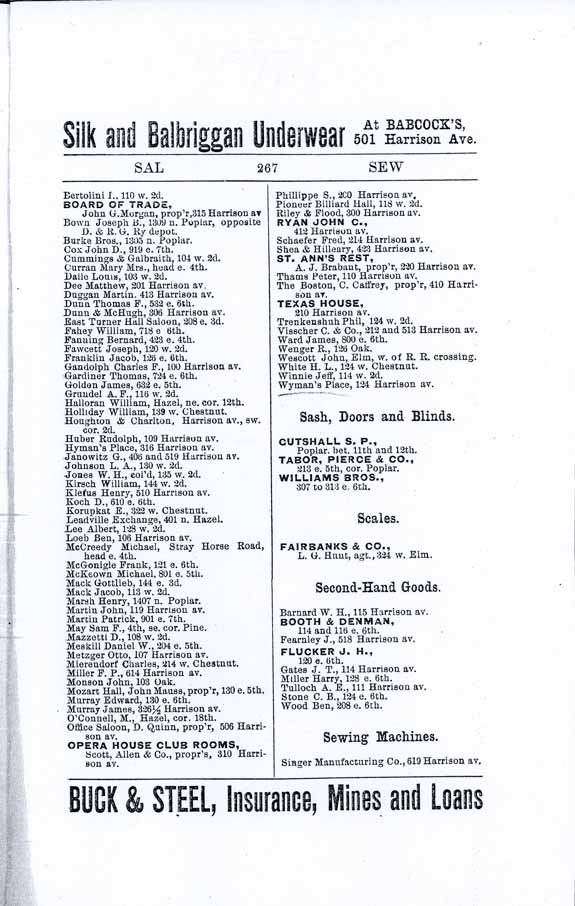
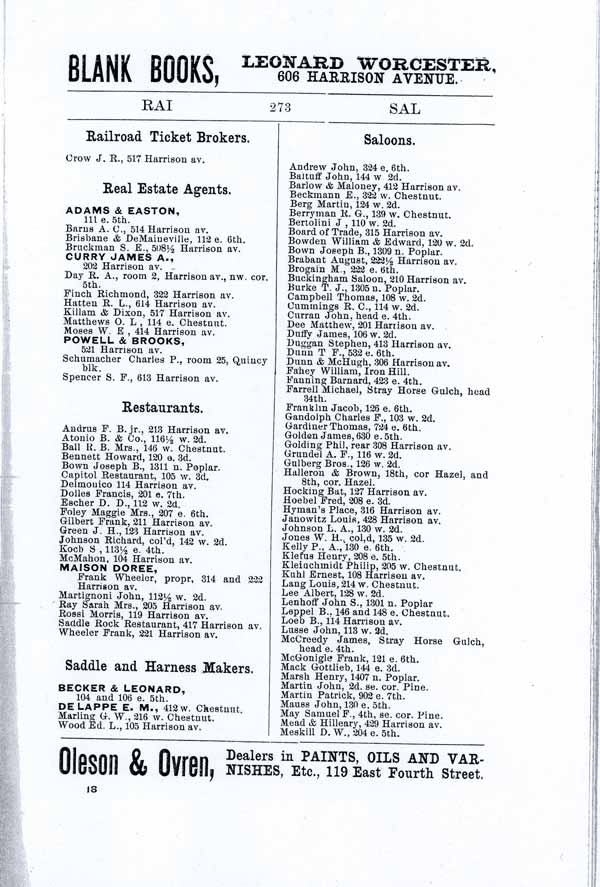
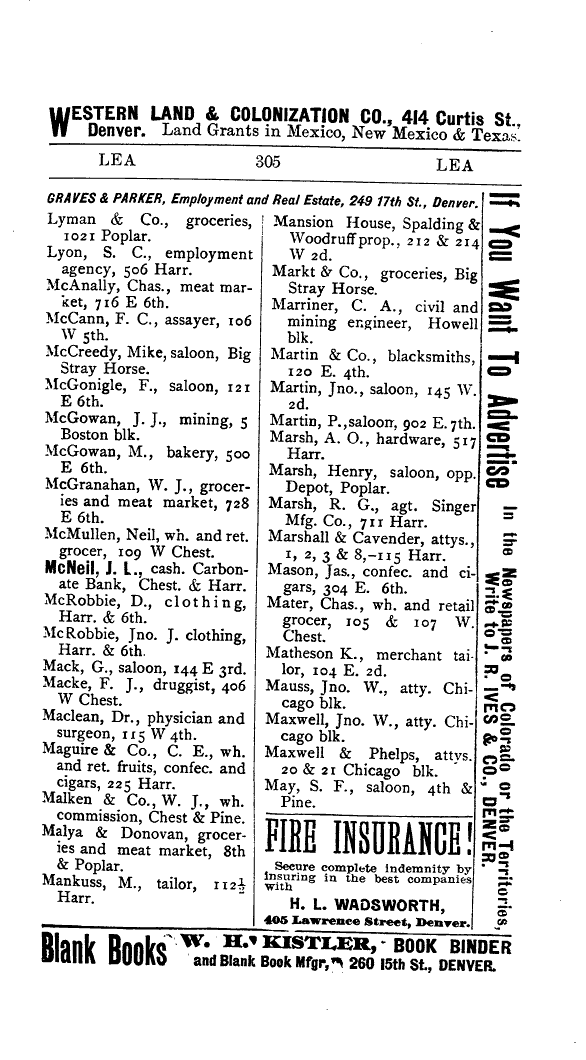
1885 Leadville Business Directory. Its been said that Leadville boasted over 120 saloons and dance halls, which the Leadville Registers seem to agree upon as well. In 1885, there were 78 saloons alone servicing 20,000-30,000 residents. There were 7 saloons on East 6th Street, among them Frank McGonigles establishment. It was said that a saloon existed in every other house...it was probably true that there was a a saloon on every block. The saloons went by the proprietor's name, however, some of the larger saloons had fancy names such as the Texas House or Bank Exchange. The Board of Trade was probably the largest establishment, and the Texas House the most notorious as it resided in Leadville's Red Light District. | |||||||||
Click to Enlarge |
1884 Leadville Business Directory. There were some saloon keeps that were also found in 1885, but there are different names not reflected in the 1885 directory. It was a common practice to make some money in the saloon business, and after a few years, find another lucrative business. | |||||||||
Click to Enlarge |
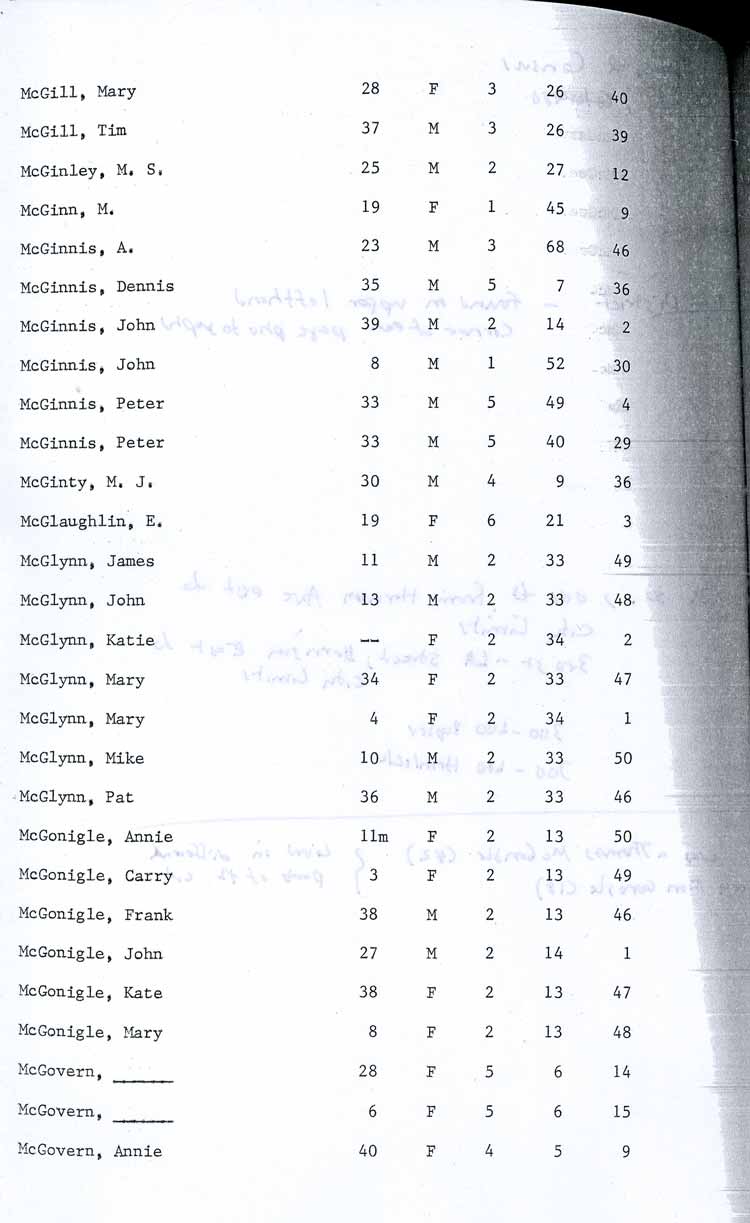
1885 Special Census. The columns read as follows: column 1-name; column 2-age; column 3-sex, column 4-enumeration district, columns 5 & 6-page and line number. The enumeration district "2" means East 7th Street, odd numbers from Harrison Avenue east to city limits; 3rd street to 6th street, Harrison East to City limits | |||||||||
Click to Enlarge |
1885 Rocky Mountain News. Shows Frank McGonigle as a saloon keeper. | |||||||||