From Ireland to Spring Green  Part One of a Six Part Series


Home | Smith Photos | Family Stories | Ryan Data | Smith Data | News Center | SITE MAP | Contact Us

Part 1 of 6 part series...by Dr. Bernie King...1st section - historical overview & King history...2nd section - Smith history..later sections - family history & stories... Wisc & S DAK history.


From Ireland to Spring Green

Smith Family History

August 2, 2001 

Part 1


Editor’s Note 

The following history is a compilation of historical records, family stories and a handful of assumptions.  Names, dates, and historical facts are as close as I could make them.  Invariably, some of the facts may be wrong. 

This will be the first edition of, hopefully, many more “updated” and “expanded” Editions. 

Please write down any corrections and stories, facts, photocopies and references and send them to me and I will begin work on the next addition!

Thank you,

Bernie (Biff) King

1129 Audaz Ln SW

Rochester, MN 55902

507-289-0214

King.bernard@mayo.edu 

P.S.  Thanks to the many who helped with this first edition with their stories, facts, e-mails and phone calls. 

King Family Reunion

Spring Green, WS

Aug 1 – 5, 2001


“In the heart of each of us there is some spot of the good earth, enriched by childhood, that is forever treasured.  No matter what life may bring us nor what far places life may take us, these roots do not die, but mellowed by time, become the tendrils of our memory”

James H. Hill Sr. 


The following booklet is a first attempt at tying our family histories together.  This compilation of memories, newspaper articles and historical facts will be divided into four chapters:


1)      History of Ireland

2)      Why go to America?

3)      King Family history

Smith Family history


Chapter 1


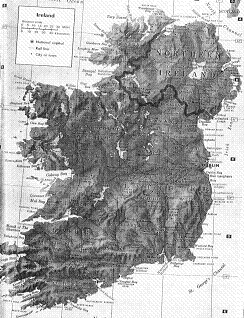
Ireland is often referred to as the “Emerald Isle” because of its beautiful green countryside.  It is also called “Eire” (AIR uh) in Gaelic the ancient language of Ireland.  Finally it has also long been known by the poetic name “Erin”.  “Erin go bragh” is a well know Gaelic phrase that means Ireland forever. 

So why leave Ireland?  Why would our forefathers and foremothers leave such a beautiful land?  To better understand this, we must review a little of Ireland’s history.  As you will see, our ancestors left because they had no choice – they had to leave or perish! 

Celtic tribes were the first tribes to move into Ireland in 400 B.C.  The Celts were the dominant tribe in Europe and were one of the first peoples to make iron.  Celts were eventually conquered by the Romans.  The only Celts to preserve their culture were those in Ireland and Scotland.  The Celts were known for a large body of written literature in Ireland.  In 500 B.C. the Celts developed the ‘La Tene” Style of art utilizing metal and elaborate patterns of interwoven curves and spirals.  

Saint Patrick brought Christianity to Ireland in the A.D. 400’s.  St. Patrick was born in Britain and was taken to Ireland as a slave in the early 400’s.  After 6 years he escaped to France where he studied for the priesthood.  He returned to Ireland as a Christian missionary in 432.  The Irish accepted Christianity and came to regard Patrick as their patron saint. 

The Vikings invaded Ireland about 795 and occupied Ireland until 1014 when they were defeated. 

The Normans invaded Ireland in 1160’s and controlled Ireland until 1400’s. 

In 1534 Henry VIII of England forced more English Laws and culture on Ireland.  It was during this time that many Irish changed their Irish names to more English sounding names (MaCrae -> King, McGowan -> Smith).  Religious persecution started in earnest and continued until the early 1800’s when the English ruled all the land and the Irish could own nothing and could not even practice their religion.  By 1800 the Irish were the poorest of the poor, unable to go to school, own land or Practice Catholicism. 

In 1798 the “Irish Rebellion” occurred and Ireland was joined with Great Britain.  Some Protestants helped the Irish Catholics and by 1829 some rights were given to the Irish.  However, by that time many Irish had left Ireland including Owen King and Bridget Sweeney who took their young son’s Patrick, John and Michael to Prince Edward Island, Canada, in 1832.  This was a time when the population of Ireland grew, rents were high, poverty worsened and the only thing the Irish could rely on was the potato! 

In 1845 – 1847, Ireland’s potato crop failed because of a fungus.  The potato was introduced into Ireland in 1600s, but only one type of potato was introduced and it was susceptible to fungus.  750,000 Irish died and many more left the country because of starvation and disease.  Wealthy English landowners did very little to help the Irish who depended on the potato for everything.  Corn sent to Ireland from America for the starving Irish was often confiscated and sold for profit by the English.

John Smith was born right in the middle of the famine in 1847.  He and his mother fled to America, coming to New York.  His father likely died en route, as many did.  His mother re-married in Brooklyn and they moved to Bear Creek, WS. 

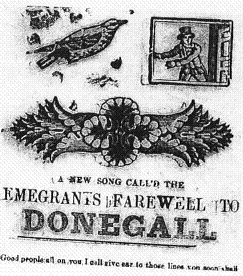
Many Irish fled Ireland in the 1800’s and sent money back to their impoverished relatives back home. 

In 1905, Arthur Griffith, formed “Sinn Fein” (We ourselves) to politically fight for home rule and independence from Britain.  A militant organization “Irish Republican Brotherhood” (Precursor to IRA) was formed and members became known as “republicans”.   

In 1920, the British Parliament divided Ireland into two countries, “Northern Ireland” and “Ireland” (southern).  Southern Ireland became the “Republic of Ireland” and in 1948 cut all ties with Great Britain declared itself an independent state. 

APPENDIX 1    


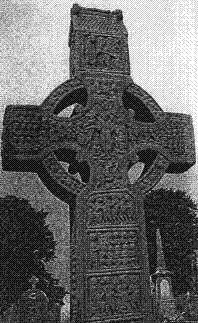
Celtic Crosses are famous Irish artworks.  Some of them were created for artistic and religious expression about 1,000 years ago.  Later, many were carved to serve as grave markers.


 The Shamrock


There's a dear little plant that grows in our isle,

‘Twas Saint Patrick himself, sure, that set it;

And the sun of his labor with pleasure did smile,

And with dew from his eye often wet it.

It grows through the bog, through the brake, through the mireland

And they call it the dear little Shamrock of Ireland

(Irish Blessing)


The Shamrock, at one time called the ‘Seamroy’, symbolizes the Cross and blessed trinity. Before the Christian era it was a sacred plant of the Druids of Ireland because its leaves formed a triad. 

The well known legend of the Shamrock connects it definitely to St Patrick and his teaching. Preaching in the open air on the doctrine of the trinity, he is said to have illustrated the existence of the Three in One by plucking a shamrock from the grass growing at his feet and showing it to his congregation. The legend of the shamrock is also connected with that of the banishment of the serpent tribe from Ireland by a tradition that snakes are never seen on trefoil and that it is a remedy against the stings of snakes and scorpions. 

The trefoil in Arabia is called shamrakh and was sacred in Iran as an emblem of the Persian triads. The trefoil, as noted above, being a sacred plant among the Druids, and three being a mystical number in the Celtic religion as well as all others, it is probable that St. Patrickmust have been aware of the significance of his illustration.

 THE IRISH SHAMROCK


The origins of the shamrock are lost in antiquity, but legend suggests that it was used by St. Patrick in the fifth century to demonstrate the meaning of the Trinity. The shamrock is found on Irish medieval tombs and on old copper coins, known as St. Patrick’s money. The plant was reputed to have mystic powers... the leaves standing upright to Warn of all approaching storm. 

It is said that Patrick had a time of it trying to convince the people he met in Ireland to believe in the Holy Trinity. Reflecting for a moment, Patrick plucked a shamrock from the earth, and pointed to the three leaves on the shamrock, living proof of the Holy Trinity. Since then, the Shamrock has become the symbol of the land of Ireland. 

Only one thing is certain about the shamrock, worn by millions on St. Patrick’s Day.  The word is derived from the Irish ‘seamrog’, meaning summer plant’, and it remains Ireland’s most famous symbol.


 BORD SHAMROCK


The Shamrock is not an official emblem of Ireland. That honour is reserved for The Harp. But it is used as a popular ‘national’ brand by all sorts of State Bodies and commercial concerns. Probably the most visible of these internationally is the Irish national airline Aer Lingus, with its heart-shaped trefoil on the tail of each plane. On St. Patrick's Day every year, Aer Lingus flies fresh shamrock to Irish Embassies all over the globe for their Traditional National Day diplomatic parties. Irish uniformed personnel everywhere are also presented with Shamrocks to wear for the day.


SHAMROCK HISTORY


In written English, the first reference to the Shamrock dates from 1571, and in written Irish, as seamrog, from 1707. As a badge to he Worn on the lapel on the Saint’s feastday, it is referred to for the first time as late as 1681. The Shamrock was used as an emblem by the Irish Volunteers in the era of Grattan's Parliament in the 1770’s, before ‘98 and The Act of Union. So rebellious did the wearing of the Shamrock eventually appear, that in Queen Victoria’s time Irish regiments were forbidden to display it. At that time it became the custom for civilians to wear a little paper cross coloured red and green. 

As a symbol of Ireland it has long been integrated into the symbology of the United Kingdom, along with the Rose, the Thistle and the Leek of England, Scotland and Wales. So today, on St. Patrick’s Day, a member of the British Royal Family presents Shamrock to the Irish Guards regiment of the British Army.


 THE MAGIC SHAMROCK


Three is Ireland’s magic number. Hence the Shamrock. 

Crone, Mother and Virgin.

Love, Valour and Wit.

Faith, Hope and Charity.

Father, Son and Holy Spirit. 

Numbers played an important role in Celtic symbolism. Three was the most sacred and magical number, it multiplies to nine, which is sacred to Brigid. Three may have signified totality: past, present and future / behind, before and here / sky, earth and underworld. 

Everything good in Ireland comes in threes.  The rhythm of story telling in the Irish tradition is based on threefold repetition. This achieves both intensification and exaggeration. Even today in quality pub talk, a raconteur can rarely resist a third adjective, especially if it means stretching a point. 

‘Three accomplishments well regarded in Ireland: a clever verse, music on the harp, the art of shaving faces.”


“You tell us that there are three gods and yet one,’ the puzzled Irish said when St. Patrick was preaching the gospel to them in the 5th century AD. “How can that be?” The saint bent down and plucked a shamrock. “Do you not see,’ he said, “how in this wildflower three leaves are united on one stalk, and will you not then believe that there are indeed three persons and yet one God?” 

-‘-Excerpted from Compton's Interactive Encyclopedia 

Webster’s Dictionary Says: Shamrock \Sham”rock\, n. [L. seamrog, seamar, trefoil, white clover, white honeysuckle:

akin to Gael. seamragj (Botj A trifoliate plant used as a national emblem by the Irish. The legend is that St. Patrick once plucked a leaf of it for use in illustrating the doctrine of the trinity. Note: The original plant was probably a kind of wood sorrel (Oxclis Acetocella); but now the name is given to the white clover (Trifolium repens), and the black medic (Medicago lupulina).


Robert Scally is a professor of history at New York University and director of Ireland House in New York City.  He is also author of THE END OF HIDDEN IRELAND. 

If there was one experience common to the Irish refugees from the Great Famine, other than hunger, it was the sight of Liverpool.  Very few sailed directly from Ireland across the Atlantic – fewer than one in four.  The vast majority first sailed east to Liverpool, the greatest seaport of the nineteenth century – leaving Cork City, Dublin, Wexford, and Belfast behind.  For these future Americans, the grimy seaport of Liverpool was the last they would see of Europe. 

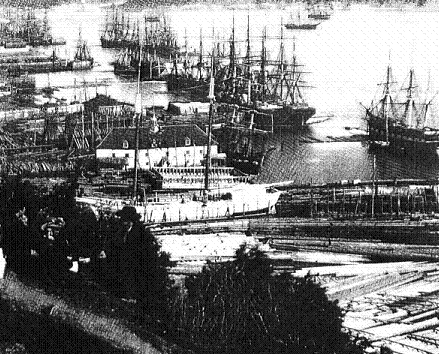
Liverpool was the first gateway to America, directing the flow of hundreds of thousands of Irish to New York, Quebec, New Orleans, Boston, Charleston, and Savannah.  Its influence extended along a global maritime network of commercial ties and routes


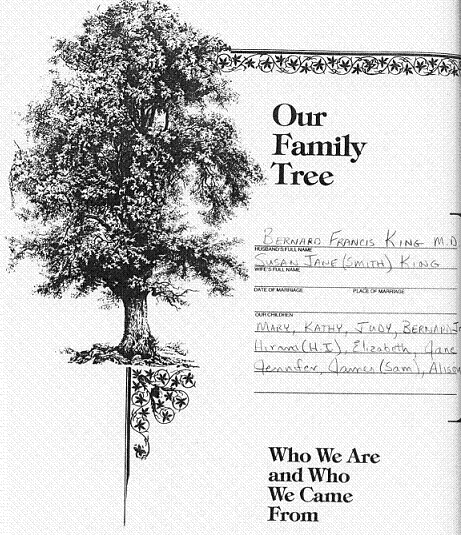
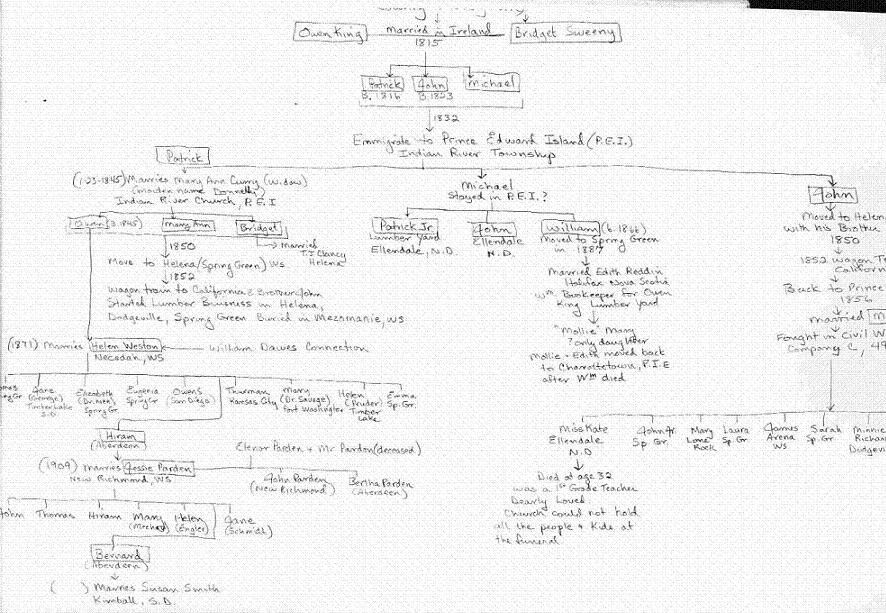
APPENDIX 5 – OUR FAMILY TREE


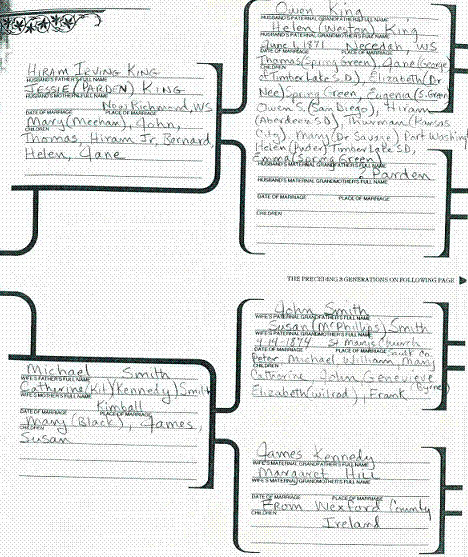
APPENDIX 6 – OUR FAMILY TREE


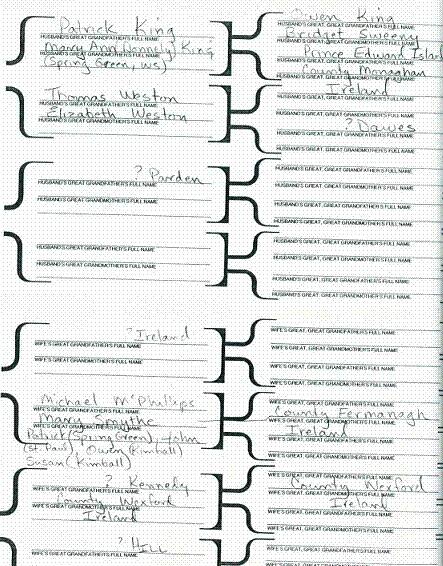
APPENDIX 7 – OUR FAMILY TREE


Searching for Family Roots in Ireland 

Orlo Jones 

Hundreds of Prince Edward Islanders, descendants of immigrants from Ireland, are now attempting to trace their lineage.  Their task is not easy.  Some authorities tell us that our chances of establishing a documented link with ancestral Irish families of the seventeenth and eighteenth century are one in ten, at best.  The odds stacked against us, but with the determination and addiction which characterize family historians, coupled with the skill and patience of sleuth, it might be possible to improve our chances. 

First, if we are to track down our Irish forebears, we should know the main lines of Irish history.  From it we may learn where our people moved and when and why.  We may learn why so many records have been lost over the years, and why other records were never kept.  We may also come to a greater appreciation of the attitudes and values of the Irish.  Ireland's history has been one of conquest and reconquest, suppression and more suppression, troubles and more troubles.  For our purposes we should review at least the last eight centuries.  Pope Adrian IV, a former English monk, gave King Henry II the right to take over Ireland in 1155, and in 1169 the Anglo-Norman conquest began with the taking over of the coastal areas which contained some of Ireland's best land.  The feudal land-holding system created landlord-tenant problems; and Ireland was denied the benefit of English law while Irish law was split apart, leaving native-born Irish few benefits. 

By the time of Henry VIII, the emergence of Protestantism as the religion of England complicated matters.  To the severe poverty of the Irish was added the repression of the native Irish who held to their Roman Catholic beliefs.  Under the Penal Laws Catholics were not permitted to own land, vote, hold public office, work in the civil service, own property worth over five pounds, be educated, own a weapon, practice professions or train priests.  In addition, Roman Catholics and all Protestant Dissenters had to pay tithes to the Anglican Church of Ireland. 

In 1610, the English confiscated the land from the Irish in Ulster, and forced most of the inhabitants to move to the south or west of the country or be killed. The seized land was settled with English and Scottish planters.  In this way the Irish became a minority in their own province, while they watched the Planters lease and buy larger acreages and build large stone houses.  Furthermore, many of the laws discriminated against the Irish Catholics; their lands were taken by overthrowing their Irish titles, and a set of statues governing Trinity College in Dublin, the only Irish university, made it impossible for practicing Catholics to obtain degrees or hold scholarships. 

The severely-restrained Irish saw the Scottish Presbyterians rebel successfully against control by England, they decided to try to do the same in the 1641 Rebellion which began in Ulster.  England retaliated by seizing the lands of all Irish who took part in the rebellion.  Cromwell landed at Dublin in 1649, and by the next year the conquest was complete.  Cromwell's payment for services rendered in the take-over was to seize all of the farmland in the south and give it to his soldiers, while the Irish Catholics were forced to move to the rocky land in Connaught.  Thus the Irish lost their scanty possessions.  Furthermore, as they were not permitted to lease nor to own more than two acres of land, and many had none, very few land records were kept.  With little or nothing to bequeath, wills were not common.  In any event, most documents were lost in the successive conquests and migrations. 

As Catholics could not practice their religions and the usual sacraments and rites of the Church could not be performed, very few birth and marriage records were kept.  This is one of the great disappointments for family historians.  An elementary school system was started in Henry VIII's reign in 1538 to teach English to all.  The teachers included both Catholic priests and Protestants until 1611, when the Oath of Supremacy was introduced.  As this Oath required all teachers to deny the Pope, priests could no longer teach, until 1775, when Anglican schools taught the Anglican religion and tried to convert Catholics and Dissenting children who might have attended.  In Northern Ireland Catholics and Scottish Presbyterians shared a common cause because both religions were severely oppressed by the English laws. 

Some Catholic schoolmasters taught clandestinely in ditches and hedgerows.  These schools were dubbed "hedge schools" and by 1800 were held inside sod huts.  The few students who attended were taught reading, writing, arithmetic, Latin and even Greek.  These were the only schools available to the young Catholic Irish, and very few children received any education.  In the 1830s a national school system emerged but attendance continued to be very poor until the 1870s.  With so many uneducated, very few were capable of keeping records and most signed their name with a mark.  The Irish, therefore, depended upon oral tradition to keep their history alive.  For this reason, it is imperative that any researcher of Irish background collect all legends, oral traditions and folklore available among Irish families. 

In the eighteenth century, when the government needed recruits to build up the army, young Roman Catholic Irishmen were admitted to junior ranks.  Accordingly, for this period Irish ancestors may emerge from obscurity in official military lists and records of the time.  Furthermore, until the Hearth Tax was abolished in 1793, the hearth Money Rolls listed persons liable to pay a Hearth Tax, the funds from which were used at first to finance the wars of King Charles II.  Hearth Money or "Smoke Silver" was a tax of two shillings on every hearth and fireplace.  Although the very poor often had no hearth, or at most one, and this list is not complete for every household of the time, it is nevertheless one of the best records to check for Irish forebears in the period between 1663 and 1793. 

By 1792 Catholics were permitted to bear arms, and to take degrees at Trinity College.  In fact, most rights were restored except those of becoming Members of Parliament or of holding a government office.  Hence, records were kept again.  The Catholic Emancipation Act was finally passed in 1829, enabling Irish Catholics to vote and to use their political strength to gain additional concessions. 

Life styles among the Irish varied greatly in the nineteenth century.  A few had rented large farms or estates of up to two hundred acres, especially in the grazing counties of Meath and Roscommon, and in the dairy counties of Cork, Limerick and Kerry.  But in 1845 four out of five farms were still smaller than fifty acres and two out of five farms contained fewer than fifteen acres.  Smallholders had only enough land to provide a bare subsistence living, the income from anything they might sell going entirely to paying rent.  Chances for success varied according to the area of Ireland in which one lived.  Along the western coast were many smallholders and farmers of very small acreages; while eastern and central Ulster consisted of smallholders, too, they were also spinners and weavers of linen, who were therefore financially much better off than smallholders elsewhere.  From 1790 the government encouraged cottage industries by giving out free spinning wheels: fortunately for today's researchers, the government kept lists of all who received these spinning wheels.  Despite these limited advances for some, the evils of absentee landlordism continued.  Many Irish who were landless became beggars who traveled around at seed time and harvest when they hoped to get a little food and a few shillings as casual labourers.  Resident beggars were listed and given medals which gave them the right to request alms. 

When the great potato famine occurred in Ireland in 1845 there were already four million people, most of whom were Irish Catholics, living on the poverty line and depending almost entirely on the potato for food.  In a recent lecture, Brian Trainor, a director of the Public Records Office in Northern Ireland, cited this report of life in 1844 Ireland: 

It would be impossible adequately to describe the privations which they habitually and silently endure…their cabins are seldom protected against the weather…a bed or a blanket is a rare luxury….and nearly in all, their pig and manure heap constitutes their only property…(Their) suffering (is) greater…than the people of any other country in Europe have to sustain. 

Mr. Trainor also quoted the contemporary report by George Nichols on the Irish poor between 1834 and 1837.  Nichols was much less sympathetic when in 1836 he told of their 

Desultory and idle habits…If there be a market to attend, a fair, or a funeral, a horse race, a fight, or a wedding, all else is neglected or forgotten; they hurry off in search of the excitement and the whisky which abound on such occasions…(and) at the moment they are complaining most loudly of distress, they are taking the most certain steps for increasing it…The heaviest share of work falls upon the females, who appear to do all the drudgery, and are commonly seen without shoes or stockings, whilst the men in general are supplied with both. 

The side of the story can be seen in the 1851 Census, where we find that more than one million Irish died in the seven years of the famine, while 1,600,000 emigrated to America, mainly to the United States.  These deaths and emigrations, many of which were unrecorded, even in family papers, disrupted family continuity, thereby creating an insurmountable obstacle for genealogists.  According to historians 65% of all Irish who immigrated to the Maritime provinces came between 1815 and 1845 or were “pre-famine” while only 1-2% arrived between 1847 and 1850 or “post-famine”; but the biggest surprise may be that 33% OF THE Irish came before 1815. 

Prince Edward Island had a large influx of Anglo-Irish and Catholic Irish settlers who came to the New World to improve their lot; furthermore, some of the Scottish Presbyterian Planters who had settled in Ulster eventually came to America.  Most went to the United States, where they were known as Scots-Irish.  Many of the Irish who came to Charlottetown around 1815 were Protestants from Northern Ireland.  As these people were educated and in a position to do well economically they became leaders in the early community of Prince Edward Island.  Early Irish names include Patterson, DesBrisay, Callbeck and MacNutt.  These families made their presence felt in law, politics and government.  So strong was their influence here that for a short time in 1780 this Island was known as New Ireland. 

The Catholic Irish also settled on Prince Edward Island, in the first half of the nineteenth century.  Oppressed in Ireland, most of the prefamine Irish were able to choose good lands on the Islands and eventually prospered here. Many early nineteenth-century Irish settlers on the Island came by way of Newfoundland.  The fisheries off the Grand Banks of Newfoundland required manpower, and as the fishing fleets left the south-western shores of England they stopped at Wexford and Waterford fro crews and laborers.  Up to ninety percent of the Irish in Newfoundland are said to be descendents of these two Irish counties.  Around 1810, the cod-fishing industry collapsed and many of the Irish left Newfoundland and moved to the three Maritime provinces.  For descendants of “Newfoundland Irish” there is a good chance of ancestry in Wexford and Waterford.  Many who came to Prince Edward Island later went to the United States. 

Many Islanders today will find that at least a few of their ancestors came from Ireland.  Therefore, in researching these ancestors back to Ireland they should be aware both of the history through which their ancestors lived, and the absence of many of the standard records on which the genealogist relies.  They should also become aware of what records do exist and make full use of them.  Many books and papers have been written on genealogical map entitled Hibernia 1567, which shows the locations of many of the old Irish families by surnames whose descendants may be found there still.  This is available at the National Library of Ireland. 

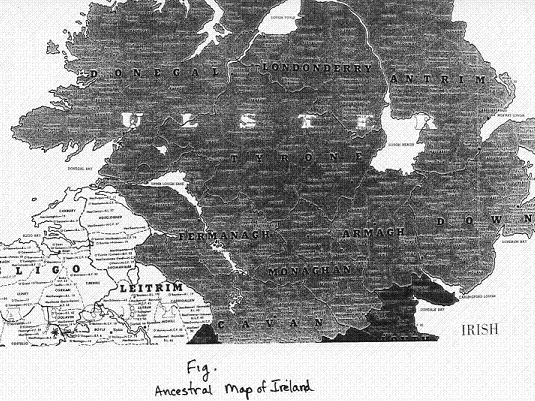
Irish names can be confusing, and families of apparently different names may turn out to be one and the same.  In some cases Gaelic names were given anglicized  pronunciations to become an existing English surname:  O’Maile became Marrey and O’Braonain became Brennan.  In others, the Gaelic translation of the name was used, such as MacGabhen became Smith.  “Gil” ( or “Kil”) before a name comes from the Celtic “Giolle” and denotes that the family was a servant of St. Bridget, and Gilfoyle was a servant of St. Paul.  Irish names were sometimes made from a given name when Mac, Mc or M’ was prefixed and translated as “the  son of”:  McFadden when translated means the son of little Patrick; while O’Donnnell is translated simply into a “descendant of Donall” – Donall having been a grandfather or forebear.  Often the Mac or O’ was dropped.  Other Irish names came from animal, vegetable or mineral kingdoms.  Darrach was from “dair’ or oak, and Lamb and Forrest from the respective English words.  Still other names referred to the locality where the family first resided.  Although this is quite rare in Irish names, Monaghan and Cavan do illustrate this.  As with other nationalities, Irish names were sometimes based on personal attributes or personalities:  such as Duff from “dubh” or black; Brody from “Brodach” or proud; and Daly from “dall” or blind. 

Some English settlers in Ireland took Irish names, while Irish families were compelled to adopt English names according to laws passed in 1366 and 1465.  Therefore, it may be impossible to tell whether such families are Celtic, English by the surname.  If you have difficulty in finding records on your family you might want to look at other names which might have been substituted.  Another peculiarity about Irish names is that children were frequently registered under their mother’s maiden name rather than the father’s name.  Even death notices or widows may give their maiden name only. 

Some archivist believe too much stress has been placed on the records which were destroyed in the 1922 fire in the Public Record Offices in Dublin and not enough said about the records which have survived.  Other records too, have been copied and are available to help researchers.  Among these materials frequently overlooked by researchers are these: (1) Census reports which began prior to 1821 and were taken every ten years until 1941, but most before 1922 were lost; (2) property valuation lists from 1831, the most important being Sir Richard Griffith’s “Primary Valuation of Tenements 1848 – 1864” (the basis of taxation the tenants had to pay toward support of the poor, they are found at the Public Records Office); (3) Directories are often helpful as a source of genealogical information; (4) Tithe Applotment books 1840; (5) Subsidy Rolls give the names of those on whom the taxes were one of both sexes over fifteen years of age who was taxed for military purposes; (7) Tithe Books for parishes from 1828 to 1837 were comprehensive registers of the people at that time; (8) the Civil Survey, a record of Irish land and its owners in 1640; (9) the Books of Survey and Distribution which give the name of the old proprietors, lands forfeited and new owners; (10) Militia, Yeomanry and Muster Rolls for the 1830s which list men liable for service in local defence forces; (12) Poor Law Records of the Boards of Governors of Poor Law Unions from 1838-1945; and (13) Emigration Records, semi-official lists for one or two years of most counties some time in the 1830s. 

There are no passenger lists for the many vessels which transported the Irish who came here.  Often the captains took more passengers than the rules permitted and, therefore, they did not dare keep passenger lists.  Fortunately, there are many other useful genealogical records to be found in Ireland at the main repositories there.  Some are not well known, and others are the usual parish, cemetery, land, probate, civil registration and bound genealogies common to most archives and larger research centres.  Books on genealogy usually contain a section on Ireland and give specific advice to researchers.   

Careful homework, persistent searching of records both in Prince Edward island and in Ireland, a good knowledge of family traditions, and a familiarity with Irish history should enable the Islander of Irish descent to find out something about ancestors from the Emerald Isle.  Regardless of the ultimate results, the preparation and the search will be rewarding. 

Chapter 2 

Why Go to America 

The departure of the Irish from their stricken land was a mass migration on an epic scale.  In the villages and towns of Ireland, a way of life, a communal culture and an ancient language were wiped out!  At the same time the arrival of the “Famine Irish” in America transformed the young republic such that the flight of the hungry from Ireland became a milepost in U.S. history.  The “Famine Irish” were the original “Huddled Masses”.  They came not with dreams and plans, but with the modest goal of staying alive.  Most were unskilled and uneducated, a rural people whom the Americans (established) soon came to regard as “dangerous aliens”. 

“Our Celtic fellow citizens are almost as remote from us in the temperament and constellation as the Chinese” stated the Anglo-Dutch merchants and politicians who ruled American cities before the Civil War.  This “distaste” of the Irish was also compounded by the fact that all of them were Roman Catholic.  This was important because the U.S. was a predominantly Protestant country in the early 1800’s and a place where many Catholic churches had already been put to the torch! 

Many Irish landed on the eastern seaboard:  Boston, New York, and Charleston.  Many more Irish landed in the Maritime Provinces in Canada as the cheapest sea-going fare was to Nova Scotia and other maritime provinces.  That is why Owen and Bridget King probably landed in Prince Edward Island. 

Many ships carried 400 passengers or more.  In many cases, up to 100 passengers would die during the trip. 

Many Irish “Celts” stayed in Boston and other cities instead of moving in-land for fear of farming failure again!  So they stayed in the cities and worked in construction building canals, buildings and railroads.  Irish women – Brigids, Marys and Mollys worked in great houses of the rich in New York, Boston and Charleston.  These “servant girls” sent money to the “old Country” far in excess of what other immigrant women would send. 

The Irish men worked hard, drank, fought hard and often died early. 

Many other Irish did move Inland to look for farming land.  Most would go to the edge of the frontier to establish a homestead.  In 1845 – 1855 the frontier was scattered along the Mississippi River in Illinois, Wisconsin, Iowa and Minnesota.  That is why Patrick King left Prince Edward Island and settled in the small river town of Helena, WS, near the current town of Spring Green.  That is also why young John Smith and his mother, Catharine, and her new husband settled in an Irish farming settlement in Bear Creek, WS, near the current town of Spring Green. 

Patrick King and John Smith and his mother, Catharine, may have also left the eastern seaboard for reasons of prejudice and discrimination.  Many native Americans (Protestant) believed Catholic immigrants were subverting American institutions.  Not only were there the German-American Catholics but also the Italian-American Catholics.  However, the American Catholic Church, as a whole, took on a stricter, more authoritarian character of the Irish parishes which emphasized things like weekly attendance at mass. 

The American Catholic Church became dominated by the Irish because of the one million Irish that immigrated.  The “Famine Irish” brought with them a distinct identity based on their religion an abiding affection for the clergy who shared their sufferings, and a faith they held on to even in the face of severe discrimination and bigotry.  This new “American Church” insisted on its own separate “Catholic identity” which has resulted in Catholic schools and hospitals all across the country.  The Irish dominated the convents and the Rectories. 

So, many of our Catholic traditions are based on the Irish Catholic traditions.  These and many other traditions shed light on who we are today and where we have come from. 


…thousands of Famine exiles arrived in Quebec, in part because fares to Canada, a British dominion, were cheap.  Grosse Isle, found in the St. Lawrence River, became a huge hospice and burial ground for passengers who suffered en route to the new world.


APPENDIX 9


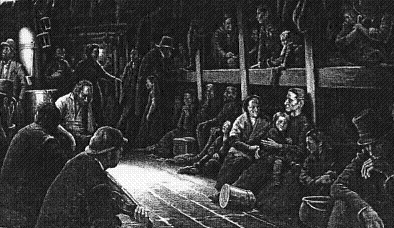
Fig.  Leaving for America


APPENDIX 10


Fig. Traveling to America

APPENDIX 11


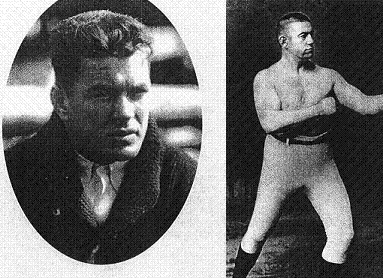
The Irish found their way in sports, too, earliest and most memorably in boxing.  John L. Sullivan the Boston boy of Famine immigrants, was the last of the boxing champs.  Gene Tunney had move-star looks combined with feet and hands.  He bested Jack Dempsey in the famous “count” fight…


APPENDIX 12


Fig.  “The Fighting Irish”


APPENDIX 13 

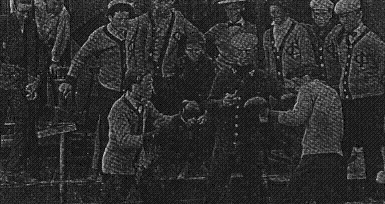
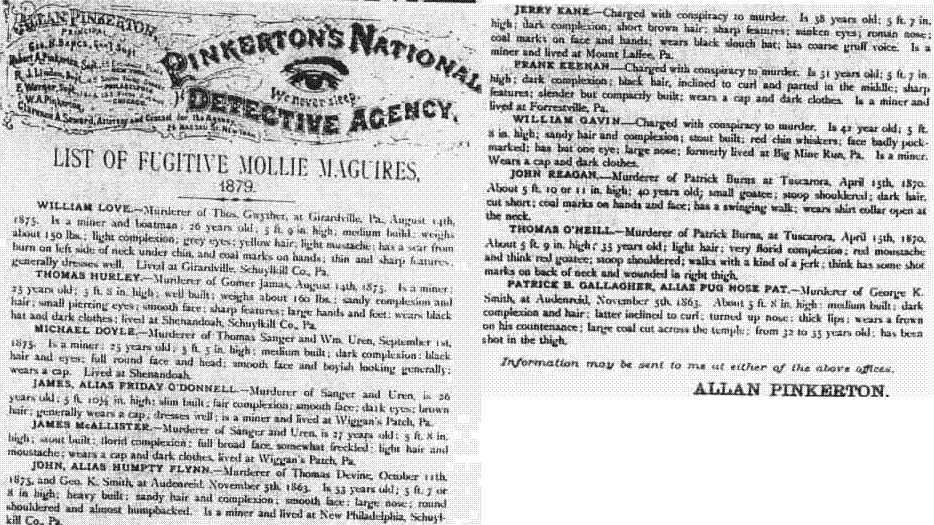
The Molly Maguires of Pennsylvania got their name from secret society active in Ireland just before the Famine.  According to one popular story, Molly Maguire was an old woman threatened with eviction from her cottage.  In Pennsylvania, a power trade union movement, the Workingmen’s Benevolent Association (WBA), became the largest union in the nation.  A series of strikes in the late 1860s and early 1870s, the union won important victories, not least of which was recognition by the employers and the linking of wages to the price of coal, and in the 1870s it met its nemesis in the person of Franklin Gowen. 

President of the Philadelphia & Reading Railroad Company, Gowen was determined to destroy all obstacles in his way, including small-scale entrepreneurs, trade unionists – and the Molly Maguires.  Half the leaders of the union were Irish-born.  All Mollys, composed of Irishmen and favoring tactics of violence acted as a shadow organization.  To gather information against the Mollys, Gowen hired America’s foremost private detective, Allan Pinkerton. 


APPENDIX 15


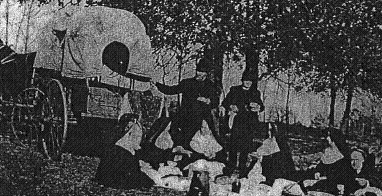
Fig. Going West.  Irish immigrant nuns went where the faithful needed them.  Here members of the Sisters of Mercy take a break on their journey via covered wagon

 APPENDIX 14 

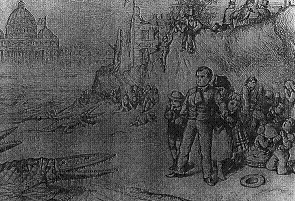
Fig. Fear of Catholics.  Thomas Nast, the famous cartoonist of the nineteenth century, expressed the feelings of Nativists who believed Catholic immigrants were subverting American institutions.  Here, Nast draws bishops as alligators attacking defenseless America.  The Vatican looms in the background, with a flag displaying a harp. 


APPENDIX 16 

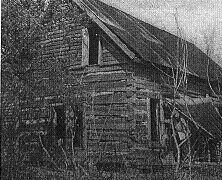
Fig. Early Homestead  


APPENDIX 17 

Catholic schools staffed by nuns educate the children of immigrants and preserved their sense of separateness. 


APPENDIX 18 -- King Family Tree


Chapter 3 

King Family History 

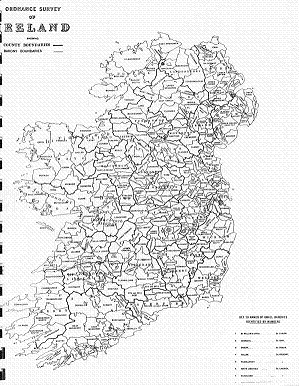
County Monahan (or Monoghan) is situated in the northern most border of the Republic of Ireland.  It borders Northern Ireland in current-day geography.  County Monahan is one of the best farming areas in Ireland.  It is located significantly inland and is very rural in its setting.  It is a very beautiful area and is the richest farmland in Ireland.  Much of this land was taken from Irish farmers and given to English nobles. 

Sometime around 1795 – 1800 a young boy was born in County Monaghan.  His name was Owen King.  Owen is a Welsh form of John.  The Irish were still very oppressed at the time of Owens’s birth.  Napoleon was dictator of France, Thomas Jefferson was soon to become President of the United States.  England and France were at war.  Wisconsin was just acquired from the British Quebec region.  It was made part of the Indiana Territory in 1800. 

As far as we know, Owens’s last name “King” was his birth name.  King is one of the most common surnames in Ireland.  In or near Ulster, many, though not all, will be of English stock.  The name arose as a description of someone Kingly in bearing.  The majority of Kings in Ireland, however, are of native Irish origin.  King Henry VIII in 1600s forced many Irish took their Gaelic names and changed them to a variety of names for many different reasons.  In County Monaghan, the Mac Fhearadhaigh family translated their name to McAree or McRae which contained the sound “ri” which mean “king”.  Eventually, McAre or McRae became “King”. 

In other counties, the name King arose from other names (i.e. Conroy – County Roscommon or County Galway). 

In about 1815, Owen King met and married Bridget Sweeney in County Monaghan.  Lewis and Clark had finished exploring the Louisiana Purchase in 1805 – 1810 and news was spreading that America was a “wide-open” paradise. 

In 1812 the United States went to war with Great Britain, Napoleon invaded Russia, but had to retreat and the Indian forces were shattered at the battle of Tippecanoe. 

In 1815, to many historians, saw the beginning of the “era of good feeling” a time of peace, industry, unity and optimism in the United States.  British oppression was starting to loosen in Ireland, Napoleon was defeated in Waterloo and the lure of a better life an exciting option for the newly married couple of Owen and Bridget. 

Owen and Bridget had three children in County Monaghan, Patrick (b. 1816), John (b. 1823) and Michael.  I suspect Owen and Bridget desperately wanted to come to America and they began to save whatever money they could for passage over the ocean.  They must have been anxious to give their young family a new beginning. 

In 1832, Owen (age ~ 35) and Bridget and their young family Patrick (age 16), John (age 9) and Michael left their families in County Monaghan and sailed for America.  They sailed on ships that were likely very crowded and the journey took about 4 weeks.  The cheapest fares were to Canada and the Maritime Provinces.  This likely was a major factor in their destination.  Friends or even family members were likely already there and most often sent money back to Ireland so that Owen and Bridget could pay for the fare. 

Owen, Bridget and their young family arrived in Prince Edward Island, Canada in 1832 and settled in the township of Indian River.  In 1832, the Indians had just been defeated in Wisconsin in the Black Hawk War. 

White settlers began arriving in Wisconsin in the 1820’s.  Southwest Wisc had rich deposits of lead ore.  In the 1820s, the demand for lead rose sharply for lead shot and for making paint.  Lead miners poured into the region and many of them lived in shelters they dug out of hillsides.  These miners were nicknamed “Badgers” which in time became the nickname of all Wisconsinites. 

The Sauk Indians of northwestern Illinois had been pushed back across the Mississippi River into Iowa by the arrival of white settlers.  Black Haw, a Sauk Leader, wanted to return to his homeland and grow corn.  In April 1832, he led a thousand Indians back across the Mississippi.  The white settlers panicked and volunteer militia and regular U.S. Troops were called out.  The Indians retreated into southern Wisconsin where several bloody battles were fought in and around Spring Green, WS.  When the War ended in 1832, only 150 Indians were left. 

In 1836, the Wisconsin Territory was created and included parts of current Minnesota, Iowa and the Dakotas.  In 1848, Wisconsin became a state.  The population of Wisconsin soared from 30,000 in 1840 to over 300,000 in 1850 from the influx of newcomers who saw a better life in “Frontier Wisconsin”. 

Prince Edward Island, meanwhile, was experiencing a new influx of settlers in the 1830s.  PEI was first settled by the French in 1534.  It was taken over by the English and in 1767, the British Government divided it into sixty-seven lots or townships.  Lot 18 assumed the name “Indian River” township which derives its name from the presence of the “MicMac” Indians who made its tidal flats their home. 

Indian River Township was settled primarily by Scottish immigrants in the late 1700’s and early 1800’s.  In the early 1800’s the Irish also started to arrive.  Indian River flows into a beautiful bay, “Malpegue” Bay.  Malpegue Bay was a populated settlement area.  Chie among the landmarks in the area is the beautiful church, “St. Mary’s of the Pines” church.  It served as the central point of the Irish community.  Young Patrick married Mary Anne Donnellly there!  Their first child Owen King was christened there!  The beautiful church burned, but was rebuilt in 1905 where it currently stands as a beautiful place of worship today! 

In 1845 young Patrick King (age 29) married Mary Ann Curry.  Mary Ann was born in Ireland on Feb 11th, 1813.  She married John.  Her Maiden name was Donnelly.  She married John Curry and they had a son, John Curry, Jr.  John Curry died, and Mary Ann was left a widow at an early age.  We don’t know what happened to young John Curry, Jr. 

Mary Ann married young (a 29) Patrick King when she was 32 years of age.  They were married in St. Mary’s Church, Indian River Township, PEI.  It is unclear what line of work Patrick engaged in, but was likely a carpenter as he later worked as a wagon maker.  Patrick and Mary Ann had 3 children wile living in Indian River, Owen born 1845, Mary Ann and Bridget. 

Patrick had 2 brothers in PEI, Michael and John.  In 1848, Patrick and Mary Ann and their 3 children moved to Helena, Ws (near Spring Green) along with Patrick’s brother, John.  They followed other Irish settlers from PEI who had settled in this area.  

Patrick and Mary Ann settled in Helena where he built a home for his family.  The California Gold Rush was just starting and many struggling settlers were looking for fame and fortune.  Because of this, many wagon trains were put together to travel to California.  Patrick sign on as a wagon maker and he and his brother John traveled to California.  Many Ann and the children must have stayed in Helena, but may have gone with Patrick – it’s unknown. 

In 1850, thy returned and Patrick used the money he earned and saved to go into the lumber business with a Mr. McCutchin.  Their lumber yard was located on the east side of the Wisconsin River.  He eventually bought out McCutchin and took his son, Owen, in as his partner.  Owen was 19 y/o at the time.  They moved the lumber yard upstream across from the “high Banks” to a place called “King’s Landing”.  It was there that they would tie up the rafts that brought lumber from the saw mills and planning mills of the North Woods.  It was this business that led Owen King to meet and do business with Mr. Thomas Weston from Necedak, WS.  Mr. Weston was a successful pioneer and lumber businessman who owned T. Weston & Co for many years, one of the best known lumbering businesses in Central Wisconsin.  Mr. Weston’s daughter, Helen, eventually would meet Owen, fall in love and marry Owen.  On June 1st, 1871, Helen Weston married Owen King and they made their home in old Helena.  Helen was a direct descendant of William Dawes who rode with Paul Revere at the start of the American Revolution. 

Helen and Owen had Eleven children, Thomas (Spring Green), Jane who married a Mr. George (from Timber Lake, SD), Elizabeth (who married Dr. Nee) & lived in Spring Green, Eugenia who never married, Owen S. (who moved to San Diego & started the hotel chain “Travel Lodge”), Hiram (who became a doctor & married Jesse Parden & lived in Aberdeen, S.D.), Thurman P (Kansas City), Mary (who married Dr. Savage from Port Washing, WS), Helen (Mrs. Puder from Timber Lake, SD) and Emma from Spring Green. 

The railroads came through Wisconsin in 1870’s and put an end to rafting of lumber and the river towns began to disappear.  In 1881, Patrick & his son Owen moved the King Lumber Yard to Dodgeville south of Helena.   The King Lumber Yard is still there today across from the Chicago Northwestern Railroad Depot.  Several years later Owen bought a lumber yard in Spring Green and in 1887 he and Helen bought a home and moved his family to Spring Green.  The old Helena Lumber yard was dismantled and their planning mill was converted into a granary. 

In 1851, Mary Ann King died at the age of 68.  Patrick King’s health started to fail and he had to travel south for the winters.  Patrick passed away at the age of 73.  Patrick was said to have been a man of energy and possessed great natural ability.  Those who knew him said “…he was a great gentleman and a man whose friendship meant to his neighbors the possession of a lasting prize.”  Patrick and Mary Ann had only two surviving children, Owen King and a daughter Bridget who married TJ Clancey of Helena. 

Helen and Owen King were busy raising their children and pursuing a successful Lumber business.  In 1885 Owen was operating 5 lumber yards in Dodgeville, Spring Green, Edmund, Rewey and one in partnership with his cousin Patrick King Jr. in Ellendale, N.D. 

Patrick King Jr, was the son of Michael King (Patrick Sr’s brother).  Michael was the youngest of the 3 brothers in PEI.  His older two brothers (Patrick and John) moved to Helena WS in 1850-52.  It is not clear what the younger son did, but he likely stayed in PEI to look after his parents Owen & Bridget.  Michael married and had at least 3 children, Patrick Jr., John & William.  Patrick Jr and John moved to Ellendale N.D. to start a lumber business.  This must have been around 1800 – 1885.  Owen (Patrick Jr’s cousin) in Spring Green must have helped Patrick Jr. get started.  This was an important link as Owen’s son Hiram would eventually move to Ellendale to start his medical practice.  By 1892, Owen sold his interest to Patrick Jr and also the yards at Edmund and Rewey were closed.  Owen went on to operate yards in Wyoming & Lone Rock as well.  Eventually he maintained just his two largest yards in Dodgeville & Spring Green. 

The white pine forests of Northern WS were eventually depleted and lumber had to be brought in on the railroads.  Planing mills were closed and business shifted more towards building materials such as cement block, concrete, etc. 

The consistent policy of service kept the King Lumber Yard in business for over a hundred years.  In spite of competition, financial depression and economic changes, the King Lumber Yard kept going and was best described in the classic advertisement that Owen King ran, year-after-year, in the Spring Green Home New: 

The Old Reliable Lumber Yard.  All kinds of Building Material.  Best Possible Prices and Terms 

Helen & Owen also were committed to raising their children and gave them the opportunity to attend college and professional schools.  Many attended the University of Wisconsin and others went onto graduate school. 

Hiram King attended Northwestern Univ Medical School.  He then went to Ellendale N.D. to begin his medical practice near his Uncles Patrick Jr and John King.  Hiram’s Cousin, Kate King also moved there and taught school.  She died at an early age, but was dearly loved by her students, friends and the community. 

The Presentation Sisters of Aberdeen So Dak were building a new hospital and were in need of a good Catholic physician.  So Hiram moved to Aberdeen and established his medical practice there in 1907. 

He met Jesse Parden in Aberdeen and fell in love.  Jesse was from New Richmond, WS and was visiting her sister who was living in Aberdeen.  The Aberdeen American News announced their wedding in 1909 saying “Both are popular young people and are well known to a very large circle of friends.  Dr King is one of Aberdeen’s sterling young men and has practiced medicine in this community for 2 yrs after coming here and joining the practice of Dr. H. I. Rock. 

H. I. and Jesse started their family.  H. I. was in Vienna Austria when WWI broke out in 1914.  He returned to Aberdeen to continue his practice.  Jesse & H. I. had 7 children (John, Thomas (Tommy), Hiram Jr (HAR), Mary Helen, Bernard and Jane). 

Bernard was born in 1920 shortly after WWI ended.  Bernard grew up during the “Roaring 20s” but latter would start college in the late 1930’s during the depression.  Bernard would recall going on housecalls with his father and the only payment some patients could make were with produce or service.  Many farmers went bankrupt in 1930’s, and H.I. helped as much as one could.  H. I. acquired a significant amount of farm land but eventually just maintained a farm outside of Aberdeen.  Bernard and his brothers worked on the farm and helped build the barn & silo. 

When Bernard was 18 y/o he started college at Northern State College (Normal) in Aberdeen.  He later went to Medical School at the University of So Dak and transferred to Northwestern Medical School in Chicago for the final 2 years.  He graduated and did his internship in Milwaukee WS where he stayed on to do an Internal Medicine Residency in hopes of getting into the surgical residency.  Unfortunately he was drafted into the Army and began his medical service at Madigan Army Hospital in Tacoma, Wash.  The war finally ended and Bernard was sent to Japan just months after the atomic bombs had been dropped. 

Bernard said he was transferred to Japan because he disobeyed orders to NOT report all the gonorrhea the recruits were developing.  Apparently this reflected poorly on the unit, but Bernard felt it needed to be reported because it was a communicable disease.  Needless to say, the commanding officer did not like that & sent Bernard to Japan for disobeying orders. 

Unfortunately, the “M.A.S.H.”-like hospital he was working at in Japan was set afire by an arson and Bernard suffered 3rd degree burns over his hands, face, head & neck.  He nearly died.  He recalled a “Near Death” Experience & saw a very bright light.  He then came to and was ultimately able to survive.  He spent 1 – 2 yrs recovering in an Army Hospital in Pennsylvania and ultimately returned to Aberdeen to recover more fully. 

Because of his burns, he could not practice surgery and gradually helped with his Father’s medical Practice.  He eventually was able to do surgery but he would commonly wear make-up to hide his scars on his face & neck. 

Bernard then met a beautiful young pharmacist at St Luke’s hospital in Aberdeen.  Her name was Susan Smith and they began to date.  Susan was hoping their relationship would become more serious, but Bernard did not make any motions.  Finally, Susan moved to Duluth, MN to take a new job.  Bernard was devastated so he purchased his first automobile, drove to Duluth and proposed to her on the spot.  The rest is history!

APPENDIX 19


King Name 

King is one of the most common surnames in Ireland, and is distributed throughout the country. In Ulster, many, though not all of those of the name will be of English stock, bearing the English surname which simply as a description of someone of kingly bearing. The majority, however, are of native Irish origin, since King was used as a (mis)translation of a number of Irish names which contained sounds ri “king".  Among them such names are Mac Fhearadhaiqh (McAree/McGarrvy) in Co. Monaghan, O Maolconaire and O Conraoi ("Conry/Conry") in Co. Roscommon, Mac Conraoi, (“Conroy") in County Galway (where the change to King was almost total), O Conaire (Connery”) in Munster. In Ulster, in counties Antrim, Tyrone and Down, Mac Fhinn (Maginn) was also changed, by phonetic misrepresentation rather than mistranslation, to King. 

IRISH FAMILIES 

HENEBRY. Philip de Hynteberge was lord of the manor of Rath, Co. Dublin, in 1250. Thence the family, later called Henebry, migrated to Counties Kilkenny and Waterford. They are chiefly found in the latter county to-day, though the name is not common. Father Richard Henebry (1863—1916) was a foremost Gaelic scholar and collector of Irish music.

HYDE. The Hydes of Castle Hyde, Co. Cork acquired many extensive estates in that county in 1588. Dr. Douglas Hyde (1859—1949), first President of Ireland and probably the best known of all the leaders of the Gaelic revival, was of this family his father, Canon Arthur Hyde, was a clergyman in Co. Roscommon. The name Hyde appears in the Ormond Deeds relating to Co. Kilkenny several times in the fourteenth and fifteenth centuries. 

KENT. Though now regarded as belonging to Co. Cork, the more so as Eamonn Kent (1881 - 1916), one of the leaders of the 1916 Rising, was from that county, the name Kent, when first it came to Ireland soon after the Anglo-Norman invasion, was to be found only in Meath and Dublin. There Kent of Daneston and several others were among the leading gentry of the Pale in 1598, and their name is perpetuated in the modern parish of Kentstown, Co. Meath. 

KICKHAM. The Kickhams are not an old family in Ireland. The name is included here because Charles James Kickham (1826—1882), author of Knocknagow etc., has a well earned place in the Anglo—Irish roll of honour, His father was a substantial shopkeeper at Mullinahone of a family completely Hibernicized though not many generations in the country. There was one family of the name in Dublin city in 65g. 

KING. Some of the most famous Irishmen named King have been of Anglo-lrish stock, notably Archbishop William King (165o—1729), a vigorous Protestant he was an ornament to the nation by reason of his encouragement of the Irish language in Dublin University, his collection of manuscripts, and his support of Swift, e.g. iii his campaign against "Wood’s  halfpence“. Another Protestant, Rev. Robert King (1815—1900) was a distinguished Irish language scholar. He was from Co. Cork as were the Kings (Earls of Kingston) who were prominent members of the Anglo-Irish ascendancy. On the other hand Rev. Paul King (d. 1665) was a noted Irish Franciscan. For King as the anglicized form of several Gaelic patronymics, see sub Conroy p. go supra. 

APPENDIX 21 

Fig. King Name 

O’CONRY, CONRY, O’Mulconry, (King) 

Thought the surnames Conry and Conroy are, properly speaking, quite distinct, they are dealt with together here because in modern times they have become almost interchangeable.  To illustrate this we may refer to the list of synonyms issued by the Registrar-General of Births, Deaths, and Marriages in the year 1901.  At that comparatively recent date births in families usually called Conroy were also registered as Conary, Conrahy, Conree, Cunree, Cory, King and also Mulconry and Conry; the synonyms for Conry were Connery, Mulconry and Conroy.  All that can be done to elucidate he resultant confusion is to give a brief account of the background of the several Gaelic surnames which have assumed the various anglicized forms given above. 

The most important of these is O’Maolconaire, i.e. descendant of the follower of Conaire, from which O’Mulconry and its abbreviation, Conry, naturally derive, though, as we have seen, Conroy is also used by modern descendants of this sept.  However, it should be stated that in the homeland of the O Maolconaire sept, whose patrimony was the parish of Clooncraff in the neighbourhood of Strokestown, Co. Roscommon, they are usually called Conry not Conroy.  The O’Mulconrys were hereditary poets and chroniclers to the Kings of Connacht, and many such are recorded in the “Annals of Connact,” the “Annals of the Four Masers” etc. the most notable of whom were Fearsfasa O’Mulconry, who was himself one of the four Masters (whose work was completed 1636), and Maurice O’Mulconry whose copy of the “book of Fenagh”, made in 1517 is an exceptionally beautiful manuscript.  Most Rev. Florence Conry, Archbishop of Tuam, was also of this sept.  His name is so spelt in the Franciscan records, but in some other contemporary documents he appears as Conroy, and also as O’Maolcaonaire.  This most distinguished Franciscan was associated with the foundation at the Irish College at Louvain, and wrote many important works including a theological treatise in Irish.  He was chaplain in the Spanish Armada and to Hugh O’Donnell at his death.  Charles O’Mulconry (son of John O’Mulconry, who fought in the Cromwellian war and lost his estate in Co. Roscommon) was an ardent Jacobite and was killed at the battle of the Boyne in 1690.  Another John O’Mulconry, the famous Gaelic poet and chronicler, whose family had settled in Ardkyle in Co. Clare, was of this sept.  He presided over a school of poets at Ardkyle from about 1440 to 1470.  Hardiman’s inclusion of the Mulconrys among the Dalcassian septs is an error. 

A further complication is the use of the surname King as a synonym for MacConraoi, and even for O Conraoi and also for Mad Fhearadhaig.  This arose from the similarity in sound of these Mac names and Mac an Righ:  the latter means son of the king, and so became King in English by a process of mistranslation very common in the late seventeenth and eighteenth centuries.  In fact nearly all MacConroys of Moycullen use the name King, and in the nineteenth century they called their ancestral seat of Ballymaconry Kingstown.  King, of course, is a common English name, and it is also the anglicized form of the Gaelic surname o Cionga or O Cingeadh (First anglicized O’Kinga). 

History of Sauk County – The Catholics (St. John Congregation) 

As to the religious privileges enjoyed by the people of Spring Green, the wants of the Catholics appear to have been first met. A number of Catholic families arrived in the spring of 1857, the heads of whom had been employed on railroad work.  Murtah Brennan, section foreman, was one of these.  Others who came at that time with their wives and families, were John McKune, Thomas Norton, Henry Hammill, Michael Dean, Michael Hurley, George Reeley, Patrick King and Patrick McDonald, and Mrs. Alice Fagan and Mrs. Ellen Canty, with their families.  His first mass was said at Mr. Brennan’s house in 1860 by Reverend Father Stroker, then resident priest at Mazomanie.  Messrs. Albert Daley, Garwood Green and A.G. Darwin had donated a block for church and school purpose, and the three congregations each took a quarter block, the first high school begin erected on the fourth quarter.  In the year 1866 a small frame church was erected by the Catholics, then in charge of Rev. D. V. McGinnity, of Mazomanie.  Father McGinnity left that place in 1867, and he was succeeded by Rev. Theodore Bean, who, for a number of years, had charge of the parishes in Richland County and the western half of Sauk.  In the early ‘60s Rev. L. Spitzlberger of Honey Creek had charge of Plain and Spring Green.  In 1875 a parsonage was built at Plain, and from that year until 1902 the church at Spring Green (incorporated as St. John Evangelist’s Catholic Congregation) was attended by the priests residing at Plain, with the exception of a year or so when Rev. G. Sluyter came from Sauk City.  In 1900 St. John Congregation erected the brick church now occupied at a cost of $8,200, a great part of the work having been donated by the people, and in 1902 its first resident pastor was sent, Rev. J. L. Schumacher.  In 1907 Rev. Joseph Collins was assigned to St. John’s Parish, and in January, 1909, the pastor now in service, Rev. J. B. Brudermanns.  In the following year the large parsonage was erected.  St. John’s Congregation now numbers about 520 members. 

Mission of St. Mary -- Indian River 

Towards the close of the last century the tide of emigration flowed steadily from the “misty isles of the north” to the “sandbank’ in the gulf of St. Lawrence”.  The years 1790, 1792 and 1796, saw the arrival of many hardy clansmen.  Of these several families, chiefly McLellans, Gilllises, MacMillans, and Morrisons, settled in Malpeque in Prince County.  Malpeque, or as it was more usually spelt, Malpec, was the name then given to all the district surrounding the large sheet of water now know as Richmond Bay, from Darnley on the North east to Bow Point on the North West.  Before the conquest by England this large district was supplied by a chief or parish church at Low Point, and possibly a smaller one at French River, New London, where the remains of the old cemeteries are still plainly discernable, that at Low Point being on Mr. H. Newcombe’s farm, that at New London on the property of Mr. McLeod.  Upon the return of the Acadians to Prince Edward Island, they did not settle in their former names, but clustered upon the southern shores of the Bay near St. Eleanors and River Platte. 

A few years later when the immigrants from the Western Highlands arrived in the district, they established themselves in localities which had been evacuated by the French.  Many of them took up land upon the North eastern side of Malpec Bay on the shores of a small but beautiful stream called by the French “Rivere des Savages” or Indian River, from which the settlement derives its name.  In early days of this settlement the people had mass but twice a year, that being as often as the Rev. Ameas McEachern could visit that part of his vast field of labour.  The station was held, and confessions heard usually at the house of Mr. John McLellan, Indian River, or that of Mr. Roderick Morrison of Darnley.  It was the missionary’s custom to drop in when passing the house of members of his flock, he also visited the Protestant settlers with whom he lived on the most amicable terms, indeed many of those people would bring their children to him for baptism, there being at that time but one Protestant clergyman on the Island, the Rev. Theophilus DeaBrisay from Thurles, Ireland, whose visits like those of his close friend Father McEachern, were necessarily rare.  Sometimes in case of urgent need a French priest from Riviere Platte for from Rustico would be sent for by the Scotch Catholics, of Indian River, for from 1800 to 1804 the Abbe de Calonne ministered to his countrymen on the seigneur of Colonel Compton, and after his departure, there was a French priest at Rustico until the year 1823.  When the first church at Indian River was built in 1814, there were about twenty seven Catholic families in this mission.  The size of the church was forty feet by thirty, it was framed by Isaac Newton of Charlottetown, and finished chiefly by the parishioners themselves.  It first stood down near the bay, on land given by John and Angus McLellan, where an old burying ground still marks its site.  This church was afterwards hauled to the spot occupied by the present one, and later was moved in to Summerside to become the first church of that mission.  The present church was built by Alexander McLellan in 1843 is ninety feet in length by fifty in width; from its tower may be had a magnificent view of the surrounding country.  The interior of the church is very delicately painted, the prevailing tint being a pale peach colour.  The ceiling is frescoed fairly well.  The former pastor, the Rev. Doctor O’Brien erected a handsome altar, to the Blessed Virgin; it is carved in black walnut, and above it stands her statue richly crowned.  At the gospel side of the altar is a bracket holding a statue of the Sacred Heart.  This church of St. Mary at Indian River is well appointed and is one of the finest wooden sanctuaries of the diocese.  Until 1824 Indian River was served only by the occasional visits of Bishop McEachern, from 1824 to 1838 the Rev. B. D. MacDonald, afterwards the Second Bishop of Charlottetwon attended the mission from 1838 to 1842 it was attended by various priests, then the Rev. James MacDonald took charge until 1869; he was followed by the Rev. James McKenna who in 1874 was succeeded by the Rev. C. O’Brien.  When D. O’Brien was called in 1882 to the Archiepiscopal See of Halifax, a place at Indian River was taken by the present pastor, the Rev. D. Chaisson who entered upon his duties on the 18th January 1883. 

If one credit the words of the old folk at Indian River, the worst enemies they had to contend with during the early days of the their immigration were grass hoppers; these insects in clouds ravaged the fields but were finally driven away by Bishop McEachern.  Here, as in other Highland settlements legends are plentiful.  One tells how a Mr. M. of Darnley who was concerned in building the first church in 1814, had an adventure with his Satanic Majesty.  On a very dark night, preceding the day on which the frame of the church was to be raised, M. worked until very late.  At length laying down his tools he prepared to go home to Darnley, the way was long and as he would have to be back the next day, the people of Indian River tried to dissuade him from going, telling him he would be sure to meet with ghosts or gobliers.  The brave M. replied that he “was not afraid of all the devils in hell”, and went his way. 

Next morning he arrived on the scene somewhat lame and bearing a black mark on his leg which he carried to his grave.  His story was that when on the previous night, he had reached a small stream on the shore of Darnley Basin, he saw a dark figure standing on the bank.  In answer to M’s friendly greeting the figure turned, disclosing itself to be a malicious fiend. 

It sprang on poor M. who bravely resisted; the battle was fierce and the mortal only escaped after being severely wounded.  So goes the story.  An explanation offers itself in the fact that between Indian River and Darnley in those days stood a distillery.  In any case the spirit story had better be taken Cum grano salis. 

The chief feature of the scenery around Indian River church is the number of grand old pine trees; in some parts the forest is really dense and the wind sobs through the cone laden branches with a cadence not easily forgotten.  Under the frowning pines, beautiful wild flowers bloom and here and there on the banks of the stream is still seen one of the traditional wigwams of the Mic-mac. 

This quiet home at Indian River was very dear to the Rev. Dr. O’Brien, who when leaving it to assume the dignity and responsibility of the Archbishop of Halifax, expressed his sentiments in a sonnet which by his grace’s kind permission we affix to this paper: 

“St Mary of the Pines: 

Sweet restful spot, embosomed in thy pines.  Earth holds no fairer in its boundless range.  All hearts beneath its subtile magic change.  Like rays through tinted glass o’er holy shrines,  Or as a cloud when suns last beam declines, so gently come transitions new and strange, till weary souls their somber hues exchange, and gird them with the light that round thee shines.  Sweet, restful spot, by Mary’s shrine endeared, I love they lichens, mosses, sweet wild fern; Thy leaves by Autumn’s loving touch now seared, and voiceful pines whose words I try to learn, My thought, when severed as I long have feared, Shall rest ney should mid duties high and stern. 

First Catholic Settlers of the Mission of St. Mary -- Indian River 

John McLellan                        from Uist                     1790

Angus McLellan         from Uist                     1790

Roderick McIsaac       from Uist                     1792

M. McIsaac Tailor       from Uist                     1792

Roderick Morrison     

John McMillan                        from Barra                   1796

Roderick McMillan     from Barra                   1796

Angus Gillis                from Barra                   1796

James Gillis                 from Barra                   1796

Delaney

Duggan

McPhee

Breanor  

Prince Edward Island

Indian River Settlement 

Long before the coming of the white man, Prince Edward Island was the favourite warm weather camping ground of the Micmac Indians and was called by hem ‘Abegweit’ meaning “The Home Cradled on the Waves.  According to MicMac legend, Prince Edward Island was given its bright red soil by Glooscap, the great Indian demigod, worshipped by the MicMacs. Clooscap wanted a cozy home where he could retire from the cares of life, so he took his fairy paintbrush and colored the rocks and earth of Abegweit red — the gayest and most cheerful of all colors. 

Our community of Indian River received its name from the numbers of those MicMac Indians who made its tidal flats and adjoining low hills their homes from the earliest days. Their settlements were all about Richmond Bay, but the tidal inlet, that hears their name, was home to hundreds when our forefathers came to the New World. Indian River, a small but beautiful stream, is on the northeastern side of Richmond Bay. Richmond Bay, now known as Matpeque Bay, is a large sheet of water stretching from Darnley on the North East to Low East of the North West. The stream, Indian River, flows down past Tuplin’s Mill. Under the mill bridge on the Malpeque Road, through the woods, under Indian River bridge below Mann’s through fields into Chinchester Cove, and on to Richmond (Malpeque Bay). It was along this river that the Indians camped. 

The cover for our history Is made of birch bark. On it we have painted a picture of the river flowing through the woods. Also eight Indian camps which were located near the headwater. 

The early MicMac Indians lived in wigwams along the river harks and near the woods where they could hunt and fish, History tells us that the woods and waters of Abegweit teemed with game and fish. The Indians hunted with bows, arrows and spears made of wood tipped with bone or stone. For fighting they used stone tomahawks, bows and arrows, spears and bone knives. Stories are told in our community of how the MicMacs fought the Malecites and Mohawks on the banks of Indian River. The MicMacs traveled by birch bark canoe in spring, summer and fall. They used snowshoes in winter. Evil spirits and magic was the cause of their illnesses. 

The first homes of the MicMacs that camped in the woods along Indian River wore called wigwams or “camps”. These camps were conical in shape and the framework was made of poles stuck in the ground in a circle. They were covered with birch bark and later bags or tar paper were used. In winter a layer of spruce boughs was laid over the outer covering to keep out the cold winds and snow. A hole, just large enough for the Indians to crawl in and out, was left for the doorway. Usually a piece of loose bark was put over the entrance and had to be lifted up when one wanted in. This kept the wind and insects out. The floor of these camps was just the clay ground covered with spruce boughs. These spruce boughs took the place of carpets, cushions, chairs, and beds. The Indians always sat or squatted on the floor of their camp. A pole went up the center and a pot hung from it. Whatever they ate was put in the pot and when mealtime came the Indians would all sit around it in a circle and wait his turn for food. Sometimes the baby would be put in a sort of hammock suspended from the ceiling. 

The last year-round homes were on the south side of the brook from the head of the tide to the bridge on the Malpeque Road known as Tuplins Bridge. Up to 1915 six to families made this area their home. During the winter months they were joined by many other family groups from Lennox Island who returned to Lennox Island each April 19 when the ice left Richmond Say. 

In 1873 when, the Reservations were set up for these “First Settlers”, they were supposed to move their permanent homes unto the Reservation and remain there. In cases like our community where they were kindly treated and made welcome, they remained because the newer settlers looked upon them as good neighbours and helpful citizens. 

The last permanent homes were moved from the area about thirty-five years ago, but part time residents were here twenty two years ago. They lived in warmly built shacks in the shelter of thick pine and spruce trees. The floor, frame, and roof of these shacks were wood. The walls were usually of layers of black tar paper. In the spring when the family moved to permanent homes on Lennox Island the materials were carefully taken apart and moved with them. 

There was an unwritten law that an Indian could hunt whatever game was available at any season, he could cut wood for his fire, and trees for his crafts on any person’s land. The farmer would often come upon an Indian in the woodlets cutting hickory, ash, yellow or white birch trees. These would be carried carefully back to the camp on his back, and there slowly cured until it was ready for a basket, a sled, or an axe handle. None of these articles made by other people was ever so smooth to the hand, so comfortable to carry, or smelled so sweet, as those fashioned by the loving care of the Indian craftsmen or women. 

For their pillows and lining of the baby’s basket, they used a ‘sweet hay’ that grew on the tidal flats at the upper parts of the river. This same grass was woven into the ornamental baskets that they bartered from door to door. They would ask for flour, vegetables, bread or meat, but not for money. No Indian was turned away hungry from a home in Indian River. They wore also given Clothes and blankets. 

Some of the Indians were good workers. They helped the farmers cut wood and lumber, make the hay, and harvest the grain and potatoes. They were usually present when a steer or hog was slaughtered and expected to have a piece to take home with them. 

Quiet, gentle, courteous, and humble made them universally loved. All of the fine qualities attributed to Canada’s Redman in literature was true of these ‘First Settlers” of Indian River, We could well copy their honesty, integrity, and innate abilities. Their homes were tidy, their children loved and well cared for, and their needs were simple. One former resident of the district told us that some of the finest men and women she knew as a child were these ‘‘First Settlers’’. The last year-round homes wore taken down and moved to Lennox Island about 1935. The last Indian resident of the community was a very well-known Islander. He was the famed long-distance runner Barney Francis, who with his wile and child lived near the old sites while he was a famous athlete. From 1930 on he won every race he entered including some five-mile tests. He died at an early age soon after leaving Indian River. 

Many are the personal experiences told by older residents regarding, these ‘‘First Settlers’’. 

One former resident remembers taking a white dress to an Indian camp near her home for a little girl that had died. The Indian mother had already laid the child out in a pink dress, but rather than disappoint her kind neighbor, she put the white dress on the dead girl over the pink one. 

Another told us that the Indians would be visited by an Indian Doctor from time to time. One day she visited this certain Indian family and saw a pot of stones heating on the little round stove. She was told that the old Indian lying on the floor had a sore chest and the heated stones were being used as a plaster. 

Another resident remembers an Indian family who did not like their surname and went through the legal action of having it changed. Honorable Mr. Peters who was premier at this time, told them to take his name. So this Indian family was known afterwards as ‘Peters’. 

Another resident told us that when he was young, be could remember seeing an Indian carve his initials in the bark of a certain tree. To this day these initials can be seen but not very clearly. 

Many of our people tell of the enjoyable times crouched on the floor of an Indian camp listening to the Indians making music on such instruments as the jews-harp, violin, comb and paper and mouth organ. Someone might bring along a cylindrical gramophone. These enjoyable times often lasted until the small hours of the morning. 

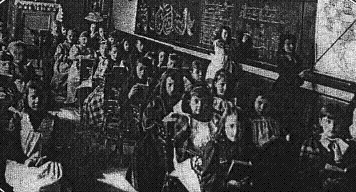
Space does not allow us to write any more of these personal experiences, but one can see how the Indians and our grandparents and parents lived side by side, attending the same school and church, and having the same joys and sorrows. 

We were able to obtain a picture of a well-known Indian who lived in our district. He carries a gun and a pair of boots over his shoulder, He was never known to leave a question unanswered. The story is told that some-one tried to stump him by asking this question: Why are there so many fiddlers in hell?’’ The Indian thought a moment and scratched his head and said, ‘Because the Lord doesn’t like music’. 

‘The Indian and his birch bark camp

That stood in days gone by,

Along the winding river’s bank

No more does greet be eye.” 

Our Island proved to be the goal of many pioneers who crossed the stormy Atlantic and made it their new home. In the next pages we have written an account of these hardy pioneers who came to our community. 

Jacques Cartier, a French explorer, visited the Island In 1534 and from then on until The British Conquest, missionaries, fishermen, and colonists came to the Island. About the year 1632 the Island was known as the Isle of St. Jean. We do not have any written records of French settlers in our community. However, we believe that many of them lived here and later moved to French settlements such as Miscouche. 

Captain Holland made a study of the Island for the British Government from 1764 to 1766. In 1767 it was divided into sixty-seven lots or townships of about 20,000 acres each. Our district is included in Lot Number 18.


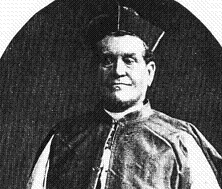
Fig. Right Reverend Daniel Jerome Gillis:  Born at Misouche Dec. 4th 1842.  Made his studies at St. Dunston’s College and Montreal Seminary.  Ordained priest in Montreal May 1st 1870.  Curate for some months at St. Patrick’s, Montreal.  Pastor at St. Andrew’s St Peter’s East Point and Indian River.  Named Roman prelate by Pope Leo XIII. Special benefactor Monument Fund

One of the earliest proprietors or Landowners of our lot was Colonel Stewart. This situation of having absentee landlords made it very difficult for the settlers until it was removed in 1873. 

In the latter years of the 18th century and early years of the 19th century vessels arrived from Scotland bringing settlers among whom were the MacLellans, MacDougalls, Mackinnons, MacDonalds, Morrisons, Camerons, Maclntyres, Gillises, and MacNellises. These settlers were met in Charlottetown in his township in Prince County, thus they went westward and some settled at Indian River and others at Grand River. 

The story of these early settlers is one of determination, endurance, courage and hardship. They came from their Motherland, crossed the stormy oceans, and entered the wilds of Prince Edward Island. 

When the settlers arrived having traveled by boat to Malpeque and by canoe from Malpeque to Indian River they were too late to put in a crop, so they began clearing the land and preparing for the next year. The following year they were able to put in a crop buying their seed from the neighbours in Malpeque. Food was scarce the first year and the story is told of how one of these early settlers, Mrs. Angus MacLellan, used to take a canoe and paddle to what is now called Raynor’s Creek, leave the canoe there, cross through he woods to Bedeque Bay, and board the timber ships from Liverpool, where, upon making her wants known, they would give her as much ship bread as she could carry. She would then return to her canoe and paddle back to Indian River. 

Indian River wasn’t only to be the homes of the MicMacs and Scottish settlers, for in the year or early 1800’s settlers such as the Noonans, Hickeys, and Sheas settled here from Ireland. Many of them came out following the Potato Famine in Ireland.

Descendants from the early MacLellans, Gilllis, and Cameron families are still living in our community as are the Noonans, Hickeys, and Sheas. Many of the early settlers’ families such as the MacKelvies, Maccarville, Tuplins, MacDonalds, Driscolls, Sherrys, Burts and Jordans have left the district. In their places new families have moved in among whom are Manns, Rogers, Campbells, Sinclairs, Heckberts, Humters, Easters, Mackenzies, Branders, and Turners. The last family to arrive was Francis Gallant in 1963. 

Reading and inquiring about the church history of our community proved to be very interesting to us. The following is an account of what we found out about the churches in our community. 

Chief among the landmarks of the community is the beautiful church of Saint Mary’s. Fifty years ago It was claimed to he the most beautiful church in the Maritimes. This is the third church to be built at Indian River. 

The first church was built in 1815 and was located near the bay. An old burying ground still marks the spot today. A parochial house was situated nearby. Up until I838 the settlers had visits from Bishop MacEachem hut no resident priest. In 1838 Father Deligney took up residence among the settlers.  The church, although rude in construction, was a joy and comfort to all. As Summerside began to grow and became the business centre of the area, his church in 1855 was hauled across the ice of Richmond Bay to the new town and was used for worship for many years al its new location. 

In 1842 Father James MacDonald became priest at Indian River and one of his first undertakings was to build a new parochial house and church as the first church was too small for the congregation.  In 1843 the corner - stone was laid and the church christened St. Mary’s. It was located on the same site as our present church and filled the role of parish church until August 12th, 1896 when it was burned during a severe thunder and lightning storm. It was famous for its beauty and the stained-glass windows were works of art. The loss of the church was serious because the people from all the surrounding communities depended upon it for a place of worship. It served the areas now known as Springfield Clinton, Kelvin, Travelers Rest, Margate and all the sections to the north shore of the Island. 

This church was known as ‘Saint Mary’s of the Pines’ because of the pine trees that surrounded it. The parishioners would tie their horses to the trees while they attended Mass. It was under these trees that our grandparents and parents walked while on processions to the cemetery. The trees have been removed. Archbishop O’Brien of Halifax, former parish priest here, wrote several poems and books. In his poems he mentioned how he loved to listen to the wind moaning against the pines of St. Mary’s. 

After the fire a vestry was built and used by the parishioners until our present St. Mary’s was finished in 1902. It is located on the top of a hill and standing at its door a magnificent view of the surrounding country can be seen. This church was built by the late Monsignor Gillis. His Pastorate extended from 1890 to 1929. His successor was Reverend Reginald MacDonald from 1929 to 1950. He was succeeded as Pastor by our present priest, Reverend Dr. L. P. Callaghan. 

The following is a newspaper clipping of fire at Indian River: 

On Wednesday evening last a terrific thunderstorm raged in the vicinity of Kensington and during its existence the lightning Struck St. Mary’s church, Indian River, setting it on fire and completely destroying it. The following account of the fire is from the Summerside Agriculturist. The people of Indian River have met a sad toss in the destruction of their beautiful church, a building endeared to them by so many years of sacred associations, a building in which so many of them were baptized and married, which has re-echoed the requiem of so many of their near and dear ones who sleep in the quiet cemetery adjoining, and a temple in which they were wont to assemble, Sunday after Sunday, for decades past, for divine worship. The associations and the memories that clustered round the sacred edifice have endeared it to the people of the parish, and the effect of its destruction is about the same as if every family in the parish had lost some member by death. It fell prey to the storm on Wednesday evening last, and an hour after being struck, nothing remained of it but a mass of smoking plaster and stone and a few burning timbers. The lightning struck the spire, setting it on fire, and it evidently spread through the body of the church as well, as the whole interior of the church seemed to be on fire almost immediately. Very Rev. Msgr. Gillis, its pastor, who was on the verandah of the parochial house watching the storm, says that it appeared as though a ball of fire from the clouds struck the spire, just below the cross, shattering the spire and tower, and setting the building on fire. He ran at once into the church, but be tower, gallery, and all that part of the church were a mass of flames. He then hastened to the chancel and saved the vestments and the sacred vessels. These, with the altar carpet were about all that was saved from the building as the fire progressed too rapidly to save the altars, paintings or any of he heavier furnishings. The main church the new vestry, and the old vestry, which was about thirty feet from the old one, were all burned to the ground and the parochial house was saved with great difficulty. The furniture was all removed from the house, as it looked though it would be impossible to save it. So completely were the buildings destroyed that all the woodwork or timber remaining from the three could be piled on a single truck and the ground for some distance around is deeply burned. The entire cemetery is thickly covered with flakes of burned shingles and with cinders. The glare of the conflagration was seen all over this part of the country being visibly plain at Summerside. Port Hill, Malpeque, Bedeque. and many other places, and many correctly located the tide. The glare in the sky was plainly visible at Charlottetown, nearly forty miles distant. This with the continual play of electricity made the sky a scene of terrible grandeur. Hundreds of people were quickly on the grounds, but they could do nothing to save the church, and, had the wind been in the opposite direction, their efforts to save the house would also have been in vain. The new bell which stood a little distance from the vestry was saved uninjured, though the framework was burned and broken. 

St. Mary’s church, Indian River, was erected in 1843. It was about ninety feet in length by fifty in width, with a large tower adjoining at the south end, and a large new vestry on the north end. It was beautifully situated, and was rather a handsome edifice. Interiorly, it was a beautiful edifice, or church, being finely arched and frescoed throughout. In fact we know of no church of its size in the provinces in which here was better fresco painting the paintings of the arches and chances especially being works of art of a high class. The chancel and the three altars which stood it were very pretty. The whole interior was a model of chaste church architecture and paintings, and the destruction of the building is sincerely regretted by many hundreds outside of the congregation. The loss of the parish cannot be less than ten or twelve thousand dollars. There was no Insurance. Two or three thousand dollars insurance was carried on the building until a short time ago, when it was allowed to lapse. 

When Mgsr. Gillis decided to build St. Mary’s church again the zeal and co-operation of all people in supplying lumber and all essentials and completing the job was overwhelming. Special mention goes to Mr. Thomas Tuplin and sons for their generosity in sawing all lumber for this church free of charge.  A valuable contribution to any building project.  Priests of former years who served the Parish were Rev, Bernard MacEachern later first Bishop of P.E.I., and Rev. L O’Deligney. In 1842 Rev. James MacDonald, Rev. James McKenna, Rev. Cornelius O’Brien, Rev. John Chassion. Rev. John A. MacDonald 1890 - 1929 Monsignor D. J. Gillis and Rev. Joseph Trainor served while Father Reginald was overseas. 

The present parochial house was const erected in 1886 and is still being used today by Father U. P. Callaghan. A note of interest to us in one of the scrapbooks was that when the first St. Mary’s was being built the money system used on the Island was pounds, shillings, and pence, and farthings. This system was used until our present Canadian coins were issued in the 1870s.


Rev. Reginald MacDonald;

Former Pastor, St. Mary’s, Indian River


Father Joseph Trainor

St. Mary’s 1950 – 1954


Dr. Louis Callaghan

Resident Pastor at Indian River (1973)


        ST MARY’S CHURCH, Indian River and Parochial House, winter 1940.


         RED CROSS KNITTING CLUB - 1916