Book of Ryans - The American Experience
Molly McGuires
Still, still in those wilds might young liberty rally,
And send her strong stout over the mountain and valley,
The star of the west might yet rise in its glory,
I too shall be gone, but my name shall be spoken
When Erin awakes and her fetters are broken.
Jeremiah Jon Callanan
'Gougane Barera' 1795-1825
The Molly McGuires were a secret Irish society formed in response to the deplorable living and working conditions in the coal fields of Pennsylvania. Although some speculation exists that the Mollys never existed at all, the miner's hysteria and their uncontrolled anger influenced several murders of mining officials. As acts of violence increased in the coal fields, word spread quickly that the Irish and their new secret organization were responsible for these deaths.
These stories gained credence because the Irish, unlike other ethnic groups, were known to organize into loosely defined, probably better described as clannish, associations. The clan was an ancient relationship which defined the political and social structure of the sept, and after the Norman invasion this relationship was completely redefined through feudal arrangements making the bulk of the Celtic population 'outsiders'. Even so, the Irish continued to organize themselves in less formal arrangements which resembled the family oriented clan structure. By the 17th century these informal groups became especially prominent as religious persecution intensified. Organizations such as the White Boys terrorized the Protestants, and similar organizations such as the Orangemen terrorized the Catholics. Associating with informal, and often violent, groups became part of a culture which nurtured violence, and as such, was brought with them as they migrated from Ireland.
Even as the Irish moved to America, they found they could not escape the religious persecution they faced in their homeland. They found anti-Catholic prejudice everywhere, even in the coal fields of Pennsylvania. The mine bosses were mostly Protestants of Scottish descent while the miners were mostly Irish Roman Catholics either by birth or descent. As the country's demand for coal escalated, so did the tension between miners and their employers. Accusations were made against the Irish which suggested that the abuses were racially motivated, and as conditions worsened the miners attempted to unionize. The relations between labor and management deteriorated as miners organized under Union contracts, and it reluctantly resulted in the deaths of several mine leaders. Because the assailants were unknown, stories spread that these deaths were perpetrated by members of a new secret organization that formed in the mine fields, the Molly McGuires.
These murders attracted the attention of the Pinkerton Detective Agency, and in response to these deaths the agency sent James McParlen to infiltrate the Mollys. McParlen came to the Pennsylvania coal fields assuming the identity of a wanted criminal, and for the next several years he became aware of their plans and intended murder victims. It was his testimony that led to the death sentences of 20 Molly McGuires of which 10 were hanged in a single day.
During the trials the defense attorneys tried to picture McParlen as a liar and an opportunist because his testimony was so damaging. One of the defense attorneys was John W. Ryon, a Pottsville attorney and defense attorney for the Ancient Order of Hibernians. He issued this possible motive for McParlen's irregular testimony:
'It can be but for one purpose. to make himself a great detective, and give him a bureau under Mr. Franklin, he has to make some great and startling disclosure.'[1]
The defense attorneys, including Ryon, interrogated McParlen to uncover potential weaknesses with his testimony. They researched his past, but had nothing more damaging other than that he had held many different jobs. Ryon and the other attorneys continued to probe for holes in McParlen's sworn statements, and found that he had made conflicting statements, especially how one of the accused, James McKenna, had received his income. It was Wayne Broehl's assumption that all of these accusations were leading up the central theme of the defense -- that James McParlen instigated and participated in the violence.[2] John Ryon was able to obtain statements from McParlen that he was aware of at least three murders before they were committed, but McParlen swore that he only knew of one and persuaded the men to return before the crime was consummated.
Attorney John Ryon also tried to portray the Irish as a persecuted race, and he was accused, to some extent, for inciting widespread hysteria in the Pennsylvania coal fields. The prosecution attempted to discredit Ryon's defense posturing, and found one witness who testified under oath that Ryan was also an instigator of unrest in the coal fields. He said that Ryon told him that
'there is about two thousand five hundred men banded together in the county for the purpose of prosecuting the Ancient Order of Hibernians, and that there is positive proof that there is detectives amongst them and find out all their secrets, and then turn around and either send them to the penitentiary or hang them.'[3]
The disturbances in the mine fields ended after 20 men were hanged, but the conditions of the mines improved little and poverty was still commonplace. Some historians contend that the Mollys may never have existed, but the murders and violence were real enough. It was quite possible that the murders and accusations of a secret Irish society were part of a larger plan to prevent labor unions from forming, and that these murders and stories were planned by the mine owners themselves. If this was true, then their plan worked because unionization of mine workers failed leaving the miners in the same desperate condition as they were before.
Erie Canal
Fifteen years on the Erie Canal
I eat my meals with Sal each day,
I eat beef and she eats hay,
She ain't so slow if you want to know,
She put the `buff' in Buffalo.
from "Low Bridge, Everybody Down'
William S. Allen
The Irish were employed in great numbers to dig this American ditch, or the `canawal' as they pronounced it. The Irish immigrant, particularly men from the South of Ireland, were imported onto the American continent beginning in 1817 to dig a canal from Albany, New York to Buffalo, New York. Because many Irish families depended upon the cutting of hardened bog to supply heating fuel in Ireland, the canal contractors felt that they had the most experience in moving large sections of earth. The canal was officially opened in 1825 after Governor DeWitt Clinton poured waters from Lake Erie into New York City Harbor to symbolize the joining of east and west, and this connection of Buffalo to the Atlantic ocean has been forever etched in the local folklore.
Irish communities sprung up along the canals, and these Irish towns became famous for its violence. It was the fighting that reinforced what Americans knew about the Irish, and their undisciplined action and hard drinking left many to believe that the Irishman could never be civilized. Many men had become popular figures in folklore by the bloody confrontations that erupted along the Erie Canal. Fighting was often justified as Mr. Edmonds, an old canaler, long ago commented, "The men had nothin' else to do."[4] Men like Chippy Connolly known as the Champion of the Erie, was known not to hire anyone that would steer clear from a fight. It was clear that fighting was commonplace and accepted in these Irish ghettos; and one of the easiest ways to start a fight was to enter any tavern along the canal on a Saturday evening and disrespectfully `slander' any county in Ireland. 19th century fighting was bloody, and it often involved the use of bare-knuckles and hobnails in their shoes which could inflict a serious wound. Commentaries also suggested that dirty fighters chewed snuff during their fights so they could squirt this disgusting potion into their opponent's eyes. It is not surprising that frequent fighting along the Erie canal would produce world boxing champions, and one of the more famous boxers to hale from the canal was Patrick (Paddy) Ryan.
Patrick Ryan was born in County Tipperary in 1853, and he later moved to Troy, New York, in 1859 when he was eight years old. Because he was born on St. Patrick's day, he was given the name Patrick Henry after the noted Irish saint. He was employed with D. and H.R.R., and later worked as a locktender on the Erie Canal. Locktenders were despised by ship captains and their crews because they enforced Lock regulations, and frequently Ryan found himself entangled in brawls over admittance through the canal system. He left the canals in the 1870s to open a saloon at the old Sidecut in Troy, and his ability to control his patrons caught the attention of Jimmy Killoran, a Troy boxing promoter and athletic director at the Rensselear Polytechnic Institute (RPI).
|
|
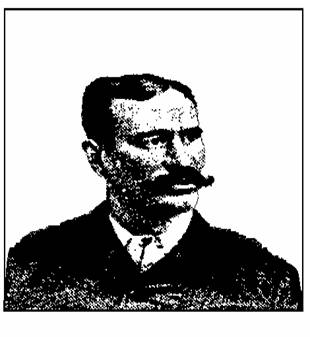
Paddy Ryan |
Killoran set up a series of fights for Paddy Ryan, and after each match, the purses grew larger and larger. During each boxing match he wore dark trunks with shamrocks and green stockings to show that he was a `Tip' from Tipperary. His first major bout was fought at Green Island with a purse of $25.00 against a "Blueskin" who was "so heavily greased that Paddy's knuckles kept slipping off until Killoran had the happy ideas of rubbing them in dirt."[5] Ryan, because of his unbroken string of triumphs, eventually was allowed to fight the European heavyweight champion, Joe Goss, whom was described as an aging Englishman on June 1, 1882. Paddy's promoters initially challenged Johnny Dwyer, the American heavyweight champion, but Dwyer failed to show, so Goss agreed to fight the challenger.
Unlike the modern rules of boxing, there were no set rounds. A round ended when either opponent fell to the ground, excepting this could be as simple as dropping to one's knees. A fight continued until there was a clear winner which usually meant a knockdown. The London Prize Ring rules were used which allowed bare knuckle fighting, even though the use of boxing gloves was becoming more popular in America. Ryan's battle with Goss took 85 rounds, and although this sounded like a marathon event, the whole event lasted one hour and 27 minutes. At the end of the fight both faces were "beaten to a jelly."[6] A Song, `Paddy Ryan's Victory', commemorates this epic fight and describes the fury that took place as these few lines recorded:
From round seventy-eight to eighty-six
Left room for to believe
No Englishman could ever stand
The weight of Paddy's sleeve;
For his well trained hundred pounder
It lighted with free will
In the very corner that Joe choose
His flood did freely spill.[7]
Ryan's reign as heavyweight champion was temporary, because within a year he lost his title to one of the most famous fighters of all time, John L. Sullivan. Sullivan was the heavyweight boxing champion from 1882 to 1892, and it started by his victory over the Troy Terror, in Mississippi City, Mississippi, on a ninth round knockout February 7, 1882. After the fight, Paddy was asked by reporters to discuss the fight, and he responded by saying, "When Sullivan struck me, I thought that a telegraph pole had been shoved against me endways."[8] Paddy Ryan fought Sullivan three more times, but was never to regain his title. As Quentin Reynolds later wrote "Paddy Ryan spent most of his time in the ring with John Sullivan - usually on his back."[9] In his later years, Ryan spent more time at his Troy saloon; however, the fortune that he earned through his many title matches was gone, and he died nearly broke