Book of Ryans - The American Experience
French America
The French were the original settlers in the American North, and emerging territories like Michigan had an occasional Irishman living in the country, although rare, in its earliest years. In 1713 French Canada had a population of over 18,000, and within 20 years the population grew to nearly 40,000 people. These numbers were small in comparison to the English colonies which approached nearly 500,000 persons. Because of the explosive population growth in British America and unavailability of farmlands inside the English colonies, pioneer families began establishing frontier communities and farmlands in French occupied lands; unfortunately France was not overly enthused with the encroachment on their lands. The imbalance of new English-speaking settlers began to threaten French dominance in Louisiana and Canada, and by the turn of the century the French were no longer the dominant ethnic group in these territory. In analyzing the early census of Detroit taken in 1810, Irish surnames became more common; and men like Edward Ryan from River Rouge were becoming more commonplace in the great northern frontiers. Later other Ryans moved further west, and by 1840 John Ryan of Milwaukee and Samuel Ryan of Brown County were documented in the 1840 census figures. By 1856 Nebraska opened its frontiers, and thousands of pioneers, including several Ryan families, settled its vast tree-less plains. John Ryan of Douglas County, James Ryne of Dakota County, John Ryne of Dakota County, Nicholas Ryne of Dakota County, and John Ryan of Washington County had settled into farmlands of the Nebraska territory. Many of the Ryans emigrated to America during the Great Famine, and as the American west opened up for settlement, these Irish refuges settled in large numbers. The Ryans continued to move west, and by the start of the Civil War had moved further north into Dakota Territory. The 1860 Census showed Ellen Ryan, Mary Ryan, Mary Anne Ryan, and two Michael Ryans living in the Dakota Territory. The Ryans were registered with the Yankton agency which was responsible for managing the flow of settlers into the territory, but it would not be until 1878 that this frontier province be opened for widespread settlement. The government offered more than 24 million acres of public lands for homesteading, and the population which registered only 12,000 white persons prior to 1878 exploded to over 348,000 persons by 1890. The territory attracted Germans, Norse, and Irish settlers as well as settlers from neighboring states. Bartholomew Ryan's life in the territory is typical of many of the settlers who registered their land with the Yankton Agency.
Bartholomew 'Batty' Ryan registered his land deed the Yankton Agency, and within a year brought his young family to live on the homestead. Batty Ryan emigrated with his parents Daniel and Anna (MacDonald) at the age of 12 from School Hill, County Tipperary to Boston, Massachusetts. Within a few years, Daniel Ryan began a westward migration which took him to Cincinnati, Ohio, but after being driven out of Ohio by the Ku Klux Klan, he took his family further west and purchased a farm near Waukon, Iowa. Waukon in its early days contained a large Irish population, and it was here that young Batty married a woman of Irish descent, Elizabeth Hill, who was born in New Hampshire of Irish parents. Waukon was a small community surrounded by fertile pastures which attracted many settlers, and as farmlands became unavailable the younger men began looking at lands further west to farm. Batty, much like hundreds of other men of his time, rushed to the territory to stake his claim. He registered his claim in the pioneer town of Kimball, and returned to Waukon after six weeks of living in temporary quarters on his claim. However, a year would lapse before he returned to Kimball with his family. He brought various tools, cows, horses, and other things necessary for farming from Waukon. During his first year he planted turnips which probably yielded a low production level because his grandson later commented that, "It was the last time he planted turnips." Before long his wife Liza gave birth to a son named James, and his new son became listed in the County records as being the first white child born in Kimball. His luck was challenged a few years later when his claim was disputed, and Batty Ryan had to obtain references showing that he was on the land since the land claim was filed. He also included a note from the local land agent Dennis Ryan (no relation) verifying his right to the claim. His petition was successful, and today his land is still in possession of his descendants whose posterity still farms the homestead.
New Empire
Its one cent for coffee,
Two cents for bread,
Three for mince pie
And five for a bed.
There's eighty-three boarders
All packed at my door
And they paid their five cents
For to sleep on the floor.
Song describing hotel accommodations
for Irishmen working the Erie Canal
from "Body, Boots, and Britches"
The Irish represented the largest group of immigrants entering American ports between 1800 and 1850. Unfortunately the actual numbers of Irish reaching North American points of entry may never be fully documented because shipping records were either poorly maintained or outright destroyed. Shipping records that have survived provide extensive information about the immigrant's origin, occupation and final destination as this immigration notice indicates:
1803 James Ryan, 34, Bantry farmers, Mary, 36, wife, passengers on `Fortitude' of NY, Hezekia Pinkam, master, bound for New York [1]
In the 1830s, 500,000 persons immigrated to the United States of which the Irish comprised 44% of that total. After the Great Famine, the Irish represented over 50% of the total immigrants arriving in the United States (the Germans were second to the Irish and coincidentally were also experiencing a blight causing the potato fields to whither). Irish immigration to the United States was actually larger than official estimates because many family oral histories have recorded that their ancestors illegally entered the United States from Canada. The illegitimate migration across Canada's borders puzzled some historians, but it appears that the decision to enter the United States via Canada was a financial one. Sea fares to Canada were less expensive than fares to the United States, and the disparate passenger rates were designed to encourage population growth of the American British Commonwealth. Once the immigrant reached their Canadian destination, it was not too difficult for them to make their way to the United States by foot.
One of the more dreadful ordeals the Irish migrants faced was the passage to America, and while England tried to regulate a minimum set of standards for passenger care, the trip overseas was frequently filled with disease, starvation, and death. U.S. shipping was, at this time, superior to that provided by English shippers, even though it was not until 1855 that the United States legislated minimum standards for emigrant passage. With few legal restrictions legislated by English lawmakers, it was not unusual to find Irish men and women sleeping in cramped and tightly packed quarters lacking proper ventilation and sanitation, and often they only had access to limited or spoiled food supplies to keep them alive on their journey. After they reached the United States, they also had to be careful of unscrupulous confidence men who promised jobs if they would give them money. If they could survive the trip and the persuasive calling of charlatans, they might be able to begin a new life among their friends and family who came before them.
The bulk of the early 19th century Irish immigrants were peasants displaced from their leased lands. Their skills were limited to basic trades or agrarian labor, however, many stayed in the cities to take on construction, factory, or servant work. These jobs were eagerly filled by the Irish because they were "tired of farming"[2] as Samuel Eliot Morison noted, but it was more likely that the succession of blights in Ireland forced them to seek work in the non-agricultural sector. The famine Irish sought employment in factories and construction so they would not expose themselves and their families to another major crop failure and the resulting hunger, disease, and death that comes with it.
The American cities began to swell with Ireland's immigrants, and the political parties soon realized that the Irish represented a huge block of new voters. Blighted inner-city areas such as Hell's Kitchen in Brooklyn, New York, were targeted; and as these Irish immigrants became naturalized citizens, the Democratic party recruited them in great numbers, especially those living in major East Coast cities. The Democratic machines, such as Tammany in New York City, offered jobs and favors to the Irish in return for supporting the party organization. Years ago my great-grandfather, an Irish refugee from the famine, was asked to join the Republican Party. He had little information about the American political system, so he asked the recruiter if there was another political party. The man responded that, "The other political party was the Democrats". He further asked the recruiter which party was the largest, and the man responded, "The Republicans, of course." He looked at the man and politely said, "I'll join the Democrats...because I like a good fight." While this family tale attempts to explain how 'Irish John' became a Democrat, it is no secret that the Irish latched themselves to the Democratic party in great numbers.
|
|
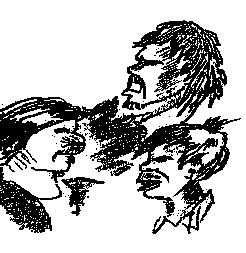
The Irish immigrant experienced discrimination for not only being Irish, but being Catholic also. Many of the 19th century newspaper cartoons pictured the Irish with animal-like features - the most common being a resemblence to an ape with a long jaw and protruding mouth. This representation of the Irish occurred long before arriving in America - even during Cromwell's time, the Irish were said to have tails which proved they were not human. This justified to many the cruelties they imposed upon this race. |
Labor Movement
It was on the 17th of March, in the year of '52,
Those Orangemen assembled our Catholics to subdue,
But being loyal Irishmen assembled as we should,
For our holy church and clergy we shed our dearest blood.
The holy temple of the Lord they swore they'd pull it down,
Away with the Pope and popery it was the word went round,
They'd pull'd the dead out of their graves most dismal for
to see,
And swore to banish Catholics out of that country.
The Battle of Philadelphia
John O. Bebbington, Manchester
During the 1800s anti-Catholic, anti-immigrant and anti-Black riots were commonplace. Many Americans opposed Catholic immigration, particularly immigration of Irish Roman Catholics, because they were viewed as one step above ignorant savages. Political cartoons, as printed by 19th century newspapers, characterized the Irishman as having the features of a chimpanzee (on occasion possessing a tail), resembling an 'animal' who drank in excess, and belonging to an uncivilized group of people who had uncontrollable hostile tendencies. This caricature made assimilation into the American culture very difficult, and since the Irish were clannish by nature, it became even more troublesome because the general population believed the negative characterization as their exposure to the Irish was limited. The newspapers reinforced these negative feelings through their reports describing the crowded tenement conditions in Irish slums, transgressions committed by Irish thugs, the high murder rates in the blighted city communities, and anything else that would seem to make headline news. As the century progressed, relations between the native-born Americans and the immigrant Irish Catholic grew more distant and hostile. Much of this disaffection resulted from the Irish immigrants desperate need for work, so much so, that they were willing to work at greatly reduced wages. Their willingness to work for less than the prevailing pay-scale induced many small business owners, including the Protestant working class, to complain loudly about the impact this cheap labor had on their business. As they continued to enter U.S. ports, their protestations would result in violence before the century's end.
The Irish immigrants moved to cities in huge numbers, and a great amount has been written about their concentration in the urban centers. Ireland was a rural country with the majority of its citizens living on farms, and traditionally they avoided city life which placed more restrictions on their personal and religious activities. The first towns in Ireland were introduced by the Vikings, and were later populated by men of English descent whom were more accustomed to living in villages. Yet, the Celtic population tended to avoid living among the foreigners which brought in their own set of laws and religions. By the time they made their way to America, they clustered around others of Irish descent, which for the most part were found living in the major U.S. urban centers. They lived in ghettos made up of other Irish Catholics, and it was a place so distressing that non-Catholics and the police infrequently entered. Because they were unskilled, uneducated and accustomed to living in poverty, the Irish were actively recruited by businesses which offered low wages and unsafe working conditions.
Race and religious riots were frequent during this time, and many were spontaneous reactions to a perceived degradation of Catholic liberties such as making their children study the King James bible in school, job opportunities being greater for Protestants, and even giving Protestants more freedoms to worship as they choose. Later tensions between the Irish, and to some extent German Catholic, and American Protestants manifested itself in the creation of a new, although short-lived, political party called the `American Republican Party'. This political group was also known as the `Know Nothing Party' because whenever a member was asked what happened during their secret meetings, its members were expected to respond with, "I don't know". Its purpose was to enact a naturalization law which would require 21 years residency in America before an immigrant could seek citizenship. The emergence of reactionary political organizations and the subsequent ill-feeling it created among the non-Irish public made them an outcast, and rather than assimilating quietly into the mainstream, they were forced to become more militant in acquiring better jobs, providing adequate housing, and creating educational opportunities for their children.
The job environment of the working class poor was deplorable, and as America stepped up its industrialization effort, the unhealthy working conditions forced workers to resort to work stoppages and strikes. The strikers demanded safer working conditions and petitioned factory owners for improved salaries beyond the starvation wages they were paid. Poor salaries and unsafe conditions on the factory floor led hundreds of laborers to join one of many city-wide unions that were being created in the major American cities. It was not until 1859 that the first national union, the National Union of Iron Molders, was created, but after the idea of nationalizing the American work force caught on, one of its first efforts was to provide a minimum wage and a 40 hour work week.
One of the more successful Unions of the period originated in Philadelphia, and it attempted to reduce religious and ethnic barriers that existed in the United States. Even its motto, "independence from bourgeoisie abuse and social equality" hinted at how the Union hoped to make their lives better. According to Kerbey Miller, "their greatest success occurred in Philadelphia in 1833-37 when the General Trades Union - led in part by John Ferrall of Philadelphia and the Irish cordwainer John Ryan - marshal led some 10,000 Protestant and Catholic, native - and foreign born workers in a series of successful strikes."[3] Later in the century, Philadelphia had a population of over 800,000 inhabitants with approximately one-fifth of them immigrants. Theodore Hershberg noted that by 1900 the Irish represented about 90,000 persons in this population study, or roughly 10% of the total population of this Pennsylvania city.
It was not until after the Civil War that a truly powerful national worker's union was developed. William Sylvis, a Philadelphia ironworker, united a number of national labor unions in 1866 into a confederation called the National Labor Union; however, he could never completely integrate the divergent labor unions and their disparate objectives under a single platform. As the National Labor Union declined in membership, another union, the Nobel Order of the Knights of Labor, was created in 1869. This organization was eventually reorganized to become the American Federation of Labor (AFofL) which in the 20th century would merge with the CIO to become the largest union in the country.
The late 19th and early 20th century represented the hallmark of labor influence in America. As the industrial output of the United States markedly increased, so did the influence of the Unions and its associated membership. The Unions' leverage was influential even at the highest levels of government, and its nearly absolute control of Union membership led to rumors of consorting with the criminal underworld. Charges of racketeering and the promotion of unchecked violence against Union critics were all too commonplace by the late 19th century. One of the classic examples of criminal wrongdoing was reflected by the questionable activities of the Longshoreman's Union. General complaints of corruption along the waterfronts of Brooklyn, New York, were being voiced loudly by the Union's rank and file; and Joseph Ryan, a political power within New York City's Tammany Hall, was elected President of the International Longshoreman's Association to bring "order and protection to the Union's shakedown operations"[4] Several decades later, one of the more violent attacks sponsored by Union leaders occurred before World War I when the International Association of Bridge and Structural Iron Workers planted dynamite at the Los Angeles Times Building. The conspirators whom were eventually captured included the President of the Union, Frank M. Ryan. Ryan and other members of the Union were convicted of transporting explosives illegally across state lines, and all accomplices were sentenced to seven years at the U.S. Penitentiary at Leavenworth, Kansas. While at Leavenworth, petitions were sent to members of the Union to rally support for the release of these confederates:
Petitions for Frank M. Ryan
Unions Here Asked to Get Signatures for Pardon
The Unions in this city received copies yesterday from John Fitzpatrick, President, and E.M. Nockles, Sec. of the International Association of Bridge and Structural Iron Workers, of a petition to be sent to President Wilson and the members of Congress; asking for a pardon of Frank M. Ryan, former President of the Association, who was arrested some time ago on the charge of complicity in the blowing up the Los Angeles Times Building.[5]
A few weeks after the petitioning drive began, President Wilson offered pardons to those involved in the bombing except for 20 men including Ryan. Because he was 58 years old, he was offered a clerk's role at the jail. He refused because he "wished to be with his companions"[6] and was assigned the job of foreman in the iron workhouse.
There have also been other Ryans active in Union affairs. Martin Francis Ryan, born in Coldwater, West Virginia, in 1874 became one of the more powerful union leaders of the last century. He was the son of John and Mary (Call) Ryan, and no doubt his life in the mining fields molded his opinions regarding worker's rights. He gained prominence in the labor field, and in addition to having been elected to the Executive Board of the Brotherhood of Ry, was also a co-leader with Samuel Gompers to the Pan-Am Federation of Labor Convention. Another well placed union official was John F. Ryan, or Jack Ryan as he was known to his friends. Jack Ryan rose in the American Newspaper Guild leadership, and because he was an outspoken critic of government and business pursuits, he was labeled a Communist in 1941 by his enemies. Post-depression America viewed outspoken critics of U.S. culture as un-American, and her schizophrenic fear of socialist infiltration into American society reached its peak in the 1950s when Senator Joseph McCarthy labeled hundreds of 'undesirable elements' as Communists. The United States government was not entirely convinced that Ryan was innocent of spreading Communist ideology, and by 1947 he found himself testifying in a House Committee denying charges that he violated the Corrupt Practices Act.