Hatingeennonniahak
So what is our American Indian Heritage?
There were comments made over the years by family members that suggested we had some American Indian roots. We had no proof of this being true, so when asked about our ancestors, we would generally say "1/4 French, 3/4 Irish."
Since using Ancestry.com, it became clear that this percent distribution wasn't quite accurate. It was true that we were mostly Irish, followed by French, but the rest was a mix or hodgepodge of multiple ancestry roots. When I took a DNA test, one of the results in GEDMatch showed that we had American Indian "blood." This started a process to find out what these roots looked like.
Ancestry.com made this exploration an easy tool to answer this question.
Initially, I could see that we were connected to the Huron tribe through Abraham Martin's wife, Marguerite Langlois (METIS or Half Breed born around 1600 in Kebec). She married Abraham Martin, born in 1580 in France, and his arrival to the new world was at the request of one of his friends, Samuel de Champlain. To be fair, there are some genealogists who believe Abraham was born in Canada, and was of aboriginal birth (or as the Jesuits would say "savage").
Initially, I found this connection through Jean Marie Trachey who was Phileas Turgeon's mother (my great great grandmother). Phileas' grandmother was a Bourget, and the Bourgets traced their lineage to Anne Martin born 1645 (daughter of Abraham Martin and Marguerite Lagnois) and spouse of Jacques Rate a Frenchman. There are many stories about "who" Marguerite was...was she a METIS...was she born in France, however, the church records show that her children were described as "savage", "METIS", or "half-breed". This suggests that Marguerite was minimally "half-breed", and we are also told that she was of the Huron Wendat tribe (Hurons from Kebec).

CLICK TO ENLARGE: PHILEAS TURGEON ABORIGINAL LINEAGE
While we could show a connection to the Huron tribe through Anne Martin, born 1645, it did not fully explain how our genetic profile could range from 1-3%. If this was it, then the percentage should be lower as this is 9 generations back. As I researched further, I found a second connection to the original natives of Kebec, or Quebec.
 |
The second connection was through Merida Patry, wife of Phileas Turgeon. Merida's grandmother was a Cote who traced her lineage to Jean Cote born in 1610 in early Kebec, or Quebec. In the church records, Jean is listed as "half breed or METIS", and was most likely one of the first child born in Canada to a French man. |
What did I find surprising? Jean Cote married Anne Martin, born 1614, who was also a daughter of Abraham Martin. Abraham was married twice. His first marriage was to a full breed Huron Wendat woman, and they had several children of which this Anne (born 1614) was one of them. His second wife was Marguerite Langlois (METIS), and they had multiple children but what made this interesting is that one of their children was also named Anne (born 1645). We are connected to both Annes.
Abraham is a common ancestor, and we have two lines that connect to him through two different wives.

CLICK TO ENLARGE: PHILEAS TURGEON ABORIGINAL LINEAGE
Abraham Martin and Family
There is a lot of confusion over the origins of Abraham, yet this most likely is the correct observation of his lineage: "He was born about 1589, probably at La Rochelle, his father probably was Jean Galleran Martin, known as “The Merchant of Metz”, he could have also been born at Metz, Lorraine, France. His mother was Isabel Cote. Throughout his lifetime, Abraham Martin L'Ecossais [the “Scotsman”], that nickname was often used at that time, as a derogatory term to describe a deserter or member of an illegal organization. It may have also meant that he had made several voyages to Scotland in his youth, or assisted the Scottish settlers who began arriving at Port Royal (then called Port Charles) about 1628, under the direction of Sir William Alexander. It's highly unlikely that he was actually of Scottish descent."
He is often called Abraham Martin a king's pilot, leading to the conclusion that he was the first river pilot of Canada. He was illiterate, however, he associated with men of letters such as Samuel de Champlain and Pierre Desportes. His first wife, her name unknown and was often referred to as "girl", was a Huron-Wendat Indian living on Ile de Orleans, with whom he had three children Matchonon ("a Savage" according to the Jesuits) b. 1609 Kebek, [Quebec ] baptised 3 Nov 1634 as Joseph Martin; Anne Martin/Matchonon Metis b. 1614 (Kebek) d. 14 Dec 1683 (Kebek) m. Jean Cote' dit Coste' 1635; Eustache Martin b. 1621 Kebek
His second wife, a Metisse (half-breed woman) was Marguerite Langlois b. 1611 Kebek, married at Kebec, abt 1621, they had eight children, of which the 7th was Anne Martin Metis, born 23 Mar. 1645 at Kebek, she married Jacques Rate.
Yep, that is a lot of people to remember, however, our family is connected to both Anne Martins, and both are referred to as savage or half-breed. That is how we are connected to the aboriginal peoples of Quebec.
There is also evidence that he had at one time been employed by Jean De Biencourt and Du Gua de Monts as navigator on the coast of Acadia, although he would have been very young at that time. It is here that he befriended Charles La Tour, and they remained life-long friends. When Abraham’s son, Charles-Amador, was born on March 7, 1648, his godfather was none other than Charles de Saint-Étienne de La Tour, who was also the infant’s namesake. Charles La Tour's father had accepted a Scottish Barony after being captured by the Kirke Brothers in 1629.
When the British took control of Kebec for the first time, everyone was shipped back home, where it is believed that Marguerite's sister, Francoise Langlois, and her husband Pierre, died so the Martin's became guardians to little Helene, who was now almost nine.
The Martins would become one of the first three families to be granted land in Quebec City, when they were presented with 12 acres by the Company of New France in 1635. The additional 20 acres were a gift from Sieur Adrien du Chesney, ship's surgeon to Pierre Legardeur. Abraham and Marguerite's descendants later sold this parcel of land to the Ursuline nuns.
Marguerite and her husband played a major role in the development of French Canada, and in a culture that likes it's 'firsts'; a few can be added to their credit. Eustace Martin is the first baptism which is registered at Notre-Dame of Quebec, dated October 21, 1621. His daughter Helene Martin was the god-daughter of Samuel de Champlain. We know Abraham had two other children with his first wife, but they were not recorded in church records.
Abraham drew up the first map of Quebec, even though he was illiterate. Champlain's wife Helene Boulle, did not adapt well to frontier living and only spent four years in Québec. She found solace and companionship with Abraham's wife Marguerite and her sister Françoise Langlois who bore the first French child born in New France, When Samuel de Champlain died he left a legacy to Marguerite Martin, another daughter to help her "marry a man of Canada", and he left money to Abraham Martin "to be spent for clearing land".
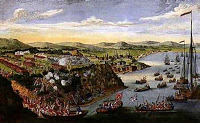 |
The ground that Abraham Martin cleared was the summit of the Cape Diamonds, Known now as the “Plains of Abraham”, site of the 1757 battle, between Wolfe and Montcalm, the “Coast of Abraham” was the path used by Martin, to go down to the river Saint-Charles to water his animals. |
|
Today a monument features a column on a square base, topped by a terrestrial spheresupported by four thistles, emblems of Scotland. The base (or lower) relief depicts the French symbol of a fleur de lys (lily flower) emerging from flood waters to represent the pioneering role played by Abraham Martin as a king’s pilot. |

In February 1649 the little Québec colony had quite a shock when it was announced that 60 year old Martin Abraham, friend of Samuel de Champlain and the father of a large and respected family, was accused of having an affair with a 16 year old girl [i.e., “conduite incorrecte envers une jeune fille” in that Abraham had forfeited the honor of a young girl of 16, what today would possibly be statutory rape, although marriages in those days occurred as young as 10}.
He spent some time in prison beginning on 15 February 1649 as a result of his improper actions.
Abraham Martin died on September 08, 1664 in Quebec city, at the age of 75; and Marguerite the following year on December 17, 1665, at the age of 63. A note made by Father Le Jeune, in 1632. Eustache Martin, Metis, b-1621 the eldest son of Abraham and Marguerite, were baptized in 1621 , were the second and third children of White men born at Quebec.
Family Tree of Abraham Martin
The Plains of Abraham in modern day Quebec City are named for Abraham MARTIN dit L'ECOSSAIS. He and his "country" wife, an unknown Huron-Wendat woman, had three children:
1. MATCHONON ("a Savage" according to the Jesuits) b. 1609 (Kebek) baptised 3 Nov 1634 as Joseph MARTIN;
2. Anne MARTIN/MATCHONON b. 1614 (Kebek) d. 14 Dec 1683 (Kebek) m. Jean COTE' dit COSTE' 1635;
3. Eustache MARTIN b. 1621 Kebek
His second wife, a Metisse (half-breed woman) was Marguerite LANGLOIS b. 1611 Kebek, their children were:
1. Marguerite MARTIN b. 1624 d. 1679 m. Kebek 22 May 1638 Etienne RACINE
2. Helene MARTIN b. 21 June 1627 d. 1651 m. Kebek 3 Sep 1647 Medard CHOUART Sieur des Groseilliers (1618-1696)
3. Marie MARTIN b. 10 Apr 1635 Kebek d. 25 Apr 1699 Chateau Richer m. 21 Jan 1648 Jean CLOUTIER
4. Adrien MARTIN b. 22 Nov 1638
5. Madeleine MARTIN b. 13 Sep 1640 m. (1) Kebek 6 Feb 1653 Nicolas FORGET (2) Repentigny 1 Feb 1681 Jean Baptiste FONTENEAU
6. Barbe MARTIN b. 4 Jan 1643 d. Chateau Richer 5 Oct 1660 m. Kebek 12 Jan 1655 Pierre BIRON
7. Anne MARTIN b. 23 Mar 1645 Kebek m. 12 Nov 1658 Jacques RATE
8. Charles Amador MARTIN b. 7 Mar 1648 Kebek d. 19 Jun 1711 second priest New France born
In BLACK : Anne Martin Cote connects to our family through Merida Patry Turgeon. Anne Martin connects to our family through Phileas Turgeon's mother.
Samuel de Champlain Will
The name Abraham MARTIN also appears in the controversial will Champlain signed in November 1635, two months before his death. Canadian history was young then and still in the making. The original will was not discovered until 324 years later, in August 1959 to be exact, by the historian and archivist Olga Jurgens, and published in 1963. In his will, Champlain "gives to Abraham and his wife 600 livres with the charge of using it to clear land in this country of New France." The founder also gave 600 livres to Marguerite, daughter of Abraham, "to support her in marrying a man of this country--New France--and no other."
The original will stated clearly that if Champlain should leave little or nothing in goods and Quebec properties to his widow, he wanted her to have the largest part of his inheritance in France.
Land Deed of Abraham
In 1635 Abraham Martin accepted, from the Company of New France, a land grant of 12 arpents in Quebec. Another parcel of 20 arpents was added 10 years later. The combined land was well-situated in the upper town, but north of the present Grand Allée, on what was at that time called St-Genevieve Hill. For this reason Abraham Martin's land should not be confused with the Plains today
We discover in a notarial act dated 16 October 1675 the name Charles-Amador Martin, only surviving son of Abraham. Priest and co-inheritor, Charles-Amador cedes to the religious order of Ursulines 32 arpents of land situated in a place called Claire-Fontaine in exchange for the sum of 1200 livres, a small fortune at the time
METIS
Genealogists have come up with competing lineages for Abraham Martin and his two wives. "Purists" have tried to show their heritage to be of French origin. Minimally, it appears that Abraham's wives were Huron, either partially or full Huron. Even Abraham's heritage is uncertain, as some show him to be Scottish (his nickname L'ECOSSAIS means "the Scot" in French). There is also some evidence that Abraham, himself, was METIS or half-breed, and born in Canada.
What is certain is that church records show the METIS or Half-Breed designation for Abraham's children and grandchildren. It doesn't make any sense that the Church would incorrectly identify his family and descendents.
Below are some snippets referring to our ancestors' METIS lineage:.
October 25: Kebec, birth (II)-Louis Cote, Metis, d-1699 son (I)-Jean Cote, d-1661 and (II)-Anne Martin, Metis, d-1684: married November 6, 1662, Quebec. Elizabeth Langlois |
Marie Martin, Metis, (1635-1699 |
September 3: Kabec, marriage (I)-Medard Chouart, Sieur des Groseilliers (1618/21-1696) |
Kebec, baptism (II)-Guillaume Hebert, Metis (1604-1639) son (I)-Louis Hebert, Metis (1575-1727) and (I)-Marie Rollet d-1649; married October 1, 1634, Kebec, Helene Desportes . |
July 17 1663: Quebec, birth (II)-Marie Madeleine Fournier, Metis, died October 8, 1664, Quebec, daughter (I)-Guillaume Fournier, (1619-1699) and (III)-Francoise Hebert, Metis b-1637 |
Francoise Grenier (Garnier) is among the many “marriageble women” in the colony of New France (1600 - 1650) who’s origins have been generally labelled as “unknown” or “unsubstantiated” and recognized as “Metis” by Historian Dick Garneau. They include Jeanne Du Roucy (Voizy?) wife of Nicolas Pelletier, Francois Tourault wife of Jacque Archambault and Marguarite Langlois wife of Abraham Martin. |
September 19 1663: Chateau Richer, birth (III)-Madeleine Cote, Metis, died August 25, 1689 Cap Ste Ignace, daughter (II)-Louis Cote d-1669 and (II)-Elizabeth Langlois, Metis b-1645: married November 26, 1682 Cap St. Ignace, Louis Lemieux |
September 6 1668: Chateau Richer, birth (III)-Jean Cote, Metis, died October 5, 1668, Chateau Richer son (II)-Martin Cote, Metis, b-1639 and (II)-Suzanne Page |
November 16 1638; Kebec, (I)-Etienne Racine and (II)-Marguerite Martin, Metis (1624-1679) were the heros of the celebration held in the house of (I)-Abraham Martin, (1589-1664). This document is the first to reveal to us the origins of the young fiance. He was the son of Rene Racine and Marie Loisel, from the parish Fumichon, |
August 29: Ste Pierre, I., birth (II)-Ignace Rate, Metis, son (I)-Jacques Rate, (1630-1690) and (II)-Anne Martin, Metis, b-1645. |
May 22: Kebec, marriage (I)-Etienne Racine, b-1607 to (II)-Marguerite Martin, Metis (1624-1679) daughter (I)-Abraham Martin dit L'Ecossais (1589-1664) and Huron savagesse and/or Marguerite Langlois, Metis b-1611?, see 1608 & 1624: It was on May 22, 1638 that, Father (I)-Nicolas Adam (1588-1659) fulfilled his parish duties at Kebec. He blessed the union of (I)-Etienne Racine and (II)-Marguerite Martin, Metis, b-1624, now fourteen years old. (I)-Olivier Tardif/LeTardif (1601-1665) and (I)-Guillaume Couillard (1597-1663) were present. Promise of marriage was made November 16, 1637. |
(III)-Charles Martin Metis b-1651 Quebec , (III)-Antoine Martin Metis b-1654 Quebec d-1715 Charlesbourg 1st married 1690 (II)-Jeanne Cadeau; 2nd married 1699 Charlesbourge (II)-Marie Bonet (III)-Isabelle Martin Metis married 1670 Pierre (Jean) Ozannes |
November 16: Kebec, baptism, (II)-Marguerite Martin, the daughter of (I)-Abraham Martin dit L'ecossais (1589-1664) and Marguerite Langlois, (Metis or savage), b-1611, was baptized at Quebec, on January 4, 1624 and displayed the freshness of her thirteen years against the mature thirties that her suitor had already accumulated. The young girl was assisted by her godfather and godmother, Nicolas Pivert and Marguerite Lesage and Guillaume Hebert . What probably appeared to her as a fortune was the 200 livres promised from her groom to her, plus a dowry of 50 livres. The couple benefited also from the 100 livres in silver which Abraham Martin gave Etienne after the wedding, plus utensils and clothes valued at 64 livres. |
(II)-Marguerite Martin, Metis, born January 4, 1624, Kebec, died November 25, 1679, Chateau Richer, daughter (I)-Abraham Martin dit L'ecossais, (1589-1664) and savage and or Marguerite Langlois, Metis, b-1611?); married May 22, 1638, Kebec, (I)-Etienne Racine (1607-1689). Thierry Des Dames is godfather of (II)-Marguerite Martin, a girl of (I)-Abraham Martin, in 1624, Kebec . Marguerite Lesage, wife of (I)-Nicolas Pivert is godmother to (II)-Marguerite Martin. III)-Marie Martin Metis married 1673 (I)-Jacques Charie dit Lafontaine |
Eustache Martin, Metis, b-1621 the eldest son of Abraham and his sister, Marguerite, were baptized respectively in 1621 and 1623, were the second and third children of White men born at Quebec, the first having been their cousin Helene Desportes, born in 1620, to the marriage of Pierre Desportes and Francoise Langlois. |
15 Feb 1649: "Kebec, (I) |
Anne MARTIN /MATCHONON was the daughter of Abraham dit L' ECOSSAIS who was a "river pilot" and her mother was an unknown Huron-Wendat woman. He married twice, his second marriage was to a Me'tisse (half-breed woman). Since he was born in Kebek ("Quebec" as it is now known) in 1589, his mother was probably Huron-Wendat as well. It is believed his father might have been Scottish for L'ECOSSAIS means "the Scot". |
|
Huron-Wendat Confederacy
"Huron" was a nickname given to the Wendat by the French meaning “boar’s head” from the hairstyle of Huron men, or “lout” and “ruffian” in old French. Their confederacy name was Wendat (Ouendat) perhaps meaning "people of the island." The members of the confederacy were the Attinniaoenten ("people of the bear"), Hatingeennonniahak ("makers of cords for nets"), Arendaenronnon ("people of the lying rock"), Atahontaenrat ("two white ears" i.e., “deer people”) and Ataronchronon ("people of the bog"). Each of these peoples were termed by the French ‘nation,’ meaning that they were separate political and territorial entities, with similar cultures, a common origin in the distant past and spoke similar but not identical languages. The “Bear” and the “Cord Makers” were the original inhabitants of the area. In the late 16th century the other three nations migrated from the north shore of Lake Ontario and the Bay of Quinte area to join the Bear and Cord in a loose defensive alliance against their common enemy, the five Haudenosaunee nations south of the lake.

Our genealogy connects to the "Cord Makers" tribe within the HURON nation. In several of the documents that exist, they describe our family members as METIS Cords, or HURON Cords.