National University of Ireland, Maynooth
THE ANCIENT ORDER OF HIBERNIANS IN COUNTY MONAGHAN WITH PARTICULAR REFERENCE TO THE PARISH OF AGHABOG FROM 1900 TO 1933
by
SEAMUS McPHILLIPS
IN PARTIAL FULFILMENT OF THE REQUIREMENTS FOR THE DEGREE OF M.A. DEPARTMENT OF MODERN HISTORY NATIONAL UNIVERSITY OF IRELAND
MAYNOOTH HEAD OF DEPARTMENT: Professor R. V. Comerford
Supervisor of Research: Dr. J. Hill, July 1999
TABLE OF CONTENTS
Page
Abbreviations----------------------------------------------------------------------- vi
Introduction-------------------------------------------------------------------------- 8
Chapter I
The A.O.H. and the U.I.L. 1900 - 0 7 ------------------------------------43
Chapter II
Death and destruction as home rule is denied 1908 - 2 1 -------------81
Chapter III
The A.O.H. in County Monaghan after partition 1922 - 33 -------120
Acknowledgement------------------------------------------------------------------- iv
Conclusion---------------------------------------------------------------------------143
ii
FIGURES
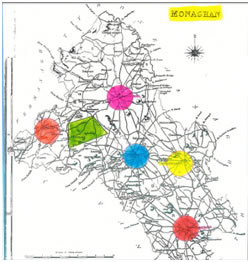
Lewis’s Map of 1837 showing Aghabog’s location
in relation to County Monaghan------------------------------------------ 12
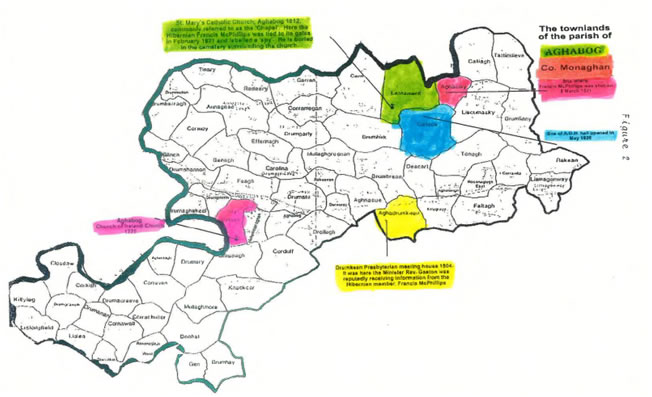
Figure 2
P. J. Duffy’s map of Aghabog parish
showing the 68 townlands--------------------------------------------------13
Figure 3
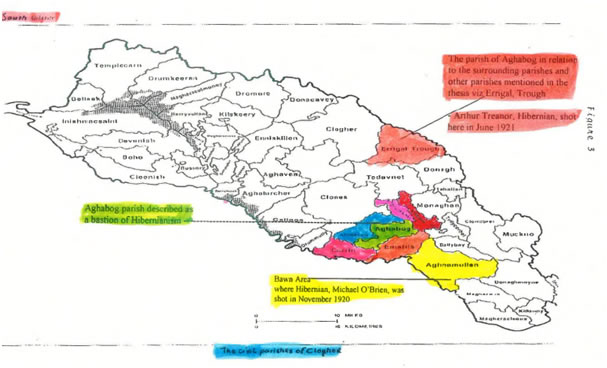
P. J. Duffy’s map of the civil parishes of Clogher showing Aghabog in relation to the surrounding parishes-----------14
TABLES
Table 1
Population and houses of Aghabog 1841 to 1911-------------------- 19
Illustrations----------------------------------------------------------------------152
Figure 1
Bibliography---------------------------------------------------------------------153
ACKNOWLEDGEMENT
I wish to acknowledge with gratitude some of the many people who encouraged and assisted me to complete this work and to whom no blame is attached for its weaknesses or inaccuracies.
Firstly, I am deeply indebted to Dr. Jacqueline Hill, my supervisor, for her encouragement, support and helpful suggestions. I also owe a debt of gratitude to Dr. Raymond Gillespie, Course Director for his ongoing help and support, to Dr. Eamonn Phoenix, Belfast, Dr. M. T. Foy, Belfast, Dr. P. J. Dufiy, Maynooth, Dr. T. Dooly, Bray and Dr. Brian Doman, Dundrum, for their suggestions and observations. I extend my deep appreciation to all those helpful people in the National Library of Ireland, the National Archives, particularly Brian Donnelly, the Royal Irish Academy, the Gilbert Library, the local authority libraries at Ballyroan, Tallaght, Ilac Centre and Castletymon, the Simmons Library, Boston, particularly Vivienne Brady-Piroli, the R.C.B.I. Library, Churchtown, Tony Carroll, the national president, Francis Kieran, the national secretary, of the Ancient Order of Hibernians, The Mall, Newry, County Armagh, the Monaghan County Library, Clones, County Monaghan, especially Joe McElvaney, the Monaghan County Museum, particularly Patrick Long and Padraig Clerkin.
I am also indebted to the Northern Standard newspapers at the Diamond, Monaghan for allowing me to study their files. I wish to thank all those families in County Monaghan, many of whom have been touched by the tragic events referred to in this thesis, who provided me with vital information, constructive hints and assistance with photography. My sincere gratitude is likewise extended to my many neighbours from Aghabog, especially to nonagenarian Michael Kerins and members of my own family, particularly Michael, Anne, Mickey and T. J. for their unceasing help and hospitality.
Finally I owe an immense debt of gratitude to Yvonne Dowling for her great skills in typing and presentation, my wife Eithne and daughter Fidelma for their patience and forbearance over the past two years.
Seamus McPhillips,
July 1999
LIST OF ABBREVIATIONS
D.M.P. Dublin Metropolitan Police
R.I.C. Royal Irish Constabulary
CBS. Crime Branch Special
C D. Crime Department
C.O. Crime Ordinary
I.G.C.I. Inspector General County Inspector
H,0, Home Office
N.A. National Archives
N.L.I. National Library of Ireland
S.O.C. State of the Country
T.C.D.L. Trinity College Dublin Library
I.N.F. Irish National Foresters
M.C.M. Monaghan County Museum
M.C.L. Monaghan County Library
A. O. H. Ancient Order of Hibernians
B.O.E. Board of Erin
U.I.L. United Irish League
L.O.L. Loyal Orange Lodge
R.I. A. Royal Irish Academy
I.R. A. Irish Republican Army
S. F. Sinn Fein
INTRODUCTION
This thesis is an exploration of an oath-bound secret Catholic organisation, the Ancient Order of Hibernians, during a very important period in its existence from 1900 to 1933. The focus will be on County Monaghan with particular reference to my native parish of Aghabog. The period between 1900 and 1933 witnessed a series of very dramatic changes in the Irish political scene which have had lasting and profound effects on the island up to the present time. The Hibernians, as the Order was commonly referred to, were emerging at the end of the nineteenth century from a period of division and stagnation both in Ireland and Britain where the Order had taken root among the numerous Irish emigrants in Scotland and the north of England.(1)
Divisions had also occurred in America where the Hibernians were very strong among the Irish masses and where the Order received its name in 1838.(2) The Order had also to contend with the disapproval of the Catholic church which had imposed a ban on membership of secret societies as a result of Pope Leo XII’s papal decree of 1825 in an apostolic constitution called ‘Quo Graviora’.(3)
What was the Ancient Order of Hibernians? The A.O.H. like the Orange Order was a sectarian movement; sectarian in the strict sense of the word as meaning denominationally exclusive. Membership was confined to practising Catholics of Irish birth or descent. It regarded itself as a society with the task of protecting both the Catholic faith and Catholic population/45 It considered its role as historically necessary due to attempts under English rule to destroy the Catholic faith and to counter discrimination against Catholics.(5) Due to Catholics being a minority in one part of Ireland, Hibernians felt that a society like theirs was necessary. The Order claimed to do for Catholics what the Orange Order claimed it did for Protestants. As a sort of Irish Catholic freemasonry which combined nostalgia with benevolence it gained significant support in immigrant America/6’ It was described as ‘the strongest of all Irish-American organisations which plot the downfall of the British Empire’.(7) The Order grew rapidly in Ireland in the early years of the twentieth century. It was very successful in getting out the Catholic vote for John Redmond’s parliamentary party.
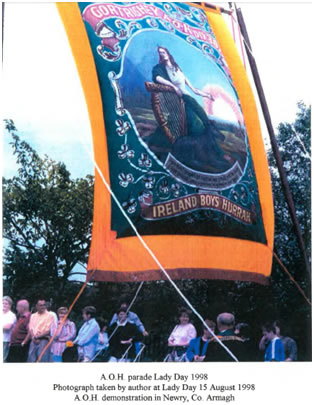
Only after that party’s failure to get home rule without partition, did it begin a decline, from which it never recovered/8’ The A.O.H. which was also a friendly society, found jobs for its members, provided social welfare benefits like medical assistance, sickness benefits and grants in the event of death/9’ The Order organised in units known as divisions had similar trappings to the Orange Order, in bands, banners, regalia, halls and a special day for parades on ‘Lady Day’, namely 15 August each year. The Order while making no secret of the fact in believing in a united Ireland constantly renounced violence as a means of achieving political ends/10’ However as we approach 1900, we learn that there were 2,965 members enrolled in eighty six lodges, mostly in Ulster/11’ Membership figures for the Order in County Monaghan at this time were 120, spread over three divisions which according to an R.I.C. report, were described ‘as inactive and a mild reflection of the I.R.B.: they pass similar childish resolutions about the Boers with less aggression’/ 12’ The local newspapers, whether unionist like the Northern Standard or nationalist like the People’s Advocate have no mention of any Hibernian activities.(13) It was not until 1903, that reports appear of the nationalist organisations such as the United Irish League, Trade and Labour Associations and Irish National Foresters joining the four A.O.H. divisions of County Monaghan, (including Aghabog division 226), at ‘the magnificent Emmet Centenary demonstration at Clones, County Monaghan on 15 August’.(14) Towards the end of the nineteenth century the Order split because of a decision on the American side to admit members where both parents hadn’t been born Ireland.(15) This caused dissension in the A.O.H. in Ireland which lasted up until a conference in 1902.(,6) The healing of divisions within the Order after that conference of 1902 lead to the re-organisation of 1905 under Joseph Devlin, M.P., as national president and John Dillon Nugent as national secretary resulted in the rapid growth of Hibernianism across the county.(17) The drive and energy for which both Devlin and Nugent were legendary was felt at the meeting setting up the Monaghan A.O.H. County Board on Saturday 21 October 1905 at Castleblayney which was personally addressed by Nugent.<18) The speech was a clarion call to the assembled delegates, (including those from Aghabog), to work for increased membership, was a rebuttal of attacks and smears against Hibernians, (with a strong denial of being in the pay of the Dublin Castle authorities) and called for support for the United Irish League and the Gaelic League.(19)
Consequently, it was now no surprise that the Order in County Monaghan had grown in 1905 to eleven divisions stretching from Ballinode in the north of the county to Inniskeen at its southern most tip.(20) The membership was doubled in 1906 with the establishment of nine extra divisions bringing the total to twenty.(21) Between 1906 and 1912 the number of divisions levelled out at twenty three.(22) With the introduction of the National Insurance Act 1911 and the AO.H.’s shrewd move to register under its provisions as an approved benefit society, membership in the county again soared to forty divisions in 1916 and reached forty five by 1921.(23) This massive increase was as a result of the many insurance and social welfare benefits of which A.O.H. members could now exclusively avail.(24) However as will be discussed below the drift towards political conflict in Ireland of the 1920s resulted in three fatalities for the A.O.H. between 1920 and 1921 ,<25) Consequently the atmosphere of intimidation from the republican elements in the county, either forced the Order to keep a low profile or suffer more casualties. Partition and the destruction of the parliamentary party in the 1918 election, forced Hibemianism to re-think their position in the new political order.(26) Hibernians still proclaimed their support for the ideals of the late John Redmond. They sought vindication for their murdered colleagues by pointedly erecting memorials near to the sites where they met their untimely deaths. Despite the speeches justifying the stand Hibernians had taken on non-violence, they began to portray a sense of doubt about their future in 1933 as this thesis ends.(27)
In order to fully understand the fortunes of the A.O.H. in Aghabog between 1900 and 1933 it is necessary to look at its overall location in the context of the county.
St. Mary's Catholic Church, Aghabog 1912, commonly referred to as ths Chapel'. Here the Hibernian Francis McPhillips (federal oatfit in February 1921 and labelled a 'spy' He is buried In the cemetery.
The townlands of the parish of AGHABOG Co. Monaghan . Drurnkesn Presbyterian meeting house 160S
It wee hare the Mtnleter Rev Gaston was reputedly receiving Information from the Hibernian member, Francis MePhllllps no South Otst- ’
The parish of Aghabog in relation to the surrounding parishes and other parishes mentioned in the isis viz,Errigai, Trough Arthur Treanor, Hibernian, shot here in June 1921. Aghabog parish described as a bastion of Hibemianis:.
Bawn Areawhere Hibernian, Michael O’Brien, was shot in November 1920
Sir Shane Leslie, a member of the well known Glaslough landlord family, wrote of Monaghan, ‘it is a border county and presents a very good instance of Milesian and Scotch races living side by side, maintaining the neighbourliness of an agricultural community.(28) The poet Patrick Kavanagh from a very different background to Leslie, wrote
‘wherever I turn I see
In the stony grey soil of Monaghan
Dead loves that were born for me (29)
From both of these native sons however, we have an image of Monaghan as a county situated between the borders of Ulster and Leinster, overwhelmingly rural but without that rural richness associated with more affluent counties. The economic and social character of the county in 1900 shaped its political make-up and gave a basis for the existence of the various political and religious groupings. From the 1911 census, County Monaghan had a population of 71,455 with only 14.6% of that being an urban population spread over the towns of Monaghan, Clones, Castleblayney and Carrickmacross.(30) Most of the farms in the county were small with 14,000 out of 16,000 farms recorded as under thirty acres.(31) Many farmers were still classified as tenant farmers and the largest number of these owned farms in the five to fifteen acre category.(32) It was therefore a county of small holders.
Because of the A.O.H.’s close association with Catholicism, it is important to examine the county population returns according to religious persuasions. The percentile breakdown was, 74.68% Catholics; 12.21% Church of Ireland; (Protestant Episcopalians); 11.91% Presbyterians; and 1.2% for ‘others’.(33) Generally there were more Protestants in the north of the county holding larger farms, the exception here being Presbyterians, who had on average, small farms like their more numerous Catholic neighbours. Catholics were in the majority on poor law boards and the local government bodies after the introduction of local government in 1898 where in Aghabog parish John Gray, was the only Unionist elected.(34) From 1900 the two M.P.s were Catholics as there were not a sufficient number of Protestants to elect one.
Despite the preponderance of Catholics in the overall population however, the majority of positions in the professional, administrative and legal occupations were held by Protestants with Protestants from the landlord class holding important crown positions. A leading Protestant landlord, Lord Rossmore, was Her Majesty’s Lieutenant for the county, all of his sixteen Deputy Lieutenants were Protestants and of the county’s 100 magistrates only thirty nine were Catholics.(35) Similarly most of the commercial life of the county was controlled by Protestants again greatly in excess of their numbers. Emigration was a major factor in County Monaghan with a steady decline in population since the high record of the 1841 census.(36) Between 1851 and 1901 the gross emigration from the county was 73,825.(37) From 1901 to 1911 there were an average of 433 people leaving County Monaghan each year.(38)
Politics in the county was divided largely along religious lines with unionists getting their support from the Protestant population whilst the Catholics invariably gave their support to the nationalists. In some cases however there were instances of a local Protestant candidate like Alex Hazlett standing as an independent in north Monaghan, getting considerable Catholic support in 1926.(39) In 1918 in south Monaghan Protestants voted for the A.O.H. candidate T. J. Campbell in an attempt to defeat the Sinn Fein candidate Sean Mac Entee.(40) In this regard, Catholics could be divided into roughly three classes, shopkeepers, small farmers including labourers, and a small educated class of solicitors, doctors, teachers and clergy, (the ‘intelligentsia’). Consequently the political leaders
on the Catholic side came from the professional or ‘intelligentsia’ class, from shopkeepers or in some instances from the very large farmers. This division was clearly shown in the county’s parliamentary nominations of candidates for election in both 1907 and 1910 when solicitors J. T. Donovan and Charles Laverty, both prominent members of the A.O.H., were nominated.(41) As standard bearers of Hibemianism they represented the conservative home rule nationalism as espoused by their leader John Redmond. Both of them failed to get elected. The small farming class which made up the majority of the population gave their mass support to Redmond either through membership of the A.O.H. or the United Irish League, a body which spread throughout the county to promote land-inspired nationalism.(42) The fusion of middle class home rule support with that of the United Irish League members formed the central core of the parliamentary party’s support. However the conservatism and cronyism that marked the activities of the home rule party drove, many of the educated class to support the new nationalism of Sinn Fein from 1908.(43)
The unswerving support of the county’s small farmers for Redmond and the parliamentary party, began to erode during the world war I years over the 1916 rising and the recruiting issue. This erosion would have been more accelerated but for the discipline imposed by the A. OH. on members across the county and particularly in Hibernian strongholds like Aghabog parish.(44) Aghabog’s isolation in ‘the rural fastness of County Monaghan’ has only been tackled by the erection of road signs within the last ten years.(45) Lewis in his 1837 map, (p. 12), placed Aghabog in the north-west of the county in the centre of the barony of Dartry, about one mile west of the village of Newbliss, equidistant at eight miles west of Clones, south of Monaghan town and north-west of Ballybay.(46) In P. Duffy’s more recent maps of south Ulster, Aghabog (pp. 13 - 14), is shown as being bounded by Killevan and Currin parishes on the north and west and by Ematris and Kilmore parishes on the south and east.(47) Lewis gave Aghabog’s acreage as 11,543% acres divided into 68 townlands, (map p. 5), with a population of 7,442 inhabitants made up of 55.4% Catholics, 23.5% Presbyterians and 22.1% (Episcopalians Church of Ireland), with all faiths represented in most townlands.(48) The parish had a very high density of population as can be seen from the 1841 census returns, a position which was to change with the arrival of the famine in 1845.(49)
When contemplating huge population loss, our minds tend to associate it with congested districts of the western seaboard but it was equally disastrous in County Monaghan and particularly Aghabog as can be seen from the table as below:
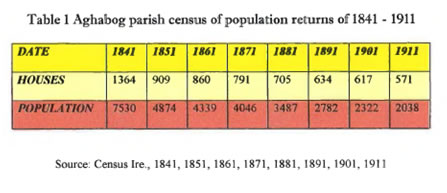
Table 1 Aghabog parish census of population returns of 1841 - 1911
DATE 1841 1851 1861 1871 1881 1891 1901 1911
HOUSES 1364 909 860 791 705 634 617 571
POPULATION 7530 4874 4339 4046 3487 2782 2322 2038
Source: Census Ire., 1841, 1851, 1861, 1871, 1881, 1891, 1901, 1911
These figures reflect a very high population prior to the famine being supported in quite an impoverished area of small subsistence level farms. With the onset of famine, those lucky enough to escape death or the dreaded workhouse fled the country for Scotland, England, north American cities or Australia. These emigrants swelled the ranks of societies like the A.O.H. or the I.R.B. in their new surroundings. The Griffith valuation 1858 illustrates the economic impoverishment of the parish with the majority of farms being returned as in the three to five acre bracket, the tenants burdened by high rents and land ownership overwhelmingly in Protestant hands.<50) As a parish it was a fertile ground for secret societies and political organisations which aimed to protect the oppressed and disgruntled. Through the centuries the United Irishmen, the Ribbonmen and the A.O.H. all recruited Aghabog sons and daughters with ease from the following examples. The Gavan brothers in Latnamard were prominent in the United Irish society 1798.(51) In 1817 Rev. Mr. Wright was reporting on the large number of Catholics in Aghabog ‘engaged in the association of Ribbonmen’.<52) The A.O.H. formed a Ladies Auxiliary division in Aghabog in 1918.(53)
The development of the A O H. in County Monaghan is mirrored by similar growth in Aghabog parish. The A.O.H. division which was numbered 226 was one of the original three divisions mentioned as taking part with its band and banner in the Emmet centenary demonstration at Clones on 15 August 1903. The report of the time records that there were ‘8,000 present with 48 bands addressed by two members of the parliamentary party, John P. Farrell M.P., west Cavan and Denis Kilbride M.P., north Kildare, both making ‘moderate speeches’. The Aghabog Hibernians who paraded at Clones were ‘wearing the regalia of the Order on the occasion of the commemoration of Robert Emmet’s martyrdom’, accompanied by the parish’s United Irish League branch/54' Aghabog a completely rural parish of small farms and was indeed fertile recruiting area for the Order among its numerous Catholic population. The Aghabog division was prominent at each nationalist commemoration or A.O.H. demonstration on 15 August, parading from the parish to the chosen venue for the event. The Aghabog A.O.H. delegates always played a prominent part in the affairs of the Order at county level as at Ballybay on ‘6 January 1905 Brothers Nolan and Fitch proposed that all divisions be affiliated to the Board of Erin’/ 55' Brother John Nolan of Corranewey and Brother Patrick Fitzpatrick, (Fitch), of Latnamard were prominent A.O.H. members and represented Aghabog at A.O.H. county level.
They were anxious to have all A.O.H. divisions affiliated to the governing body of the A.O.H. called the Board of Erin. This body effectively controlled the Hibernian movement. It was made up of delegates from each county board with a
Plat (t 1)
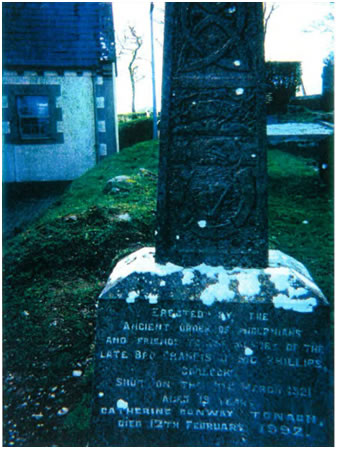
A.O.H. memorial at St. Mary’s Church, Aghabog to Brother Francis McPhillips shot on the 9 March 1921, unveiled September 1933. Photograph taken by author on 29 July 1998. twelve member executive comprising national president, national secretary, national chaplain and trustees representing all sections of the Order.(56) Aghabog A.O.H. were anxious to spread the Order in County Monaghan and ensure it was under Board of Erin control. Again on 17 December 1906 both John Nolan and Patrick Fitzpatrick are prominent at the re-organisation of the Monaghan county board of the A.O.H.(57) As will be seen in chapter one they were very involved in the 1907 north Monaghan election debacle which resulted in a climb down for the Order.(58) Hibemianism grew stronger in Aghabog and to such an extent that another division 2144 appeared by 1917 and adding to that strength, the women organised a branch of the Ladies Auxiliary in 1918.(59) That same year Aghabog was described as a ‘stronghold of Hibernianism’ by its division president, John J. Turley, a journalist, who unsuccessfully stood as the parliamentary candidate in the fateful 1918 election.(60) The Hibernians in
Aghabog were undaunted and celebrated in 1919 the unfurling of their new banner dedicated to John Redmond.(61) However two years later disaster struck the Aghabog A.O.H. in 1921 with the murder of one of its ordinary members, Francis McPhillips on 9 March 1921.(62) This resulted in a period of intimidation, fear, bitterness and a very low profile being kept by the organisation. However by 1926 they felt confident enough again to celebrate the opening of their new hall.(63) Finally by 1933 as this study ends, they had commemorated their murdered member in style by unveiling a memorial to his memory with a massive A.O.H. demonstration, Hibernians coming from as far away as Antrim.(64) However apart from holding their traditional parades the Order was in terminal decline from as early as 1928.(65) Thus the rise, expansion and decline of the Hibernians in County Monaghan and particularly Aghabog over the period 1900 - 33 forms the central focus of this thesis.
It is important to understand that as a secret organisation a certain cloud of mystery hangs over the inner workings of the A.O.H. in all areas with few or no written records generated by the Order itself either being available or forthcoming. Aghabog’s divisions were no way exceptional in this regard. The air of mystery, exclusion and a hint of threat, either real or imaginary, could easily colour an outsider’s perception of Hibemianism. The Ancient Order of Hibernians was in reality quite a modem organisation despite the claims of such authors as Thomas McGrath, John O’Dea and James J. Bergin. They claimed in varying degrees that it had its origins in the Defenders and Ribbonmen which were earlier Catholic defence associations of a secret oath-bound nature. T. McGrath in his search for a date of origin went back to 1565 when he stated that there was a body working on behalf of Irish Catholics.(66) However, J. J. Bergin in the official history of the A.O.H., dismissed this saying ‘there is insufficient material available to support this date as entirely accurate’.(67) His claims for the origins of the A.O.H. were no more accurate. He placed it with Rory O’More who held out against the Cromwellians until 1652 when he vanished at Innisbofin leaving behind a group which Bergin called ‘Defenders’.(68)
According to Marianne Elliott, the Catholic secret society, the Defenders had originated in Armagh in the mid 1870s ‘to defend Catholics from militant Protestant groups like the Nappach Fleet and the Peep O’Day Boys’.(69) The Defenders recruited their membership not from rural areas but a “growing artisan class in towns such as weavers, labourers and tenant farmers involved in domestic industry”.(70) Elliott contends that it was the Defenders and their offspring the Ribbonmen who sustained the notion of foreign assisted revolution from the United Irishmen to Fenianism’.(71) Thus from this group the Ribbonmen emerged in the 1820s and both Bergin and O’Dea identify them as the source from which the A.O.H. itself sprung.(72) However the Ribbonmen were only one of a multitude of secret societies operating in Ireland about this time.(73)
The A.O.H. was quite satisfied to trace itself to mid-nineteenth century America where the name A.O.H. emerged in 1838.(74) As already mentioned it was a sort of Irish Catholic freemasonry which appealed equally to immigrants in America and Catholics in Ulster as a counter to the Orange Order.(75) What is clear is that the Order was active in the U.S.A. and Ireland by 1884 and that by 1900 there were 100,000 members in America and it claimed to be the largest of all Irish societies there with strong growth also in Australia, Scotland and the north of England.(76) By 1900 the Order in Ireland was involved with the newly re-united Irish parliamentary party under John Redmond.(77) He soon achieved hero status with Hibernians and was the central political figure represented on the Aghabog A.O.H. banner, unfurled in 1919.(78)
The interaction between the Hibernians and the comparatively new nationalist organisation, the United Irish League, (founded in County Mayo, 1898), was very important.(79) It will be examined in detail in chapter one during the controversial nominations for the vacant parliamentary seat in north Monaghan in 1907.(80) The A.O.H. was fully involved in the vanguard of the parliamentary party’s efforts to secure home rule. Their sense of achievement on the passage of home rule in 1914 was almost palpable with headlines like ‘home rule in sight’,(81) It was all dashed away from them when World War I intervened and a suspensory bill prevented it from coming into operation.(82) The hype with which Redmond had invested the passing ofthe home rule bill was totally undermined, as dismayed Hibernians saw it postponed. As a result, subtle changes were coming in people’s political attitudes which would soon herald a decrease in the Order’s influence in gaining adherents. In the A.0 H. stronghold of Aghabog, the Order was undaunted by these changes on the national scene. It still gave its unswerving support to the parliamentary party by leading the 15 August parade in 1917 at Ballybay.(83) When the war ended in 1918 and the general election was declared, Aghabog’s A.O.H. division president John J. Turley was the party’s unsuccessful candidate for north Monaghan in that fateful election.(84) This brought a land slide for Sinn Fein both locally and nationally.(85) The Hibernians had to re-think their strategy after the 1918 election. They despised the Sinn Fein movement as evident from John J. Turley’s speech in 1919.(86) As we’ve seen Aghabog was always being lauded as a bastion of Hibernianism.(87) Confrontation between the members of the Order and followers of Sinn Fein, the I.R.B. and the Volunteers over the ‘national question’ took a decidedly violent turn.(88) The attacks on A.O.H. members homes, property, halls, bands, musical instruments, banners and eventually members were to lead to three Hibernian deaths in County Monaghan, Aghabog being the scene of one of these murders.(89) This resulted in great division in the parish with attendant bitterness and sorrow. Outward displays of Hibemianism ceased from late 1920 until almost 1926 when Aghabog’s new A.O.H. hall was opened, ushering in an era when the Order attempted a revival.(90)
Even with new political organisations like Fianna Fail and Cumann na nGaedheal in a newly partitioned state, the Hibernians still believed in Redmondism namely of having a parliament for the whole island within the empire. The Order was strengthened by the crowds which flocked to the unveiling of memorials to their threemurdered colleagues.(91) Once again in the late 1920s it found itself opposing an IR. A. now more socialist in direction thus giving the A.O.H. further concern at the possible spread of communism in Ireland and in continental Europe, especially Spain.(92) Despite a seeming renaissance in Hibernianism in both Aghabog and County Monaghan during the late 1920s it turned out to be but a flickering flame that had almost extinguished itself by the end of the next decade.(93)
In dealing with sources for this subject, the main primary sources used in the text are the constabulary reports. The research in this area covered reports from the R.I.C. Divisional Commissioners, County Inspectors, District Inspectors Crime Special, Crime Branch Special, Dublin Metropolitan Crime Branch Special, which were all sent to the Chief Secretary’s Office. These papers, available in the National Archives, are a rich source of information on the growth, state and decline of the A.O.H. Often however, on closer examination it would appear some reports were little more than imaginative composition. They were based on reports obtained from informers and spies and varied in reliability according to the diligence of the R.l.C. county inspectors. Aghabog figures very prominently in the 1921 reports.
A second important primary source were the A.O.H. Board of Erin minutes, from 1905 to 1933 which are available on microfilm in the National Archives. They are an excellent source for the many decisions of the central governing body of the A.O.H. They are often telegramatic in content, but deal effectively with policy shifts and trends in an organisation, that had to adjust to the vastly changing political fortunes in Ireland during the relevant twenty eight years. The minutes refer frequently to County Monaghan when dealing with the murder of the A.O.H. members there. However there is only a brief reference to the Aghabog murder maybe because of the allegations concerning spying by the victim Francis McPhillips. Similarly important, were the war of independence papers in the county Museum, Monaghan, compiled by the late Monsignor Laurence Marron. These contain statements from old l.R.A. members made in the 1960s many years after the events to which they relate. They convey Sinn Fein views on constitutional nationalism and particularly the role of the A.O.H. from 1916 onwards. They highlight the tensions between the two groups, at a time of great national upheaval from 1920 onwards. These papers are an excellent source on the Aghabog’s A.O.H. member’s tragic death.
The following newspapers were also an important primary source used in the text. The Hibernian Journal, a monthly paper for the A.O.H. which commenced publication in January 1907. It explained the Order’s policy, details on senior officials who were also usually prominent in the parliamentary party, activities of divisions like demonstrations or social events, advertisements for banners, musical instruments and nationalist or religious publications. It was a strong source of support for the Order. The Northern Standard. 1900 - This weekly newspaper covering the entire county was published in Monaghan town and covered mostly unionist political events. Consequently up to 1921, it hardly ever reported on any A.O.H. or nationalist activities.
The Dundalk Democrat. 1900 - This weekly nationalist paper published in Dundalk served south Monaghan and was very supportive of the parliamentary party and reported regularly on all A.O.H. activities.
The Monaghan People. 1906 - 1908, - This short lived nationalist newspaper, published in Monaghan town is an excellent source o f information on the newly reorganised A.O.H. from 1905 onwards.
The People’s Advocate. 1876 - 1906, - which was published in Monaghan town by Daniel McAleese, M.P. was a nationalist paper providing information on the A.O.H. from 1902 until it ceased publication in 1906.
Plate. 1
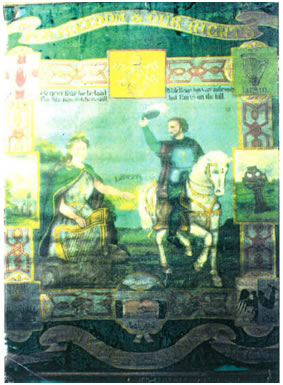
Reverse side o f A.O.H. banner for Latton, County Monaghan, depicting the maid o f Erin as Liberty and A.O.H. hero Rory O’More. Photograph by courtesy o f Seamus O’Draoda, Shantonagh, County Monaaghan, 15 May 1999
The Anglo-Celt. 1900, - This nationalist newspaper, published in Cavan town, covered the A.O.H. in its regular weekly reports in the north Monaghan area and is an excellent source for the Order in Aghabog and surrounding parishes. To fill out these written sources the author conducted a series o f interviews with people in Aghabog and other parts o f County Monaghan who had recollections on the A.O.H. and its activities. Some o f those interviewed were relatives or neighbours o f murdered A.O.H. members while others were Sinn Fein supporters and were opposed to the Order and what it stood for.
Iconography was also an important source. This consists o f a series o f photographs o f banners, memorials and sites associated with A.O.H. events particularly in Aghabog. The banners illustrate through the mixture o f political and religious events depicted, the religious nature o f the Order through the years. The memorials however, convey the sense o f outrage felt by Order at the violence visited on its members and the neglected hall site is testimony to the total decline o f Hibemianism in the Aghabog o f today. A range o f secondary sources exist for this subject, official histories o f the period produced by the A.O.H like T. F. McGrath, (Cleveland, 1898). J. J. Bergin, (Dublin, 1910), J. O’Dea, (Philadelphia, 1923), are concerned with events in America, Dublin or London and the group o f dominant personalities at the head o f the organisation.(94) Works produced in the U.S.A. usually dealt with the Order in Ireland, only when its business, activities or disagreements intruded on that o f the American Order. At home in Ireland J.J. Bergin, himself prominent in the Order, was mandated to write an official history in 1910 which is in fact a defence o f the Board o f Erin. It is inadequately sourced, propagandist in tone and skates over important issues. Thomas McGrath writing on the A.O.H in 1898 is weak on sources, using conjecture in placing the origins o f the Order in 1565. He covers the first split in the A.O.H. o f 1884 in a very detailed fashion, giving a refreshing account o f the efforts in 1898 by Bishop McFaul towards unity. John O’Dea’s three volumes is an extremely rambling but reasonably dispassionate account o f the Hibernians in America. There are other American authors namely, T. J. Shahan, G. Reilly, J. T. Ridge and P. G. Dowd, who have written on the A.O.H. chiefly from the American stand point and are o f little use as a source for Ireland.(95) Among other authors, A.C. Hepburn’s work, deals with the Order’s activities in Irish politics, particularly between 1905 and 1914.(96) The unpublished work o f M. T. Foy deals extensively with the evolution o f the Order from earlier Catholic defence societies and particularly the expansion brought on by the energy and drive o f the Belfast M. P. Joseph Devlin.(97) However he doesn’t deal in any detail with the increasing internecine strife between the republicans and the Order in 1921 and ends precipitately by telescoping together the events surrounding partition to the outbreak o f communal violence in 1968.
Other general sources consulted on the period included F. S. L. Lyons who was excellent on the moves to re-unite the parliamentary and the tensions and friction between the various factions after the Pamellite split.(98) William O’Brien’s numerous allegations about the A.O.H. trying to dominate the United Irish League are dealt with in his two books from 1910 and 1923.(99) David Miller in 1973 gives a more balanced view o f the interaction between the Order and the United Irish League.(100) He also highlights the great difficulty in relations between the A.O.H. and the Catholic Church whether the ban on the Order was in place or removed. As a type o f Catholic freemasonry, the A.O.H. was portrayed in unionist circles by Lord Ashtown in a most sinister light as part o f the Protestant propaganda war over home rule prior to 1914.(101) Paul Bew in 1994, in a more modern work, explores the role o f the A.O.H. in the Castledawson incident which set off the shipyard riots in Belfast, as a case against granting home rule confirming the worst fears o f Protestants.(102) Eamon Phoenix in exploring northern nationalism for the years 1890 - 1940 is an excellent source on the rise o f Joseph Devlin, M.P., his years as A.O.H. national president, the difficult years for the A.O.H. and the parliamentary party after the debacle o f the 1918 election and the subsequent republican onslaught and makes a reference to the A.O.H. member murdered in Aghabog.(103) He deals extensively with attempts by nationalism o f all hues to face the reality o f partition. He explores the subsequent re-adjustments which should have been made but were frustrated by division in the nationalist ranks between the traditional wings o f constitutionalism and physical force. In dealing with the belief that the A.O.H. evolved from earlier Catholic secret societies like the Defenders, Marianne Elliott in 1982 highlighted the anticipation o f revenge against Protestantism as one o f the main elements in Defender thinking.(104) The A.O.H.’s antipathy to the Orange Order led to clashes like the Castledawson incident in 1912, described by Paul Bew, which is dealt with later in the text.(105) Ruth Dudley Edwards in 1999, outlined how the Defenders organised themselves on a lodge or division basis with secret oaths, signs and pass words similar to those in use later by the A. O H. after 1 8 3 8 Edwards while concentrating on the loyal institutions illustrated how the Defenders moved beyond sectarian hate into something like the Catholic nationalism o f the A.O H. As a local secondary source Livingstone’s book, The Monaghan story gives scant coverage to A.O.H. with the exception o f the re-organisation o f the early years immediately after 1905.(107)
The research and most o f the sources for this thesis, relate to County Monaghan and Aghabog parish in particular. It attempts to analyse the activities o f a secret Catholic organisation which has now disappeared from County Monaghan. It is hoped to examine and explain a belief that membership o f the A.O.H. was a badge o f support for the imperial parliament. Catholics had a shared idea o f nationalism, which involved a dislike o f English rule maintained by a group different in race and religion from them, who held the major positions o f power and influence in the country. There was no real class consciousness among the majority o f nationalists as popular nationalism was ‘capable o f drawing strength from social groups with sharply divergent interests and outlooks’,(108) This thesis examines the claims o f the Aghabog nationalists who supported the A. O H. and were equally devoted to the cause o f Ireland as their more revolutionary neighbours. They joined the A.O H many out o f the confining boredom o f rural life, because o f family connections, to finding a vehicle whereby they expressed their support for home rule, and dislike o f the Orange Order in their midst and for the security which Hibemianism offered. Whilst Hibernians honestly believed that the people were wrong to vote as they did in 1918 they were totally bewildered at being labelled as ‘traitors’, the same term used for unionists by Sinn Fein supporters. This thesis illustrates the sense o f anger and dismay at the murders o f A.O.H. members in the county during the War o f Independence. This sense was heightened by the divisions caused by the Anglo-Irish Treaty o f 1921 and civil war in 1922. Aghabog Hibernians firmly held the view that more would have been achieved by Redmond and the parliamentary party without the bloodshed.
This thesis contains three chapters with an introduction and conclusion. In the first chapter the emergence o f the A.O.H. as a support for the re-united home rule party in 1900 is examined. It considers why was Aghabog parish a fertile area for A.O.H. recruitment. It examines the growth o f the Order in the parish. The growth o f the U.I.L. and the confrontation that resulted from the nominations in the 1907 election are also examined. In chapter two a look is taken at Aghabog as a bastion o f Hibemianism and the prominent role played by the division in the 1918 election. The confrontation between Sinn Fein and the A.O.H. leading to violence in County Monaghan in the 1920s is also analysed.
Chapter three examines how the A.O.H., driven almost underground by the violence o f the I.R.A., tried to re-emerge in the latter part o f the 1920s, believing that the republicans had failed to achieve their goal. The A.O.H. honoured its murdered members with memorials, whilst it called for an enquiry into their unnecessary deaths. It attacked the evils o f communism and suffered from decline in support in the early 1930s which is where this thesis ends.
INTRODUCTION - ENDNOTES
1. A. C. Hepburn, The Ancient order o f Hibernians in Irish Politics. 1905 - 1914. (New York, 1971), p. 6
2. James J. Bergin, History o f the Ancient Order of Hibernians.(Dublin, 1910), p. 34
3. Michael T. Foy, ‘The Ancient Order o f Hibernians: An Irish Political - Religious pressure group, 1884 - 1975’, M.A. Thesis, Queens University, (Belfast, 1976), p. 16
4. Eamon Phoenix, Northern nationalism. (Belfast, 1994), p. 4
5. Bergin, History o f the Ancient Order o f Hibernians, p. 2
6. Hepburn, The Ancient Order o f Hibernians in Irish politics. 1905 - 1914, p. 5
7. The Times. 26 December, 1911
8. Belfast Telegraph. 30 July, 1985
9. Ibid.
10. Ibid.
11. R.I.C., C.B.S., I.G.C.I., monthly report, Dec. 1899, N.A., 19926 S
12. Ibid., monthly report Oct. 1899, N.A., 19926 S
13. Northern Standard. 1839 -------
People’s Advocate. 1876 - 1906
14. Anglo-Celt. Saturday 22 August 1903. United Irish League, (U.I.L.), was founded by William O ’Brien, M.P., on 23 January 1898 at Westport, County Mayo. Trade and Labour Associations was organised by William Field, M.P., Limerick junction in November 1894 for those involved in trade union and labour activities. Irish National Foresters, (I.N.F.), was founded in Dublin in 1877 as a benefit society.
15. T. F. McGrath, History o f the Ancient Order o f Hibernians. (Cleveland, 1898), p.
16. Bergin. History o f the Ancient Order o f Hibernians, p.38
17. Bergin, History o f the Ancient Order o f Hibernians, p. 50
18. The People’s Advocate. 28 October, 1905
19. Ibid.
20. R.I.C., C.B.S., I.G.C.I., monthly report Dec. 1905, N. A., Co. 904/83
21. Ibid., Monthly Report Dec. 1906, N.A., Co. 904/82
22. Ibid., Monthly R eport Dec. 1912, N.A., Co. 904/87
23. Ibid., Monthly Report Dec., 1921, N.A., Co. 904/114
24. Foy, ‘Ancient Order o f Hibernians’, p. 94
25. Michael O’Brien, Bawn A.O.H. Division, shot 12 November 1920
Francis McPhillips, Aghabog A.O.H. Division, shot 9 March 1921
Arthur Treanor, Errigal Truagh A.O.H. Division, shot 25 June 1921
26. The Hibernian Journal January, 1919
27. Ibid., November 1933
28. Denis Carolan Rushe. History o f Monaghan for two hundred years. (1660 -
18601. (Dundalk, 1921), p.x - (preface)
29. Patrick Kavanagh, The Complete Poems. (New York, 1972), p. 74
30. The Census o f Ireland for the year 1911, Pt. 1, province o f Ulster Area o f
Population and Housing, pp. 22, 23, 24, 25, 34, 35, vol. iii, [cd. 6051], H.C.
1912- 1913, cxvi,I
31. Denis Carolan Rushe, Letter 21 April 1918 to Sir Shane Leslie in U.S.A. now in
Monaghan County Museum, MS, 19817 H
32. 1911 Census, Province o f Ulster, County Monaghan
33. Ibid.
34. P. Livingstone, The Monaghan story, (Enniskillen, 1980), p. 355
35. Directory o f County Monaghan. 1908, p. 22
36. Census o f Ireland, 1841, Return o f Population in England, Ireland, Scotland,
1841. Abstract o f the number o f persons in Ireland o f each religious persuasion,
H.C. 1834, 1843, (354), 1 1 321
37. P. J. Dufly, Landscapes o f South Ulster. (Belfast, 1993), p. 17
38. David Fitzpatrick, Irish stem family. (Cambridge University Press, 1983), p. 41
39. Livingstone, The Monaghan story, p.404
40. Ibid., p. 376
41. Livingstone, The Monaghan story, p. 363
42. Twenty seven branches o f the United Irish League - recorded for County
Monaghan, 10 August 1904. Minute Book o f the National Directory o f the
United Irish League, 10 August 1904 to 30 April 1918, MS Room, N.L.I., MS 708
43. Livingstone, The Monaghan story, p. 363, ‘Sinn Fein’ clubs formed in County
Monaghan as early as 1908,
44. Dundalk Democrat. 22 June 1918, A.O.H. Demonstration at Aghabog on 16
June 1918, addressed by J. J. Turley, President o f Aghabog 226 Division -
‘Nationalists are right and Sinn Fein is wrong’
45. Sir Tyrone Guthrie, describing his native parish o f Aghabog in a documentary
B B C. 2 programme, ‘One pair o f eyes’, 14 October 1968
46. Samuel Lewis, Lewis’s atlas comprising the counties o f Ireland and a general
map o f the Kingdom. (London, 1837), re-issued, (New York/London, 1970)
47. Dufly, Landscapes o f South Ulster, p.27
48. Samuel Lewis, A topographical dictionary o f Ireland. (London, 1837), i, p. 12
49. 1841 Census, Province o f Ulster, County Monaghan, Civil Parish o f Aghabog
50. Griffith Valuation and Tithe Applotment Books, 1858 - Aghabog Map ref. 12,
pp. 70 - 87, Tab 23/12/66
51. J. E. Rev. McKenna, History of the parishes of Clogher. (Enniskillen, 1920), p. 551
52. S.O.C. County Monaghan, 29 January 1817, N. A., 1831/37
53. Dundalk Democrat. 22 June 1918
54. Anglo-Celt. 22 August 1903
55. Anglo-Celt. 14 January 1905
56. Hibernian Journal July 1909
57. Livingstone, The Monaghan story, p. 361
58. Monaghan People. Thursday 20 June 1907
59. Dundalk Democrat. 22 June 1918
60. Livingstone, The Monaghan Story, p.377. The following was the result o f the 1918 election for the north Monaghan constituency: E. Blythe, Sinn Fein - 6,842, M.E. Knight, Unionist - 4,497, John J. Turley, Nationalist, (President o f Aghabog A.O.H. Division 226) - 2,709.
61. Hibernian Journal. November 1919
62. Northern Standard. 11 March 1921
63. Hibernian Journal. December 1926
64. Ibid., November 1933
65. Ibid., March 1928 in an article headed, ‘Has the necessity for continued activities o f the Order passed away’?
66. Thomas F. McGrath, History o f the Ancient Order o f Hibernians. (Cleveland, Ohio, 1898), p. 14
67. Bergin, History o f the Ancient Order o f Hibernians, p. viii, (preface)
68. Bergin, History o f the Ancient Order o f Hibernians, p. 9
69. Elliott Marianne, Partners in revolution. (New Haven and London, 1982), p. 40
70. Ibid., p. 41
71. Ibid. p. 40
72. John O’Dea, History o f the Ancient Order o f Hibernians and Ladies Auxiliary.
(Philadelphia, 1923), ii, 666
73. Foy, ‘Ancient Order o f Hibernians’, p. 3, listing ‘Rockites, Shanavests, Terry Alts, Whiteboys, Carders, Dowsers, United Sons o f the Shamrock, Peep O ’Day Boys’
74. Bergin, Ancient Order o f Hibernians, p. 34
75. Hepburn, The Ancient Order o f Hibernians in Irish politics. 1905 - 1914. p. 5
76. O’Dea, History o f the Ancient Order o f Hibernians and Ladies Auxiliary, iii, 1279
77. F.S.L. Lyons, The Irish parliamentary party 1890 - 1910. (London, 1951), p. 125
78. Hibernian Journal. November 1919
79. Report on the foundation o f the United Irish League which stated ‘the object o f which, (the League), is to boycott and intimidate the holders o f grazing farms’, R.I.C. C.B.S. I.G.C.I., monthly report Feb. 1898, N.A., 1561 IS
80. Monaghan People. Thursday 20 June 1907
81. Hibernian Journal. September 1914
82. Eamon Phoenix, Northern nationalism 1890 - 1940. (Belfast, 1994), p. 17
83. Hibernian Journal. September 1917
84. Livingstone, The Monaghan story, p. 377
85. Ibid.
86. Hibernian Journal. September 1919, ‘Mr. Griffith knew as much o f when they would get freedom as the stacks o f tu rf in the bog’ - John J. Turley, Aghabog’s A.O.H. Division 226 president, 14 September 1919
87. Dundalk D emocrat. 22 June 1918
88. Hibernian Journal, April 1920
89. R.I.C. C.B.S. I.G.C.I. monthly report March 1921, N.A., Co. 904/114
90. Hibernian Journal. June 1926
91. Northern Standard. Friday 6 October 1933
92. Hibernian Journal November 1933
93. Hibernian Journal. July 1945
94. McGrath. History o f the Ancient Order o f Hibernians. (Cleveland. 18981
Bergin, History o f the Ancient Order o f Hibernians. (Dublin, 1910)
O’Dea, History o f the Ancient Order o f Hibernians and Ladies Auxiliary. (Philadelphia, 1923)
95. Thomas J. Shahan, Ancient Order o f Hibernians. (Chicago, 1960) George R. Reilly, Hibernians on the march. (San Francisco, 1948)
John T. Ridge, Erin’s sons in America: The Ancient Order o f Hibernians. (New York, 1986) Patrick J. Dowd, The Ancient Order o f Hibernians. (Chicago, 1926)
96. A. C. Hepburn, The Ancient Order o f Hibernians in Irish politics. 1905 - 1914
97. Foy, ‘The Ancient Order o f Hibernians’
98. F.S.L. Lyons, Ireland since the famine. (London, 1971)
F.S.L. Lyons, The Irish parliamentary party 1890 - 1910. (London, 1951)
99. William O’Brien, An olive branch in Ireland and its history. (London, 1960)
William O’Brien, The Irish revolution and how it came about. (London, 1923)
100. David W. Miller, Church state and nation in Ireland. (Dublin, 1973)
101. Lord Ashtown, (Fredrick Oliver Trench, 3rd Baron Ashtown), The unknown
power behind the Irish nationalist party. (London, 1907)
102. Paul Bew, Ideology and the Irish question. (Oxford, 1994)
103. Eamon Phoenix, Northern nationalism - nationalist politics, partition and the catholic minority in N orthern Ireland 1890 - 1940. (Belfast, 1994), p. 118
104. Elliott Marianne, Partners in revolution, p. 42
105. Bew, Ideology and the Irish question, p. 56
106. Ruth Dudley Edwards, The faithful tribe. (London, 1999)
107. Livingstone, The Monaghan story
108. David Fitzpatrick. Politics and Irish life 1913 - 1921. (Dublin, 1977), p. 146
CHAPTER I
TH E A.O.H. AND TH E U.I.L. 1900 - 07
Writing the history o f an oath-bound secret society for a defined area and historical period is a most challenging exercise. This is certainly a truism as far as the Ancient Order o f Hibernians is concerned. Today, people living in the Republic o f Ireland know little or nothing about Hibernianism, as I discovered at the start o f my study. In the areas o f Northern Ireland where Order does exist, it is in a far from healthy state. Membership is in decline with 165 divisions and around 20,000 members, including those in Scotland and London.(1) Many o f the members are in the older age groups whilst the majority o f young people who join the movement now, do so to play in bands. The A.O.H. called off their parades between 1969 and 1975 due to the communal disturbances in Northern Ireland.(2) These have since resumed as I witnessed on 15 August 1998 when attending the main A.O.H. ‘Lady Day’ demonstration in Newry, at the invitation o f the A.O.H. national secretary, Dundalkborn, Francis Kieran. The present-day desultory type parade, is but a pale shadow o f a what once great movement had and is more like watching a folk pageant. The Order has become ‘a respectable historical fossil which gives offence to no one’.(3) Across County
Photograph taken by author o f Aghabog A.O.H. hall
Plate,
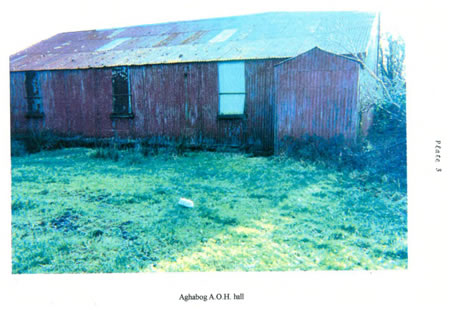
Monaghan a tiny handful of ageing Hibernians nostalgically recall the Order’s better though often difficult days. Similarly in Aghabog parish, the few remaining ‘Hibs’ look despairingly on the only remaining evidence of their proud past, a crumbling galvanised hall now in a sorry state o f neglect. Regardless however of their slightly anachronistic image, present-day Hibernians make no apology for continuing to espouse firmly the principles upon which the movement was founded. As the President of the Newry A.O.H. Tony Carroll stated in his message to all visitors at the 1998 demonstration, ‘we the A.O.H. are proud o f our motto “Friendship, Unity and true Christian Charity” an ideal that does not become out dated but belongs to every a g e \(4) There is great ignorance amongst the public as for what the A.O.H. stands. The Order has been called the ‘green Orangemen’, which may be gently mocking but the term is not inappropriate. Like the Orange Order the A.O.H. is a sectarian movement in the strict sense o f the word as denominationally exclusive. As laid down in their constitution only practising Catholics o f Irish birth or descent are eligible for membership.(5) But what is the history o f the movement and how did it grow and develop throughout County Monaghan and in Aghabog in particular from 1900 to 1933?
The Ancient Order o f Hibernians is quite a modem foundation by historical standards and the ‘ancient’ in its title is subject to interpretation. Tracing the origins of the A.O.H. leads one into controversy straight away. It is heightened by from whichever side o f the Atlantic the subject is viewed. The American versions o f A.O.H. history by authors T. McGrath, J. O’Dea and J. Ridge differ on its origins with J. Bergin’s 1910 official history o f Irish Hibemianism. McGrath places the origin o f the A.O.H. in 1565 when he theorised that there was then an organisation in existence to defend Irish Catholicism.(6) Bergin on the other hand, places the origins o f the Order with Rory, (Roger), O’More, Prince o f Laois/Offaly in 1641 when he organised a rising against the government.(7) Rory O’More had a magical hold on Hibernians in much the same way as William o f Orange had on Orangemen. O’More’s portrait, (see page ), adorned the headquarters o f the newly re-organised A.O.H. in 1905, frequently appearing on A.O.H. banners at parades and in 1906 his name was adopted by the G. A. A. club in Aghabog.(8) Charles Gavan Duffy w hose mother Ann Gavan came from Aghabog captured some o f the magic associated with O’More in his poetry ‘No! we’ll strike for our God and for Rory 0 ’More’.(9) Bergin placed the Order as having its roots in penal times when Catholic peasants banded together to defend their priests who risked death by celebrating Mass.(10)
These A.O.H. reference to ‘defenders’ was premature as a new defensive group called ‘Defenders’ only emerged in 1785.(11) They were regularly involved in clashes with Protestant secret societies such as the ‘Hearts o f Steel’, ‘Peep O’Day Boys’ and (exclusive to County Monaghan), the ‘Ashfield Association’.(12) While it is important to recognise that the Defenders relied on the artisan class in towns for most o f its support, it also attracted weavers, labourers and tenant farmers into its ranks.(13)
In the winter o f 1792 - 1793 a Defender ‘war’ raged in Counties Down, Cavan, Meath, Kildare, Dublin and Monaghan.(14) During this ‘war’ in County Monaghan quite a number o f them were killed by the army.(15) The clash in 1795 between the Defenders and the ‘Peep O’Day Boys’ at the Diamond in County Armagh gave birth to the Orange Order.(16) The Defenders wanted, amongst other things, ‘an equal distribution o f property’, ‘the conditions o f Limerick’ and to ‘destroy the Protestant religion’.(17)
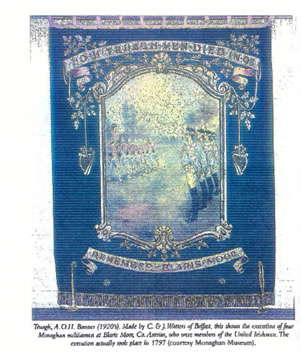
The Defenders constructed a network ‘o f lodges whose members used oaths, signs and passwords’.(18) In the 1790s the Defenders became involved with the United Irishmen even though leaders like Wolfe Tone, Samuel Neilson and John Keogh were wary o f their violent tactics at the start.(19) The United Irish society was immortalised in County Monaghan A.O.H. circles with the famous ‘Blaris Moor’ banner o f the Errigal Truagh division.(20) This commemorated the incident where four Monaghan militia men, William McKenna, Daniel Gillen, Owen McKenna and Peter McCarren were shot at Blaris Moor, County Antrim in 1797, in the hope o f either deterring the others or o f inducing the prisoners to inform’.(21) The disaster o f the 1798 rebellion shattered not only the United Irishmen but also the Defenders.(22)
In the early 1800s there were numerous secret societies operating in Ireland at this time like the Rockites Sharavests, Terry Alts, Whiteboys, Dowsers, Mollie Maguires, Carders.(23) The ‘Mollie Maguires’ was a name derived from a group who defended the widow Maguire in County Antrim in June 1839 when threatened with eviction.(24) It was a name later used not only by secret groups operating in the Pennsylvania coalfields but also given to the A.O.H. in Ireland by people far from enthusiastic about the Order’s activities. Just as the Orange Order emerged from the ‘Peep O’Day Boys’ so did a new grouping the Ribbon Society emerge from the Defenders in the early 1800s. An R.I.C. officer, District/Inspector Schoales reported at Londonderry in 1840 that ‘the popular name o f the confederacy was the Ribbon Society’.(25) Expanding on this theme o f secret societies changing names, Schoales continued that they also called themselves ‘United Sons o f Freedom’, ‘Sons o f the Shamrock’, ‘Knights o f St. Patrick’ so that they could declare on oath if necessary that they never belonged to the Ribbon Association’.(26)
In County Monaghan in 1814 ‘Pat Brady and Pat Kelly o f Comacrieve were transported at the Lent assizes for seven years for being “Riband” men’.(27) In Aghabog the rector, Rev. J. Wright wrote on 29 January 1817 that ‘steps should be taken regarding the growth o f societies o f Ribbonmen and against persons who had administered oaths to men who had furnished information’.(28) The Ribbonmen o f Monaghan clashed with the Orangemen at Ballybay in October 1828,(29) The years from 1830 saw several trials o f members o f the Ribbon Society in County Monaghan ending in 1855 with a split jury to ‘end the long sets o f trials o f Ribbonmen in County Monaghan’(30)
The Ribbonmen unlike other revolutionary movements never aimed to overthrow the government, leading the Fenian, John O’Leary, to remark ‘ was easier both in 1848 and in Fenian times to make a rebel o f an Orangeman than o f a Ribbonman’(31) Churchmen led by Bishop Doyle o f Kildare and Leighlin, campaigned against Ribbonism, Doyle saying in a pastoral letter ‘these associations are opposed to all your interests both temporal and eternal’.(32) As seen from the introduction, these ecclesiastical strictures on secret societies were backed by Pope Leo XII’s decree.(33) In order to circumvent the government ban, the Ribbonmen changed their name to ‘St. Patrick’s Fraternal Society’ in 1825.(34) The Irish emigrants in English and Scottish cities changed from Ribbonmen to ‘Hibernia Society and Hibernia Sick and Funeral Society’,(35) The St. Patrick’s Fraternal Society issued a set o f six rules, an oath and also incorporated into the organisation the motto o f ‘Friendship, Unity and True Christian Charity’ later adopted by the A.O.H.(36) The name o f the society never became popular as government newspapers reports still referred to them as ‘Ribbonmen’ as late as the 1860s.(37)
More significantly in 1836, emigrants in New York wrote back to Ireland for permission to organise a branch o f the St. Patrick’s Fraternal Society in America.(38) On 4 May 1836 the reply was ‘Brothers, greetings. Be it known to you and to all it may concern, that we send to our few brothers in New York full instructions with our authority to establish branches o f our society in America’ and the Monaghan signatory was Patrick McKenna.<39) The controversy within Hibernianism which later developed concerning whether the American body was subservient to the Irish one, dates from this time. Hepburn held the view that ‘the American Order is therefore the real Hibernian parent organisation and its power and wealth are the background against which much Hibernian activity must be seen.’(40) On the other hand the official view o f the Order in Ireland was that ‘the Ribbonmen altered their title to that o f the St. Patrick’s Fraternal Society and that body gave the authority to America to start divisions, (lodges), in that country so it can hardly be contended that our claim is any thing but bona fide as far as title is concerned’.(41) Curiously enough however, it was in America and not in Ireland, that in 1838, the title Ancient Order o f Hibernians was born.(42)
The Order grew quickly in America, ‘how well the twig from the parent tree flourished’.(43) Branches, lodges or ‘divisions’ sprung up in New York, Pennsylvania, Ohio, Illinois and ‘all the states in the Union, so that by 1883 the A.O.H. had a membership o f nearly 60,000 with over a million dollars in its treasuries to succour its members in sickness and to aid widows and orphans’.(44) In Ireland however, the earliest police reports on the A.O.H. in the 1880s speak o f it as the ‘Ancient Order of Hibernians or Ribbon Society’.<45) Obviously old names took a long time to disappear but the name A.O.H. was subsequently adopted on both sides o f the Atlantic.
By 1872 the government were less afraid o f Ribbonism and had come to regard it as the Catholic equivalent o f the Orange Order. The repeal o f the party processions act o f 1872 gave the Catholics o f Ulster an opportunity to parade, which they did on Lady Day, (15 August), 1872 wearing green sashes, carrying banners portraying heroes including Rory O’More and Patrick Sarsfield with slogans proclaiming ‘remember Limerick’.(46) In Monaghan ten thousand Ribbonmen paraded with drums borrowed from local Orangemen who later entertained them at the end o f their parade.(47) This peaceful intermingling o f the two bodies was in stark contrast to the severe rioting in Lisburn and Portadown after a similar parade on that date, to Hannahstown near Belfast .(48)
Despite that outbreak o f rioting in 1872, the A.O.H. was a tame organisation despite Michael Davitt’s view was that it ‘was perhaps the most powerful pro-celtic organisation in the world’.(49) The Order was leaving land agitation to the land league, and the violence previously associated with Ribbonism was anathema to Parnell and the home rule movement. Instead the A. O H. now routinely held lodge or division meetings, held parades especially on St. Patrick’s Day or Lady Day, collected levies and on occasions clashed with Orangemen during the marching season. The Order with its secret oaths, pass words, secret marks, (‘goods and merchandise’) and initiation rites was still very much a secret society. As has been mentioned earlier, the Catholic Church imposed a ban on all secret societies. The A.O.H. was a secret society and had inherited this ban from its parent organisation the Ribbonmen. As a Catholic organisation, it always tried to gain ecclesiastical approval and sought the services o f churchmen to arbitrate in its disputes.(50)
According to R..I.C. returns in 1894 there were a total o f 3794 A.O.H. members in 118 lodges or ‘divisions’.(51) This was an Ulster phenomenon with the greatest support in Counties Tyrone, Donegal and Belfast city.(52) In 1896 there were four A.O.H. lodges or ‘divisions’ in County Monaghan with a membership o f ninety.(53) In the urban areas o f Ulster where the A.O.H. was now expanding, the Catholic clergy had a lot less influence than their rural counterparts. The A.O.H. faced up to the evils o f bigotry particularly evident in Ulster, fighting for Catholics deprived o f employment and proper housing as shown by the Belfast corporation, ‘employing nine Catholics out o f a total o f 437 employees’.(54) The Order could thus claim to be a Catholic organisation standing up for the rights o f Catholics. As such the Order felt it should have the full backing o f the Church. The A.O.H. had submitted its rules in 1902 to the Irish hierarchy and it was not until 1904 that their ban on the A.O.H. was finally lifted and it became a ‘tolerated’ society.(55) Despite the warnings from the Church the A.O.H. could operate outside their control as on 15 August 1899 five thousand A.O.H. members assembled at Moy, County Tyrone ‘in defiance o f the influence o f the priests’.(56) The Order boasted in 1909 that their members were good Catholics but Cardinal Michael Logue commented that ‘they boycotted, threatened, waylaid and beat their neighbours for the honour o f religion’.(57) The clergy did not take kindly to the A.O.H.’s description o f themselves as ‘good’ Catholics because the Order was fast becoming an institution clearly labelled ‘Catholic’ in everyone’s mind but was effectively outside clerical control. Thus the A.O.H. was a dangerous body to most o f the hierarchy as it was an organisation which had sought their approval but could operate successfully without it.
The A.O.H. as a secret society, as we’ve already seen, was determined to keep out informers, spies and the police, allegedly ‘no policeman, police pensioner or any other man connected with English rule could be a member o f the A.O.H.,(58) The Order kept the mysterious passwords, signs and secret marks o f Ribbonism which it called ‘goods or merchandise’.(59) These ‘goods or merchandise’ were a series o f passwords like ‘the night is sharp, it is time to expect it’, signs like ‘rubbing right eyebrow or the left hand in the left pocket o f a vest’ and marks like ‘a pin head in the head o f travelling cards’.(60) These were an essential part o f Hibemianism renewed every three months by ‘county delegates’ and sent from Ireland to America which caused many difficulties especially when the Order suffered from splits over membership from 1884 onwards.(61) The secrecy o f Ribbonism transferred to the A.O.H. but in the 1820s Ribbon membership could mean death whilst A.O.H. membership in 1890s wouldn’t even merit an arrest. Despite the ban on the R.I.C. as members, the police, through informers, spies and the interception o f mail, kept a close watch on their activities. In August 1899 the report for County Monaghan was ‘the A.O.H. o f which there are three branches in this county has been inactive during the month’.(62)
The A.O.H. grew more rapidly in America than in Ireland towards the end o f the nineteenth century where new members were more easily recruited from the teeming masses o f Irish emigrants, fleeing economic depression. The Order in 1876 was soon to have a problem over the rise o f a violent organisation called the ‘Molly Maguires’ which included mostly A.O.H. members. This group took its name from the gathering o f Ribbonmen in County Antrim mentioned earlier in the chapter.(63) The A.O.H. members in the ‘Molly Maguires’ campaigned against the poor working conditions in the Pennsylvania coalfields carrying out acts o f violence and sabotage against the mine owners and mine superintendents. The reign o f terror was defeated when the Pinkerton detective agency were employed and they infiltrated the ‘Molly Mguires’, getting enough information on the leaders which ended with the execution o f some o f them in 1877.(64) A.O.H. members in Pennsylvania were excommunicated by Bishop O’Hara o f Scranton and the A.O.H. New York members disassociated themselves from the ‘Molly Maguire’ influence.(65) Membership o f the A.O.H. both in Ireland and America was confined to those who were born of parents who were both Irish. A significant number o f Irish people in America were now marrying non-Irish people and this posed a problem for the Order.
The Order met in May 1884 in Cleveland, Ohio and by a small majority changed the rule requiring only one Irish parent for A.O.H. member ship.(66) The delegates that were opposed to this change now broke away from the parent body and the A .0 H. split into two sections, A.O.H. Board o f Erin and A.O.H. Board o f America.(67) Thus the Board o f Erin represented those who wished to retain the membership mle o f having both parents Irish, while the Board o f America were in favour o f the 1884 mle change so that people who were Irish by either parent could be admitted to membership. This split was to have repercussions in Ireland.
In Ireland the Board o f Erin, (an executive made up o f delegates from the A.O.H. in Ireland, Scotland and England), was considered to be the supreme authority o f the movement to whom the A.O.H. in America paid the necessary fees and respect. When the split occurred in America both sections sent representatives to Ireland. In Ireland in 1887 the Board o f Erin split into two rival sections over the question o f recognition o f the two warring American sections. This split spearheaded by two rival Belfast A.O.H. members, John Crilly who led those favouring the Board o f America and John Morgan who led the Board o f Erin section.<68) The situation was then reached where there were two A.O.H. sections in Ireland and America. The larger one in America, (A.O.H. Board o f America), was allied to John Crilly’s A.O.H., (Board o f America) and while the smaller A.O.H. Board o f Erin in America was allied to John Morgan’s larger A.O.H. Board o f Erin in Ireland. The A.O.H. was in a period o f deep dissension and great confusion. It is not surprising that the 1890s was a time o f decay, lack o f growth, bickering, losing contact with any central authority - all o f which could be gleaned from the constabulary reports o f the period. Whilst the rancour amongst members o f the Order in Ireland went on unabated, there were conciliatory moves in the U.S.A. with the Right Reverend James A. McFaul, Bishop o f Trenton, as peacemaker.^
On 11 December 1897 he gave his famous judgement allowing the 1884 decision at Cleveland to stand and the freedom for a nationally elected president o f the A.O.H. in the U.S.A. to make ‘the goods’ until ‘a member o f the Irish hierarchy has certified that the united body is in harmony with the teachings o f the Catholic church’.(70) This event didn’t go unnoticed in Ireland where John Dillon, M.P., sent a congratulatory telegram even though delegates heard that ‘at this time both the Hibernians in Ireland and the parliamentary party were divided’.(71) Bishop McFaul sent a message to the Hibernians in Ireland, Scotland and England in his arbitration decision ‘to communicate with the new chief executive officers o f the European branches o f the Order and advise them to unite by some such feasible means as you
P l a te 5
have selected’.(72) It was not until much later in 1905 as we see below that the A.O.H. overcame its disunity and became both acceptable and respectable.
As this study o f the Hibernians commences in 1900, the Order was in deadlock because o f the upheavals from the split o f 1887 over membership. Just as in America where Bishop McFaul helped with unity, so in Ireland a priest called Fr. John J. McKinley C.C. o f Castlewellan, County Down, was the prime mover towards reconciliation.(73) In March 1902 John Morgan was replaced on the Board o f Erin by James McGough o f the Clones A.O.H., County Monaghan.(74) The Hibernians reunited as the Ancient Order o f Hibernians, Board o f Erin, (A.O.H.B.O.E.) and they stated ‘we submit our constitution to ecclesiastical authority’.(75) This re-union was mentioned in an R.I.C. report on the nationalist demonstration o f 17 March 1902 in Armagh, ‘the two sections have amalgamated and were joined by the majority o f the United Irish League in the neighbourhood’.(76)
The A.O.H. revival was marked in 1902 with Lady Day parades taking place at Bellaghy, Keady and Lurgan while the one at Moneymore was banned because o f a threat from local Orangemen.(77) Elsewhere the A.O.H. celebrated with processions, flags flying from houses along routes, triumphal green arches across streets proclaiming the A.O.H. motto. Many o f the lodges or divisions were accompanied by flute, brass or accordion bands with banners bearing images o f the old Irish parliament building, Irish heroes including Sarsfield, Rory O’More, a female Erin with a harp, religious scenes o f a priest at a Mass rock with defenders or religious figures like St. Patrick or St. Brighid.(78) In the introduction we have seen that Aghabog A.O.H. paraded on 15 August 1903 at Clones, having previously been in Monaghan at a similar Emmet commemoration on 29 June 1903 in Monaghan town.(79)
The nationalists were developing their own form o f green pageantry with parades to rival the July Orange marches. The nationalist marching family was usually composed not only o f the A.O.H. and the U.I.L., which was founded by William O’Brien, M.P., at Westport in January 1898, it also included the Irish National Foresters which was founded in Dublin in 1877 as a benefit society for nationalists and trade and labour associations first organised by William Field, M.P. from a meeting in Limerick Junction in November 1894. The latter were closely associated with workers demands, for better conditions. The U.I.L. as we will see below called for the redistribution o f large estates among small farmers attacked land-grabbers and called for unity in the parliamentary party. These organisations were the mainstay o f County Monaghan’s big nationalist demonstration on 15 August 1905 when 20,000 assembled at Corbrack, Ballybay, in a field loaned by a Protestant home ruler, Alex Wilson.(80) Speeches by parliamentarians, A.O.H. officers or clergy, (this happened after the church ban was removed in 1904), were followed by resolutions o f support for parliamentary party, the pope, Ireland as a nation and the Gaelic League. As the A.O.H. divisions paraded with bands and regalia to their home bases after such demonstrations they acted as excellent recruiting agents for new membership.
When discussing the rapid growth o f the A.O.H. where membership increased from 13,000 in 1905 to 125,000 in 1915, a brief look is needed at Joseph Devlin, M.P. and his role in the U.I.L. and the re-united parliamentary party.(81) In 1895 William O’Brien, one o f Parnell’s closest allies, disenchanted with the continued bickering o f home rule politicians, retired to County Mayo. Struck by the disparity in fortunes between the large grazier and the landless labourer and the inertia o f the congested Districts Boards, he established the United Irish League at Westport on 23 January 1898.(82) The aim was to force the graziers to part with land using tactics not unlike those o f the Land League which quickly brought the U.I.L. under police notice but the organisation grew very rapidly. The U.I.L. had as its second objective, the re-uniting o f the parliamentary party. This happened in February 1900 with John Redmond as leader, who then assumed the presidency o f the U.I.L. which became the party’s new constituency organisation based on the parish as the fundamental unit.(83) It had an infrastructure o f provincial, national governing bodies overseen by a standing committee which held conventions with very wide ranging categories, (including six delegates from the A.O.H.), entitled to send delegates.(84) By 1904 the U.I.L. and A.O.H. were seen as allies; as the R.I.C. report said ‘the A.O.H. is in close alliance with the U.I.L.,(85) The U.I.L. was spreading rapidly, gaining the support o f the clergy ‘to hunt the grabbers and Scotch graziers out o f the country’.(86) However there was also clerical opposition, as in the eight communities outside the Westport - Newport area.(87) It was not the zeal o f William O’Brien its founder, that catapulted the U.I.L. to prominence, but the organisational skill o f one who was later to be his deadly enemy, namely Joseph Devlin, M.P., (nicknamed ‘Wee Joe’).
P i a t i 6
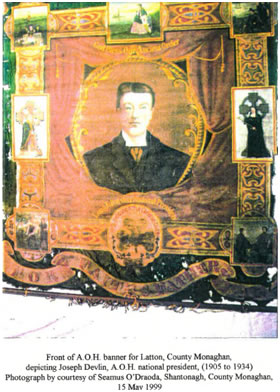
Devlin came from a humble Belfast background where he started life as a bottle-washer in a licensed premises.(88) He worked his way quickly into politics, through journalism on the Irish News, joining the A.O.H. on the Falls Road, Belfast in 1893. He viewed the A.O.H. as a threat to the U.I.L. at first. However, when organising the U.I.L. in Ulster in 1900, he saw the Order as a valuable ally only if he could control it. After being elected M.P. for Kilkenny in 1902 he undertook fundraising tours for the parliamentary party to Australia and the U.S.A. from 1902 -1903.(89) At an A.O.H. Board o f Erin meeting in Clones, 4 May 1903, letters were sent by it to Bishop McFaul recommending Devlin’s American fund-raising mission.(90) In 1903 O’Brien fell out with the U.I.L. over the Wyndham land act, and Devlin became U.I.L. secretary for Great Britain/91^ As an effective M.P., excellent organiser and parliamentary speaker he had seen the great potential o f the A.O.H. during his 1903 American tour. In 1904 he dominated the A.O.H. discussions on registration o f the A.O.H. under the Friendly Societies Act.(92) The Board o f Erin postponed a decision: as the R.I.C. noted in December 1904 ‘the organisation will be divided on the question o f registration as a benefit society’,(93) As a number o f Scottish divisions left to set up ‘The Ancient Order o f Hibernians Friendly Society’ the police reported ‘adherents o f registration had a convention in Glasgow, at this meeting it was decided that all connections with the old governing body o f the Board o f Erin should be severed’.(94)
Joseph Devlin was on the verge o f capturing control o f the A.O.H. However he needed clerical help, while in October 1904 the police reported on the A.O.H., ‘it is as a rule condemned by the Roman Catholic clergymen as a secret society’/ 95' Devlin needed an intermediary like the American Bishop McFaul. Through Bishop Patrick O’Donnell o f Raphoe who, as a Donegal man himself, a great admirer o f the A.O.H., Devlin got the hierarchy at Maynooth in 1904 to lift their ban on the Order as a secret society/ ' Another Donegal cleric, Fr. James Cannon, was not only thecounty chaplain o f the A.O.H. in Donegal but was also a representative on the United Irish League Directory/97' As 1905 began the R.I.C. reported that the A.O.H. ‘was in a state o f transition and great moves were being made to have an increase in affiliation’, (to the Board o f Erin )/98'
At a meeting o f the Monaghan A.O.H. County Board on Friday 6 January 1905 Aghabog A.O.H. division 226 took a prominent part with ‘Brother Fitch o f Aghabog who proposed that every division is to be affiliated and Brother Nolan seconded’/ 99' Right throughout 1905 in County Monaghan the A.O.H. was growing very steadily with the number o f divisions rising from eight to th irte en /100' A most important event was the national A.O.H. convention held in Dublin in July 1905 at which Joseph Devlin eventually gained control by being elected national president and his friend John D. Nugent as national secretary/101' These two masters o f organisation were to dominate the Order for the next three decades leading it to great prominence and influence but also helping to sow the seeds o f its own decline. With Devlin and Nugent in power membership rocketed nationally from 10,000 in late 1905 to 60,000 in 1909.(lo2) In County Monaghan the rise was no less spectacular with the number o f divisions rising from eight in 1905 to twenty three in 1909/103'
As we’ve seen the A.O.H. was spreading rapidly in County Monaghan from 1905 onwards. Despite the ban by the Catholic church being lifted, the Order was not universally welcomed in the county by all priests. Canon P. McGlone, P.P., Magheramey warned his parishioners after Mass against ‘a branch o f the A.O.H. which was being established’ Z104' Similarly in August 1906 a report from north Monaghan highlighted ‘difficulties in Donagh parish with the P.P. ‘as the A.O.H. is now established against his will’/ 105' At a higher level in Armagh, the police reported that ‘Cardinal Logue for a considerable time past has been hostile to the A.O.H.’1106' Canon McGlone became dean o f Clogher and in June 1910 he hadn’t softened towards the A.O.H. when he said ‘the Hibernian Society was not at all desirable’/ 107'
This clerical opposition didn’t impede the Order’s growth in County Monaghan as in 1906 divisions at Ematris, Magheramey, (January), Tyholland, Donagh, Ardaghy, (April), Ballybay, (June), Corcaghan and Tullynahinera, (November), were established/108' The procedure for establishment o f an A.O.H. division went according to a set procedure. A group in a parish or district who expressed an interest in Hibemianism called a meeting in any available premises which was addressed by the A.O.H. county organiser. The Anglo Celt o f 14 June 1904 records the establishment o f Bawn A.O.H. division in south Monaghan as follows, ‘Brother H. J. McArdle, Monaghan county president A.O.H. and Brother J. J. Turley organiser attended Bawn on Sunday to open a new division o f the A.O.H. with over 40 members enrolled in the new Bawn
division’/ 1091 The spread o f Hibemianism in County Monaghan was welcomed in the nationalist press whilst the solitary unionist paper ignored it. The nationalists were looking for an end to ‘factionalism’ as the People’s Advocate editorialised on 23 December 1905 ‘our organisations are rent with factionalism, such has not been the case with a new, at least to Monaghan, organisation, we mean the A.O.H.’(l 101 There was a palpable sense o f H ibernian growth in 1905 with Aghabog very committed to the organisation. Their delegates Brother J. Nolan and Brother J.Donahue were to the forefront at the A.O.H. convention in Castleblayney, County Monaghan on 21 October 1905 which was addressed by John D. Nugent national secretary who enthused, ‘the county at large is being awakened and Catholics see no obstacle in joining our organisation’/ 1111 Aghabog Hibernians suffered clerical interference when the curate Father Tom Maguire asked them not to attend the traditional A.O.H. demonstration at Ballybay on 15 August 1905 but to mark with respect the illness o f the Bishop o f Clogher, Dr. Owens’/ 1121 This large demonstration addressed by Bailie John Ferguson a prominent Scottish A.O.H. member set out Hibernian policy and Ferguson reassured the audience ‘the organisation is as constitutional as the U.I.L. its e lf / I13)
As we have seen above, the U.I.L. was now firmly controlled by Joseph Devlin as a vehicle for promoting the aims o f the parliamentary party. The U.I.L. unlike the A.O.H. made no claim to be a Catholic organisation, though as it developed at local level the Catholic parish priest was often one o f its key office holders. By 1906 the U.I.L. entered a new phase in its policy o f agitation with the adoption o f the technique o f cattle driving promoted by Laurence Ginnell, M.P. for Westmeath/114) From 1900 members o f the A.O.H. had been admitted as delegates to U.I.L. conventions and this was to have a strong bearing on relations between the A.O.H. and the U.I.L. in Aghabog in 1907.(115) With Joseph Devlin, M.P., as secretary o f the U.I.L and also national president o f the A.O.H., the ties between these two nationalist organisations seemed strong and interchangeable. However in 1907 A.O.H. national secretary John D. Nugent, issued a letter setting out that ‘we are a separate and distinct national body, we recognise that the U.I.L. was made the national organisation in 1901 to which national bodies which included the A.O.H. were invited’ / 116) His view o f the U.I.L. was that it aimed ‘to forward a brotherhood o f affection a communion o f rights and union o f power among Irishmen’/ 117)
The U.I.L. was introduced to County Monaghan in 1900/u8) We read o f a U.I.L. branch at Ematris, next parish to Aghabog, being formed on 29 January 1901 with ‘J. Nolan in the chair and John McGeough and Harry Hughes to represent the branch at the forthcoming convention in Dublin’/ 119) In August 1902 a County Monaghan U.I.L. convention was held in Ballybay/120) By 15 August 1903 the Aghabog branch o f U.I.L. was parading with the A.O.H. in Clones, the report commenting ‘the Aghabog band and banner was in attendance’/ 121' The report also listed the names o f individuals representing the two organisations in the p a rish /122'
On 10 August 1904 the U.I.L. minute book recorded twenty seven branches in County Monaghan, while Aghabog is returned as having paid £3 registration fe e s /123' Just as Aghabog took up the cause o f Hibemianism with enthusiasm it gave similar strongsupport to the U.I.L. We see the branch under Fr. P. McKean, P.P., prominent at the U.I.L. divisional meeting in the Catholic hall, Monaghan on 24 September 1906, with other Aghabog delegates, J. Mulligan, A. Devlin, F. McPhillips, R.D.C. and P. Fitzpatrick/124' The Aghabog U.I.L. were also very involved in the conventions to choose parliamentary candidates for the north Monaghan parliamentary election o f 1907. It was then that the close relationship between the U.I.L. and A.O.H. was put under severe strain and it will be necessary to consider the parliamentary representation in north Monaghan from 1900 onwards.
As seen in the introduction the nationalists had had an overall majority in the county with the strongest unionist representation being in the north o f the county. It was not possible to elect a unionist without gaining Catholic votes. In the 1895 election Daniel NcAleese, proprietor o f the Peoples’ Advocate, beat the unionist candidate Frederick Rutherford for the north Monaghan se a t/125' McAleese withdrew in 1900 and was replaced by Dr. Edward Thompson, a Tyrone surgeon/126' As an outsider his relationship with the electors was poor, so that as elections approached in 1906, he was fighting a losing battle for re-nomination. The nationalists in north Monaghan turned to Monaghan-bom Bailie Patrick O’Hare, a successful Glasgow businessman, magistrate and a long standing A.O.H. member/127' On 6 January 1906 Aghabog A.O.H. division was represented by Brother Patrick Fitzpatrick at a north Monaghan A.O.H. me eting/128' Speaking o f O’Hare,Fitzpatrick said, ‘Aghabog A.O.H. wholeheartedly support his candidature’/ 129' O’Hare with the full support o f the U.I.L. and the A.O.H. was returned unopposed on 20 January 1906/130' His tenure as M.P. for north Monaghan was short lived. He purchased a premises in the county at Tullygillen, but soon withdrew due to ill h e a lth /131' His departure left the north Monaghan without a candidate for the forthcoming parliamentary election and the moves for nomination began immediately/132'
What would normally have been a fairly straight-forward exercise in finding a new nationalist M.P. turned into a farce and a crisis for the parliamentary party. The nationalists o f north Monaghan at the prompting o f the clergy had been unhappy as we’ve seen with ‘outsiders’ like Dr. Thompson and Bailie O’Hare as their M .P .s/133' A lively contest was looming with the nomination o f a locally educated solicitor, James Carriage Rushe Lardner. As a native o f Monaghan town, this would mean that the seat would be filled by a Monaghan person. He had the backing o f m ost o f the U.I.L. and the local clergy. (Both o f Aghabog’s priests Fr. P. McKean, P.P., and Fr. P. McCusker C.C., were amongst his strongest supporters)/1341 The local U.I.L. and the clergy didn’t realise that Joseph Devlin, M.P. and the parliamentary party had other ideas for north Monaghan. John T. Donovan, a prominent solicitor from Belfast and also an A.O.H. member was put forward by Devlin for nomination/1351 Donovan was described as ‘well known in Belfast as Mr. Devlin’s lieutenant in the fight for west Belfast and as his colleague on his Australian expedition’/ 1361 The convention to select a nationalist candidate took place on Monday 10 June 1907 in the Catholic hall, Monaghan, with two hundred delegates p re sen t/1371 The convention turned into a heated debate bordering on farce with accusations o f vote rigging being made against the A.O.H. (138) The unionist paper, the Northern Standard, o f 15 June 1907, coined such headlines as ‘nationalist split in north Monaghan’ with a report o f ‘Leaguers and Hibernians in opposition’ and ‘The Hibernians new bom branches’(139) This was a reference to the attempts by John Nolan o f Aghabog A.O.H. and A.O.H. members from the Tyholland area to create ‘bogus’ or ‘paper’divisions o f the A.O.H. in support o f Donovan’s nomination. These divisions were called after the townlands o f Drollagh and Tattinclave in Aghabog and Greenan’s Cross from the neighbouring parish o f K illevan/1401 There are no records o f these divisions existing before June 1907 and no record o f their activities after the election was over.
The lively convention ended with John Donovan getting 161 votes and James Lardner 138 votes. A further breakdown gave Lardner a total o f twenty seven clerical votes, while Donovan got a total o f 145 A.O.H. v o te s/141* There were rumours o f a unionist candidate entering the contest and o f the former M.P., Dr. Thompson threatening to re-contest the s e a t/142* There was great excitement at the prospect o f a contest between two nationalist candidates. John Redmond stayed away from the campaign but was left in no doubt about the candidacy o f James Lardner by Bishop Owens o f Clogher who made it plain ‘that no candidate but Mr. Lardner would be acceptable’/ 143'1 The excitement abated when Donovan received a letter from John Redmond on 19 June 1907 praising his great qualities as a parliamentary party supporter but asking him to withdraw as the nationalist candidate in north Monaghan/144* Donovan accepted Redmond’s advice and Lardner was returned unopposed as the M.P. for north Monaghan/145*
The bitterness generated by Donovan’s candidacy was to reverberate for some time afterwards. The A.O.H. were roundly defeated and those who supported Donovan such as John N olan and the A.O.H. o f Aghabog were held up to ridicule. ‘It was the first time he had ever heard Mr. John Nolan o f Aghabog described as a prominent nationalist’, (laughter), Mr. Lardner the successful M.P. said in his victory speech/146* The A.O.H. influence in Aghabog had infiltrated the U.I.L branch with the result that only Tyholland U.I.L. and Aghabog U.I.L. had supported Donovan which caused Mr. James Lardner to ask ‘were they chloroformed’?(147)
John T. Donovan’s candidature was described by the convention chairman, Fr. Keown, P.P., as putting the representation o f the county ‘into the hands o f a clique’ and Donovan’s previous role, in defeating Bishop Henry, Henry’s Belfast Catholic Association in 1905 was referred to as ‘the unholy campaign for years past in his native city’.(148) The problems raised by Donovan were the subject o f letters from nationalists alarmed at the possibility o f a split in the parliamentary party, asking ‘is it part o f the new national policy to oppose candidates selected by the clergy and the U.I.L.’?(I49) But Donovan had the last word in a letter to John Nolan o f the Aghabog A.O.H. where he contended that as a result o f the clergy’s support o f Lardner ‘religion will suffer as a consequence’ and ‘the country now can judge who are the factionalists’ and concludes by decrying the jibe that parliamentary candidates not resident in the locality were ‘an alien importation’.(150)
Mr. Redmond in his letter reassured Donovan that ‘you are a young man, however and will have plenty o f opportunities before you and my experience is that a sacrifice such as I ask you to make is never forgotten by Ireland’.(151) John Redmond was himself given a backhanded compliment in the editorial o f the Monaghan People’s o f 20 June 1907, when it stated ‘Mr. Redmond has acted with the wisdom he has never displayed as leader o f the Irish nation in requesting Mr. Donovan to withdraw’.(152) We have seen how Donovan’s critics were oveijoyed at the exposure and defeat o f the A.O.H. machine but what was in fact defeated in north Monaghan was less the Hibernians themselves than the authority o f the party leadership and the U.I.L. central office. When the parliamentary party’s fortunes picked up again so did those o f the A.O.H. The revision o f the U.I.L. constitution o f 1909 to ensure that the league delegates would always be in the majority was an indication o f how far the A.O.H. had permeated the official movement especially in Ulster.(153)
It could be said that the A.O.H. wasn’t successful at any elections as the R.I.C report o f January 1908 indicated, ‘the three A.O.H. candidates at Clones U.D.C. elections were unsuccessful’.(154) The A.O.H.’s official organ the Hibernian Journal never specifically mentioned the north Monaghan difficulty but it may have prompted the directive on relations between the two bodies from John D. Nugent, national secretary, to all A.O.H. divisions in September 1907 entitled ‘The A.O.H. and the U.I.L.’(155) Similarly the police report o f the north Monaghan election difficulty was terse, referring to the A.O.H.; ‘those in the north division o f the county were active early in the month in support o f Mr. Donovan, a solicitor from Belfast’.(156) The clergy after this nationalist confrontation were very wary o f the A.O.H.; Fr. D. Gormley C.C., Clones, spoke o f these ‘A.O.H. men as the lowest degrees o f civilisation’ .(157)
Finally, James Carriage Rushe Lardner, (he was a nephew o f Denis Carolan Rushe, author), had his triumph, being elected on 20 June 1907 unopposed. He celebrated with ‘the tar barrels lighted up, a large crowd with three bands in Church Square Monaghan being addressed by J.C.R. Lardner’.(158) He was on the platform again at Castleblayney on 15 August 1907 addressing a nationalist rally o f U.I.L. A.O.H. and the I.N.F. In his speech he studiously avoided any mention o f either the recent difficulties over the nominations or the A.O.H. He praised the Gaelic League and outlined the parliamentary party’s opposition to the recent Irish council bill which was defeated/159)
The events in north Monaghan were to prove that relations between the two groups A.O.H. and U.I.L. were not always friendly in spite o f their common allegiance to the party. Redmond, despite the promptings o f D evlin who favoured his protégé Donovan, feared a unionist coup if two nationalists were nominated. In nearby Cavan the U.I.L. insisted on A.O.H. divisions getting written consent o f their parish priests to select parliamentary candidates/160* In Aghabog, Nolan and the A.O.H. were furious for being held up to ridicule by Lardner and his supporters. This attack only strengthened A.O.H. support in Aghabog because it was viewed as an attack by outsiders. Donovan went on to become M.P. in 1910 for west Wicklow and lead the A.O.H. counter-measures against the spread o f Sinn Fein in 1917/161*
ENDNOTES - CHAPTER I
1. Information supplied by Francis Kieman, National Secretary, A.O.H., 79 Willow Grove, Dundalk, Co. Louth in an interview on 8 August 1998
2. Ibid.
3. Belfast Telegraph, 30 July 1985
4. Lennon Gerry, The Defenders and United Irishmen. (Newry, 1998), p.l
5. Carroll T., Constitution o f the A.O.H., (Newry, 1994), p.4
6. McGrath, History o f the Ancient Order o f Hibernians, p. 14
7. Bergin, History o f the Ancient Order o f Hibernians, p. viii
8. People’s Advocate. 4 November 1905
9. Bergin, History o f the Ancient Order o f Hibernians, p. 11
10. Ibid., p. 9
11. J.C. Beckett, The making o f modem Ireland 1603 - 1923, (London, 1966), p. 253
12. Rushe. History o f Monaghan, p. 140
13. Elliott, Partners in revolution, p. 43
14. Ibid.
15. Dublin Chronicle, 3 January 1793
16. O’Dea, Ancient Order o f Hibernians, ii, 253
17. Elliott, Partners in revolution, p. 43
18. Edwards, The faithful tribe, p. 174
19. Elliott, Partners in revolution, p. 44
20. Monaghan County Museum - banner displayed
21. Rushe, History o f Monaghan, p. 150
22. Sunday Independent, 27 Dec. 1998, p. 12 article by (Conor Cruise O’Brien)
23. S.O.C. papers, King’s County, 25 March 1815 - Major Wills, Philipstown, re:
Thomas Moran, James Connor, John Edwards, Owen Murray, ‘Carders sentenced to death, will send John Watson, the prosecutor to Dublin for safety’, N.A., MS 1212/32
24. O’Dea, Ancient Order o f Hibernians, ii, 770
25. Summer Assizes, June 1840, Londonderry, Trial o f William Collins for Ribbonism, N.A., Frazer MSS. No. 43 - 47, p. 129
26. Ibid.
27. Denis Carolan Rushe, Historical sketches o f Monaghan, (Dublin 1895), p. 83
28. S.O.C. papers, 29 Jan.1817, N .A., MS 1831/37
29. S.O.C. papers, 25 Sept. 1828, N .A., MS 28851/1 - 21
30. Rushe, Historical sketches, p. 111
31. John O’Leary, Recollections o f Fenians and Fenianism, (London, 1896), i, iii
32. Lord Ashtown, The unknown power behind the Irish nationalist party, p. 72
33. ‘Quo Graviora’ encyclical o f Leo XII, March 1825
34. Bergin, History o f the Ancient Order o f Hibernians, p. 30
35. Ibid., p. 29
36. Ibid., p. 31
37. O’Dea, History o f the Ancient Order o f Hibernians, ii, 771
38. McGrath, History o f the Ancient Order o f Hibernians, p. 28
39. Ibid., p. 29
40. Hepburn, The Ancient Order o f Hibernians, p. 6
41. Bergin, History o f the Ancient Order o f Hibernians, p. 35
42. O’Dea, History o f the Ancient Order o f Hibernians, ii, 886
43. McGrath, History o f the Ancient Order o f Hibernians, p. 30
44. Ibid., p. 30
45. Foy, ‘Ancient Order o f Hibernians’, p. 11
46. Belfast Newsletter, 19 August 1872
47. Ibid.
48. Ibid.
49. Michael Davitt, The fall o f Irish feudalism, (London, 1904), pp. 42 - 43
50. McGrath. History o f the Ancient Order o f Hibernians, p. 132
51. R.I.C. C.B.S. precis o f information relating to secret societies, 1894 - 1905,
N.A. 18907S
52. Hepburn, The Ancient Order o f Hibernians in Irish politics, p. 7
53. R.I.C. C.B.S. I.G.C.I. monthly report, Mar. 1896, N.A., C.O. 904. 65
54. Hepburn, Ancient Order o f Hibernians, p. 6
55. Foy, ‘ Ancient Order o f Hibernians ’, p . 4 8
56. R.I.C. C.B.S. I.G.C.I. monthly report, Sept. 1899, N.A., C.O. 904 77
57. Irish Independent, 14 May 1909
58. R.I.C. C.B.S. I.G.C.I. monthly report, Dec. 1906, on a speech by Bernard McGriskin, A.O.H. division, Kiltyclogher, County Leitrim, 23 Nov. 1906, N.A., C.O. 904 112
59. O’Dea, History o f the Ancient Order o f Hibernians, iii, 1079
60. Neil Kelly, informer, Summer Assizes, Monaghan, 7 August 1840, N.A., Frazer MSS. No. 43 -4 7 ,2 1 4 651/24
61. McGrath, History o f the Ancient Order o f Hibernians, p. 61
62. R.I.C. C.B.S. I.G.C.I. monthly report for County Monaghan, Aug. 1899, N.A., C.O. 904/117
63. Foy, ‘Ancient Order o f Hibernians’, p. 21
64. McGrath, Ancient Order o f Hibernians, p. 30
65. O’Dea, History o f the Ancient Order o f Hibernians, iii, 1065
66. McGrath, Ancient Order o f Hibernians, p. 38
67. Foy, ‘Ancient Order o f Hibernians’, p. 23
68. McGrath, Ancient Order o f Hibernians, p. 127
69. O’Dea, History o f the Ancient Order o f Hibernians, iii, 1148
70. Ibid., iii, 1173
71. Ibid., iii, 1 1 4 8 -4 9
72. Ibid., iii, 1149
73. Foy, ‘Ancient Order o f Hibernians’, p. 27
74. Bergin, History o f the Ancient Order o f Hibernians, p. 38
75. Ibid., p. 38
76. R.I.C. C.B.S. I.G.C.I. monthly report for County Armagh, Mar. 1902, N.A.,
C.O. 904, 79
77. Irish News, 16 August 1902
78. Neil Jarman, Material conflicts. (Oxford, 1997), pp. 192 - 200
79. Anglo-Celt, 22 August 1903
80. Livingstone, The Monaghan story, p. 361
81. Phoenix, Northern nationalism, pp. 2 - 6
82. A. Gaughan, (ed). Memories o f Senator Joseph Connolly. (Dublin, 1996), p. 33
83. Miller, Church state and nation in Ireland, p. 46
84. Hibernian Journal, September 1907
85. R.I.C. C.B.S. I.G.C.I. monthly report, Nov. 1904, N.A., C.O. 904, 81
86. Miller, Church, state and nation in Ireland, p. 20
87. Ibid., p. 20
88. Gaughan ed.. Memories o f Senator Joseph Connolly, p. 27
89. Foy, ‘Ancient Order o f Hibernians’, p. 43
90. O’Dea, History o f the Ancient Order o f Hibernians, iii, 1249
91. Foy, ‘Ancient Order o f Hibernians’, p. 43
92. R.I.C. C.B.S. I.G.C.I. monthly report, Sept. 1904, N .A .,---------S
93. R.I.C. C.B.S. I.G.C.I. monthly report, Dec. 1904, N.A., C.O. 904 85
94. Ibid.
95. Ibid., Oct. 1904, N.A., C.O. 904 81
96. Ibid., Feb. 1905, N.A., C.O. 904 113
97. Northern Star, 25 April 1905
98. R.I.C. C.B.S. I.G.C.I. monthly report, Jan. 1905, N .A., C.O. 904 112
99. Anglo-Celt, 14 Jan. 1905
100. R.I.C. C.B.S. I.G.C.I. monthly report, Jan. 1906, N.A., C.O. 904 119
101. Bergin, History o f the Ancient Order o f I libernians, p . 46
102. R.I.C. C.B.S. I.G.C.I. monthly report, July 1909, N.A., C.O. 904 83
103. Ibid.
104. R.I.C. C.B.S. I.G.C.I. monthly report for County Monaghan, June 1908, N.A.,
C.O. 904 118
105. Ibid., Aug. 1906, C.O. 904 117
106. Ibid., July 1908, C.O. 904 118
107. Hibernian Journal, June 1910
108. R.I.C. C.B.S. I.G.C.I. monthly report for County Monaghan, Dec. 1906, N.A.,
C.O. 904 117
109. Anglo-Celt. 14 June 1904
110. People’s Advocate. 19 Aug. 1905
111. Ibid., 28 October 1905
112. Dundalk Democrat, 12 Aug. 1905
113. People’s Advocate, 19 Aug. 1905, The nine Hibernian points from the Ballybay
meeting were (i) establish a national parliament in Dublin, (ii) have and support a pledge-bound party, (iii) establish a university for the Irish people, (iv) oppose the Irish council bill, (v) secure town tenants by legislation, (vi) support and promote Irish manufacturers, (vii) improve on the land acts (viii) extend a welcome to John McKean as M.P. for south Monaghan, (ix) support the Roman Catholic Bishop o f Clogher, Dr. Owens.
114. Miller, Church, state and nation in Ireland, p. 215
115. Lyons, The Irish parliamentary party. 1890 - 1910. p. 151
116. Hibernian Journal, Sept. 1907
117. Ibid., for the selection o f parliamentary candidates, ‘four delegates from each A.O.H. division within the U.I.L. division’ were entitled to vote.
118. Dundalk Democrat, 16 June 1900
119. John McCormack, History o f Ematris parish, (Rockcorry, County Monaghan
1980), p. 172
120. Ibid., p. 173
121. Anglo-Celt, 22 August 1903
122. Ibid.
123. Minute book o f the national directory U.I.L., 10 August 1904 to 30 April 1918, N.L.I., MSS. 7436 - 7440
124. Monaghan People, 28 Sept. 1906
125. Livingstone, The Monaghan story, p. 3 5 5
126. Ibid., p. 363
127. Dundalk Democrat. 14 Jan. 1905
128. People’s Advocate. 6 Jan. 1906
129. Ibid.
130. People’s Advocate. 20 Jan. 1906
131. Anglo-Celt. 11 May 1907
132. Ibid.
133. Livingstone, The Monaghan story, p. 362
134. Monaghan People. 20 June 1907
135. Ibid., 1 June 1907 - John T. Donovan announced his candidacy after the official opening o f the new A.O.H. hall at Errigal, Truagh, north Monaghan, on 30 May 1907
136. Dundalk Democrat. 15 June 1907
137. Monaghan People, 14 June 1907
138. Ibid.
139. Northern Standard, 15 June 1907
140. Monaghan People, 14 June 1907
141. Northern Standard. 15 June 1907
142. Ibid.
143. Dundalk D emocrat 15 June 1907
144. Weekly Freeman’s Journal. 22 June 1907 - John Redmond’s letter o f 19 June
1907 to J. T. Donovan
145. Northern Standard. 22 June 1907
146. Monaghan People, 29 June 1907
147. Ibid.
148. Ibid.
149. Anglo-Celt, 22 June 1907
150. Dundalk Democrat, 22 June 1907
151. Ibid., - letter o f 19 June 1907
152. Monaghan People. 20 June 1907
153. Weekly Freeman’s Journal. 10 July 1909
154. R.I.C. C.B.S. I.G.C.I. monthly report for County Monaghan, Jan. 1908, N.A., C.O. 904 118
155. Hibernian Journal, September 1907
156. R.I.C. C.B.S. I.G.C.I. monthly report for County Monaghan, June 1907, N.A., C.O. 904/118
157. Monaghan People, 29 June 1907
158. Freeman’s Journal, 22 June 1907
159. Monaghan People, 22 August 1907
160. R.I.C. C.B.S. I.G.C.I. monthly report for County Cavan, Nov. 1908, N.A., C.O.
904 118
161. Phoenix, Northern nationalism, p. 4 5
CHAPTER II
DEATH AND DESTRUCTION AS HOME RULE IS DENIED -1908 - 21
In this chapter the continued growth o f the A.O.H. in both County Monaghan and Aghabog parish is examined covering the campaign for home rule and the emergence o f Sinn Fein. This formed the backdrop for the subsequent conflict between the physical force and the constitutional movements. Despite the electoral set-back in north Monaghan o f 1907, the A.O.H. was in the words o f the R.I.C ‘the most active organisation in the county’.(1) The struggle for home rule was being intensified and to counter this, Augustine Birrell introduced the Irish council bill in 1 9 0 7 (2) This was an attempt at devolution, which provided for a council o f 106 members, eighty-two o f whom were to be elected and twenty-four who were to be nominated with an under-secretary and veto powers for the lord lieutenant. This was rejected by nationalists on John Redmond’s advice. On 21 May 1907, the Aghabog delegates attended a convention representative o f all nationalist thinking, in the Mansion House, Dublin when Redmond declared ‘it is my duty to advise this convention to reject this bill’.(3) The parliamentary party, the U.I.L. and the A.O.H. were totally behind Redmond in his demand ‘to introduce a measure for the establishment o f a native parliament’.(4) The A.O.H. threw itself into the struggle for home rule with the utmost vigour, Joseph Devlin, M.P., told a crowd o f 30,000 in Dundalk on 18 July 1909 that ‘in Ireland they were fighting for making o f their own laws on Irish soiI’.(5) When in 1908, Sinn Fein contested an election in Leitrim, the A.O.H. became involved in the campaign as reported by the R.I.C. ‘in Leitrim the A.O.H. and U.I.L. makes common cause to oppose Sinn Fein in elections’.(6) These elections referred to were brought about as a result o f Charles Dolan a young parliamentary party M.P., who disillusioned with Birrell’s devolution attempts, resigned his seat and then stood as a candidate for Sinn Fein. This challenge sent shock waves through constitutional nationalism when in that Leitrim election o f February 1908 Dolan polled 1,157 votes against the home rule candidate, F. E. Meehan’s 3,103 votes.(7)
The parliamentary party was concerned as early as 1908 about maintaining its ongoing support in County Monaghan. This was evident in a letter to John Dillon from Dean O’Connor o f Donaghmoyne, ‘what I fear is that once the land question has been settled the bulk o f the people will take little interest even in the great national issue, home rule’.(8) All through 1908 the A.O.H. in County Monaghan is reported as ‘thriving’ and it organised a commemoration on 23 November 1908 in Monaghan town to honour the Manchester Martyrs, the Aghabog A.O.H. band having a prominent position at the parade o f ‘50Q persons o f the lower class’/ 9) The A.O.H. in the county were to the forefront in the 1910 parliamentary election campaign for Charles Laverty, a solicitor and prominent A.O.H. member who stood for the south Monaghan constituency. He was defeated by John McKean, who although in favour o f home rule wasn’t a m ember o f Redmond’s party. The A.O.H. angered at Laverty’s defeat were involved in riots in Ballybay and Castleblayney against McKean’s supporters.(,0) The A.O.H. had grown to twenty-three divisions in Monaghan by 1912 when an incident occurred on 29 June in Castledawson in County Derry that was to have a profound effect on the Order in Ulster.
This incident was an attack by A.O.H. members coming from a parade in Maghera County Derry on a Presbyterian Sunday school outing resulting in the arrest and trial o f twenty-three Hibernians and the acquittal o f all Protestants involved/1 r) The Presbyterian newspaper the Witness said ‘this incident points to the difference between Hibernians and their professed leaders’.(12) This was attacking the moderation expressed by Redmond in his demand for home rule, in contrast to the violence o f his Hibernian supporters. As a result o f the Castledawson attack, the intimidation o f Catholic workers in the Belfast shipyards became so intense that only 10Q remained there out o f an original 2,00()/13) Immediately after this, the A.O.H. in Belfast under Joseph Devlin’s direction, organised a relief fund with contributions coming in from A.O.H. divisions all over the province Aghabog’s division 226 contributed two pounds to the fu n d /14) From this time onwards, the confrontation in Belfast and other flashpoints in Ulster over home rule placed Catholics on the defensive, as the Hibernian Journal noted in September 1912: ‘the hate o f the Ulster bigot towards Catholics needs little encouragement’/ 15)
O f some help to the beleaguered A.O.H. members in Belfast was the introduction o f the national insurance bill 1911 and the registration o f the A.O.H. as a friendly society under its provisions. The bill was welcomed at the biennial convention o f the A.O.H. in Dublin on 18 July 1911 with the Aghabog A.O.H. delegate John Nolan supporting its provisions/16* The social welfare benefits o f the bill will be discussed later in the context o f the A.O.H. and social activities. The A.O.H. had now through the insurance provisions an added attraction for people to join, as the R.I.C. reported on Monaghan in July 1912 ‘the A.O.H. is active as an approved society under the insurance act’/ 17* The insurance act o f 1911 provided sickness, disablement and maternity benefits to all males and females between the ages o f sixteen and seventy. Since now insurance was compulsory, it was essential to become a member o f an approved society. The A.O.H. was an approved society and in July 1912 it engaged in a big publicity campaign to attract new members/18* John D. Nugent, national secretary, in a special message to all A.O.H. members highlighted the significance o f the 1911 insurance act when he said, ‘it will be apparent therefore that if the Ancient Order o f Hibernians is able to secure even one-half o f the insurable Catholic population its influence and power will be considerable’/ 19* The sectarian strife associated with the shipyards gave the A.O.H. an added confrontational dimension in September 1912 when the R.I.C. reported ‘the boycott o f the Belfast firms by the A.O.H. has spread through the whole country’/ 20* By 1913 the A.O.H. had also set its face strongly against socialism in the form o f Larkin ism ‘we shall as a Catholic organisation set our entire influence against the system o f syndicalism preached at Liberty HalP.(21) Its leaders did this by forcibly stopping the children o f starving workers being sent to centres in England and appealing to rural A.O.H. divisions like Aghabog to provide accommodation instead/22^ As 1914 approached, the agitation for home rule reached fever pitch while the opposition from the unionists was at a dangerous level. This was manifested in the activities o f the Ulster Volunteers as reported in Newbliss, a village next to Aghabog parish:
‘instruction in drill is being given at the Unionist club at Newbliss.‘(23) By September 1914 the headline o f the Hibernian Journal proclaimed ‘home rule in sight’ with A.O.H. exiles in Australia and south Africa sending congratulatory messages like ‘most glorious news since Grattan’s day’, Hibernians, Freemantle, Australia’.'(24)
World War I intervened and at the start, the A.O.H. were in support o f it as they talked o f the ‘hateful act o f union being undone’, and that it was ‘time to sink personal enmity as German domination would be worse than that o f England ever was’.(25) This was clearly backing Redmond’s Woodenbridge speech made on 20 September 1914 which was to have major consequence for both the parliamentary party and the A.O.H. later on.,26) In this speech Redmond, ‘with a full heart’ and ‘amongst friends’ urged the assembled volunteers ‘to account for yourselves as men, not only in Ireland but wherever the firing line extends in the defence o f right and freedom and religion in this war’.(27) After weeks o f intense negotiations between Redmond and the government, the home rule bill was placed on the statute book together with a suspensory bill preventing its operation for the duration o f the war.
Redmond followed this up by joining Asquith on a recruiting drive.(28) Redmond’s position on the war caused the volunteer movement to split with the majority staying loyal to Redmond as ‘National Volunteers, and 12,000 joining Eoin Mac Neills’ breakaway group o f ‘Irish volunteers’ later known as the ‘Sinn Fein volunteers’.(29) It is worthwhile looking at the emergence o f other nationalist bodies in County Monaghan and Aghabog at this time. In County Monaghan the volunteers made very slow progress at first but by June 1914 with the help o f the G.A.A. and the county organiser o f the volunteers Eoin O’ Duffy, membership increased rapidly.(30) The R.I.C. reported in 1914 ‘that membership had risen to 5,019’.(31) The volunteers were recruited amongst the small farming and labouring classes and as they became active the R.I.C. noted that: ‘the volunteers are o f a class that cannot be disciplined or controlled and these may at any time cause serious disturbance’.(32) In County Monaghan the unionist population were organised to resist home rule and towards the end o f 1911 and the beginning o f 1912 ‘unionist clubs’ were set up in many parts o f the county including Aghabog/33^ Both the National Volunteers and the Ulster Volunteers reflected the sectarian divisions within the county and the R.I.C. noted ‘there can be no doubt that many o f the National Volunteers are only restrained by their clergy, whose influence may not always prevail, from attacking the other party’.(34) The Monaghan U.V.F. had their plans so far advanced in anticipation o f civil war, that they had established their own civilian hospitals.(35)
For County Monaghan like everywhere else the outbreak o f World War I in August 1914 changed everything. On the suspension o f home rule, the parliamentary party lost its central theme and most o f its slogans became redundant. When Redmond at Woodenbridge said in that the Irish volunteers should ‘go where the firing line extended’ he may have appealed to the Irish middle class.(36) These were happy to support a system from which they were gaining benefit and from which they expected to get their only outstanding aspiration, namely home rule. This view was strongly re-enforced by the Aghabog A.O.H. division president, John J. Turley, an Ardee-bom journalist, married to Ellen Smith a native o f Aghabog, when he said in October 1914, ‘one o f the complaints now heard was about recruiting and that was all humbug’.(37) Redmond may have received the support o f the majority o f the volunteers in Monaghan but only a few adventurers or landless labourers joined the army.
The war brought prosperity and more men were needed to stay at home and farm intensively. These young farmers didn’t want to fight in the trenches and their motives were considered in ‘rural Ireland as evidence o f good sense’.(38) In County Monaghan between 15 December 1914 and December 1915 213 Catholics joined the army o f which 117 were members o f the National Volunteers.(39) The Aghabog A.O.H. obviously did not rush en-masse into the army despite the exhortations both o f Redmond and Turley. The Northern Standard noted on 19 September 1914, ‘Mr. Redmond is splendidly capable o f talking imperially but his followers are only capable o f acting parochially’.(40) Many o f the clergy in County Monaghan parted company with the parliamentary party over recruiting as the R.I.C. noted, ‘the Roman Catholic clergy in this country are not in favour o f recruiting’.(41) The clergy were moving towards a more active ideology espoused by Sinn Fein. In view o f the preponderance o f support and influence that the parliamentary party enjoyed in County Monaghan up to 1914, it was hardly surprising that Sinn Fein did not have a strong foothold there. Consequently it is now necessary to look at the emergence o f Sinn Fein in County Monaghan and Aghabog parish. Sinn Fein was the creation o f Arthur Griffith, a Dubliner bom in 1871 who was involved in the printing trade. He established a weekly journal the United Irishman in March 1899, founded Cumann na nGaedheal in 1900 to revive Irish culture, formed the national council in 1903 to protest against a royal visit and in November 1905 he put forward his policy whereby the representatives at Westminster would return to a legislature in Ireland and this became known as Sinn Fein.i42)
Two Sinn Fein branches were established in County Monaghan in 1908 but never flourished.(43) It was not until the decline in the parliamentary party after the 1916 rising that Sinn Fein became popular. The 1917 Sinn F ein convention adapted a policy to accommodate the views o f various people who wanted to unite in a new dynamic political party. Sinn Fein had its support among the lower middle classes finding its organisers among the younger clergy, (Fr. F. Hackett C.C. was the organiser for Aghabog where the organisation was always on the periphery because the parish was an A.O.H. stronghold), teachers, some professional men, traders and small farmers.(44) In many parts o f Ireland the young priests had gone for Sinn Fein but in Monaghan the parish priests had also lent it their support. A case in point was Fr. Lorcan O’Ciarain, parish priest o f Ematris, a parish next to Aghabog. He represented County Monaghan on the executive o f Sinn Fein in 1914 and had strong views on John Redmond, ‘at divine service Father O’Ciarain in the course o f his sermon denounced Mr. Redmond and his party’.(45) Sinn Fein, spread as the parliamentary party became unpopular over the army recruiting issue. Father Bernard Maguire o f Aughnamullen West parish, (better known as ‘Salamanca Barney’ because he attended the seminary there), said, ‘Mr. Redmond was nothing more than a recruiting sergeant for the English crown’.(46)
Sinn Fein led the opposition to conscription in County Monaghan. In June 1918 Aghabog protesters marched to the nearby village o f Newbliss for a large anticonscription meeting.i47) The movement was proclaimed in May 1918 because o f the so-called ‘German plot’ where the government said it had discovered a plot ‘to import arms and stage another rising’/ 481 This move by the government including the arrest o f many o f the leaders further strengthened the Sinn Fein movement/459 It took the considerable organising skills o f Eoin O’Duffy to spread the policies o f Sinn Fein throughout County Monaghan. He was a native o f Carrickaduff near Castleblayney and a surveyor by profession. He was also involved as a teacher o f Gaelic league classes, secretary of the Ulster council of the G.A.A. and later head of the Irish volunteers in Monaghan. He was a complex character who became entangled with theA.O.H. during the war o f independence/5^
Sinn Fein in Aghabog was in a minority position kept to townlands that bordered on the Greenan’s Cross area of neighbouring Killevan parish. There was a strong opposition in Aghabog to Sinn Fein from the majority of the population who were Hibernians. As a result it was small, localistic and territorially confined as already mentioned.
The clergy in Aghabog were involved with Sinn Fein through Father Hackett and Father Tom Maguire who served as a curate, as an administrator and later as parish priest/5 Fr. Maguire as will be seen later was confronted in 1921 and again in 1933 with A.O.H. events. These must have proved difficult for him as he was a recognised Sinn Fein supporter. It is also necessary to look briefly at the A.O.H.’s relationship with both the G.A.A. and the Gaelic League, two grass roots organisations which also vied for nationalist support. The Gaelic League founded in 1893 by Douglas Hyde, Fr. Eugene O’Growney and Eoin Mac Neill was first established on a county wide basis for Monaghan in 1898 by Fr. Lorcan O Ciarain/52) Prior to this, a teacher called Henry Morris had started a branch at Lisdoonan in the middle of the county on 8 December 1895/ 53) There was an active Gaelic League branch in Aghabog with the following officers in June 1906, ‘P. Whelan, J.P. Nolan and M. Kieran’ and the report in the Monaghan People said that: ‘travelling teacher L. O’Toole of the Gaelic League was teaching on Wednesdays during the day in schools around Aghabog and Latnamard and at night teaching the Gaelic League class’ .(S4) The Gaelic League offered a range of cultural activities ranging from classes to county feiseanna. They invited in high profile speakers like Patrick Pearse who addressed a meeting in Clones, County Monaghan on 9 November 1906 on the ‘aims and objectives of the Gaelic League’ and gave ‘an able and eloquent address’.(55)
The A.O.H. in contrast to the Gaelic League offered members financial benefits in distress through insurance, useful comradeship in business life, reading rooms, card playing and billiards facilities and various choral, band and semi-religious activities. The A.O.H. however supported the Gaelic League, printed articles in Irish in the Hibernian Journal, offered book prizes in Irish in the Gaeltacht areas of Donegal urging ‘our members to co-operate wholeheartedly with the local branches of the Gaelic League’.(S6) Attempts were made by the A.O.H. to stimulate a study of the language but as the newspaper Sinn Fein observed, ‘the classes occasionally started in Hibernian circles die an easy and natural death’,(57)
Sinn Fein in casting aspirations on these classes organised by the A.O.H. was anxious to maintain its influence on the areas of native language and culture. Eoin Mac Neill one of the founders of the Gaelic League contended that there was ‘a very thorough hostility towards the whole Irish language movement within the Hibernian organisation’(58) He held the view that A.O.H. and its supporters in the parliamentary party viewed the language movement with suspicion, ‘I can remember at a public meeting in Tyrone hearing the Irish language described as “that gibberish” ’/ 59) The parliamentary party and the A.O.H. had similar views on the language question. Both tried to fit the Irish language into the ample folds of their expansive nationalism. The Gaelic League was suspect to them however as it too was expansive and took in unionists and supporters of Sinn Fein who were considered bitter opponents.160’ The A.O.H. had given active support to the G.A.A. since its foundation in Thurles in 1884 a sports organisation which was organised on a county and parish basis/611 The G.A.A. more than any other organisation popularised the concept of ‘county’ as a social unit and the A.O.H. after its re-organisation of 1905 established itself also on a county wide basis/62’ A.O.H. members were actively involved in organising G.A.A. competitions and whilst the G.A.A. was clearly part of the Gaelic revival it did not actively take sides in nationalist politics, even surviving intact the trauma of the civil war.
The first meeting of the G.A.A. County Monaghan Board took place in December 1887 in Carrickmacross.(63) Aghabog’s G.A.A. club were not affiliated until 1890 when their club named after Robert Emmet was represented by Fr. Charles Quinn, John Croarkin and Edward McPhillips.(64) In 1904 the club set up a football tournament called the ‘Aghabog tournament’, which was played in the townland of Cam.(65) The GA.A. was thriving rapidly in the parish and had splendid grounds placed at its disposal by John Nolan A.O.H. member of Corraneway - the same ‘prominent nationalist’ as mentioned in the previous chapter over the north Monaghan election controversy.(66)
In 1905 the influence of the A.O.H. on the G.A.A. is clearly evident in Aghabog. The annual meeting of the club took place on Monday 30 October 1905 in Latnamard hall and there the delegates changed the name of the club to ‘Rory 0 ’More’s’.(67) From our earlier study of the A.O.H., Rory O’More was the hero of the Order, more frequently on their banners than any other personality. It was clear that prominent A.O.H. members such as John Nolan, Thomas Fitzpatrick, (‘Fitch’), Patrick McQuillan, P. McDonald, P. Croarkin, O. Greenan and John Mclver,influenced the name change.(68) A prominent organiser of the Gaelic League in Aghabog Patrick Whelan J.P. also became chairman of the Monaghan G.A.A. county board and later he was secretary to the Ulster council of the G.A.A.(69) As the relationship between the A.O.H. and the Sinn Fein volunteers became more strained in the early 1920s there was however no split in the Aghabog G.A.A. club.
The relationship between the A.O.H. and the unionist population in Aghabog is worth examining. As seen earlier in this study, the A.O.H.’s expressed reason for existence was for, ‘the defence of Catholics’.'7^ However one commentator argued that ‘its influence developed a community split in Ulster’.(7i) There is no doubt that the A.O.H. looked upon itself as the defender of Catholics, particularly in Ulster. In 1912 the Order organised an appeal on behalf of ‘the persecuted Catholics of Belfast. They helped organise a boycott of Belfast goods, in response to the eviction of Catholic workers from the shipyard with ‘no trade from home rulers’/ 72* On the other hand Protestants in County Monaghan viewed the Order as divisive when an attack was made on the twelfth of July Orange parade in Castleblayney in 1913, the Northern Standard reported ‘it was due to the action of the members of the A.O.H. that such a large force of police was requisitioned’/ 73*
The profile of the population of Aghabog by religious denominations shows that Lewis in 1837 recorded the Roman Catholic population at 55.4%; Church of Ireland members at 22.1%; and Presbyterians at 23.5%; thus giving an almost 50/50 Catholic Protestant division.'74' In 1861 41% of Aghabog’s population was Protestant, (today it is 20%).(75) The parish had a Catholic church in Latnamard townland built in 1812/76* It had a Church of Ireland church in Crover townland built in 1775 to cater for Episcopalians/77* The Presbyterians were catered for with their meeting house in Drumkeen erected in 1804.'78j In the parish, the Protestant population was concentrated near to their two churches whilst the majority of Catholics lived near the townland of Latnamard where St. Mary’s Catholic church, more commonly referred to as ‘the chapel’ was situated. In a local Orange ballad the concentration of Protestants in two townlands is recalled in the words ‘Drum and Drumanan where there dwells not a holy water man’ .(79) The relationship between the various faiths was not bad, with prominent A.O.H. members like John Nolan and James Plunkett serving with leading members of the unionist community such as Rev. Henry Clarke, B.A. Drumkeen and William McKeman on the Doapey co-operative dairy and agricultural society .(80) There was a tradition that the Doapey ‘creamery’ with equanimity adjusted its opening arrangements for 12 July to suit Orangemen and 15 August to suit Hibernians.
These local arrangements were at variance with the conflicts that arose between Unionists and the A.O.H. elsewhere in Ulster where the Order was usually referred to with contempt as the ‘Mollie Maguires’ by most Protestants. At a meeting of the Ulster women’s unionist council in the Assembly Rooms, Monaghan on 26 February 1914, Miss Murray-Ker of Newbliss, (a local landlord), said, ‘the prospect before us loyalist and Ulster Protestants is of being placed under a Dublin RomanCatholic parliament, I fear dominated by Mr. Devlin’s anti-Protestant Ancient Order of Hibernians’.(81) Lord Famham of nearby Cavan alleged in February 1913, ‘the only demand for home rule comes from the Ancient Order of Hibernians’.(82) We have already seen earlier in this chapter, the serious consequences of the A.O.H. confrontation with the Presbyterian Sunday school outing at Castledawson in June 1912/83)
The Order did not flinch in its support for Redmond’s policies on support for the war including army recruiting as seen earlier in the chapter. The 1916 rising caught not only the government but also the mass of the people including the A.O.H. by surprise. The Catholic middle class as represented by the Irish Independent condemned the rising calling ‘for condign punishment to be meted out to the rebels’.(84) The Dundalk Democrat called the rising ‘an act of madness’.(85) The Ballybay A.O.H. passed a resolution which praised ‘the statesmanlike way the Irish party under the leadership of that most illustrious leader, J.E. Redmond has dealt with the critical situation created by the recent occurrence’ .(86)
Whilst Redmond was describing the rising, ‘as a German plot’ John Dillon however warned on the executions in the House of Commons, ‘you are washing our whole life’s work in a sea of blood’.(87) The rising seemed to undo everything that John Redmond had worked for but John Dillon was more in touch with nationalist feeling when he issued his warning. He asked H. H. Asquith the prime-minister, to save moderate nationalism and consequently the parliamentary party by bringing in immediate home rule. Asquith initiated a series of discussions under Lloyd George involving Edward Carson the unionist leader and John Redmond. He got Redmond to accept home rule for twenty-six counties, excluding six Ulster counties, while Carson was pressurised to accept having six counties included in his new Ulster instead of nine. Redmond seemed to have accepted partition/88^
A change was coming in the mood of the country. In County Monaghan the R.I.C. reported that money had been collected in County Monaghan for the relatives of the rebels, ‘£25 in Monaghan, £32 in Castleblayney and £9 in Oram’.(89) The rising was labelled the ‘Sinn Fein’ rising and its real importance lay in the overreaction of the government to it. Despite this, some clergy in Monaghan such as Dean O’Connor an A.O.H. supporter and a friend of John Dillon, told his congregation in Carrickmacross on Sunday 30 April 1916, ‘I have good news for you today. The Sinn Fein rebellion has been crushed and its leaders will be executed’.(90) This was in contrast to Fr. J. P. McKenna of Killevan, (next parish to Aghabog), who said a mass for ‘the deceased rebels’/ 91^ At a meeting in Carrickmacross, forty A.O.H. divisions from County Monaghan met and ‘whilst still supporting the parliamentary party and Redmond, demanded the withdrawal of Sir John Maxwell’.(92) This meeting sensed a change of mood in the country more favourable to the rebels. There were very few references to the rising in the A.O.H. newspaper the Hibernian Journal. It continued to report the progress of the A.O.H. in its parades such as the one on 15 August 1917 at Ballybay where John Muldoon, M.P. said, ‘nationalist Ulster is true to the old cause and to the principles of Hibemianism’.(93) Muldoon was an A.O.H. member and for him the parliamentary party, nationalism and the ideals of the A.O.H. were one and the same.
This assertion was made in spite of Redmond’s flirtation with the idea of temporary ‘exclusion’ of six Ulster counties due to unionist demands. People unhappy with Redmond formed an anti-partition league based in Derry, Tyrone and Fermanagh which soon became the Irish Nation League in 1916.(94^ This new grouping had a broad programme to appeal to nationalists who were opposed to the ‘exclusion policy of Mr. Redmond and his friends’.(95) Members of the Irish Nation League were home rulers who would settle for limited independence without partition.
They were totally disenchanted with the A.O.H. and its support o f Redmondism. The county council in Monaghan adopted a resolution critical of ‘partition in any form either temporary or permanent’/ 9^ One of the councillors, J. McMahon, Tydavnet who according to himself, ‘was always on the side o f parliamentary party’ said ‘Count Plunkett, (by not taking his seat after winning the north Roscommon byeelection), has done more for Ireland in the last three weeks than the Irish party had done in three years’/ 9^ Not everyone however was joining Sinn Fein as the R.I.C. reported; ‘men of stake in the localities are holding aloof from Sinn Fein’.(98) By October 1917 the Dundalk Democrat was expounding on the spread of Sinn Fein amongst the young radical and enthusiastic youth, ‘one of the causes o f the spread of Sinn Fein among young men is the ignorance of those under 30 at the revolution in the conditions of Ireland in the past half century by constitutional methods’ .(99) The older population was generally more conservative and traditional and thus continued to support Redmond while the young among the rural farming and labouring classes were turning to Sinn Fein as the Leader, a national weekly newspaper noted, ‘what the Irish party is up against today is not a policy but a protest’.(100)
The areas in County Monaghan that were turning to Sinn Fein were Clones, Carrickmacross, Ematris and the fringes of Aghabog parish touching both Ematris and Killevan parishes, all due to the organising skills of Eoin O’Duffy. In other areas the influence of the parliamentary party remained strong. In Aghabog it remained considerably stronger as we have seen from the large crowd from the parish which gathered in Ballybay on 15 August 1917 at A.O.H. demonstration/101} Prior to that in June 1917 2,000 turned up for an A.O.H. demonstration and unfurling of a new banner depicting Michael Davitt and Cardinal Moran at Ballytrain in mid-Monaghan where a resolution of support for parliamentary party was passed, ‘is this the party these new found saviours want us to cast aside for an Irish republic’?(102) At the Lady Day meeting in Ballbay already referred to, Aghabog A.O.H. with its band and banner and sixty members attended/103^ Aghabog was again represented with its band and banner and 150 members at a large A.O.H. demonstration at Latton on 25 November 1917 where vitriolic attacks were made in speeches on the leaders of Sinn Fein/104) By 1918 dedication to the A.O.H. and the parliamentary party was reachingnew heights in Aghabog. From the A.O.H. Board of Erin minutes of 1917 it appears that Aghabog had now two A.O.H. divisions 226 and 2144.(105) This extra division which was created asa result of the growth in membership from the benefits of the national insurance act
F l a t i 7
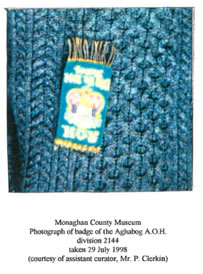
1911. This was in sharp contrast to the parish’s bogus divisions of Tattinclave, Greenan’s Cross and Drollagh, already referred to in chapter one, at the north Monaghan election of 1907.(lo6) On Sunday 16 June 1918 the A.O.H. in Aghabog held a large demonstration to mark the start of a branch of the Ladies Auxiliary, the female section of the Order, when almost one hundred ladies joined under then new president Margaret Began.(107) It was an occasion which gives an excellent insight into the extent of parish support that the A.O.H. enjoyed, ‘the splendid new band of the A.O.H. which was followed by a crowd of about 500 representing almost the entire inhabitants’.(108) The speeches covered the entire range of A.O.H. rhetoric:
‘Aghabog was a very staunch and nationalist parish’, ‘the criminal lunacy of Sinn Fein was turning all Ireland’s friends against her’, ‘they had heard the malicious slanderous statements about the Irish party being traitors’, ‘we announce a great nationalist demonstration in Monaghan town on 15 August next with Joseph Devlin present’/ 109)
The Aghabog meeting would almost convince the reader of the invincibility of the home rule cause and the 1918 Lady Day meeting in Monaghan re-enforced this, ‘our object is complete self-government within the British Commonwealth’/ 110)
The time of the long awaited general election was approaching as the war ended in November 1918. Dillon was the leader of the parliamentary party on the death of Redmond in March 1918/in) The attempt to introduce conscription in April 1918 had been a bitter blow to the parliamentary party. They withdrew their members from Westminster and joined forces with Sinn Fein in resisting it. Aghabog A.O.H. paraded to an anti-conscription protest meeting at Newbliss on Sunday 21 April 1918, adopting the resolution, ‘we pledge ourselves to resist conscription by the most effective means at our disposal’.11 )2) The battle lines were being drawn for the 1918 election with Sinn Fein ready for it. The Monaghan county secretary Denis Carolan Rushe noted on 30 April 1918 in correspondence to Sir Shane Leslie in America, ‘men who were unknown a few years ago fill the public eye at present, Ireland would be freed by a Spanish chief in the person of DeValera’.(113) The majority of the politically active clergy were supporting Sinn Fein but as late as 1918 the parliamentary party won three-by-elections which disproved the view that the country had already been won over by Sinn Fein.(l 14)
The A.O.H. organised support for the two home rule candidates in Monaghan,namely T. J. Campbell and the Aghabog A.O.H. president, J.J. Turley. The 1918 election campaign was vicious with sticks, stones and hurleys used by Hibernians to break up Sinn Fein meetings as at Ballyoisin and Carrickroe, ‘where the A.O.H. leader was Arthur Treanor’.(n5) A Sinn Fein organiser in Monaghan, John Farmer, said, ‘I assisted at the elections in Monaghan where it was impossible to carry on without physical force against the organised mobs of the A.O.H.’^116^ The results of the elections meant victory for the two Sinn Fein candidates, Ernest Blythe for north Monaghan and Sean Mac Entee for south Monaghan and were part of a landslide that had taken place throughout the country with Sinn Fein winning 50% of the popular vote. Sinn Fein was not a socially radical party, as it was controlled mostly by priests, publicans, shop-keepers and the intelligentsia. In fact it had great similarity with the home rule movement but updated its goal to independence or self determination in the words of Fr. O’Daly of Clogher, ‘we want our country and to get the strangers out of the house’/ 117) The face of nationalist politics seemed to have been totally transformed.
The 1918 election however didn’t mean the end of the A.O.H. The Aghabog divisions had another very impressive day when on Sunday 28 September 1919 they unfurled their new banner, ‘the new banner is very handsome, contains a life size painting of the late John Redmond with Patrick Sarsfield on the reverse side’/ I18)
Similar A.O.H. demonstrations took place at Carrickmacross and in Clones in December 1919.(1J9) The parliamentary party may have been eclipsed by the 1918 election but the A.O.H. was still vibrant. They were now being violently attacked by Sinn Fein in places like County Tyrone where A.O.H. members were assaulted after a court case over right of way to an A.O.H. hall/l20) The Hibernians at Carrickmacross opposed Sinn Fein saying, ‘the Hibernians of Monaghan were still heart and soul with the constitutional movement’/ 121' An A.O.H. speaker Michael Conway accused Sinn Fein of branding anyone who disagreed with them as ‘a traitor’ or a ‘west Briton’, he decried the call now of ‘vote for Mac Entee, (Sinn Fein M.P. for Monaghan) and the peace conference’, which may have been a reference to Sean T. O’Kelly at the 1919 Versailles conference/122* The bitterness between Sinn Fein and the A.O.H. was growing as the number of A.O.H. divisions in County Monaghan reached forty five in 1920.(123)
Events were to take a decidedly nasty turn. The divisions between the two sides of nationalism centred not only on the issue of what type of political settlement they wanted for Ireland but on whether to achieve it through armed struggle or by peaceful means. The Hibernians soon found themselves on the receiving end of Sinn Fein violence all over the country but it was particularly bad in Ulster. Their houses were raided for arms just like those of their Protestant neighbours, their halls broken into or burned down, musical instruments smashed or stolen, regalia, banners damaged and members threatened, intimidated or assaulted. The reports of the Hibernian Journal for 1920 and early 1921 contain a litany of outrages, as the Order had to contend with attacks not only from Sinn Fein but also from the more traditional opponents, the Orangemen in Ulster. The Board of Erin minutes is full of reports of malicious damage against Hibernian persons and property. In June 1920 the Board of Erin reported, ‘several of our members [were] waylaid by masked men, owing to the state of feeling in the country it was not advisable to expend any more money on halls’, Tetter from Brother A. Treanor, Errigal Truagh A.O.H. regarding threats from the republican party’, ‘in County Monaghan, Corcaghan, Clara, Castleblayney, Clontibret, Annaclough and Lisdoonan halls threatened’/ 124' This was only a foretaste of worse to come as the R.I.C. reported of Monaghan in January 1921, ‘the county was in a very disturbed condition during the month/125'
With escalating violence the A.O.H. now faced the ultimate from the Sinn Fein movement in the death of three of its members. As we have seen the relationship between the two faces of nationalism was very poor for many years but deteriorated
P i a t i 8
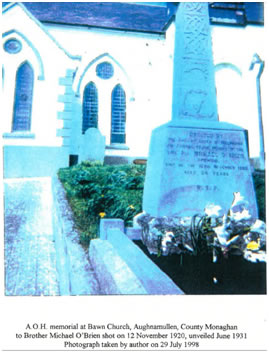
after the 1918 election and particularly with the onset of the war of independence in 1919. The Sinn Fein movement felt the violence of the Hibernians as was seen earlier in the chapter which was organised by Arthur Treanor, the A.O.H. member from Errigal Truagh. The A.O.H. on the other hand felt insulted by being labelled by Sinn Fein as less than national in outlook. Those who supported Sinn Fein in County Monaghan wrote later of this period in 1966, ‘more tragic still was the attitude of some of the supporters of the old Irish party who with the Ancient Order of Hibernians had made a useful contribution to Ireland’s cause at an earlier date and unfortunately later a small number went as far as to help the common enemy’ .(126)
Three members of the A.O.H. in County Monaghan were killed in the events which followed. Two of the three A.O.H. members killed by the republican movement were not very prominent in the Order’s activities. These were Michael O’Brien of Bawn and Francis McPhillips of Aghabog. The third A.O.H. member was Arthur Treanor of Errigal Truagh who was already mentioned above. Michael O’Brien was a twenty-four year old farmer, a member of Bawn A.O.H. and was interested in music. He was on his way home from a fair in Shercock with his Protestant neighbours when shot by armed men near his home on Saturday 20 November 1920.(l27) It was said that O’Brien recognised armed men lying in ambush and called out their names. As a consequence he was shot.(128)
Francis McPhillips was twenty years old, an only son who lived with his widowed mother Margaret and seven sisters in the Corleck townland of Aghabog. He had been accused of passing information to the police through a Presbyterian neighbour named James Breakey and also the Presbyterian minister of Drumkeen Reverend Gaston.(129) He had been warned by the republicans, who first tied him to Aghabog Catholic church gates on Saturday 19 February 1921 as the R.I.C. reported, '‘one man was tied to Aghabog chapel on the 19th inst. labelled spy’.(130) This obviously did not deter Francis McPhillips as Michael Kierans said, ‘the volunteers found out about him from raiding the mails’,(13I) Consequently Francis McPhillips was shot on 9 March 1921 along with Patrick J. Larmer, a volunteer who had given information to the army, both of them meeting their end at Aghaclay, ‘in a lonely hollow in a lane at Aghabog, Monaghan’.(I32)
This killing received a lot of coverage at a time o f very serious civil unrest in the country, the R.I.C. reported, ‘an alarming increase of I.R.A. activity which started on 9 March 1921 with the murder of two “spies”, named McPhillips and Larmer, there is no reason known for the murder of McPhillips’,(L33) It was generally accepted locally that McPhillips was given information to the security forces. The circumstances surrounding the death and burial of Francis McPhillips brought on great bitterness and division between Hibernians and Sinn Feiners in Aghabog parish.(135)
Fr. Tom Maguire, who himself was later closely identified with Sinn Fein, acted as a scrupulous pastor. He pleaded for Francis McPhillips’s life but was told by the volunteers who, after a court-martial conducted by Eoin O’Dufiy, brought their victim to him for confession, ‘you do what you have to do and we’ll do our duty’.(136) At this time Joseph Devlin, M.P., who was pleading at Westminster for I.R.A. prisoners, got
V l a t a 9
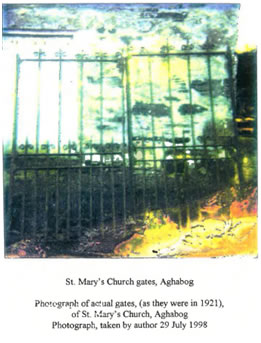
an unsigned letter on 14 March 1921 from County Monaghan setting the tone, ‘they went into the house of poor Mrs. McPhillips took out her son, aged twenty and shot him for no other reason than he was a staunch Hibernian’/ J37) There was only a scant reference to the death of Francis McPhillips in the A.O.H. Board of Erin minutes and no mention whatsoever in the Hibernian Journal. This may have been because of the widely held belief that he was a spy.
The shooting of Arthur Treanor at Emyvale on Saturday 24 June 1921 came after a series of threats from republicans when he was forced to leave home and pay a fine to the republicans. Arthur Treanor was by far the most active of all the three A.O.H. members killed. He was a leading member of the Errigal Traugh A.O.H. division, a member of the Monaghan rural district council and the Monaghan board of guardians and had assisted John J. Turley of Aghabog A.O.H. in the 1918 election, having as mentioned above had previous confrontations with Sinn Fein during that election campaign/l38)
These three murders have to be placed in context of the mayhem of 1921 against a background where 210 A.O.H. halls were burned down, (126 in the twenty six counties and seventy five in the six counties)/139) The A.O.H. were aghast at the treatment they got from the republican movement. They had adopted in their own words, ‘an attitude of benevolent neutrality towards the republican party, where we could not assist we declined to obstruct’/ 140) The Order regretted that ‘notwithstanding this attitude on our part members of our Order were attacked with a ferocity more bitter than that directed at the common enemy’/ 141) The national secretary, John D. Nugent, had written on 24 November 1921 to the minister of defence, Cathal Brugha, complaining about the deaths of Michael O’Brien and Arthur Treanor, (Francis McPhillips was not mentioned and only referred to as ‘Phillips’ in later Board of Erin minutes), ‘two respected members of our organisation who lost their lives because they refuse to join or support the I.R.A.’(142) Nugent had written on 15 October 1921 to DeValera, setting out a detailed list of complaints about the treatment of A.O.H. members by the republican movement/143) The letters were being referred back for further clarification when Nugent reported that, ‘we received from Mr. [Michael] Collins a general condemnation of the attacks on members of our Order and intimation to the effect that instructions had been issued to prevent further interference with the property of the Order’/ l44)
The price paid by the A.O.H. for their belief in constitutional nationalism was extremely high. They were deeply insulted to be put on a par with the unionists by Sinn Fein and accused of a lack of loyalty to Ireland. In the case of the three murders, personal animosities could have been the motive. Michael O’Brien was shot when he challenged armed men lying in a ditch guarding Eoin O’Duffy the volunteer commander in Monaghan/145'1 Some locals hold the view that he had recognised the individuals and called out their names, thus forfeiting his life/146) In the case of Francis McPhillips, volunteers who pleaded for him with his captors without success held the belief that, ‘he was inoffensive and innocent’/ l47) In the case of Treanor he was involved in confrontation with Sinn Fein at a Carrickroe election meeting and this may have led to his death/1481
The A.O.H. buried their dead with low-key dignity but an air of menace and intimidation hung over the Order in Aghabog and County Monaghan generally/149) It was left to the republican movement to find a solution to the Irish problem even though the Board of Erin minutes of 6 December 1921 noted, ‘the hostility of the republican party against this organisation has been even more marked during the past few months than previously’/ 1501
The Order surprisingly was being asked by Catholics in Belfast for arms being under threat from loyalists. John Nugent, national secretary reported: ‘I proceeded to Belfast bringing with me a number of pistols and ammunition, after the Hibernians and Catholic party were thus armed the fighting ceased in Belfast’/ 1S,) The A.O.H. claimed they were being true to their ideal of defence of Catholics under threat from loyalist attack. The A.O.H. in Aghabog had an equally deadly threat came from the republican movement. The Order did not suffer any further fatalities in County Monaghan but kept its head down until a semblance of peace and order was established at the end of the civil war in 1923.(152) Nothing would change their firmly held belief that permanent partition could have been avoided by following the policies of Redmond and the parliamentary party/1531 The Order had to find another political party to support but not before it was re-organised, taking into account the changed situation in Ulster, its traditional stronghold/1541
ENDNOTES - CHAPTER II
1. R.I.C. C.B.S. I.G.C.I. monthly report, May 1907, N. A., C.O. 904.117
2. Miller, Church state and nation in Ireland, p. 181
3. Dundalk Democrat. 25 May 1907
4. Ibid.
5. Hibernian Journal. August 1909
6. R.I.C. C.B.S. I.G.C.I., monthly report, Jan. 1908, N.A., C.O. 904.118
7. Miller, Church state and nation in Ireland, p. 221
8. Dean O’Connor to John Dillon, 18 September 1908, T.C.D.L., John Dillon
Papers, MS 6770 141
9. R.I.C. C.B.S. I.G.C.I., monthly report, Nov. 1908, N.A., C.O. 904.118
10. Northern Standard, 25 January 1910
11. Bew, Ideology and the Irish question, p. 57
12. Witness, 5 July 1912 (published by the Presbyterian Church)
13. Irish Times, 12 July 1912
14. Hibernian Journal, September 1912
15. Ibid.
16. Ibid., August 1911
17. R.I.C. C.B.S. I.G.C.I., monthly report, July 1912, N.A., C.O. 904.119
18. Hibernian Journal, June 1912
19. Ibid.
20. R.I.C. C.B.S. I.G.C.I., monthly report, Sept. 1912, N.A., C.O. 904.119
21. Hibgmian Journal, September 1913
22. Ibid., December 1913
23. R.I.C. C.B.S. I.G.C.I., monthly report, June 1914, N.A., C.O. 904.84
24. Hibernian Journal, September 1914
25. Ibid.
26. Phoenix, Northern nationalism, p. 17
27. Bew, Ideology and the Irish question, p. 120
28. Irish Times, 27 September 1914
29. Bew. Ideology and the Irish question, p. 122
30. Liam Walsh, unpublished biography, ‘General Eoin O’Duffy - his life and battles’, (1939), on microfilm, N.L.I. p. 6539
31. Brendan Mac Gilla Choille, fed.). Intelligence notes 1913 - 16, (Dublin, 1966), p. 77
32. R.I.C. C.B.S. I.G.C.I., monthly report, June 1914, N.A., C.O. 904.84
33. Northern Standard. 12 May 1912
34. R.I.C. C.B.S. I.G.C.I., monthly report, July 1914, C.O. 904.120
35. Livingstone, The Monaghan story, p. 367
36. Phoenix. Northern nationalism, p. 17
37. Northern Standard, 3 October 1914
38. Tom Garvin, The evolution of Irish nationalist politics, (Dublin, 1981), p. 110
39. Mac Giolla Choille, (1966), op cit pp. 181 - 2
40. Northern Standard, 19 September 1914
41. R.I.C. C.B.S. I.G.C.I., monthly report, Oct. 1914, N.A., C.O. 904.84
42. Richard Davis, Arthur Griffith and non-violent Sinn Fein, (Dublin, 1974), pp. 19-20
43. Livingstone, The Monaghan story, p. 363
44. Ibid., p. 313
45. R.I.C. C.B.S. I.G.C.I., monthly report, Sept. 1914, N.A., C.O. 904.84
46. Ibid., Nov. 1914, N.A., C.O. 904.84
47. County Monaghan, Solemn covenant to resist conscription, N.L.I., MS 3310
48. Collins, Ireland. 1868 - 1966, p. 242
49. Livingstone, The Monaghan story, p. 376
50. Walsh, ‘General Eoin O’Duffy’, 1939, p. 18
51. Anglo-Celt, 9 December 1905
52. Livingstone, The Monaghan story, p. 359
53. Ibid.
54. Monaghan People. 15 June 1906
55. Ibid., 16 November 1906
56. Hibernian Journal. 12 October 1912
57. Sinn Fein, 12 October 1912
58. M. Tierney, Eoin Mac Neill - scholar and man of action 1867 - 1945, (Oxford,
1980), p. 81
59. Ibid.
60. Ibid.
61. Collins, Ireland 1868 - 1966, p. 172
62. Bergin, History of the Ancient Order of Hibernians, p. 50
63. Padraig Greenan, Pairc Emmet Aghabog. (Monaghan, 1982), p. 2
64. Ibid.
65. Ibid.
66. Anglo-Celt. 22 June 1907
67. Monaghan People, 4 November 1905
68. Ibid.
69. Livingstone, The Monaghan story, p. 360
70. McGrath. History of the Ancient Order of Hibernians, p. 18
71. Livingstone, The Monaghan story, p. 3 61
72. Hibernian Journal. September 1912
73. Northern Standard, 19 July 1913
74. Lewis, A Topographical dictionary of Ireland, p. 12
75. Duffy, Landscapes of south Ulster, p. 77
76. Ibid.
77. Ibid.
78. Ibid.
79. Michael Croarkin, of the townland o f Cam, Aghabog, oral evidence, July 1998
80. Anglo-Celt. 8 July 1905
81. Northern Standard, 28 February 1914
82. R. Gillespie, (ed.), Cavan, essays on the history of an Irish county. (Dublin 1995), p. 180
83. A. T. Q. Stewart, The Ulster crisis. (London, 1967), pp. 59 - 60
84. M. Tierney, Modem Ireland 1850 - 1950. (Dublin, 1972), p. 117
85. Dundalk Democrat, 6 May 1916
86. Hibernian Journal. September 1916
87. Collins, Ireland 1868 - 1966, pp. 229 - 231
88. Ibid.
89. R.I.C. C.B.S. I.G.C.I., monthly report, July 1916, N.A., C.O. 904.82
90. Livingstone, The Monaghan story, p. 372
91. R.I.C. C.B.S. I.G.C.I., monthly report, Apr. 1917, N.A., C.O. 904.91
92. Hibernian Journal, November 1916
93. Ibid., September 1917
94. Phoenix, Northern nationalism, p. 36
95. Miller, Church, state and nation in Ireland, p. 343
96. Dundalk Democrat. 19 May 1917
97. Ibid., 21 April, 1917
98. R.I.C. C.B.S. I.G.C.I., monthly report, Nov. 1917, N.A., C.O. 904.91
99. Dundalk Democrat. 13 October 1917
100. A. C. Hepburn, The conflict of nationality in modem Ireland. (Dublin, 1981), p.
101. Hibernian Journal, September 1917
102. Anglo-Celt. 30 June 1917
103. Ibid., 18 August 1917
104. Ibid., 1 December 1917
105. A.O.H. B.O.E. Minutes, M/F, N.A. L.O.U. 13/1/1
106. Monaghan People, 14 June 1907
107. Dundalk Democrat. 22 June 1918
108. Ibid.
109. Ibid
110. Dundalk Democrat. 17 August 1918
111. Collins. Ireland 1868 - 1966. p. 240
112. County Monaghan - covenant to resist conscription, N.L.I. MS 3310
113. Letters of Denis Carolan Rushe, Monaghan County Museum, MS D.C.R. 18.19
114. Livingstone, The Monaghan story, p. 375
115. Frank Duffy commandant Ballykinlar camp - war of independence memoirs - County Monaghan Miscellaneous papers, Monaghan County Museum, MS 4B1-3
116. Ibid., John Farmer, MS 86 - 5H
117. Dundalk Democrat, 20 October 1917
118. Hibernian Journal. November 1919
119. Ibid., December 1919
120. Ibid., April 1919
121. Ibid., October 1919
122. Ibid.
123. Ibid., October 1920
124. A.O.H. B.O.E. Minutes, M/F N.A. L.O.U. 13/1/1
125. R.I.C. C.B.S. I.G.C.I., monthly report, Jan. 1921, N.A. C.O., 904.114
126. Peadar Livingstone, Cumhneachain Mhuineachain (1916 - 19661, (Enniskillen, 1966), p. 49
127. Hibernian Journal, January 1921
128. Oral evidence of Francis O’Brien, Dromod, Shantonagh, a nephew of the deceased taken on 20 March 1999
129. Oral evidence of Michael Kierans aged 93 years of 21 Ann Devlin Park, Rathfamham, taken on 20 February 1999, (a native of the townland of Corleck, Aghabog)
130. R.I.C. C.B.S. I.G.C.I., monthly report, Feb. 1921, N.A., C.O. 904.114
131. Oral evidence of Michael Kierans
132. The Irish World and American Industrial Liberator, 2 April 1921
133. R.I.C. C.B.S. I.G.C.I., monthly report, Mar. 1921, N.A., C.O., 904.114
134. Oral evidence of Michael Croarkin
135. Dundalk Democrat, 12 March 1921
136. Oral evidence of Michael Kierans
137. ‘Co. Monaghan Hibernian’ to Joseph Devlin, 14 March 1921, letter in the possession of Eamon Phoenix, Belfast who kindly gave a copy to the author
138. Northern Standard, 1 July 1921
139. A.O.H. B.O.E. Minutes, M/F. June 1922, N.A. L.O.U. 13/1/1
140. Ibid.
141. Ibid.
142. Ibid.
143. Ibid.
144. Ibid.
145. Anglo-Celt 4 December 1920
146. Oral evidence of Francis O’Brien
147. War of independence miscellaneous papers, Monaghan County Museum, evidence of Johnnie McKenna, Newbliss, MS 4 B1 - 3,1986
148. Ibid., evidence of Frank O’Duffy, St. Macarten’s Seminary, MS 4 B1 - 3,1986
149. Northern Standard. 11 March 1921
150. A.O.H. B.O.E. Minutes, 6 December 1921, M.F. N.A. L.O.U. 13/1/1
151. Ibid., June 1921, M.F. N.A. L.O.U. 13/1/1
152. Hibernian Journal, February 1923
153. Ibid., March 1923
154. Ibid., June 1923
CHAPTER III
THE A.O.H. IN COUNTY MONAGHAN AFTER PARTITION, 1922 - 33
In this chapter, the changed political circumstances for the A.O.H. resulting from the terms of the 1921 Anglo-Irish treaty, are examined. County Monaghan was now a border county, cut off politically by partition from the main body of Ulster. The parliamentary party had been practically wiped out in the 1918 election with only six M.P.s returned, four of these were the result of a pre-election pact with Sinn Fein in Ulster, the most prominent being Joseph Devlin, national president of the Order for Falls constituency, Belfast.(1) Nationalist and Sinn Fein members in line with their election pledges boycotted the new parliament at Stormont.(2) The R.I.C. reported on the A.O.H. in January 1921, ‘the A.O.H. while helping Roman Catholic workers with concerts in St. Peter’s Club, distrust the new northern parliament but others think nationalists will enter and make the best of it but the bishop and clergy are opposed’. 3)
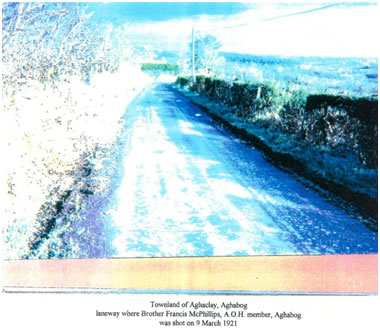
This was in sharp contrast to the unionists in County Monaghan who now found themselves in a minority in what they considered was a hostile state. There was an element of tragedy about the Protestant position in Monaghan for they had been abandoned by the Ulster unionist council and consequently on 10 April 1920 the Monaghan delegates withdrew in disgust.(4) Lord Famham of Cavan said on 14 April 1920, ‘our people look upon themselves as betrayed and deserted’.(5) In County Monaghan the county grand master of the Orange Order told Orangemen at Clones on 12 July 1920, ‘we know not what the future may hold for us but, brother Orangeman let us trust in God who has never forsaken us.(6) The unionists were not going to go away as Reverend Robert Bums of Drum, Aghabog, said on 12 July 1921, ‘we are glad to have Col . Madden on the county council where he can tell those rebels and Sinn Feiners that we are going to hold out for our rights’.(7) The unionists in Monaghan stayed on in the new state with people such as, M. E. Knight a prominent solicitor and Alex Hazlett a Monaghan auctioneer later elected to the dail, who played an important part in integrating loyalists into the Free State. On 20 July 1923 Hazlett said, ‘we live in this country and we are going to make the most of it’.(8)
In the previous chapter the difficulties between the A.O.H. and Sinn Fein in County Monaghan were examined. In Ulster A.O.H. divisions had a tendency to split into pro and anti-Sinn Fein factions and after the 1921 Truce the drift away from Hibemianism accelerated.(9) Those A.O.H. members who had drifted to Sinn Fein were dissatisfied with the apparent impotence of the parliamentary party which they had supported. They joined Sinn Fein at non-leadership level.(l0) Violent circumstances forced the defeated parliamentary party to remain relatively silent during the closing stages of the Anglo-Irish struggle but the A.O.H. continued its existence. As seen already the A.O.H. in Aghabog, Errigal Truagh and Bawn had paid a very high price. The last reference made about the County Monaghan A.O.H. in the R.I.C. files in June 1921 recorded them as, ‘having 45 divisions with 1,903 members inactive’/ 111 There are no copies of the Hibernian Journal extant covering the end of 1921 and all of 1922 but the Board of Erin minutes in 1922 listed the Order nationally as having 515 divisions and 21,197 members/121 Aghabog divisions were in good standing with the Board of Erin. It was not included in a list of eleven other divisions in Monaghan showing: ‘serious arrears in their subscriptions’/ 131 The Hibernian Journal reported in February 1923 of a series of conferences in Ulster to re-organise the Ulster provincial council of the A.O.H. The meeting for this was held in Armagh on Sunday 21 January 1923, while County Monaghan was well represented, there was no record of any Aghabog delegates/141
The country was still in the throes of the civil war and the Hibernian Journal reported, ‘bloodshed and destruction with solemn warnings by cardinal and bishops’, but it ended on a happier note, ‘the neutral I.R.A. neutral members’ association have proposals for peace’/ 151 The A.O.H. was re-organising and quietly re-asserting itself even before the civil war ended in May 1923. It issued a call for the boundary commission to be established as provided for in clause 12 of the Anglo-Irish treaty of 1921 under the heading, ‘nationalist Ulster speaks’/ 161 There were discussions on the importance of the A.O.H. in the ‘new’ Ireland as Brother John O’Keeffe of the County Cork A.O.H. said, ‘the Order had suffered a partial eclipse in the south of Ireland as a result of unsettled conditions but with peace, the movement had a great future before it’.(l7) The general secretary John Nugent called on the A.O.H. to organise on the ‘old circle system’, so that every ‘townland and parish is organised’ and asked that the social side of life be organised with ‘billiard competition, football matches, tugs of war, band competitions, socials and dances’.(18)
A.O.H. social activity put great emphasis on dances and banquets and County Monaghan A.O.H. board issued, ‘rules to be observed during dances’, where among the eight rules, ‘any ladies leaving the hall for a considerable time during dancing not to be re-admitted that evening’.(l9) This illustrated that the A.O.H. as a Catholic organisation insisted on the strict morality of the time being enforced, at its social events. The Order in Monaghan suffered an isolated attack in May 1924 on an A.O.H. hall at Ture near Clones and for a time it seemed like a return to the bad old days.(20)
The Hibernians began to hold their rallies again with a County Monaghan monster demonstration at Carrickmacross on 17 March 1924 where even six years after his death, resolutions of sympathy were being passed with the relatives of John Redmond described as ‘one of Ireland’s greatest leaders’.(2)) The Monaghan Hibernians were supporters of the treaty as they believed in non-violence but they were very distinct from the Cumann na nGaedheal party. The Cosgrave government relied on the Hibernians to support its law and order policies but as the years passed many A.O.H. members lined up with DeValera and his supporters in certain circumstances.(22)
Plate. 7 7
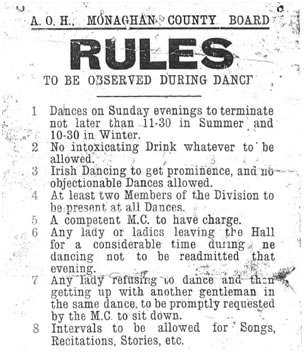
Photography of original in M.C.M.
However, when Redmond’s son William established a new party, the National League in 1926, the A.O.H. in south Monaghan gave it very active support.(23) The Order was far from uncritical of the Free State government, highlighting in 1924 the high cost of the army, financial irregularities in the ministry of finance, delays on the boundary commission, the high rate of emigration from the Free State and lack of adequate censorship/24^
The first stirring for Aghabog A.O.H. division after the killing of Francis McPhillips in 1921, was at the re-organised County board meeting on 1 July 1923 when Brother Thomas Finlay represented them. From 1923 the recovery of the Order went on unabated, with members from County Monaghan attending demonstrations across the border and ‘defying the attention of the ‘B’ Specials’ as fifty A.O.H. members from Lisdoonan, south Monaghan did on 10 May 1923 when travelling to Armagh/25^ The Order was trying to overcome the legacies of the murder of its three members, M. O’Brien, F. McPhillips and A. Treanor. The period of silence was over in May 1923 as the newly elected A.O.H. county board under their president Brother Patrick McCabe visited Michael O’Brien’s grave in Bawn. The Board of Erin became involved in commemorating the three deceased members and noted in their minutes, ‘permission was granted to the Monaghan county board to issue a general appeal for funds with the object of raising a celtic cross in commemoration of Brothers Treanor, O’Brien and Phillips’, (sic)/ ^ It is interesting to note that in the same minute County
Plate. 12
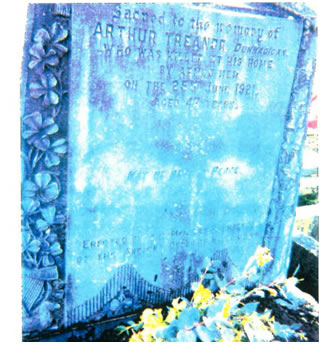
A.O.H. memorial at Carrickroe Church, Emyvale, County Monaghan to Brother Arthur Treanor shot on 25 June 1921, unveiled June 1925 Photograph taken by author on 29 July 1998
Monaghan was recorded as having twenty-two A.O.H. divisions, (twelve paid up, ten in arrears), in comparison to forty-five in 1921. The Board of Erin became further involved in County Monaghan A.O.H. affairs, when it refused a grant to assist in defraying the expenses of the Treanor memorial as it had ‘already made a grant of seventy-five pounds to the widow’/ 27)
The Board of Erin’s refusal seemed ungenerous to the Treanor family despite their praise of his great sacrifice, ‘being foully slain for no other reason than he declined to waver in his allegiance to the principles of the Ancient Order of Hibernians’/ 28) The unveiling of the Treanor memorial took place in Carrackroe cemetery on Sunday 28 June 1925, following an A.O.H. demonstration of 12,000 members with 25 bands and 40 banners, addressed by the national secretary, John D. Nugent/29-1 The unveiling of the Michael O’Brien memorial took place in Bawn cemetery on Sunday 30 June 1931, with James Cobum T.D. for Louth, who was also a prominent A.O.H. member, as the chief speaker after a large gathering at Bawn of 1,500 A.O.H. members with many bands including the Aghabog A.O.H. band/30) The final commemoration was for Francis McPhillips whose memorial was unveiled in Aghabog cemetery on Sunday 30 September 1933 with a Targe muster of Hibernian forces of the county while divisions came from Cavan and Fermanagh’ / 31)
The three memorials are identical limestone celtic crosses approximately fourteen feet high showing the arms of the A.O.H. incised with the Order’s motto of ‘friendship, unity and true Christian charity’/32' In terms of iconography they make a very clear statement of honouring the sacrifice made, re-asserting the Hibernian beliefs and stating how righteous their cause was. The Order used the three occasions to re-launch itself in County Monaghan after its period of silence and isolation in the early 1920s. The call for an enquiry by the government into the three murders fell on deaf ears. It is ironic to contemplate that the person in charge of the court-martial which condemned Francis McPhillips to death was now the Garda Commissioner General Eoin O’Duffy/33' It was also interesting to note that the parish priest, Father Tom Maguire P.P., couldn’t attend the demonstration due ‘to pressure of work’/ 34'
After telling the Flibernians of Aghabog that: ‘as a Catholic organisation working under the guidance of the bishops it has plenty of good work to do’, he wished ‘your demonstration every success’/ 35' This same priest was far from politically inactive being the treasurer of the Clones comhairle cheantair of Sinn Fein/36' Even though Father Maguire’s letter was highly praised by the A.O.H. officials at the demonstration it seemed at best a very face-saving exercise from what could be considered as the priest’s snub to the Order on an important occasion in the parish. At each of the commemorations, the Order highlighted that though these A.O.H. members were branded as traitors, the ‘Order didn’t instil into the hearts of nationalists a spirit of revenge but sought in the interests of posterity and fair play to hold an enquiry into the murder of the three’/ 37'
St. Mary’s R.C. Church, Latnamard, Aghabog
Photograph taken by author on 29 July 1998
Plate 13
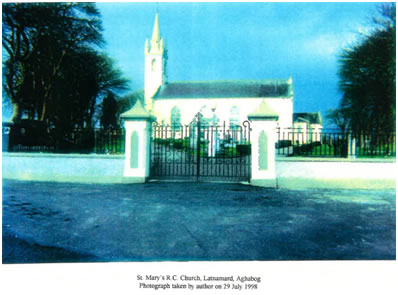
The A.O.H. in Monaghan were anxious to highlight the ties with the six counties then part of the new northern state, expressing their anti-partition view according to Joseph Stewart, M.P. Tyrone, ‘so far as the A.O.H. was concerned they knew no partition and no border’,(38) The A.O.H. didn’t get the apologies sought for the murders of their members from either the Cosgrave government or the Sinn Fein party. This is hardly surprising as prior to the Anglo-Irish treaty of 1921 as we have seen, Sinn Fein was engaged in a campaign of violence against the Order and its supporters.
It was widely believed amongst people in County Monaghan that the three A.O.H. members were victims of the spiralling rise in violent incidents which involved supporters of the ‘national effort’. Maybe these A.O.H. men were slow to realise that the methods of the parliamentary party which they supported had been discarded by the vast majority of their fellow countrymen. Perhaps they were part of a small number who continued to hinder ‘the national effort’ and help the ‘common enemy’ .(39) On the other hand perhaps, in the words of Hugh J. McArdle, county president of Monaghan A.O.H., they ‘were shot because they were Hibernians in an attempt to scare the rest of the organisation’/ 40) The bitterness caused by the shooting of Francis McPhillips which split Aghabog parish between Hibernians, unionists and Sinn Feiners which was a poor base on which to build any community spirit/41J The bitterness was very real with supporters of Sinn Fein being ostracised by their A.O.H. neighbours, who didn’t extend ‘friendship, unity and true Christian charity’ towards them/42* Conversely Hibernians were viewed with deep suspicion by republicans.
Little or no social contact took place between the both sides who even studiously avoided sitting in the same seat at mass in St. Mary’s church. Their rival bands oftenmconfronted each other both musically and physically. A.O.H. members coming out of mass would call out within the hearing of known Sinn Fein members, ‘we all know who murdered “Frank Anthony”, (this was the nickname for Francis McPhillips)’. This split worked against the parish economically, increasing emigration, created a lack of inward investment as agencies weren’t interested in a divided community and led to a perception of Aghabog as a backward area. Notwithstanding a great reluctance locally to discuss the A.O.H. there is there today a more detached view that Francis McPhillips was an innocent and unfortunate victim of the violence of that time.
The Order in Aghabog had suffered great trauma in 1921 with the shootings but it emerged in 1923 after general re-organisation with renewed confidence. As an A.O.H. division it could look back to great events such as, the 1918 demonstration for the launch of the Ladies Auxiliary division, the excitement of Turley’s 1918 election campaign, the unfurling of the new banner in 1919 and in the future the erection of its new A.O.H. hall. The A.O.H. were given a site in the townland of Corleck by the Gallagher family for what was to become not only an A.O.H. venue but also the only social centre in the parish. The hall today is in ruins and like the Order itself unknown to most parishioners. There is a local tradition of ‘bad luck’ associated with the A.O.H. hall, because on the first day of its erection a local man, J. P. Sreenan had a fatal seizure/44* However on Sunday 2 May 1926 Aghabog A.O.H. opened its new hall, ‘the occasion being marked by a demonstration which showed that the organisation is still a powerful force in the county’/ 45* Whilst Aghabog was geographically isolated its influence in A.O.H. circles was quite considerable, as demonstrated for the opening of the hall, ‘every A.O.H. district of County Monaghan was represented, twenty-two bands took part and the opening ceremony was performed by Brother John Diffin, B.L., a prominent Belfast Hibernian’/ 46* As in the days of the 1907 north Monaghan election, Aghabog’s flirtation with prominent Belfast Hibernians was maintained.
The hall was an important statement of independence by the A.O.H. It was not under the control of the parish clergy proving the Order whilst proclaiming its Catholicity could operate outside clerical control. In a rural parish like Aghabog, there were few activities where Catholics were not under the supervision of the parish clergy. This was the case for organisations like the Gaelic League and the G.A.A. These bodies made strenuous efforts to involve the parish clergy thus enjoying clerical approval. Earlier it has been seen how the A.O.H. only became tolerated by the Catholic hierarchy in 1904. This however didn’t impede their development or organisation among the Catholic population. The Order kept control of its members, its social events and its premises without the involvement of the parish clergy. This was very strictly observed in Aghabog, where the Order didn’t go out of its way to obstruct the priests but kept the organisation and use of the A.O.H. hall totally independent of them. It was not surprising therefore that Cardinal Michael Logue so disliked an Order that he couldn’t effectively control through his parish clergy/47* The A.O.H. were careful in their relationship with the clergy. They eulogised those who joined them as chaplains, (Father J. J. McKinley was on the Aghabog A.O.H. banner).
On the other hand they were not afraid to counter any clerical attack made on them as in the case of Canon McGlone of Magherarney, County Monaghan, referred to later in the conclusion. We have seen how the A.O.H. placed great importance on social control even to the point of issuing those eight rules to be observed at dances under Hibernian management/48* The Order’s influence on member’s social life was pervasive as they were against ‘intoxicating drink’, ‘no objectionable dances’ and ‘any lady refusing to dance and then getting up with another gentleman in the same dance to be promptly requested by the M.C. to sit down’/ 49* As early as 1912 the Order issued a set of guideline on how the Order’s halls and clubs should be organised/30* The Order insisted on all halls being invested in a committee of local and national trustees, ‘to prevent any small faction from trying to keep possession of the premises or using it for purposes contrary to the Order’/ 51*
The A.O.H. in Aghabog proved most generous over the years by providing their premises for most parish non-political activities which helped to improve the community spirit. The hall, the banner, the band and the regalia were all important outward signs of Hibernian influence and vitality in Aghabog. It has been said that politicians at all stages in Ireland’s past were well aware of the effect of demonstrations, triumphal arches and commemorations in articulating and defining political consciousness.(52) In Aghabog’s hall the 1919 banner depicting Redmond and Sarsfield on either side with the four historical personalities on each corner, namely Parnell, Davitt, Devlin and Fr. McKinley, (who was responsible in 1902 for healing the A.O.H. split), conveyed a strong political message of Hibernianism. As Jarman has said, ‘by incorporating and conjoining a wide range of historical figures within a single image in this way Hibernian banners can display a more diverse message than equivalent Orange banners’.(53) 1926 was a good year for Aghabog A.O.H. again at the forefront of the Order’s activities in County Monaghan such as attending traditional demonstrations, hall openings, as in Newtownbutler, 15 August 1926 where, ‘the band and banner were given an honoured position and John J. Turley, president of Aghabog division made a speech’.(54)
The A.O.H. as was seen re-organised itself in 1920s taking into account the problems created by partition. They didn’t want to recognise partition, as Joseph Stewart, M.P. said in Aghabog, ‘they know no partition and no border’.(55) They weren’t in thrall to the new Free State government and felt confident enough to condemn their Civil War activities when republicans in 1922 were shot without trial, ‘no government could condone the taking of untried prisoners out of their cell and Memorial to national secretary A.O.H. J.D. Nugent at Kimmage Manor, Dublin 6W taken by author on 29 July 1998 putting them to death as reprisals’.(56) The Order in County Monaghan drew strength from parades and commemorations of its dead, boasting on 29 June 1926 about its demonstration in Castleblayney as ‘the most representative assembly held there for many years under the auspices of the A.O.H.’^57) There were conflicting messages however coming from the A.O.H. national secretary John D. Nugent about the Order’s progress when in March 1928, he said ‘A.O.H. now on the up-grade’ )58^ On the other hand in April 1929 he was asking plaintively, ‘has the A.O.H. lost its power and vitality’? while calling for policies which seemed extreme, ‘one undivided Ireland one policy approved by one party for one people’) 59) The A.O.H. was traditionally in favour of right-wing policies which were in conformity with their twin watchwords of ‘faith and fatherland’.(60)
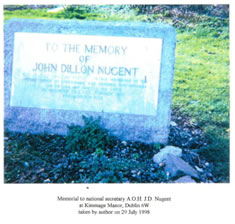
The Order’s dislike of socialism had reached fever pitch during the great 1913 lock-out with headlines in the Hibernian Journal like, ‘the deportation of Catholic children’, (a comment on James Larkin’s efforts to get food and help in England for workers’ children) and T.arkinism worse than syndicalism’) 61' On their part Connolly and Larkin considered the Order as a ‘near fascist organisation’. The Order in the period after 1923 became obsessed with the spread of communism as expressed at an Armagh A.O.H. demonstration in 1931 where the speaker Philip Smith said, ‘we notice with regret the efforts being made to utilise the sentiments of our people as a channel though which the poisonous ideals of Bolshevist and Communist teachings may be insidiously introduced’ .(63) In County Monaghan at the commemorations for both Michael O’Brien and Francis McPhillips there was the ritual condemnation of ‘the Soviets poison fangs’, ‘if any attempt is being made to spread communism those responsible would get a hot reception’.(64) John Nugent in his capacity as national secretary was equally explicit in his condemnation in a letter to all Hibernians in November 1933 when he talked o f ‘shady elements in labour’; ‘vote for men who are unshakeable opponents of communism, of the I.R.A. of Saor Eire and of all societies condemned by the Church’/ 65) The Order was back to its traditional opposition to the republicans who had taken a decidedly left-wing direction under ‘Saor Eire\(66) They would become more involved in the struggle against communism at a much later stage in 1937 waging a campaign against the left in the Spanish civil war going so far as to bring over on 23 May 1937 a Father Gabana to ‘tell the truth about Spain’ to Hibernians in Dublin’s Gaiety Theatre)67^
Finally Aghabog’s re-emergence to prominence in County Monaghan’s A.O.H.’s affairs demonstrated the strong roots that Hibernianism had in the parish. This spirit was kept alive by the energy and organising ability of the division president J. J. Turley. He ensured that the Aghabog divisions were involved not only in County Monaghan but in A.O.H. parades and demonstrations in the neighbouring counties Fermanagh, Cavan, Tyrone and Armagh such as those on 15 August 1928 at Aughnaeloy, County Tyrone, Sunday 4 August 1929 at Cootehill, County Cavan, Sunday 19 July 1931 at the famous ‘green walk’, (so called because of large amounts of green bunting used locally), in Balieboro County Cavan, 15 August 1927; at Lurgan, County Armagh and as previously mentioned at the opening of the new A.O.H. hall in Newtownbutler, County Fermanagh on 15 August 1926.(68)
This would seem to indicate great vitality which undoubtedly existed, but selfdoubts were beginning to assail the Order as already shown in the questions posed in 1928 by John Nugent himself. The Order was still back in its traditional role of defending Catholics when as late as 1938 it was complaining in the Hibernian Journal about, ‘penal laws in the six counties’/ 69) Poor economic conditions in the Free State meant an increase in emigration which was also taking its traditional toll on Aghabog’s young men, many of them Hibernians. The A.O.H. in the county had declined to ten divisions in 1931 from the highest figure of forty five for February 19 2 i (7°) g ut decijne was setting in for the Hibernians, in Aghabog they could still host a vast commemoration in September 1933.(71) It was only after the passing of Joseph Devlin M.P. in 1934 and John Nugent in 1940 that the decline accelerated.(72)
Aghabog perched in the little hills of County Monaghan, was left with its A.O.H. hall in ruins, a Celtic cross as a poignant reminder of its member’s sacrifices, in what was described in June 1918 as ‘a staunch and true nationalist parish’.(73)
ENDNOTES - CHAPTER III
1. M. E. Collins. Ireland 1868 - 1966, p. 245
2. Phoenix. Northern nationalism, p. 132
3. R.I.C. C.B.S. I.G.C.I., monthly report, Jan. 1921, N.A., C.O., 904.114
4. Irish Times, 11 April 1920
5. Ibid., 15 April 1920
6. Dafach MeDonald, The sons of Levi, (Monaghan, 1998), p. 197
7. Ibid. p. 210
8. Northern Standard, 20 July 1923
9. Phoenix. Northern nationalism, p. 143
10. M. Hopkinson, Green against green, (Dublin, 1988), p. 3
11. R.I.C. C.B.S. I.G.C.I., monthly report, June 1921, N.A., C.O., 904.114
12. A.O.H. Board of Erin minutes, June 1922, M. F. N.A. L.O.U. 13/1/1
13. Ibid., 30 September 1922
14. Hibernian Journal, February 1923
15. Ibid., March 1923
16. Ibid., June 1923
17. Ibid., November 1923
18. Ibid., December 1923
19. Original notice o f 12 June 1924 in M.C.M.
20. Hibernian Journal, May 1924
21. Dundalk Democrat, 22 March 1924
22. Livingstone. The Monaghan story, p. 402
23. Dundalk Democrat, 11 December 1926
24. Hibernian Journal, September 1924
25. Ibid., June 1923
26. A.O.H. Board of Erin minutes, September 1924, M. F. N.A. L.O.U. 13/1/1
27. Ibid., September 1925
28. Hibernian Journal, June 1925
29. Ibid.
30. Anglo-Celt. 4 July 1931
31. Northern Standard, 6 October 193 3
32. Hibernian Journal. November 1933
33. War of independence, statement of John McKenna, Newbliss, County
Monaghan, M.C.M., The Monaghan story 4A1-4 1986
34. Northern Standard, 6 October 1933
35. Ibid.
36. Dundalk Democrat, 11 October 1924
37. Northern Standard. 6 October 1933
3 8. Hibernian Journal, November 193 3
39. Livingstone, Cumhneachain Mhuineachain, p. 50
40. Northern Standard. 6 October 1933
41. Oral evidence of Micahel Croarkin, July 1998
42. Oral evidence of Michael Kerins, February 1999
43. Oral evidence of Michael Croarkin, July 1998
44. Ibid.
45. Hibernian Journal, June 1926
46. Ibid.
47. Miller, Church state and nation in Ireland, p. 245
48. A.O.H. Monaghan County Board, ‘rules to be observed during dances’, original
in M.C.M.
49. Ibid.
50. Hibernian Journal. September 1912
51. Ibid.
52. Raymond Gillespie and Brian Kennedy, (ed), Ireland Art into History (Dublin
1994), pp. 8 - 9
53. Neil Jarman, Material conflicts, (Oxford, 1997), p. 193
54. Hibernian Journal, September 1926
55. Ibid., November 1933
56. Ibid., April 1926
57. Ibid., July 1926
58. Ibid., March 1928
59. Ibid., April 1929
60. Bergin, History of the Ancient Order of Hibernians, p. viii
61. Hibernian Journal, September 1913
62. Hepburn, The Ancient Order of Hibernians, p. 5
63. Dundalk Democrat, 22 August 1931
64. Anglo-Celt, 4 July 1931
65. Hibernian Journal, November 193 3
66. M. E. Collins, Ireland 1868 - 1966. p. 347
67. Hibernian Journal. June 1937
68. Ibid., September 1926 September 1927 September 1928 September 1929
69. Hibernian Journal, December 1938
70. Ibid., March 1931
71. Northern Standard. 6 October 1933
72. Foy, ‘Ancient Order of Hibernians’, p. 157
73. Dundalk Democrat. 22 June 1918
CONCLUSION
The year 1900 was a significant one in Irish nationalist politics which saw the parliamentary party, riven by factions since the death of Parnell in 1891, re-united under John Redmond’s leadership/1’ In that same year, the Ancient Order of Hibernians established for the protection of the Catholic faith and population in Ireland was itself moving towards re-unification after a lengthy period of internal dissension.® The history of the Order has been traced to its earlier antecedents which highlighted its American connections.® The important upsurge in growth of the Order from 1905, under Joseph Devlin, M.P. as national president and the reorganised governing body the Board of Erin, has also been highlighted.® The constraints imposed by the dearth of reliable information on the Order and its activities has already been mentioned. However no in-depth study of Irish nationalism, particularly dealing with Ulster, could be undertaken without examining the Order and its influence on Irish affairs.®
Some questions are worth posing on the Order and its membership. Who joined the A.O.H? It attracted recruits drawn overwhelmingly from people classed broadly as ‘working class’. In Aghabog with its preponderance of small farmers, agricultural labourers and those engaged in the flax industry, there was a steady supply of eager recruits. The sizeable Protestant population in the parish which was higher than other areas of County Monaghan, ensured that a vibrant Orange society existed thus sending young Catholic men towards the Hibernians as a counter to the Orange Order. It is not surprising that as early as 1903 Hibernians had taken a firm hold in Aghabog with only two other divisions recorded for the entire county/6^
Why did the young men of Aghabog join up with such obvious enthusiasm? Their parish was isolated and its economy poor. Perhaps the social side of Hibernianism with its band parades, demonstrations, excursions, parties, raffles and dances was attractive to young men leading an otherwise humdrum existence. There was also the power and the sense of belonging. When a young man joined he marched festooned with the A.O.H. regalia, joined up with larger contingents at a traditional ‘Lady Day’ demonstration in a far off town, while he listened to stirring speeches from important national leaders like Devlin, Dillon or Redmond himself. All this gave otherwise unknown small farmers or landless labourers a greater sense of power and of their own importance. It wasn’t surprising that the Order flourished in Aghabog to the extent of having three divisions including a Ladies Auxiliary division, earning for the parish the description, ‘a bastion of Hibernianism’.(7)
Hibernians were not behind in their involvement in corruption as shown in chapter I where the Aghabog members created bogus divisions to boost Donovan’s chances in the 1907 north Monaghan e l e c t i o n . T h e A.O.H. while working in tandem with the U.I.L. maintained the upper hand in Aghabog. From perusal of the newspaper reports of the time, membership between the two bodies was almost interchangeable but when the crunch came in 1907 the U.I.L. was forced in Aghabog to follow the A.O.H. on the instructions of Joseph Devlin. As seen the A.O.H. also had considerable clout in the parish over both the Gaelic League and the G.A.A. Club.(9) This was not unusual considering the large number of A.O.H. members in the parish.
What was the relationship between the A.O.H. and the Catholic church? As already referred to, die A.O.H. as a Catholic organisation eagerly sought the approval of the Church authorities but as seen already because it was an oath-bound secret society it incurred ecclesiastical disapproval which lasted until 1904.(10) Even then, the hierarchy merely tolerated the Order with some clergy like Dean McGlone, already referred to, who thoroughly disapproved of it. But the Order didn’t cave in under such attacks and in 1910 counterattacked against Dean McGlone’s condemnation of its activities in Carrickmacross.(11) The clergy who praised the Order’s work such as Dr.Murphy, P.P., Macroom, Dean Ryan of Cashel or Cardinal Moran of Sydney, received the highest praise in the columns of the Hibernian Joumal.(12) Cardinal Logue was both a stern and persistent critic of all aspects of Hibernianism but this didn’t prevent the Hibernian Journal from printing a fulsome tribute to him on his death. Similarly in Aghabog, when the parish priest, Father Tom Maguire, snubbed the Order by absenting himself from their commemorative demonstration in September 1933 they took it as praise/13) The Order proved that a Catholic organisation could operate adequately without church approval and they didn’t take dictation from the church as proved by their rejection of the clergy’s candidate James Lardner in Monaghan in 1907.
That the A.O.H. was full of contradictions there is no doubt. How such a right-wing organisation could have the unquestioning support of small farmers, labourers and the urban proletariat, (particularly in east Ulster), seemed such a paradox. But then in Ireland socialism was never very widely accepted. The A.O.H. had actually increased to forty divisions in County Monaghan by 1914 and were unwavering in their support of the parliamentary party. Why was this so? Perhaps the national roles had subsumed social ones with the promise that home rule when it came was seen as the panacea for all their social ills in places like Aghabog. There was a deep hatred of socialism coming from A.O.H. platforms over the thirty years of this study. The A.O.H. was fascist in tone when it approved of young children being taken from the Liverpool boat during the 1913 strike by A.O.H. activists. The same tone came from Joseph Stewart, M.P., threatening anyone spreading communism in Aghabog in September 1933.(14) The A.O.H. justified their support for world war I by highlighting the destruction of Catholic cathedrals in Belgium by the Germans/15)
They even sent a delegation in 1915 to Cardinal Amette of Paris in solidarity with the sufferings of French Catholics during world war l / 16) As an organisation it extolled A.O.H. members who won the V.C. in the trenches when back in 1906 it had banned membership to police or army personnel. David Fitzpatrick has highlighted that in 1918 it encouraged the Dublin Metropolitan police strikers to join its ranks/l7) The A.O.H. praised the democratic nature of its organisation but practised a ‘cult of personality’, eulogising Devlin and Nugent with levels of praise more associated with the extremism leader of Europe in the thirties. Even its parades and demonstrations created an atmosphere for outsiders, bordering on menace.
What was the A.O.H. attitude towards women? Whilst the Order created a special section for women in 1908 called the Ladies Auxiliary, its attitude and pronouncements on women was traditional to the point of being extreme. A cursory glance at its ‘rules for dances’ in County Monaghan looked on women as a moral threat/18) In 1932 while making caustic comments on the ‘up-to-date girl’, it advised young wives to leam the art ‘of preparing an appetising meal’/ 19) Nearer home the Aghabog A.O.H. ladies were left in no doubt about what was expected from them in 1918 ‘in the Catholic and National life of the parish’/ 20) The Order was disliked by groups ranging from Protestants, which was understandable considering it was an exclusively Catholic organisation, nationalists such as T. M. Healy and William O’Brien who viewed it as corrupt and socialists such as Connolly and Larkin who viewed it as fascist. The most intense and deadly hatred came from Sinn Fein. Sinn Fein’s dislike of Redmond’s support for the war, mirrored earlier Fenian distrust of Ribbonism. Hibernians loudly proclaimed their detestation of violence as means of achieving political aims, yet they felt comfortable commemorating Emmet, the Manchester Martyrs and the United Irishmen. As seen above they brought arms to Belfast in the early 1920s for the defence of Catholic enclaves believed to be under loyalist threat.(21) They used strong arm tactics during election campaigns in Leitrim, Monaghan and against William O’Brien. They professed an ardent love of country with language as strident as any republican and deeply resented any hint of lack of patriotism. They supported John Redmond even on the exclusion clause for Ulster even though it was the province where they had most support. Yet when partition came they blamed it on Arthur Griffith’s ‘fateful policy of abstention’/ 22^ Perhaps their support for Redmondism led Sinn Fein to a policy of intimidation, destruction of property and murder of A.O.H. members.
Hibernians paid a high price for allegedly standing in the ‘path o f national progress’. The Hibernians as seen above distanced themselves from any blame on the issue of partition which they now most stridently condemned/23^ They found themselves increasingly supporting right-wing regimes such as those of Mussolini and Franco, (Eoin O’Duffy was now a strange bedfellow considering his earlier activities against the Order), in their struggles with communism. The Order in the 1920s was trying to justify its existence by reassuring its members on its own importance to Ireland/24^ By 1933 however terminal decline had set in. Small fanners and labourers in Aghabog could now support parties like Fianna Fail, whose day had arrived/25) However it was the economic depression of the early thirties that led to increased emigration, which did more to hasten the demise of the A.O.H. in Aghabog than any new political structures. The disappearance o f the A.O.H. was to contribute to peace in Ireland if we are to believe Lord Ashtown, ‘there will be no peace in Ireland until the Order is dead and buried’ / 26) Today, the A.O.H. in Aghabog, with few traces of its existence left, is but a memory better not recalled,as one of Francis McPhillips’s relatives remarked/27^
ENDNOTES CONCLUSION
1. Collins. Ireland 1868 - 1966, p. 142
2. Bergin, History of the Ancient Order of Hibernians, p. 38
3. McGrath, History of the Ancient Order of Hibernians, p. 27
4. Hepburn, The Ancient Order of Hibernians in Irish politics, p. 7
5. Phoenix, Northern nationalism, p. 5
6. Anglo-Celt, 22 August 1903
7. Dundalk Democrat, 22 June 1918
8. The Monaghan People. 29 June 1907
9. People’s Advocate, 4 November 1905
10. Bergin, History of the Ancient Order of Hibernians, p. 74
11. Hibernian Journal. June 1910
12. Ibid., January 1916
13. Northern Standard, 6 October 1933
14. Hibernian Journal. September 1913 November 1933
15. Ibid., June 1915
16. Ibid.
17. David Fitzpatrick, Politics and Irish life. (Dublin, 1977), p. 32
18. Original in M.C.M.
19. Hibernian Journal, January 1932
20. Dundalk Democrat, 22 June 1918
21. A.O.H. B.O.E., minutes, June 1922, M/F, N.A. L.O.U., 13/1/1
22. Hibernian Journal, February 1932
23. Ibid.
24. Ibid., November 1925
25. Collins, Ireland 1868 - 1966. p. 358
26. Lord Ashtown, The unknown power behind the Irish nationalist party, p. 182
27. Oral evidence Michael Croarkin, July 1998
ILLUSTRATIONS
Platel. A.O.H. memorial to Francis McPhillips, Aghabog, unveiled in 1933, p. 21
Plate2. A.O.H. banner for Latton, County Monaghan depicting maid of Erin and
Rory O’More, p. 30
Plate3. A.O.H. hall of Aghabog now derelict, p. 44
Plate4. A.O.H. banner for Errigal Trough, County Monaghan depicting Blaris Moor, p. 47
Plate5. A.O.H. banner for Gortrighey, County Antrim depicting maid of Erin, p. 57
Plateó. A.O.H. banner for Latton, County Monaghan depicting Joseph Devlin, M.P.,national president A.O.H., p. 61
Plate7. A.O.H. badge for Aghabog’s division 2144, p. 100
Plate8. A.O.H. memorial to Michael O’Brien, Bawn Church, County Monaghan, unveiled in 1931, p. 105
Plate9. Aghabog Church gates as they were in 1921 when Francis McPhillips was tied to them labelled ‘spy’, p. 108
Platel 0. Aghaclay lane, Aghabog parish were Francis McPhillips was shot, 9 Mar.1921, p. 110
Platel 1. A.O.H. Monaghan County Board rules to be observed during dances -
photocopy of original in M.C.M., p. 124
Platel2. A.O.H. memorial to Arthur Treanor, Errigal Trough, unveiled in 1925, p. 126
Platel3. St. Mary’s Roman Catholic church, Aghabog, County Monaghan, p. 129
Platel4. A.O.H. memorial at Kimmage Manor, Dublin to John D. Nugent, national secretary, p. 135
BIBLIOGRAPHY
Primary Sources:
Manuscripts
A. I National Library of Ireland, (N.L.I.)
An appeal from Cumann na nGaedheal to the Ancient Order of Hibernians written by Arthur Griffith in 1902, MS LOP 114/91/92
A.O.H. - Vive Viviani - Irish Hibernians and French Freemasons - a memo to William O’Brien, M.P., MS LOP11981/82
Devoy papers - letters on A.O.H. civil action and correspondence with Joseph Devlin,M.P., MS 18,093 and MS 18,096
Minute book of the national directory of the United Irish League, 10 August 1904 to 30 April 1918, MS 708
Redmond papers - Alphabetical series 1900 to 1917 - correspondence with Joseph Devlin, M.P., MS 15, 181
Solemn covenant to resist conscription, County of Monaghan, 1918, MS 3110
Typescript pages on the life of General Owen O’Dufly by Liam Walsh on microfilm TAB 23/121966 POS 8919
A. II Trinity College Dublin Library, (T.C.DX.)
Dillon papers - letters to John Dillon from Joseph Devlin, M.P., 1905 to 1918, MS 6729i 30
A. I ll Monaghan County Museum, (M.C.M.)
War of independence papers - collection of letters, statements and written documents compiled by Canon Laurence Marron, P.P. and arranged by Mr. Peadar Murnane,
Ballybay, County Monaghan, covering the period 1916 to 1922, MS 1986 - 4A - 5H
A. IV National Archives, (N.A.)
Crime branch special, (C.B.S.), special branch report on the clerical denunciation of 20400
secret societies, 29 November 1898 for County Monaghan, M S --------
Crime branch special, (C.B.S.), report on secret societies and operation of the crimnal law and procedure act 1887 with particular reference to political feeling in Belfast and . 350S northern counties division, M S --------
Crime branch special, (C.B.S.), precis of information relating to secret societies 1894 -, wo 18345
1905 - approximate numerical strength, M S --------
Crime branch special, (C.B.S.), Dublin Metropolitan police precis of information relating to the united Irish league 1900 - 1905, MS S b S 18987
Collection of pamphlets on the A. O H. from 1904 - 1937, LOU, 13/14
Monthly confidential reports of the inspector general and county inspector, (I.G.C.I.), January 1898 to July 1921, MS C.O. 904, 76- 114
Minutes of A.O.H. Board of Erin 1905 to 1937 read on microfilm in the National Archives LOU 13/1/1
Royal Irish constabulary, (R.I.C.), divisional commissioners weekly report on political societies 1887 - 1893, MS
R.I.C., C.B.S., Home office precis annual returns on political activities concerning 26268
secret societies, 21 February 1902, M S --------(S.O.C.), State of the country papers, reports of the several trials of members of the
Ribbon Society on the north-east circuit at the summer assizes June 1840, Frazer, MSS No. 44, 101516
(S.O.C.), State of the country papers, King’s country, Major Wills, Philipstown report on carders sentenced 25 Mar. 1815 MS 1212/32
(S.O.C.), State of the country papers, report of Rev. J. Wright, Church of Ireland rector, Killevan and Aghabog. Letter of 29 January 1917 to lord lieutenant concerning Catholic inhabitants engaged in the association ofRibbonmen. MS 1831/37
Royal Irish constabulary, (R.I.C.), divisional commissioners weekly report on political 19801
societies 1887 - 1893, M S --------R.I.C., C.B.S., Home office precis, annual returns on political activities concerning 26268 secret societies, 21 February 1902, M S --------A. V Private papers
Anonymous letter written from County Monaghan on 14 March 1921 to Joseph Devlin, M.P., at the House of Commons, concerning murder of Aghabog A.O.H. member Francis McPhillips, in possession of Dr. Eamon Phoenix, Stranmillis College, Belfast, who kindly supplied a copy to the author
PRIMARY SOURCES
B.I Printed Material
(i) Parliamentary Papers
An index of surnames and house holders in Griffiths’ primary valuation and tithe applotment books, County Monaghan 1858, Aghabog parish map ref. 12 pp. 70 - 87
Census of Ireland, 1841, return of population in England, Ireland, Scotland, 1841, abstract of the number of persons in Ireland of each religious persuasion, 1834, 1843,H.C., (354), li, 321
Census of Ireland, 1851, pt. 1., area, population and number of houses by townlands and electoral divisions, County Monaghan, [C1575], H.C. 1852 - 1853, xcii, 259
Census of Ireland, 1861, pt. 1., area, population and number of houses by townlands and electoral divisions, provinces of Ulster and Connaught, [C3204], H.C. 1863, Ivi
Census of Ireland, 1871, pt. 1., area, population and number of houses, occupations, religion and education, vol. iii, province of Ulster, [C964], H.C., 1874, lxxiv 1.1
Census of Ireland, 1881, pt. 1., area, population and number of houses occupations, religion and education, vol., iii, province of Ulster, [C3204], H.C., 1882, lxxvii, 1
Census of Ireland, 1891, pt. 1., area, population and housing, vol., iii, province of Ulster, [C6567], H.C., 1892, xci. 1
Census of Ireland, 1901, pt. 1., area, population and housing, vol., iii, province of Ulster, [Cl 123], H.C., 1902, cxxvii. 1
Census of Ireland, 1911, pt. 1., area, population and housing, vol., iii, province of Ulster, [C6051], H.C., 1912 - 1913, cxvi. 1
First report of the commissioners on public instruction, Ireland 1, H.C. 1835, [45] [46], xxx iii 1. 829
Third report of the ecclesiastical commissioners for Ireland to the lord lieutenant, 1836, (130), H.C. xxv. (ii) Printed primary source of microfilm
The British in Ireland, colonial lists, (Dublin Castle records of police reports, 1914 -1921), on microfilm, read inN.L.I., reel 80, P. 8559, reel 82, P. 8561
(iii) Newspapers
Anglo-Celt. (Cavan/Monaghan)
Argus. (Monaghan)
Belfast Evening Telegraph
Belfast Newsletter
Belfast Telegraph
Dublin Chronicle
Dundalk Democrat. (Louth/Monaghan)
Freeman’s Journal
Gaelic American
Glasgow Star
Hibernian Journal, (official monthly publication of the Ancient Order of Hibernians)
Impartial Reporter. (Fermanagh/Monaghan)
Irish Freedom
Irish Independent
Irish News
Irish Press
Irish Times
Irish Weekly
Irish World and American Industrial Liberator
Leader
Leitrim Advertiser
Monaghan People. (1906 - 1908)
Northern Standard. (Monaghan)
Northern Star. (Belfast)
People’s Advocate, (Monaghan), (1876 - 1906)
Sinn Fein
Sunday Independent
Sunday Times
Times. (London)
United Irishman
Weekly Freeman’s Journal
Weekly Northern Whig. (Belfast)
Witness. (Belfast - Presbyterian Newspaper)
(iv) Contemporary works of reference, (N.L.I.)
Swan, William, (ed ), The County Monaghan yearbook 1913. (Monaghan, 1914)
Thom’s Directory 1914 - 1918. Dublin
B, II Other primary Printed sources read on microfilm in N.A.
Griffith’s valuation. The primary valuation of tenements, County Monaghan, (1858 -
1883), ref. no. pv.23/3,23/4,23/5, encl. lc, 20a, la B, III Photographs in possession of author
Collection of (i) photographs taken at the annual ‘Lady Day’ A.O.H. demonstration in Newry,
County Armagh on 15 August 1998 (ii) collection of photographs taken on 29 July 1998 in Aghabog and other locations in County Monaghan in connection with research on the Ancient Order of Hibernians B. IV Personal communication Typescript of oral evidence taken from contemporaries of murdered A.O.H. members, Francis McPhillips, Michael O’Brien and Arthur Treanor.
(i) Michael Kerins, 21 Ann Devlin Park, Rathfamham, Dublin 14, who was aged 94 years in 1998, (native of Corleck townland, Aghabog, County Monaghan) (ii) Michael Croarkin, Carn townland, Aghabog, County Monaghan
(iii) Peadar McElroy, Mullagbrock townland, Shercock, County Cavan
(iv) Francis O’Brien, Dromod townland, Shantonagh, Castleblayney, County
Monaghan, a nephew of A.O.H. murdered member, Michael O’Brien
B. V R.T.E. Archives, Donnybrook, Dublin 4
Television documentaries:
BBC.2 documentary, ‘One pair of eyes’, 14 Oct. 1968, by Sir Tyrone Guthrie, Annamakerrig House, Aghabog, County Monaghan
C,1 Other contemporary publications Ashtown, Rt. Hon. Lord, (Frederick Oliver Trench 3rd Baron Ashtown), The unknown power behind the Irish nationalist party - its present work and criminal history, (London, 1908)
Bergin, James J., History of the Ancient Order of Hibernians. (Dublin, 1910)
Cambray, Philip, Irish affairs and the home rule question. (London, 1911)
Dalton, E. A., History of Ireland, iii, (London, 1925)
Davitt, Michael, The fall of Irish feudalism. (London, 1904)
Department of Agriculture, Agricultural statistics of Ireland. 1914. (Dublin 1915)
Dowd, Patrick J., The Ancient Order of Hibernians in America, (Chicago, 1926)
Duffy, Sir Charles Gavan, Mv life in two hemispheres. (London, 1898)
Gwynn, D., The life of John Redmond, (London, 1932)
Kettle, T. M., The ways of war. (London, 1917)
Leslie, Canon James B., Clogher clergy and parishes. (Enniskillen, 1929)
Lewis, Samuel A., A Topographical dictionary of Ireland, i, (London, 1837)
Lewis, Samuel A., Lewis’s atlas comprising the counties of Ireland and a general map of the kingdom. (London, 1837)
McCarthy, Justine, A history of our own times. (London, 1910)
McDonagh, Michael, The Irish on the Somme. (London, 1917)
McDowell, Michael F. J., Ireland and the home rule movement. (Dublin, 1908)
McGrath, Thomas F., History of the Ancient Order of Hibernians, (Cleveland, 1898)
McKenna, Rev. J. E., History of the parishes of Clogher. (Enniskillen, 1920)
Morrison, H. S., Modem Ulster. (London, 1920)
O’Brien, R. Barry, Dublin castle and the Irish people. (London, 1912)
O’Brien, William, An olive branch in Ireland. (London, 1910)
O’Brien, William, The Irish revolution and how it came about. (London, 1923)
Field, William, Governments in Ireland. (Dublin, 1916)
O’Dea, John, History of the Ancient Order of Hibernians and Ladies Auxiliary. 3 vols., (Philadelphia, 1923)
O’Hegarty, P. S., The victory of Sinn Fein. (Dublin, 1924)
O’Leary, John, Recollections of Fenians and fenianism. (London, 1896)
Rosenbawm, S., Against home rule. (London, 1912)
Rushe, Denis Carolan, Historical sketches of Monaghan. (Dublin, 1895)
Rushe, Denis Carolan. History of Monaghan for two hundred years. (1660 - 18601. (Dundalk, 1921)
Shirley, E. P., History of County Monaghan. (London, 1879)
Taylor, Lieutenant P., ‘A statistical report on the parish of Aghabog, County
Monaghan, (1835)’ in the O.S. memoirs south Ulster, xl, (Belfast, 1998), pp. 62 - 68 DX Secondary sources
Bew, Paul, Ideology and the Irish question - Ulster unionism and Irish nationalism. 1921 -1916. (New York, 1994)
Boyce, D. G., Nationalism in Ireland. (London, 1982)
Buckley, Anthony D., Brotherhoods in Ireland - the Ancient Order of Hibernians. (Cultra, 1988)
Carroll, Tony, Welcome to the A.Q.H. - a modern organisation. (Newry, County Down, 1994)
Clark, S., The social origins of the Irish land war. (Princeton, 1979)
Collins, M. E.. Ireland 1868 - 1966. (Dublin, 1993)
Collins, Peter, County Monaghan sources in P.R.O.N I.. (Belfast, 1998)
Coogan, Tim Pat, De Valera. (London, 1993)
Cronin, Sean, The McGarrittv papers. (Tralee, County Kerry, 1972)
Davis, R., Arthur Griffith and non-violent Sinn Fein. (Dublin, 1974)
Duffy, Patrick J., Landscapes of south Ulster. (Belfast, 1993)
Dwyer, T. Ryle, Big fellow, long fellow. (Dublin, 1998)
Edwards, Ruth Dudley, The faithful tribe - an intimate portrait of the loval institutions. (London, 1999)
Elliott, Marianne, Partners in revolution. (New Haven and London, 1982)
Fitzpatrick, David, Politics and Irish life, 1913-1921, (Dublin, 1977)
Fitzpatrick, David, The two Irelands - 1912 - 1939, (Oxford, 1998)
Gaughan, J. A., Memoirs of senator Joseph Connolly. (Dublin, 1996)
Gray, Tony, The Orange Order. (London, 1972)
Hepburn, A. C., The Ancient Order of Hibernians in Irish politics 1905 - 1914. (New York, 1971)
Hepburn, A. C., The conflict of nationality in modern Ireland. (Dublin, 1981)
Hopkinson, M.. Green against green, (Dublin, 1988)
Jarman, Neil. Material conflicts - parades and visual displays in Northern Ireland. (Oxford, 1997)
Kavanagh, Patrick, The green fool. (London, 1975)
Kee, Robert, The green flag. (London, 1972)
Larkin, Emmet. James Larkin. Irish labour leader. (London, 1989)
Lennon, Gerry, The Defenders and United Irishmen 200th anniversary. (Newry, County Down, 1998)
Livingstone, Rev., Peadar, Cuimhneachain mhuineachain 1916 - 1966 - the war of independence in Monaghan. (Enniskillen, 1966)
Livingstone, Rev., Peadar, The Monaghan story. (Enniskillen, 1980)
Loftus, Belinda, Mirrors, orange and green. (Dundrum, County Down, 1994)
Garvin, Tom, The evolution o f Irish nationalist politics, (Dublin, 1981)
Lyons, F. S. L., The Irish parliamentary party 1890 - 1910. (London, 1951)
Lyons, F. S. L., John Dillon. (London, 1968)
Lyons, F. S. L., Ireland since the famine. (London, 1971)
MacDonald, Darach. The sons of Levi. (Monaghan, 1998)
McCluskey, Seamus, Emvvale - McKenna country. (Monaghan, 1996)
McCormack, John, History of Ematris parish. (Rockcorry, County Monaghan, 1980)
McMahon, Theo. Old Monaghan 1785 - 1995. (Monaghan, 1995)
Macardle, D., The Irish republic. (London, 1937)
Mansergh, N., The Irish question. 1840 - 1921. (London, 1975)
Miller, David W., Church, state and nation in Ireland 1898 - 1921. (Dublin, 1973)
O’Draoda, Seamus, History and folklore of Aughnamullen West parish. (Monaghan, 1995)
O’Dufaigh, Brendan, The book of Clontibret. (Monaghan, 1997)
O’Grianain, Padraig, Pairc Emmet Aghabog. (Monaghan, 1982)
O’Leary, C., Irish elections 1918 - 1977. parties, voters and proportional representation. (Dublin, 1979)
O’Mordha, Pilib. The story of the G.A.A. in Currin and an outline of parish history. (Monaghan, 1986)
Oram, Hugh, The newspaper book. (Dublin, 1983)
Phoenix, Eamon, Northern nationalism - nationalist politics, partition and the Catholic minority in Northern Ireland. 1890 - 1940. (Belfast, 1994)
Pollard, H.B.C., The secret societies of Ireland. (Kilkenny, 1998)
Refausse, Raymond, A handlist of Church of Ireland registers. (Dublin, 1991)
Reilly, George R., Hibernians on the march. (San Francisco, 1948)
Ridge, John T., Erin’s sons in America: The Ancient Order of Hibernians. (New York, 1986)
Ridge, John T., The flat bush Irish - A.O.H. Brooklyn. (New York, 1983)
Shahan, Thomas J., The Ancient Order of Hibernians. (Chicago, 1960)
Tierney, M., Modem Ireland 1850 - 1950. (Dublin, 1972)
Tierney, M., (ed.), F. X. Martin. Eoin Mac Neill - scholar and man of action 1867 -1945. (Oxford, 1980)
Vaughan, W. E., A new history of Ireland - Ireland under the union 1870 - 1921. vi, (Oxford, 1996) DII Articles
Fitzpatrick, David, ‘Irish farming families before the first world war - Irish stem family - a study of Aghabog, Glencastle, Churchtown, Kilcomb and Ennistymon’ in Comparative Studies in Society and History, xv no. 2 April 1983, pp. 339 - 395
MacCarvill, Canon James, ‘An Aghabog glossary’ in the Clogher Record. 1965, pp. 361 -370
O’Gallachair, Rev., P., ‘Clogher’s altars of the penal days - a survey’ in the Clogher Record. 1957, pp. 125 - 133
O’Mordha, S. P., ‘The Irish language in Aghabog parish 1835’ in the Clogher Record. 1958, pp. 266 - 272 D. III Unpublished theses
Foy, Michael T., ‘The Ancient Order of Hibernians: an Irish political - religious pressure group 1884 - 1975’, unpublished M.A. thesis - Queen’s University, Belfast, 1976
Moloney, M., ‘Sectarianism, nationalism and the politics of County Armagh 1916 -1921’, unpublished B.A. thesis, Trinity College, Dublin, 1979