

Irish John Smith Family History
IRISH JOHN SMITH FAMILY
By Elizabeth Willrodt
John Smith was born in County Monaghan, March 3, 1841. His wife, Susan was born
in County Monaghan, Ireland 2, 1857 and died in 1939. Mr. Smith died in Brule
County in 1928.
Mr. Smith emigrated to the United States at the age of 4 years. Mrs. Smith emigrated at the age of 10. Both families settled in Wisconsin. They were married on April 14, 1874 at Keysville, Wisconsin.
Mr. and Mrs. Smith homesteaded in Brule County in 1882. The children who remained in Wisconsin followed their parents to South Dakota County in 1883. Brule County remained their home until their deaths.
To this couple, thirteen children were born, three died in infancy. The ten children born and died as follows:
Peter Smith born in Sauk County, Wisconsin on April 22, 1875 - died 1952.
-died 1952.
Michael Smith born in Sauk County, Wisconsin on June 20, 1887 - died 1960.
William Smith born in Sauk County, Wisconsin on April 14, 1879 - died 1960.
Mayme Smith Carroll born in Sauk County, Wisconsin on August 18, 1880 - died
1961.
Kathryn Smith born in Sauk County, Wisconsin on September 26, 1882 - died 1955.
Margaret Smith Miller born in Kimball, South Dakota on May 9, 1887 - died 1945.
John C. Smith born in Kimball, South Dakota on June 23, 1S89 - died 1957.
Genevieve Smith Byrne born in Kimball, South Dakota on March 28, 1893 - died
1969.
Elizabeth Smith Willrodt born in Kimball, South Dakota on February 2, 1894 -
Frank Smith born in Kimball, South Dakota on June 24, 1901 -
To this family were born thirteen grandchildren, twelve of whom are living.
Mr. Smith became Private John Smith, Company G, 29th Wisconsin Infantry when he enlisted from Cross Plains, Wisconsin in 1861 for a three year hitch. He had less than a month of training on what is now located the football field of the University of Wisconsin at Madison. They mobilized their forces at Helena, Arkansas and engaged the rebels at Champion Hill, Mississippi. The Wisconsin Regiment was in the center at Champion Hill and an Indiana Regiment on the left. This was the start of the campaign to take Vicksburgh, Mississippi which they did in a very crucial battle.
Pvt. John Smith at the age of 19 was seriously wounded at Champion Hill, Mississippi. The official records show he was wounded in the left shoulder and subsequently, was in the army hospital for 18 months, being discharged in December 1864.
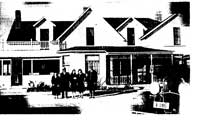
Mr. and Mrs. Smith built a thirteen room house where they farmed in Brule County, south of Kimball. Frank, the youngest, is still engaged in farming the unit, together with his wife, Eleanor.
He was known familiarly as "Irish John Smith". This he was to his dying day.
Judge Bakewell said of him that he was one of the most intelligent witnesses he ever had on the stand. He was used as a witness to help establish corner lines for measurement of land areas.
Mr. Smith enjoyed politics and was a Senator from Brule County. He served in the10th session for the years 1907-1908.
Of this pioneer family just two of the children are still living. Elizabeth Willrodt of Chamberlain and Frank, still on the farm.
An epitaph could be written from his own words. He lay on the battlefield for three days and nights. The sun was hot and maggots were eating at his wounds. He was 19 years of age, alone and severely wounded. Finally, a wagon came to pick up his remains. The young private got up and said, "I'll not die in rebel territory." His life story was - they might try to kill, but they will never defeat me."
He never was quite sure how old he was - so one day he got the idea to go to Ireland and find out. As he was sight-seeing in different places he went to Scotland as he had relatives there. He visited Edinburgh Castle and whom did he meet there buy Judge Brown from Chamberlain. They hugged, danced and kissed each other - as it was so nice to meet someone from home.
My mother was quiet, retiring and a homebody person. Happy with her
large family. Always there ready to welcome all the many friends in her
home.
Other notes from A Short History of Brule County.
This quote tells how Irish John Smith began his fortune. He used technology to get ahead.
 |
HIGHLAND TOWNSHIP The township was given this name on account of its surface being higher than the surrounding townships, especially those to the south and east, which to a great extent were covered with lakes. In those early days it seemed that there was too much water in Brule County, and the Highland Township inhabitants considered themselves favored in not having so many lakes, but even then the first settlers often built their shanties or houses on their highest ground in order to lessen the danger of being flooded out. The township was settled for men and women, quite a number being school teachers who practiced their professions when they could while holding down their claims. Some of the men brought oxen with them and those did not bought a pair of oxen for $75 as soon as they could. Horses were not available. "Irish" John Smith brought three with him and they were the envy of the whole neighborhood. He was in a "class by himself." |