

Last name origins & meanings:
- English and French: from the word denoting the animal, Norman French came(i)l, Latin camelus, classical Greek kamēlos. The surname may have arisen from a nickname denoting a clumsy or ill-tempered person. It may also be a habitational name for someone who lived at a house with a sign depicting a camel.
- English: from an assimilated pronunciation of CAMPBELL.
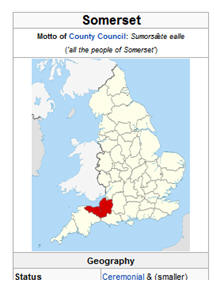
- English: possibly a habitational name from Queen Camel and West Camel in Somerset, Camel(le) in Domesday Book (1086), possibly a Celtic name from canto- ‘border’, ‘district’ and mēl ‘bare hill’.
- Probably an Americanized spelling of KAMEL.
How this Surname impacts our family.
Nancy Anne Camel married James Ryan in 1836, and they are the parents of Batt Ryan of Kimball, South Dakota. Above are the generally accepted origins of the Camel surname, and we believe the most likely option is that its a derivation of the Campbell surname (Option 2). While we believe this is the most likely origin for our family line, Nancy Anne's family line could be derived from an old Anglo-Saxon name which appeared almost 1,000 years ago in the Celtic (Welsh) region of SW England. The following is a description of this surname, and addresses options 1 and 3. Option 4 is of German origin.
CAMEL Surname - nickname or region name
The surname of CAMEL and its variant CAMMELL have the associated coat of arms recorded in Sir Bernard Burkes General Armory. Ulster King of Arms in 1884. Registered to Charles Cammell Esq, JP of Norton Hall and Brookfield Manor, Hathersage, County Derbyshire, and Ditcham Park, County Southampton, and County Sussex. The name was originally a nickname meaning 'the great, awkward, hulking fellow', as used by Shakespeare 'A Dray-man, a Porter, a very Camell'. The earliest of the name on record appears to be Robert de CAMEL, who was recorded in 1200 in County Somerset, and Richard de CAMMEL was documented in 1319. John le CAMULE was recorded in 1319 in County Somerset. Many factors contributed to the establishment of a surname system. For generations after the Norman Conquest of 1066 a very few dynasts and magnates passed on hereditary surnames, but most of the population, with a wide choice of first-names out of Celtic, Old English, Norman and Latin, avoided ambiguity without the need for a second name. As society became more stabilized, there was property to leave in wills, the towns and villages grew and the labels that had served to distinguish a handful of folk in a friendly village were not adequate for a teeming slum where perhaps most of the householders were engaged in the same monotonous trade, so not even their occupations could distinguish them, and some first names were gaining a tiresome popularity, especially Thomas after 1170. The hereditary principle in surnames gained currency first in the South, and the poorer folk were slower to apply it. By the 14th century however, most of the population had acquired a second name. A later instance of the name mentions George CAMELL and Elizabeth Hanson who were married at St. George's Chapel, Mayfair, London in 1752. In the Middle Ages heraldry came into use as a practical matter. It originated in the devices used to distinguish the armoured warriors in tournament and war, and was also placed on seals as marks of identity. As far as records show, true heraldry began
 |
The Camel name is an important part
of the history of the ancient Anglo-Saxon tribes of Britain.
Camel is derived from the given name Camel a variation of the
old Norse name Gamal. The surname Camel is also of
nickname origin and refers to a person who had physical
characteristics similar to a camel. These characteristics
could include awkwardness and ill-temper. The origin is
also toponymic which means that thebearers came from Queen Camel
or West Camel which were parishes in Somerset. Camel early Origins. Before the last few hundred years, the English language had no fast systems of spelling rules. For that reason, spelling variations are commonly found in early Anglo-Saxon surnames. Over the years, many variations of the name Camel were recorded including Camell, Cammel, Camel, Camule, Camyll, Gamyll, Cammel and many more. |
Camel Settlers in the United States in the 18th Century
- James Camel, who arrived in Virginia in 1724
- Adam Camel who arrived in Pennsylvania in 1762
- Peter Camel, who landed in America in 1782
- Robert Camel, who arrived in Mississippi in 1799.
Camel Settlers in the United States in the 19th Century
- Carl T Camel, who arrived in Allegany county, Pa in 1848
- Francis Camel, who landed in California in 1875
Death
- Timothy Cammell dies in 1767, Limerick
Marriage
- Mary Camel, 1790 in Limerick
- Anne Camel, 1836 Co. Tipperary (our ancestor)
- Patrick Camell, 1860 in Limerick
- Catherine Camel, 1865 in Limerick
- Thomas Camel, 1878 in Tipperary
Baptisms
- Johanna Camel, 1850 in Limerick
- Honora Camel, 1863 in Limerick
- Catherine Camel, 1867 in Tipperary