Deadwood Turgeons - Part 2
Abraham Turgeon’s Wife Remarries
According to an account found in the Black Hills Daily Times dated May 16, 1888, Abraham Turgeon’s widow, Eleanor Turgeon, married Alexander Bertrand. There is no grave record for Abraham Turgeon in any cemetery found in the Lead or Deadwood, South Dakota area. Both public libraries in Lead and Deadwood contain indexes to cemeteries in Lawrence County, South Dakota. To be fair, the burial records for St. Ambrose Catholic Cemetery at Deadwood were destroyed in the Nineteen Thirties when a local funeral parlor burned to the ground. The parlor maintained these records for the Church. Many graves in the Catholic cemetery are unmarked. Estimates suggest 800 people are buried there but only half are marked.
At first we thought her dead husband was our own ancestor's (Philias Turgeon) brother, Abraham Turgeon, who lived in Charles Mix County, Dakota. This would have made a titillating tidbit if true, especially since the 'Charles Mix' Abraham Turgeon died in 1890 due to accidentally ingesting Aconite instead of his prescribed medication.
So who was this other Abraham Turgeon? Ferdinand and Joseph Turgeon had a brother named Abraham. His marriage record appears below. Abraham’s parents were Pierre Turgeon and Olive Morin. He married Eleonore (Eleanor) Giroux from St. Roch parish in Quebec on November 8, 1864. Abraham’s brother, Theophile, served as best man. Eleonore’s parents were Jean Giroux and Julie Gagne.

Alexander Bertrand and Eleonore Turgeon
Alexander Bertrand was the superintendent of the Lawrence County, South Dakota, poor farm at Deadwood. We was born in Bordeaux, France, on October 18, 1855, a son of Marcell and Marcelle (Levis) Bertrand, the former a native of Bordeaux, while the latter was born in northern Italy. His father was a farmer and in 1864 the family sailed to Montreal, Canada, and began farming on the Ottawa river near Point Fortune.
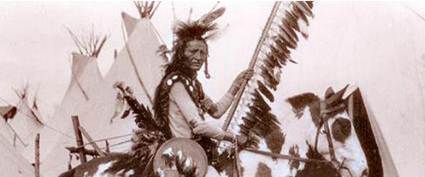
Two Sticks
Before coming to Deadwood, Alexander worked as a ship's steward, blacksmith, and prospected gold in Aspen, Colorado for a short time. From Aspen he started on foot for the Black Hills. In Deadwood he secured a job as cook in the old Merchants Hotel. In 1880 he became proprietor of a boarding house in the Blacktail Gulch. Later he operated the Overland Hotel, ran a restaurant in Galena, and then became a jailer in Deadwood. While employed as a jailer he watched over a famous Sioux chief, Two Sticks. Two Sticks was tried and convicted of murdering several cowboys near Rosebud, and many thought the charges were contrived. Before his death, Two Sticks gave Alexander his peace pipe. In 1906 Alexander Bertrand was selected county superintendent of the poor farm.
Black Hills Daily Times; May 16, 1888; Deadwood, South Dakota

Bertrand and Turgeon Wedding Announcement
Eleanore Turgeon Bertrand Dies
The Daily Pioneer-Times
Deadwood, South Dakota
Wednesday, August 31, 1904
The following article is grainy. It reads: Funeral of Mrs. Bertrand. The funeral over the remains of the late Mrs. Alexander Bertrand will be held from the Methodist church this afternoon at 2:30 o’clock. Following the services interment will be made in the Mt. Moriah cemetery.
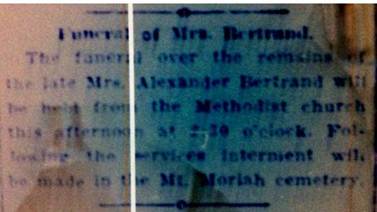
Although Eleanore Bertrand was married in the Catholic Church, at some point this family became Methodists. The 1890 list of Deadwood Catholics did not include either Eleanore (Lenore) or Alexander Bertrand.
Why they became Methodists is unknown. However, the Methodist Church in Deadwood specifically targeted the Gem Theater in its moralistic drive to clean up the town. The Gem Theater was owned by Ellis Albert ‘Al’ Swearengen, who married Odelia Turgeon.
Al Swearingen and Odelia Turgeon
Al Swearengen was one of the more nefarious characters in old Deadwood. Ellis Albert "Al" Swearengen (b. Oskaloosa, Iowa, July 8, 1845 – d. Colorado, November 15, 1904) was a pimp and early entertainment entrepreneur in Deadwood, South Dakota, running the Gem Theater, a notorious brothel, for 22 years, and combining a reputation for brutality with an uncanny instinct for forging political alliances.
Swearengen and his twin brother, Lemuel, were two of ten children of Daniel Swearengen and Keziah (often called Katie) Swearengen of Oskaloosa. Unlike so many of Deadwood's residents who left home at a young age to make their fortunes on the wild frontier, Swearengen remained at home well into his adult years, arriving in Deadwood in May 1876 with his wife, Nettie Swearengen. Nettie would later divorce him on the grounds of spousal abuse, and Swearengen would marry two more times, both marriages ending as the first. His second wife was named Odelia Turgeon. Odelia’s background is hazy but she was a young woman living in Deadwood during those raucous gold mining times.
Swearengen was one of the first Deadwood residents not to be a prospector or miner; he represented the beginning of a second wave of residents, attracted there by the promise of
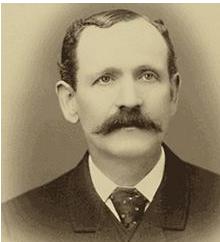
Picture of Ellis Albert Swearengen
riches to be stripped not from the earth, but from the prospectors and miners. He built a small saloon called the Cricket Saloon, which featured as entertainment in its close spaces local miners engaged in what were advertised as "prize fights", although no prizes were actually awarded. Within a year, Swearengen had accumulated enough money to build the much larger and more opulent Gem Variety Theater, which opened on April 7, 1877, featuring the now traditional "prize fights" in addition to stage shows, and, mainly, prostitution.
The first two dancers Swearengen employed were his wife, Nettie, and a woman named Martha Jane Canary better known as Calamity Jane. Calamity Jane worked on and off at Swarengen's Gem Theater for many years.
Al Swearengen was one of the main characters in the HBO series, Deadwood. The television series portrayed Al as ruthless and violent; however, in real life Al Swearengen was much crueler than portrayed in the series.

Old Photograph of Deadwood, circa 1876
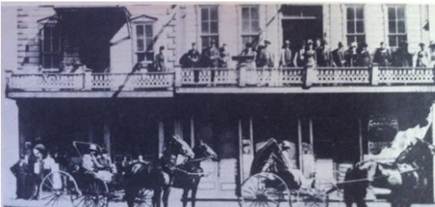
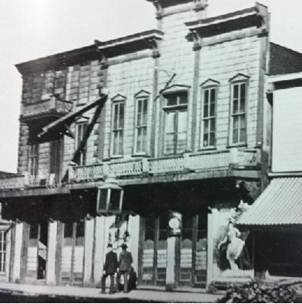
Photograph taken outside of the Gem Theater in old Deadwood
The Gem Theater (Den of Infamy) provided not only much entertainment consisting of stage performances and dancing but also the services of prostitutes, many of whom were recruited by deceptive means, as illustrated in the September 5, 1884, edition of the Black Hills Daily Times (Deadwood) front page headlines blared out the news - "A Den of Prostitutes Under the Guise of a Dance Hall...Backed with Unsuspecting and Innocent Girls...Engaged through Misrepresentation by the Bestial Proprietor...narrow Escape".
A party of 11 girls had arrived on the Pierre coach from Chicago under engagement of E.A. Swearingen, proprietor of the Gem, only to find themselves in an unexpected situation which "culminated in anguish as the hideous proportions and surroundings of the iniquitous Gem burst upon them in all its miserable reality".
These gals escaped to the nearby Wentworth Hotel. "They had been engaged in honest employment at Chicago and were allured by an ad in the News for twelve girls to work in a hotel, application to be made to E.A. Swearingen". Al met them all and lured them to Deadwood by his lies and deceit.

The photograph above comes from the Adams Museum and depicts the Gem Theater as it appeared in 1880.
The photograph below was taken inside the Gem Theater between 1882 and 1886.

The fact is many of the girls lured to the Gem committed suicide out of despair. One girl in particular was beaten senseless by Swearingen. This was after she lodged a hatchet into one of her John's head in self-defense. Al beat her not because she killed someone, but because she killed one of his best customers.
Erik Iverson in his article, “A Deadwood Gem” wrote: “After his divorce from Nettie, Swearingen's next significant romance was with a young tart named Odelia Turgeon. When the couple met "Dela" was twenty-one years old and Swearingen forty-two. After a brief courtship they married.”
Al Swearingen and Odelia Turgeon married at St. Ambrose’s Catholic Church in Deadwood. The following news article appeared in the Black Hills Daily News dated July 10, 1889.

Odelia bore no known children while married to Swearengen; however, they did have a daughter together before their marriage. She was born August 19, 1886, and baptised at St. Ambrose Catholic Church on September 1, 1886. They named this baby ‘Leonore’. Her godparents were ‘F. Walsh’ and ‘Leonore Turgeon’. We assume the sponsor, Leonore Turgeon, was Eleonore Turgeon who later married Alexander Bertrand.
Alas, this marriage made in heaven would not be a happy one. By the end of the year the following news item appeared in the Black Hills Daily News, Deadwood, dated December 12, 1889. Al beat up his wife pretty badly but the police did not arrive until after the fight was over. Odelia filed charges and Al skipped town.
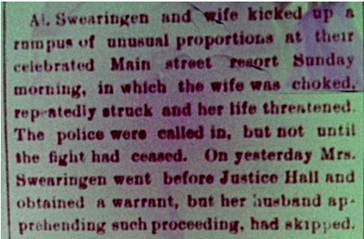
Al Swearengen in District Court
A few days after Al beat up his wife, he left Deadwood via stagecoach to evade arrest. Al Swearengen earlier made a deal with Sheriff Seth Bullock. Bullock would control upper Deadwood and control crime there. Swearengen would control lower Deadwood which contained the saloons, opium dens and houses of ill repute.
Later that month Al arrived back in Deadwood but was forced to appear in District Court and face domestic disturbance charges stemming from his assault on Odelia. Later all charges were dropped against Al. Odelia dropped all charges and paid the court costs which were assessed at $7.50.
The Black Hills Daily Times
Deadwood, Dakota
December 18, 1889
Page 1, column 4
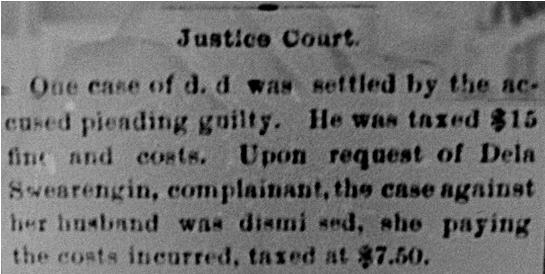
More Domestic Abuse
Odelia’s marriage to Al was hallmarked by bouts of domestic disturbance and violence. Perhaps Al promised to change his ways in December, which prompted Odelia to dismiss charges against him. Unfortunately, all was not well in the Swearengen household. Odelia required doctor’s care a month later due to hemorrhaging. Was she beaten again or did she suffer a miscarriage? The facts are unknown.
It was said you normally saw Odelia sporting one or two black eyes.
Black Hills Daily Times
Deadwood, Dakota
January 31, 1890
Page 3, column 2
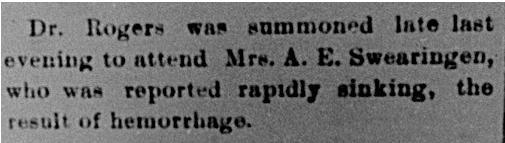
Almost a year after they were married, Al Swearingen began divorce proceedings against Odelia on the grounds that she was unfaithful. Later the judge would grant the divorce but not due to adultery. The divorce was probably granted due to spousal abuse. (Black Hills Daily Times, July 10, 1890). Whatever the real reason, Odelia left the area for she is not buried in either Deadwood, Lead or St. Onge. No one knows when or where she died.

Who was Odelia Turgeon Swearengen? Her nativity and early life remain a mystery. I believe Odelia’s parents were Eleonore Giroux Turgeon and Abraham Turgeon. Eleonore later married Alexander Bertrand after Abraham’s death. What was Odelia’s occupation? Unknown; however, Al Swearengen forced his first wife to work as a dancer in the Gem Theater. Calamity Jane worked for awhile as one of the dancers. Perhaps Odelia was employed as a dancer or other dance hall worker in the Gem as well.
According to his recently rediscovered obituary, Al Swearengen was found dead in the middle of a suburban Denver street on November 15, 1904. He apparently died of a massive head wound and was not hopping a freight train as is often reported. One theory suggests Al's brother, Lemuel, may have been involved in his death. Something to do with a business deal that went sour. Swearingen did not hide his bad reputation in Deadwood, so it is amazing anyone would be attracted to him, including Odelia Turgeon. About the only thing we know of Odelia is she traveled in and out of Deadwood frequently. Leonore Giroux Turgeon had property in Deadwood and transferred title of said property after her marriage to Alexander Bertrand. Perhaps these Turgeons ran a boarding house.
Odelia disappears from Deadwood Scene
Odelia seems to have disappeared entirely from the Deadwood scene after her divorce. Nothing is known of her daughter, Leonore, or whether her daughter survived childhood. The 1890 list of Deadwood Catholics shows the following parishioners: Mrs. Alfred Swearengen and Al Swearengen. If little Lenore survived, perhaps both she and her mother, Odelia, moved back to Quebec.
St. Ambrose Catholic Church
Deadwood, South Dakota
In America a great number of Catholic Churches were started by Irish or German immigrants. St. Ambrose Parish was created to serve the large number of French Canadian gold miners living in or near Deadwood. St. Ambrose was created in 1877, shortly after the start of Black Hill’s Gold Rush.
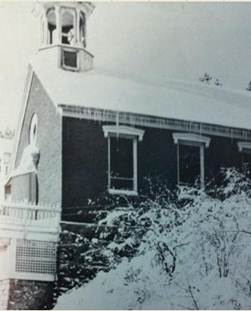
Photograph of old St. Ambrose Church in Deadwood. This building located on Williams Street was used by Catholic worshippers from 1877 to 1934. In 1934 Catholics began worshipping in the new church on upper Main Street in Deadwood.
Below is a picture of the Gem Theater’s exterior.
Tragedy Strikes Turgeon Family
The following appeared in December 22, 1889, Black Hills Daily Times
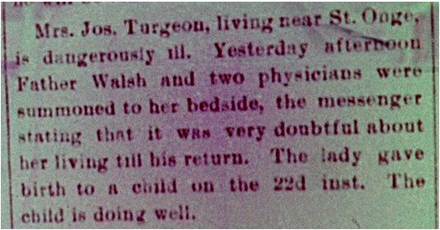
In 1889 the dreaded black smallpox epidemic raged in Deadwood and took the life of Mary Turgeon and two of her children. At this time the family was living near present day St. Onge. Black smallpox describes a symptom of smallpox that is caused by bleeding under the skin which makes the skin look charred or black. Although more common in adults, it also affects children. This symptom usually indicates that a patient with smallpox is going to die. The above news article painted a dire picture for Mary Turgeon.
A few days later the following obituary for Mary Turgeon appeared in the Black Hills Daily Times. The child’s name was Joseph Francis.
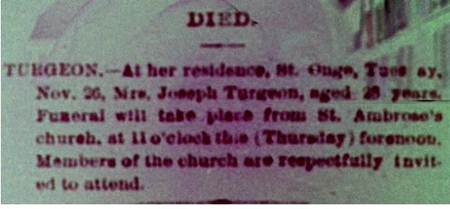
Several days later on December 3, 1889, her four year old child, Charles Henry, died of smallpox. There is an old saying about tragedy striking three times. On December 22, 1889, another son, Joseph Francis, died of smallpox too. In those days it was common for caregivers to be smallpox survivors. Calamity Jane was famous for providing this care as she survived smallpox in one of Deadwood’s earlier epidemics. In many communities it was common for care to be given in a separate house from your residence. Once the epidemic finished these pox houses were burned to the ground. In this case, Mary Turgeon, died in her own home. Mary’s sister, Caroline Brouillette Lavier, always remembered her departed sister with love and sadness.
Black Hills Daily News
December 22, 1889
Deadwood, South Dakota
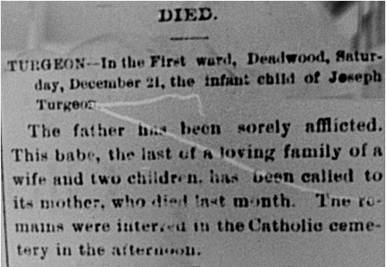
Joseph and Mary Turgeon had one son, George, who survived the epidemic. George was born in 1881.
St. Ambrose Catholic Cemetery

Turgeon tombstone in Deadwood’s St. Ambrose Cemetery. Below shows the Turgeon gravestone in relation to the Giroux Family Plot. The Giroux family connects to Joseph Turgeon through his brother, Abraham Turgeon. Abraham married Eleonore Giroux.
St. Ambrose Catholic Cemetery was established as a Catholic graveyard in 1889, although it may have been used as a cemetery prior to this date. This graveyard was not used for many years and is in need of great repairs. One Newspaper article suggested it had not been used since the Nineteen Thirties; however, at the top of the hill there is a new monument dated 2007 for the Walsh family.
The tombstone above appears in St. Ambrose Catholic Cemetery in Deadwood. It marks the resting spot for Mary Turgeon (mother) and her two sons, Charles and Joseph. An inscription at the bottom of the monument reads: “No pains no grief no anxious fear can reach our loved ones sleeping here.”
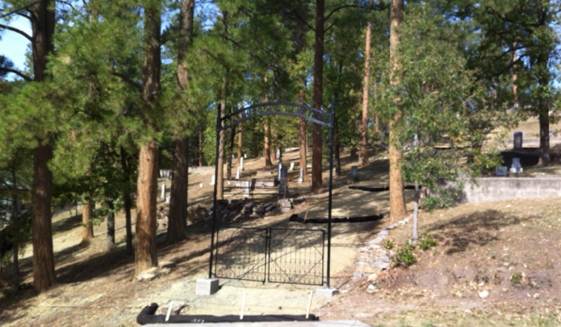
St. Ambrose Cemetery Gate; Deadwood, SD
One other Turgeon lies buried in this graveyard but there is no tombstone. Church records state Alfred Turgeon, aged 10 months, died in 1885 and is buried somewhere in this cemetery. Joseph Turgeon, Sr., never remarried. Church records do not record an interment for Abraham Turgeon.

Above shows the Turgeon gravestone in relation to the Giroux Family Plot. The Giroux family connects to Joseph Turgeon through his brother, Abraham Turgeon. Abraham married Eleonore Giroux.
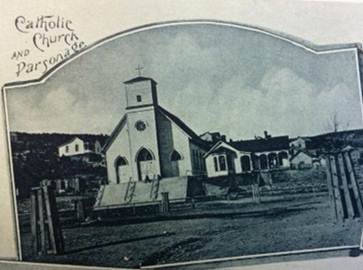
Photograph above shows the Early Catholic Church and Parsonage in Lead, South Dakota. Lead served as the head of the Catholic diocese in the latter 19th and early 20th centuries.
Layout
Since this is a one-column layout, the .content is not floated.
Logo Replacement
An image placeholder was used in this layout in the .header where you'll likely want to place a logo. It is recommended that you remove the placeholder and replace it with your own linked logo.
Be aware that if you use the Property inspector to navigate to your logo image using the SRC field (instead of removing and replacing the placeholder), you should remove the inline background and display properties. These inline styles are only used to make the logo placeholder show up in browsers for demonstration purposes.
To remove the inline styles, make sure your CSS Styles panel is set to Current. Select the image, and in the Properties pane of the CSS Styles panel, right click and delete the display and background properties. (Of course, you can always go directly into the code and delete the inline styles from the image or placeholder there.)