Ferdinand Turgeon in Civil War
'Deadwood' Dakota Turgeon Clan
After the initial Black Hills's gold rush we find the following Turgeons living in Deadwood: (1) Ferdinand Turgeon, (2) Joseph Turgeon along with his family, (3) Leonore with Abraham Turgeon, and (4) Odelia Turgeon. The following are their stories. All these Turgeon's trace their lineage to Joseph Turgeon and Olive Morin.
Ferdinand Turgeon
Ferdinand Turgeon may have been the first Turgeon settler in the Dakotas. Ferdinand Turgeon was living in Dakota Territory prior to the Civil War. He was born in Bellechasse County, Quebec, near our own Turgeon ancestors. Ferdinand’s parents were Pierre Andre Turgeon and Olive Morin. By 1852 Pierre Andre Turgeon (age 48), a farmer, and Olive Morin (age 39) had the following children: Jean (age 17), Ferdinand (age 15), Abraham (age 11), Theophile (age 4), Joseph (age 1), Adelaide (not born), Celina (age 20), Rose, (age 7), Arzelie (age 6), George (age 2) and Malvina (age 5). Pierre’s parents were Pierre Turgeon and Marie Anne Roy.
1852 Lower Canada Census, Beaumont, Bellechasse County, Quebec

Pierre Andre Turgeon’s lineage is as follows: (1) Pierre -> (2) Andre -> (3) Jean -> (4) Zacharie -> and (5) Charles. Compare that to our own ancestor, Cesaire Turgeon: (1) Francois Xavier, (2) Antoine -> (3) Louis, (4) Zacharie, and (5) Charles. Pierre and Cesaire are third cousins based on their Turgeon lineage. They may be closer relations via another family line. It was a bit confusing considering Cesaire’s brother is named Pierre Narcisse Turgeon. Pierre Andre Turgeon married Olive Morin on November 23, 1830, at Saint-Henri-de-Lauzon church in Levis, Quebec. Olive’s parents were Jacques Morin and Marie Louise Anne Morissette.
Ferdinand Turgeon’s baptismal record appears below. He was born ‘Joseph Ferdinand Turgeon’ and baptized in 1837 (mil huit cent twente sept). His parents were Pierre Andre Turgeon, a farmer, and Olive Morin at the family's home parish (St. Etienne Parish, Beaumont, Bellechasse County, Quebec). Ferdinand’s godmother (marraine) was his father’s sister, Adelaide Turgeon.

The following records Pierre Andre Turgeon’s marriage to Olive Morin. Pierre’s parish is listed as Saint Etienne Parish in Beaumont, which is the same parish as his parents, Pierre and Marie Turgeon.

Pierre Andre Turgeon Family Members
The following is what we know about various members of Pierre and Olive Turgeon’s family. Their son, Pierre Turgeon, married Chrystine Shink at Beaumont on March 9, 1857. Son, Abraham Turgeon, married Eleonore Giroux at St-Roch Quebec on November 8, 1864. Daughter, Jean Turgeon, married Onesime Charbonneau at Ottawa on December 8, 1869. Daughter, Adelaide Turgeon, married Louis Carrier at Beaumont on October 2, 1876. Daughter, Celina Turgeon, married Charles Letiellier at Beaumont on October 5, 1852. Daughter, Marie Rose (Rose) Turgeon, married Pierre Roy on August 20, 1908. Son, Joseph Turgeon, married Mary Brouillette at Sioux City, Iowa, in 1880 or 1881. Son, Theophile Turgeon, married Marie Georgiana Halle at Notre Dame de Levis Parish on February 18, 1873.
Dakota Bound
In early Eighteen Sixties there was a small group of French settlers living in Union County near present day Elk Point, South Dakota. When Ferdinand arrived in Dakota is unknown. Whatever date he actually arrived will never be known; however, he was an early settler in Dakota Territory. Indians still roamed this wild land, and modern conveniences were almost unknown.

French Settlers in Union County, Dakota Territory
Lewis and Clark made an expedition up the Missouri River and their first stop on Dakota soil was made near the present site of Elk Point on August 22, 1804. The main motive for exploring the country and then settling it was found in the profitable fur trading business at first. It was not until 1851 that white men had any legal claim to territory within the limits of Dakota.
Other researchers indicate the first permanent French Canadian settlement may have been in 1859. The early settlers concentrated in the area around Elk Point and Sioux Point at the junction of the Missouri and Big Sioux Rivers.

Sioux Indians in Dakota Territory
In 1988 Dr. Nancy McCahren wrote an article regarding an early Indian attack on French settlers: "Those French who crossed the Missouri River and came to South Dakota first settled in southern Union and Clay Counties. Among the early settlers in Jefferson, Elk Point, and Civil Bend Townships, all in Union County, were the families of Albert LaBrune, Alexander Duhaime, Marc Chicoine, David Remillard, R. J. Authier, Charles LaBreche, Philippe Beauchemin, Joseph Yerter, Clement Guillaume, Abraham Chaussee, Charles LeMoges, and the LeMeres. All were farmers; Charles LaBreche owned 1,100 acres, and was cited by one early biographer as "probably the most prominent French-American citizen living in Union County." In the fall of 1862, the same year Mr. LaBreche and seven other French Canadian families settled in Union County, the Indians became restless and hostile, and settlers were compelled to get away from the locality or suffer the consequences. While Mr. LaBreche and his party were passing over Brule Creek near Richland on their way to Sioux Falls with government supplies, the Indians were seen to attack a Mr. LaMoure and Tom Watson. Although they had no firearms with them, nor weapons, Mr. LaBreche, Joseph Yerter, Francis Bertrand and Vincent LaBelle started to rescue their unfortunate neighbors. Watson had been wounded, and it was Charles LaBreche who found Mr. LaMoure's body and carried it to a nearby house before he continued his safe journey to Sioux Falls."
The Dakota Cavalry

Dakota Cavalry
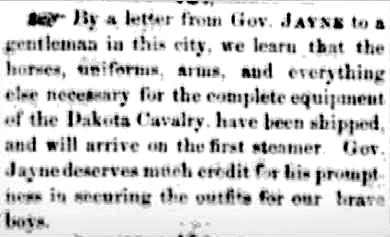
The 1st Dakota Cavalry was a Union Army battalion of two companies during the American Civil War. They were used for service along the frontier, primarily to protect settlers during the Sioux Uprising of 1862. The Cavalry was created and Governor Jayne of Dakota Territory had to request uniforms and other supply items.
Civil War in South Dakota
Company B, Dakota Cavalry, was formed by recruiting and by the consolidation of two or three small detachments that had been raised under the proclamation of the governor on October 12, 1862, at Sioux City. William Tripp was the Captain and Ferdinand Turgeon as one of the Corporals.
Yankton Press and Dakotan; June 17, 1862
Company A
By order of the War Department, this cavalry unit was organized in the winter of 1861-2, with recruiting stations established at Yankton, Vermillion, and Bon Homme. At Yankton, with Captain Nelson Miner commanding, 98 men of Company A were mustered into service on April 19, 1862. They first were stationed at Fort Randall under Lt Colonel Pattee of the 7th Iowa Cavalry, but detachments of the company were afterward sent to protect the settlements at Yankton, Vermillion, Sioux Falls and Brule Creek. Upon the commencement of the August 1862 uprising, Company A escorted the settlers as they moved to protective stockades. Governor William Jayne also called for "every able-bodied man to arms in defense of the homes of Dakota", with 399 men responding.
Dakota Republican; Vermillion, Dakota; March 14, 1863
Company B
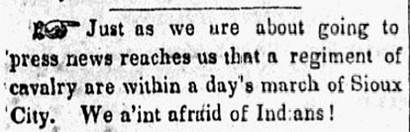
Within a short time Captain Alpheus G Fuller, an early settler in the territory, began raising a cavalry militia in Bon Homme and Charles Mix counties, the "Miltia Brigade of Dakota". Failing to form a company for U.S. service, the men were merged in with volunteers being organized at Elk Point, and were mustered in as Company B on March 31, 1863, at Sioux City, Iowa with Captain William Tripp commanding. This company was known by the settlers as the "Dakota Rangers".
Both companies were engaged in the protection of the Dakota frontier towns, while Generals Henry Sibley and Alfred Sully, with regiments of infantry and cavalry from Minnesota, Iowa and Nebraska, sought out hostile Indians throughout the territory. The two companies were split into detachments for use at several settlements. With the Civil War ended, and the Indian troubles drawing to a close in 1865, the two companies were mustered out, Company A on May 9, 1865 and Company B on November 15, 1865. A list of soldiers gives the battalion a total of 194 soldiers.
Yankton Press and Dakotan; Yankton, Dakota; May 12, 1863
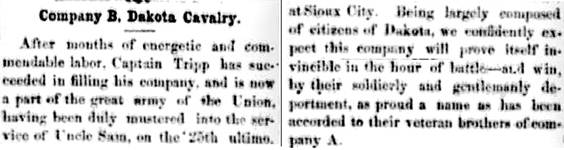
Newspaper article reports Company B has a full contingent of horse soldiers ready for service to her country.
Yanktonian Press and Dakotan; Yankton, Dakota; June 14, 1863
Newspaper article suggests Companies A and B will be quartering in Vermillion, Dakota Territory, to protect settlers in the vicinity.

Yanktonian Press and Dakotan; Yankton, Dakota; July 7, 1863
Odd news item regarding Company B’s part in Yankton’s Fourth of July Celebration when no other celebration was planned.

Yankton Press and Dakotan; Yankton, Dakota; September 29, 1863
Captain Tripp and Company B scouted Indian country

Engagements
In June 1864, Gen Sully selected the 1st Dakota Cavalry to serve as his guard while he traveled to Fort Sully, to rendezvous with other forces joining him there. Upon the completion of the brigade, the expedition left Fort Sully on June 24, 1864. On July 28, 1864, Sully's force of 2,200 soldiers encountered a camp of between 5-6,000 warriors, and the Battle of Killdeer Mountain commenced. The US forces lost 5 killed and 10 wounded in the battle, but they were not said to be from the 1st Dakota Cavalry.
History of the Dakota Cavalry
History of South Dakota Volume 2, by Doane Robinson
“When the committee returned from the Yanktons they found the Yankton stockade about half completed and the news they brought threw the community into another panic. Captain Ziebach sent a messenger with the news to Captain Miner at Vermillion and the latter arrived at sundown with reinforcements for the militia and Sergeant English's squad of cavalry at Yankton. During the day English had been scouting through the bottoms for a party of Sioux who had fired on J. B. Greenway, the Jim river ferryman, that morning. He overtook them on the bank of the little lake at Gavyville and in a sharp skirmish one Indian was killed.
Mahlon Gore gives this account of the occasion of the stampede. When the detachment of Company A discovered the band of Indians and rounded them up in the log cabin on the lake at Gayvlle a soldier named Bell was detailed to go express to Vermillion and secure assistance. Instead of going directly to Vermillion, Bell instead went to different settlements sounding the alarm of impending Indian attacks. These families gathered up their effects and went to Sioux City in exodus. This happened at the same time when the crops were ripening. Except for a few hardy men, all women and children left Vermillion for Sioux City. Most settlers moved back to Vermillion area within the week.
However, the settlers anticipated an Indian attack and they were in constant terror. Governor Jayne of Dakota Territory called out the militia and recruited all winter. Active service began on March 31, 1863 when the company was mustered into the United states Service. Ferdinand Turgeon was recruited into this militia.
In late November, Captain Miner, with forty of his men, escorted some of the settlers back to Sioux Falls to recover the goods cached there when they left so abruptly in August. They secured the goods, but ran upon a band of Indians who showed fight. The Indians were quickly repulsed by the soldiers and one was killed by Charles Wright, still of Yankton, in the slough known as Covell's lake just west of Sioux Falls. This was the band of Inkpaduta and the savage killed was an exceptionally vicious young fellow by the name of Wakeyandoota. After the capture of the Indians by General Sibley at Camp Release in Minnesota, a party of Wahpetons struck out for the dirt lodges of the land located on the Jim near Redfield, but they were overtaken and captured by Lieutenant Colonel Marshal, at Lake Nicholson in Coddington county, and were returned to Minnesota.
This is the story of the Indian war of 1862, so far as South Dakota is concerned. Much worse depredations occurred in Minnesota. Its net results were the massacre of Judge Amidon and his son at Sioux Falls in August and the killing of one Indian near Gayville by Sergeant English's squad and the killing of another at Sioux Falls by Charles Wright, of Captain Miner's company, at Sioux Falls, in November. The war effectively stopped immigration for several years after.”
Historical data suggests the Dakota Cavalry saw little action. Ferdinand Turgeon was promoted to Corporal three months after his enlistment. He was given a $25 dollar bounty and he brought his own horse which the military valued at $90. His pay was $22.68 a month including extra pay for his horse. On May 9, 1864, Ferdinand was assigned to a surveyor by the name of Anders. Official records do not state this purpose; however, the US Government earlier approved a survey of its public lands.
Hartford Daily Courant; Hartford, Ct.; May 15, 1863
This article may indicate why Ferdinand Turgeon was accompanied a surveyor in Dakota Territory.

Ferdinand Turgeon was placed on special detachment away from his unit. Eventually he was mustered out on November 15, 1865. However, a note on his record states the following: “Corporal from April 1/63 - Stop. Revolver and acc $8.00 retained. Horse stampeded by Indians and lost in fight near Powder River Aug 13/65”.
May 27, 1865; Yankton Press and Dakotan; Yankton, Dakota
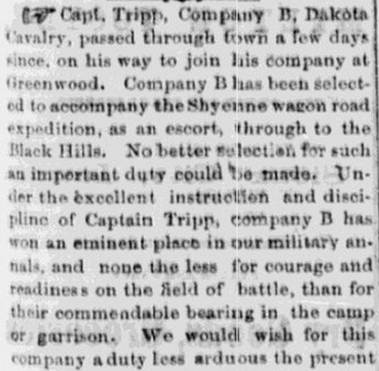
The following news article reports Company B was stationed in Greenwood, Dakota Territory. Greenwood no longer exists but was located south of present day Wagner, SD, on the Nebraska-South Dakota Border.

Powder River Expedition (1865)
The Powder River Expedition was a large and far flung military operation of the United States Army against the Sioux, Cheyenne, and Arapaho Indians in what soon became the Wyoming and Montana Territories. One Arapaho village was destroyed and one fort, Fort Connor, was established to protect travleers on the Bozeman trail. It was considered a failure since the expedition failed to defeat the Indians and secure peace in the region. It is possible Ferdinand traveled with Colonel Nelson Cole’s regiment composed of 1400 Missouri soldiers. They marched from Omaha through Nebraska and the Dakotas until finally reaching the Black Hills. They reached Bear Butte, near present day Sturgis, South Dakota, on August 13, 1865, which was the same day Turgeon’s horse reportedly stampeded after an Indian attack according to Turgeon's muster record.
Above is what official records suggest at least. From Bear Butte they were supposed to go to the Powder River region and meet up with the Samuel Walker’s Kansas 16th Cavalry in the Powder River basin. Walker and Cole actually met at Bear Butte. Both commanders reported no Indian problems at Bear Butte.
May 6, 1865; Yankton Press and Dakotan; Yankton, Dakota

It was not until September 1, on Alkali Creek, near Broadus, Montana, where they first encountered Indians. About 300 Hunkpapa, Sans Arc, and Miniconjou Lakota Sioux raided the soldier’s horse herd. The soldiers guarding the horses “dropped their guns and run”. Six soldiers were killed. Sioux warriors Roman Nose and Crazy Horse were part of the attack forces. It is likely Ferdinand Turgeon lost his horse During this battle.
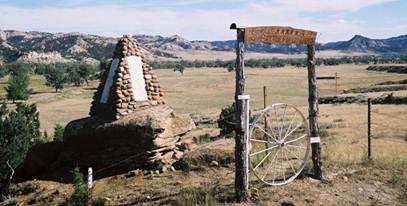
Why was Ferdinand Turgeon assigned to different units? Perhaps Uncle Sam was looking for someone who could translate with the native population. Many Indians could speak French. Apparently the U.S. Military learned little from this expedition. In 1876 the US military sent troops into the Powder River area again where Custer met his demise.

Ferdinand Turgeon After the War
Yankton Press and Dakotan; Yankton, Dakota; November 25, 1865
Company B Musters out of Service

According to Doane Robinson’s South Dakota History, Ferdinand Turgeon’s whereabouts were unknown after the Civil War. However, the 1890 US Census for Soldiers and Surviving Spouses shows Ferdinand living in Deadwood. This 1890 census record says he served 3 years 6 months in the Dakota Cavalry, Company B. He suffered no disability from the war. Company B’s Commander, Captain Tripp, wrote a letter to his unit thanking them for their service during the war. He commended them for their work and diligence even though “none died during their service nor did their bones bleach on some distant battlefield”. It appears Tripp pined for more action.
1890 US Census for Soldiers and Surviving Spouses

The following pension card appears to have been created for Ferdinand Turgeon when he applied for veteran’s benefits as an invalid in 1898.

War’s Aftermath
For his military service Ferdinand was awarded 162.5 acres in Union County, Dakota Territory, by the Land Office in Vermillion. By 1868 he owned this land free and clear with no encumbrances. In 1870 Ferdinand’s brother, Joseph Turgeon, moved to Dakota Territory near his brother, Ferdinand. Perhaps Joseph worked in Sioux City since his future wife lived nearby in Union County.