Joseph George Esser - American Hero
Early Years
Joseph Esser was born on March 19, 1902, to Mary Catharine Vallender and Frank Esser of Madison, Wisconsin. Joseph’s grandmother was “Irish” John Smith’s sister, Bridget Smith Vallender. Joseph left Madison to train for the priesthood at St. Francis Seminary in Milwaukee, Wisconsin. Father Esser was ordained to the priesthood in St. Paul, Minnesota, on June 11, 1927, when he was 25 years old. Nothing suggests his early life was anything but ordinary. As a youth he attended school and church.
After his ordination, Father Joseph was assigned Assistant Pastor at St. Stanislaus Catholic Church in St. Paul, Minnesota. On April 15, 1934, this church burned to the ground and mass was held in the parish hall. Father Joseph was still living in St. Paul by 1935, according to the 1940 U.S. Census. By 1940 he was working as parish priest at the Church of the Nativity in Cleveland, Minnesota.
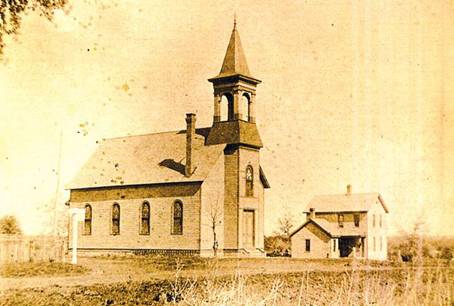
Church of the Nativity, Cleveland, Minnesota
Pearl Harbor
The attack on Pearl Harbor was a surprise strike by the Imperial Japanese Military against the United States naval base at Pearl Harbor, Hawaii, on the morning of December 7, 1941. Later, President Franklin Delano Roosevelt would declare December 7, 1941, as a “date which will live in infamy“. Prior to this attack, the American public was split between staying neutral or offering aid to Great Britain in what was viewed as someone else’s war. This unprovoked attack galvanized the American public; consequently, war was declared against Japan and other Axis powers. Wrapped in this political fervor, Father Joseph Esser enlisted in the Army as chaplain.
It is estimated one out of every ten US Catholic priests served as chaplains during World War II. The following news item gives us a good idea when Father Joseph Esser became a chaplain with the Army’s 90th Division.
Chaplains Assigned for 90th Division
Abilene Reporter-News
Abilene, Texas
Wednesday Evening, March 18, 1942
Assignment of chaplains for the 90th Infantry division, Camp Barkeley, has been announced by the war department, according to Lieut. Col. E.V. Sainsbury, assistant chief of staff, G-2, of the division. Division chaplain will be Maj. Hamilton H. Kellogg, formerly with the 43d Infantry division, Camp Shelby, Miss.
Other 90th chaplains, all first lieutenants, include: Harry G. Griffiths, William H. Hewit, Rex G. Kendall, Joseph G. Esser, Raymond P. Gerne and Bernard F. Schumacher, all from Fort Benjamin Harrison, Ind.; Merle M. Grove, Rufus Higginbottom and David P. Tarver, all from Fort McClellan, Ala.; James M. Hamilton, Dean L. Vermillion, and Cornelius J. O'Mara, all from Camp Roberts, Calif.
The chaplains are expected to arrive at Camp Barkeley between now and March 26.
Camp Barkeley was located eleven miles south of Abilene, Texas.
D-DAY and Normandy
The Normandy landings, codenamed Operation Neptune, began on June 6, 1944 at 6:30 AM. There were two phases. The first phase, an airborne assault, landed 24,000 paratroopers in Normandy. The second and most famous phase was the amphibious assault along the Normandy coast. The landings took place along a 50 mile stretch of Normandy coast divided into five sectors - Utah, Omaha, Gold, Juno and Sword.
Utah Beach was the code name for the right flank, or westernmost, of the Allied landing beaches during the D-Day invasion of Normandy. It was part of Operation Overlord. Utah beachhead was an afterthought, and was only added later to the invasion plan once more landing craft became available.
Utah Beach, about 3 miles long, was the westernmost of the five landing beaches, located between the villages of Pouppeville and La Madeleine, which became the right flank anchor of the allied offensive along the western side of the Douve River estuary. The German sector code was known as W5.
Despite being off course, the US 4th Infantry Division (part of VII corps) landed with relatively little resistance, in stark contrast to Omaha Beach, where the fighting was fierce. The 90th Infantry Division, including Father Joseph Esser, landed at Utah Beach on D-DAY.
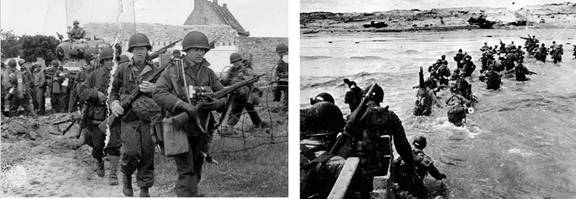
Pictures above show US soldiers securing Utah beach and troops moving onshore.
Seves Island
For three days a unit composed mostly of Texans and Oklahomans fought a desperate battle for the Island of White Witches, or Seves Isle in French. The German army repulsed an American beachhead landing which required trudging through four foot deep water. This isle formed where the Seves and Ay Rivers crossed near the western coast of the Cherbourg Peninsula.
The only way to drive German forces from the villages of Seves and Saint Germain-Sur-Seves required American soldiers wading through a little river annexed to a wide strip of Seves marshes. The German enemy maintained a small force of tanks and infantry in nearly impregnable positions.
The attack started July 22, 1944, after two days of incessant rain that raised the water over a large part of the marshes to twice the depth which had been expected. The Germans also backed up Ay waters by plugging holes in the causeway which usually flows to the sea. Despite these unfavorable weather conditions, the southwestern United states regiment pushed forwarded all along the high causeway across the marshes connecting the island and higher ground to the north.
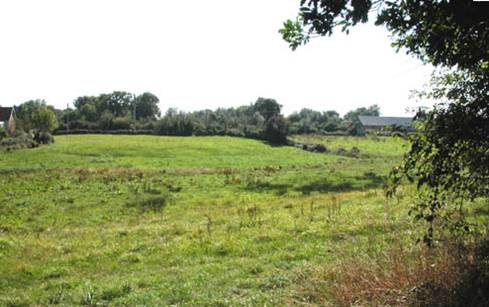
Seves Island
Too Hot to Hold
Heavy mortar fire on the advancing men forced them to wade water with rifles held over their heads. Some soldiers sank up to their faces. German machine-guns inflicted heavy casualties to Allied forces during this fierce fighting. Four companies got on the beachhead, approaching from the east after a heavy American cannon fire, but the position could not be held for long.
The German army launched a counterattack using tanks and infantry, and held Seves Island. The Americans knew the Germans were there, but their artillery was unable to knock them out. The isle was bombed by U.S. airplanes but the enemy stood firm. The Germans were entrenched in the hedged island on ground above the marshes, with American artillery pouring fire on enemy positions from the north. It looked like all sides were hopelessly deadlocked in a skirmish with no end in sight. The men were soaked to the skin in ice-cold water after three days of rain.
On July 23, 1944, three brave chaplains of the 90th infantry demonstrated true courage and respect for life. It was a glimpse of decency even in time of war. It is times like this that make one wonder if man shapes his destiny or destiny shapes the man. The attack brought out the strangest battle experience of the campaign when a former Salvation Army street preacher, Captain Edgar Stohler of Ipava, Illinois, and a Catholic priest, Captain Joseph Esser, of Cleveland, Minnesota, went under the Red Cross flag through the marshes only a few feet away from German lines picking up American wounded, some of whom had lain 24 hours in the marshes with no hope of aid.
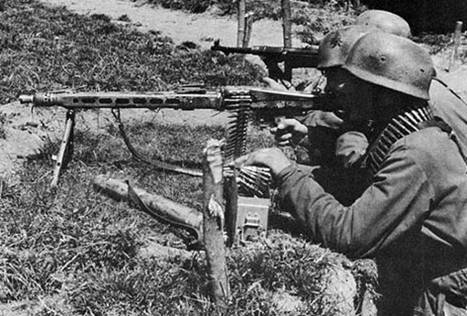
German Paratroopers manning machine guns at Seves Island
Like Ducks in a Shooting Gallery
The chaplains were all buddies. A few days earlier they tried rescuing wounded soldiers under cover of darkness, bringing in 14 men. From this earlier success they were determined to repeat more rescues through the water in broad daylight. The two men went out, sometimes wading neck-deep in water, carrying a litter. The first wounded soldiers they found they carried back themselves. They then got volunteer litter-bearers to come out when signaled. They went within 50 feet of the German lines. All this time there was a lull in the fighting with only a few shots being fired.
Then some United States fighter planes flew over, strafing German entrenchments which nearly hit the chaplains. Chaplains Esser and Stohler dived into a ditch full of cold water. The planes came back again, shooting more bullets at them. The second time, a frightened German Medic, seeking his own wounded comrades in the swamp, dived into the ditch with them. He was terrified, but Father Esser told him not to worry as he and Stohler were chaplains. The German man said he was a Catholic but neglected the church.
Father Esser pulled a rosary from his pocket, a memento which he had carried for 15 years, and gave it to the Medic, and asked only he say his prayers daily. The German promised and went his own way after the airplanes passed. The two chaplains remained more than three hours wallowing in the muddy water, with only an occasional grass bush patch to climb onto, seeking American wounded. They rescued 16 men.
All the time the swamp was under direct observation and fire but they escaped injury. Chaplain Stohler was cited once before for bravery. News articles reported both chaplains looked like tough soldiers, distinguished only by the crosses on their collars.
Esser and Normandy
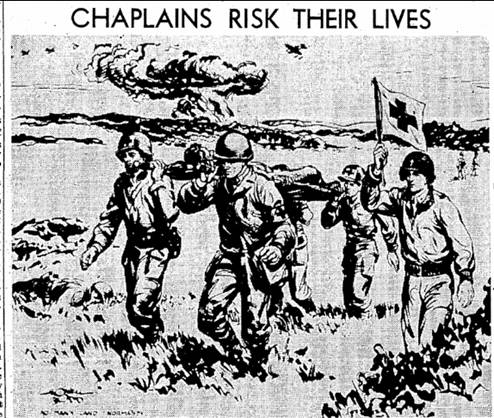
IN NORMANDY - Howell Dodd, Associated Press artist, was on the scene when three chaplains went into No Man's Land to seek wounded. He made this eyewitness sketch, as the chaplains and litter bearers, holding a Red Cross flag aloft, returned with the wounded. The chaplains were Joseph Esser of Cleveland, Minn.; Edward H. Stohler, Ipava, Ill., and James M. Hamilton, Fort Worth, Tex. - A.P. wirephoto of sketch, June 1944.
++++++++++++++++++++++++++++++++++++++++++++++++++++++++++++++++
Defying fire from both sides and menacing planes overhead these men of the cloth went into the marsh holding Red Cross flags over their heads, helping a man here, another there.
The enemy was impressed by the bravery of these men of the cloth and stopped shooting. Soon guns on both sides fell silent except the artillery in the rear.
The chaplains were met in No-Man's land by a German officer and through a German-speaking American negotiated removal of their wounded soldiers. The German officer reported back to German Major von der Heydte. Von der Heydte known for his compassion allowed a three hour cease fire for the recovery of wounded soldiers. Fighting stopped on both sides with one exception; an American bombing attack that could not be recalled forced rescuers on both sides into bunkers for a short time.
While the little group was negotiating, a German cameraman came out and snapped pictures of them. Associated Press artist Howell Dodd and writer Edward D. Ball witnessed the removal of the last casualties from a safe distance between the Allied line and the enemy. It is from their reporting that we know what happened in Seves Island. During the brief armistice the Germans came out and directed the chaplains and litter-bearers to the wounded.
Within a few minutes after the chaplains reached an aid station the eerie silence was broken over the battlefield. The Germans started shooting again and the fighting continued.
"There was no request for an armistice," Esser said. "We were out there carrying on when Stohler came over to get me to give the Last Sacrament to a dying Catholic and then Stohler and I decided to go further into the swamp and see if we would draw fire. There was none so we called back for litter bearers and began picking up our wounded.”
"Meanwhile Hamilton was picking up wounded with a party of American aid men farther down the line. They were hailed by a German paratrooper who emerged from behind a machinegun emplacement. The German directed them to a wounded American they had missed. While picking up soldiers they came upon another man whose left leg had been shot away." It is likely the paratrooper was the one who wounded the American.
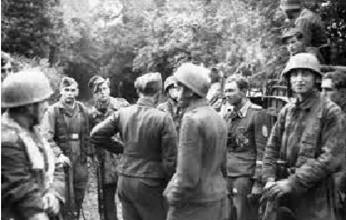
German Soldiers prior to mission in Seves Island
According to an interview after the incident, Stohler believed they were able to rescue 16 wounded soldiers with the assistance of 12 litter bearers.
The aid men who carried the wounded back to safety included Corporal James M. Gardner, Route Two, Amory, Mississippi.
The wooded swamp island has a famous Norman history. In medieval times it was the home of a mystery race of "white witches". They were wandering gypsy shepherds, ‘possessing’ occult powers that supposedly blighted the orchards and killed the flocks. In the reign of Louis XIV, 35 of them were condemned to be burned at the stake by the Normandy Parliament. The King stopped the order and evacuation of the people from this island, and appointed a commission to examine the evidence. The commission upheld the Parliament. Nevertheless, the King ordered the witches set free.
Stohler and Esser earned Silver Star awards for their bravery during this campaign.
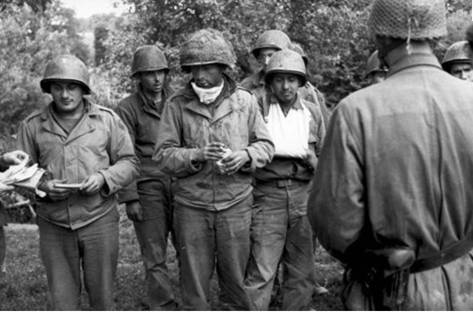
American Prisoners of War at Seves Island
Joseph Esser Adventures UNKNOWN TO HIS FAMILY
Father Esser rarely talked about his wartime experiences. He was awarded a Silver Star, which no one in his family knew existed until after his death. Father Joe was wounded three separate times. One time so severely part of his right hand was blown off, and such wounds would have been hard to hide even from his closest kin. The following news article describes Joseph Esser’s wartime adventures and provides a glimpse into his character.
Silent Hero
Wisconsin State Journal
May 30, 1982
_____________________________________________________
Priest's brave acts in World War II unknown to family
until death in '79
_____________________________________________________
By Sunny Schubert
Feature writer
Perhaps in autumn, when the sound of hunters' rifles rang through the forests of Minnesota, the Rev. Joseph Esser remembered World War II.
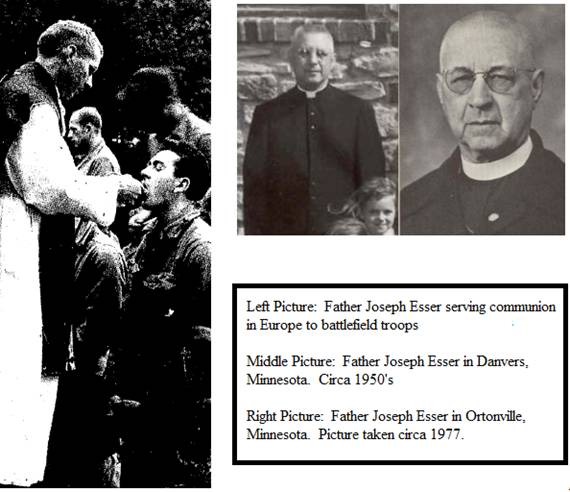
Certainly when he celebrated Mass, when the flickering candles on the altar sent pinpricks of pain through his eyes, when he offered communion wafers with his left hand because part of his right had been blown away, he remembered World War II.
Esser never talked about the war, however. He never mentioned the Silver Star he won for bravery, never recounted the harrowing day in 1944 when he and two other Army chaplains walked directly into enemy fire in search of wounded Americans - and for a few brief hours, brought peace to a blood-stained swamp on the French "Island of White Witches" (Seves Island).
"He never told us, not a word," Esser's niece, Eleanor Walker, said.
"And actually, that was just like him," she added with a fond smile.
The uncle Mrs. Walker always knew as "Father Joe" was born in Madison in 1902, one of eight children of Frank Esser, former composing room foreman for The Wisconsin State Journal.
He attended Holy Redeemer School on West Johnson Street, then entered St. Francis Seminary in Milwaukee, later transferring to St. Paul Seminary in St. Paul, Minn. He was ordained in 1927, and spent the next 14 years in a number of parishes scattered throughout Minnesota.
Then, the Japanese attacked Pearl Harbor. The following day, at age 39, Esser enlisted in the Army. After attending a chaplain's school in Boston, he shipped out for the battlegrounds of Europe.
He was wounded three times. Once, as he gave last rites to a fatally wounded German soldier, another German shot him in the face.
The second time, he had entered a mine field to give last rites to a dying American; on his way out he stepped on a mine and took 167 pieces of shrapnel, losing the thumb and forefinger of his right hand. He was later granted a special dispensation from the Pope to offer communion with his left hand.
The third time, an explosion damaged his eyes. For the rest of his life, Esser felt pain whenever he looked into the headlights of an oncoming car, or stared at the flickering candles in a darkened church sanctuary.
Dawn of New Hope Painting
He, however, escaped unscathed in the incident that earned him the Silver Star, as well as the respect and love of soldiers and war correspondents. His bravery and heroism are recorded for posterity in an oil painting called "The Dawn of New Hope," hanging in the Pentagon office of the U.S. Chief of Chaplains in Washington, D.C.
Commissioned by the Salvation Army and painted by Leslie Michaelson, "Dawn of New Hope" depicts a begrimed, battle scarred chaplain helping a wounded soldier to safety.
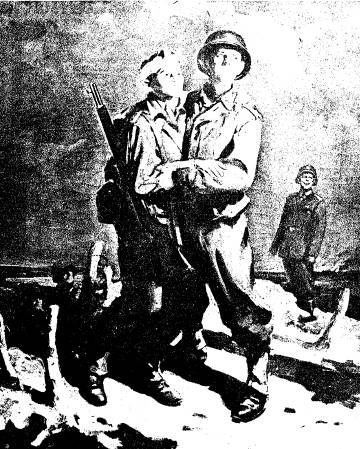
Dawn of New Hope - Painted by Leslie Michaelson
The solider was one of 40 rescued July 23, 1944, by Esser, Edgar Stohler, a Salvation Army street preacher and James M. Hamilton, a Disciples of Christ minister.
The three chaplains were assigned to the 90th infantry division, which had landed on Utah Beach during the Normandy invasion on D-Day, June 6, 1944. Six weeks later, the unit was battling to drive the Germans from the marshy, miserable Seves Island, known to the French as the "Island of White Witches".
According to an Associated Press report, the three chaplains "Brought a spontaneous unofficial cessation of hostilities in this bloody sector for three hours" while they searched the swamp for wounded soldiers.
"Defying fire from both sides and our strafing planes overhead, they went into the marsh holding aloft Red Cross flags, succoring a man here, another there.
"The enemy was impressed by the bravery of these men of the cloth, and stopped shooting. Soon guns on both sides fell silent, except the artillery in the rear.
"The chaplains were met in no-man's land by a German officer, and through a German-speaking American, removal of the wounded was arranged," the report read. For three hours, the chaplains carried out the wounded, sometime wading through neck-deep water, holding litters above their heads.
Then, "within a few minutes after the chaplains reached an aid station, the deathlike silence was broken over the battlefield. The Germans had started shooting again and the fight was on."
Wrote a war correspondent for the Minneapolis Tribune: "Father Esser's name is famous in his entire division because of his disregard for his safety. This is something he won't talk about, but the subject always comes up when you are talking to the boys in the foxholes.
"Father Esser was just by here," they say, and you can feel the lift in their voices.
"When I talked with Father Esser, his unit was beating back the fourth German counterattack since dawn.
"We sat on a pile of logs in the sun and talked, and there wasn't anything very impressive about Father Esser.
"He is just a little man with spectacles and a cross on the lapel of his battle jacket. But when he talked I forgot there was a battle going on, and I stopped listening for the whine of German shells. And I understood why the boys in the foxholes feel better when Father Esser has walked by."
After the war, Esser returned to the Midwest. He never mentioned the incident on Seves Island to his brothers and sisters, nor to anyone else, apparently. He re-enlisted in the Army during the Korean conflict, then went back to Minnesota, where he worked with Indians.
In 1977, he celebrated his 50th anniversary as a priest with a special Mass said by his nephew, Mrs. Walker's brother the Rev. Eugene Bauhs of St. Mary's of Pine Bluff. Two years later, he died and was buried in Ortonville, Minn.
It was only after his death his family learned of his heroism, and the painting recording it, Mrs. walker said. The Silver Star was found among the priest's meager personal possessions, as was an address book.
When the family began notifying people listed in the book of Esser's death, letters and news clippings from across the country began pouring in. Bauhs flew to Washington to view the painting, and sure enough, there was Father Esser, looking down at him from the wall.
"He was such a good and kindly man, and he really kept the religious tradition going in our family," Mrs. Walker said.
Esser is survived by two sisters. Mrs. Catherine Bauhs, (Mrs. Walker's mother) lives in Madison at Oakwood Village; another sister, Marion Thierer, lives in Marysville, Wash.
The memory of his quiet heroism and startling bravery lives on, in "The Dawn of New Hope".
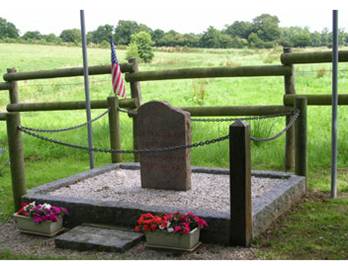
90th Infantry Division Monument in St.Germaine-Seves, France
“Doc” Bulger
The following item is another account of Father Esser’s military service. It is taken from the book, “Doc Bulger: Battalion Surgeon and Country Doctor”; Camp Comamajo Press, Bring History to Life.
During a brief lull in the action at the Falaise Gap, Doc Bulger began nosing through some of the German wreckage. A dead Kraut driver sat in the front seat of a disabled, nondescript two-door sedan. But in the backseat, Doc discovered several briefcases. Curious, he opened one to find it packed full of baby-blue bills—1,000 Franc, French notes. Had he stumbled onto a German Division’s payroll?
A life of luxury, early retirement, a debt-free, Stateside medical practice—the possibilities seemed endless. But just then, an uninvited visitor from above peered over Doc’s shoulder. A man of the cloth, Chaplain Joseph Esser, abruptly interrupted Bulger’s wistful glimpse into a privileged future. “You have to turn that in to Regiment!” Esser counseled. So much for Doc’s big dreams! He’d have to work for a living after all.
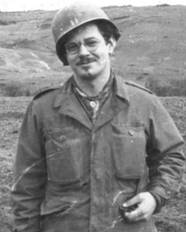
“Doc" Bulger, 3rd Batt. Surgeon, 90th Inf. Div.
War’s Aftermath
After WWII ended Reverend Joseph Esser mustered out of the Armed Forces, and he was appointed pastor of St. Mary's church, Manannah, Minnesota. Father Esser’s wartime record indicates he served in two wars - World War II and the Korean Conflict. Although the Korean Conflict lasted until mid-1953, Father Esser was back home in the States by at least 1952. Peter Smith, son of “Irish” John Smith and Susan McPhillips, died in June 1952. Father Esser was one of the presiding priests at Peter’s funeral, and at that time assigned to the Catholic Parish at Danvers, Minnesota.
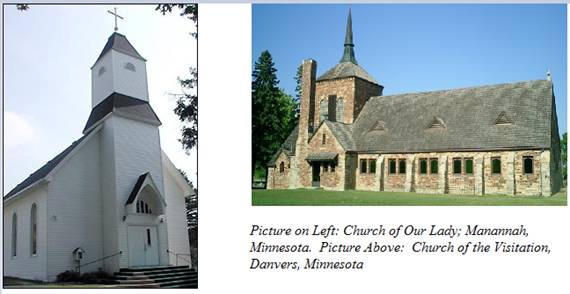
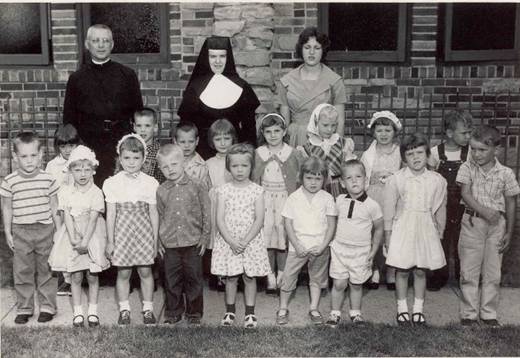
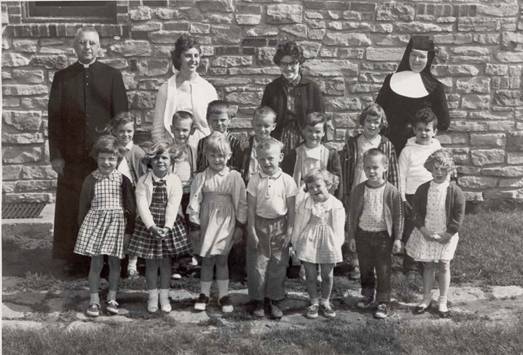
Early Photographs - Danvers, Minnesota
Father Esser is pictured with Catholic youngsters, possibly taken in mid to late 1950’s.
Other Assignments
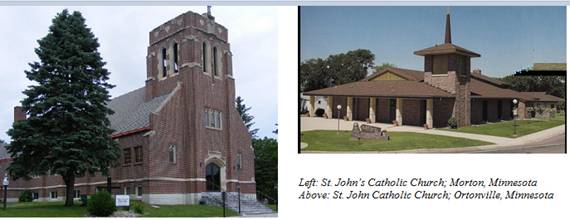
Later, Father Esser was assigned to St. John’s Catholic Church in Morton, Minnesota. Two miles south of Morton is the Lower Sioux Mdewakanton Dakota Reservation. This is a small Indian reservation which contains only 1,743 acres of land but has a population of 241 people.
His last assignment was Pastor of the Ortonville parish, possibly as early as 1969. Although based out of Ortonville, Father Esser may have been responsible for other parishes in the area. Three Catholic churches in the area are connected and known as the ‘Border Mission Chain’: (1) St. James Catholic Church in Nassau, Minnesota; (2) St. Joseph Catholic Church in Rosen, Minnesota; and (3) St. John’s Catholic Church in Ortonville, Minnesota.
Death
Joseph G. Esser died on August 29, 1979, following his arrival at St. Mary’s Hospital in Rochester, Minnesota. The previous news article suggests Father Esser is buried in Ortonville; however, a grave stone for Father Esser can be found in Resurrection Cemetery at Madison, Wisconsin. His nephew, Reverend Eugene Bauhs, was co-concelebrant at Father Esser’s funeral mass. Reverend Bauhs was also a direct descendant of Bridget Smith and William Vallender.
Final Comments
The Wisconsin Veterans Museum in Madison has a folder about the ‘Irish’ John Smith family.

An attached blurb describes this folder’s contents:
Transcription of a biographical sketch of "Irish" John Smith and family written by his daughter, Elizabeth Smith Willrodt. The sketch was published in the "Brule County History" published by the Brule County Historical Society (South Dakota) and most likely transcribed by Reverend Joseph G. Esser. The collection also includes two photographs of Reverend Esser as well as a front and rear view of John Smith showing the wound he received while serving with Company G of the 29th Wisconsin Infantry during Siege of Vicksburg in the Civil War.
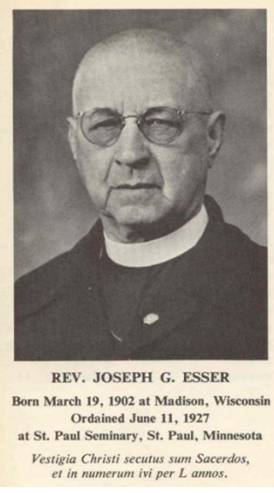
The picture above was probably taken circa 1977 for Father Esser’s 50th anniversary in the priesthood. The bottom portion of this card reads (as translated roughly from Latin to English):
I have followed the footsteps of Christ the priest, and numbering 50 years.
Our leaders, both secular and religious, ask all of us to do the right thing. Father Joe lived his life, according to his strong religious beliefs, by doing the right thing helping others in the best way he knew how. Had he been alive, “Irish” John Smith would have been very proud of