The Greenan Family from Milltown
In the Parish of Ematris,
County of Monaghan
By Joseph Napier
(Editor’s Note: The Greenan Family from Milltown was “Irish” John Smith’s relatives. Joseph Napier descends from Peter Greenan, whom John visited while traveling Ireland in 1908. Peter was born and raised in Milltown. John visited Peter and other Greenan relatives in Ireland and Scotland. “Irish” John Smith’s mother was born Catharine Greenan.)
In the year 1803 Robert Emmet was executed for his ill-fated attempt to end English domination of Ireland. In that year when one of Irelands finest rebels breathed his last, Edward Greenan, being nurtured in the drumlins near Milltown, took his first gulp of air. His legacy and those before him remains. I intend to follow that legacy. Through history, both political and social, I will trace the footsteps of a family that delivered my beloved mother. As an historian I will endeavour to provide documented evidence. As an author I retain the ability to add my own thoughts and feelings.

The earthen ring fort which adorns the highest drumlin in Milltown.
Authors Note
It was a damp sullen day in June. I was driving south out of Rockcorry. I was being drawn by the forested hilltop on the horizon to my right. I stopped at a lonely house for directions. Before I got out of the car I knew I was on the right road. Half a mile on I was standing knee deep in sodden grass among the lichen covered gravestones of Edergole cemetery. I felt at home. I felt connected. I believed that my forefathers were there. I couldn’t find a gravestone and as the rain grew heavier, I left, but strangely I was content that I was in the right place. My people were calling me. Four weeks later I was back. I cleared the nettles and pulled back the brambles. Lying flat before me, the solid tablet lay shattered in three parts, but through the moss and debris, I could make it out, ‘Greenan’. Here, below me, lay the bones of my ancestors. Their spirits, hanging in the trees, welcomed me home.
Armed with an 1858 valuation map I found myself driving cautiously over potholed roads, negotiating overgrown verges and narrow bridges. I was a mile or so out of Rockcorry and crossed the stream into the townland of Milltown. Intuitively, a right turn was made. This was my first trip to Monaghan. I was 22 years old. I had never been in the county but I knew were I was going. The crumbling mill, the lake, and the steep ditches were all familiar. The house, nestled into the hillside, was in sight. My great grandfather had left this house, via this very lane in 1862. I didn’t know who lived there now. Were they still Greenans? Would they know the Greenans? Would they be friendly? It was the unknown, but yet it wasn’t. I didn’t feel uneasy. I was calm and simply felt that I was being drawn ever closer.
The farm looked deserted, the gate was barred, and the yard quiet. I called next door and a nervous looking gent answered. I spoke of the ‘Greenans’ and told him I had descended from ‘Peter’ who had been born in Milltown. He had never heard of a ‘Peter’ and seemed unsure. I produced my maps, the family tree, and although he offered those words of confirmation that, I was indeed standing on my great-grandfathers farm, my spirit already knew it.
It was never intended for this work to be a definitive history of the Greenans of Milltown. I do not claim it as such. That was never my intention or desire. It began primarily as an attempt to ‘find’ my mothers people. It was only the reference to ‘Fr Francis McVeagh’ in my great-grandfather’s RIC record that took me to Ematris and into the heart of County Monaghan. I soon realized that well beyond my immediate extended family, lay others unavoidably connected to me through blood. I was enchanted by the land and felt as if I had been called there for a purpose, to search, to find and to record. The warm welcomes I received in every doorway strengthened my resolve to ensure that the hospitality and effort would not be in vain.
Thankfully, my people were not weathered names on a headstone, in a long abandoned graveyard. They were alive and living in the land of our common forefathers. For over 100 years we had lived parallel lives, neither knowing of the other. Branches had spread and taken root on foreign continents. Life is short, places change, and people pass from this world to the next. I had inherited a great sense of history. I was interested and it seemed only natural to leave a record for those coming behind.
As I walked the fields of Milltown the energy, which I had felt in Edergole, returned. It was there in Washington but I couldn’t grasp it. It flowed again on the Somme, and again as I stood outside Flinders Station and on Pickles Street in Melbourne. The connection was ever present. The names, records and photographs come alive as I listened to others describe the people they knew and loved. From here, a small farmstead, nestling under Celtic occupation on the ridge of Drumavaddy my people had worked, emigrated, fought and died in all corners of the globe. The family and families will continue to diverge and with each passing generation we will move further and further from the dark damp nights we sought shelter among the mud and stone of Milltown.
I have tried to respect the dignity and privacy of those who shared their family stories. When I’ve wondered from own linear line the information becomes more concise, more factual and hopefully causes no offence to those I have befriended. I hope that in this work I have left posterity a vessel, so that those who come after me, whether descended from John, Edward, Peter, Mary or the Brien’s, will find it easier to record and cherish their ongoing family history. Let this work travel with time, forever unfinished, not only as a testament to its author but as a testament to all those included in it and those still to be added.
J. Joseph Napier
Saul 2004
Chapter One
HISTORICAL INTRODUCTION
A brief insight into the political and historical background of the region from 1600 to
1800 when the first identifiable Greenan is incorporated into the story.
My Greenan homestead in Milltown, lays in the Parish of Ematris and the Barony of Dartrey. The area was originally an independent kingdom named after its inhabitants, the “Dartraighe”1 who were a band of warriors, the Dartraighe were a pre-celtic group of people who upon their expulsion from Munster allied with the kings of Meath. They fought their battles along the Ulster border, and on eventual victory at Rockcorry settled down. The Boylan family ruled Dartrey until the McMahons, boosted with Norman support, overthrew them and they in turn retained control until the arrival of Cromwell.
Despite the area remaining relatively untouched by James I’s plantation it is in a patent of his granting land that we find the first modern reference to Ematris. Local Monaghan records of the time spelt it Ematresse and Nordens old map of Ireland referred to it as Kill Emars yet no derivation has yet been put forward and its exact meaning remains unknown.
Situated on Monaghan’s southwestern border with Cavan the unassuming topography is a mixture of low hills crowned with ancient forts and small undrainable bogs. It is in essence classic Irish drumlin country. A rich shallow loam of soil caps the deep abounding clay yet it provides difficult conditions for cultivation.
In ancient times large oak forests covered much of the land but by 1750 the last of these native woodlands were being felled. In their place the tenant farmers endeavoured to carve out a meager subsistence. Grain and potatoes and the slow running streams proved ideal for most farms. The tenant farmer rarely kept livestock save for a few horses and pigs. These animals have been described as being of the “very worst kind”.2
The defeat of Owen Roe O’Neills 1641 rebellion during the reign of Charles II brought an end to Ematris’s isolation from large scale foreign influence. Ancient Irish estates were promptly confiscated and bestowed on victorious English soldiers and the Queen’s personal favourites. Whilst it was recorded that some of the native Irish were permitted to retain their land after the rebellions, any notions of leniency were brutally dashed with the arrival Cromwell on his anti—papist crusade. Little mercy was shown. The McMahons were the ancient native clan and in 1835 an English lieutenant wrote of two of their chieftains treatment at Cromwell’s hand. Both, sympathetically and poetically, he recorded “the lords of the soil were executed from the trees before their homes”.

Ematris is marked in red.
In Sir William Petty’s census of 1659, 434 English are recorded as living in Ematris as opposed to 3649 Irish. That many of Cromwell’s men remained in the area is preserved for posterity by Rockcorry town. It was named after the descendants of Cornet William Corry, a soldier in the Cromwellian Army. Drumavaddy, 4 as Milltown was previously known, saw a large number of English settlers. Prominent among them was Colonel Josias Campbell who later took part in raising the siege of Derry in 1689.
However, in the early 1700’s many of these earlier planters unhappy with their ‘reward’ were anxious to give up their robbers title. Their desire to leave was a crucial part of Ematris’s history because the vacuum left was quickly filled by the descendants of the earlier Scots-Presbyterian planters that had settled in the other parts of Ulster after Hugh O’Neill’s demise.5 While this influx was monumental both historically and politically for the region it was not accompanied by the brutality which followed plantations elsewhere. The indigenous people had already had their land confiscated and their culture and customs quashed in Cromwell’s time. The osmosis of the Presbyterians only took place as holdings became vacant. The result was no different but it was much less barbaric. The landlords were already established and the new breed of settlers were merely lowly tenant farmers. As a result there was little local antagonism as compared to other areas of Ulster where the plantations had been much more brutal.
During the reign of Queen Anne Catholic priests were once again permitted to administer the faith without government persecution yet the 1704 register records that Ematris remained priestless. English leniency did not last long and in 1710 when required to take various oaths the Irish clergy, once again under persecution, were forced to administer their flock in secrecy. 6 That the Scots-Presbyterians were becoming restless due to their disillusionment with the results of the ‘glorious revolution’ of 1689 was an added worry for the English. The more affluent simply left for the religious freedom of the Americas. Behind them they left a larger percentage of Catholics and by 1731 the government was very alarmed about the “growth of popery” in the region. A new offensive was launched and the notorious Penal Laws passed. Interestingly in the 1743-44 ‘hitlist’ of Catholic Clergy we find included a John Clerkin living in Cornawall, a neighbouring townland of Milltown. 7
The general population, unable to speak the invaders language, lived in general insecurity and poverty. Most lived in ‘bohogs’, small houses constructed from mud and stone and dug into the ditches. Due to the English trade dominance and selfish desires to keep the status quo intact nothing was done to encourage Irish industry. Subsistence was the aim. Few of the native Irish were even allowed to be tenant farmers. A livelihood was eked out as a labourer on the settler’s farms with whom they probably got on as they shared an equal burden. Not only were they universally exploited by the landlords but both lived on the breadline. All hard-earned produce had to be sold off to pay the rent and the tithe to a foreign church. Bad seasons often brought default and this in turn merited eviction. The only industry the English encouraged was linen, and this only because their own climate was not suited for it. Ematris was fortunate in that it had been blessed with numerous ponds and idling streams required for maturing the flax. In this parish there was at least some relief from the continual despair.
Despite their favourable position conditions were bad enough that in 1758, cornered by persecution, the people of south Monaghan armed themselves, and joined the rest of Ulster in a ‘land war’. Unfortunately, it was quickly quashed and although their misery was to continue virtually unabated for another hundred years, they had won for themselves a significant ‘right’. The Ulster Tenant Right allowed the tenant farmer to get a reduction in his rent for improvements carried out on the land. No such privilege was given to the rest of Ireland and therefore there was no incentive for the farmer to improve his holding.
Local rapparees provided the only means of native redress. Often these ‘outlaws’, thrown off their farms by unscrupulous land agents for the pettiest of wrongs, would remain within their parish boundaries, haunting their father’s farms, administering summary justice. Common all over Ireland they were prevalent in the remaining forests of south Monaghan. They set about to right the people’s wrongs. Landlords and their agents were the favoured game but even the military were targeted. It was not unknown for much of the proceeds to be returned to the cottiers struggling to remain on their precarious holdings.
With the onset of more liberal thinking in the latter 1700’s the local Protestants, predominantly Presbyterian, disillusioned with English rule and the established Church became somewhat more accommodating. In 1785 on the formation of the Parish Constabulary, a Catholic named John McManus was given the post. 8 When the volunteers, who would do the brunt of the fighting in 1798, were organised in 1782 the local Catholics were actively encouraged to provide what little money they had to arm the formation. Things had not changed enough for them to be able to join but here like elsewhere a certain alliance was formed between the Presbyterians and the Catholics. The Catholics, with a lingering “folk-memory” of the savagery that followed previous rebellions, were in any case probably relieved to be taking a secondary role. Despite the imposition of martial law, 1798 passed off relatively peacefully in the region. The government aware that its locally recruited troops were impregnated with United Irishmen took drastic preventative measures. All eight troops of Cavalry in the region were disbanded. Many of the more spirited are reputed to have made their way to the battles in Down, individually or in small groups. Loyal units also headed north but the Monaghan Militia left some behind. Four United Irishmen, including two McKenna brothers, hung from the gallows in Monaghan square as the horses rode out, bound for Ballynahinch.
With the rebellion brutally suppressed and the leaders either dead or abroad, the English by bribery and blackmail passed the Act of Union. Shocked and leaderless, the Presbyterians finally settled down to life under the Crown. Removed from their political allies, the Catholics remained in as precarious a predicament as ever.
___________________________
1 Dartraighe comes from the old irish word Dartorgion, “Kingdom of the Heifer”.
2 Lieutenant P. Taylor Royal Engineers.
3 Statistical Report. Lieutenant P. Taylor Royal Engineers 1835.
4 Drumavaddy means “The Hill of the Dog”.
5 Between 1747 and 1750 Samuel Campbell, Josias son, granted six leases on the Milltown estate.
6 The Oath of Aburation
7 Return of Sheriff of Monaghan 12th March 1743-44
8 History of Monaghan for Two Hundred Years, Denis Carolan Rushe
Chapter Two
GREENAN
An analysis of its origin, derivations, and frequency in Ireland.
Unfortunately, due to Greenan being used interchangeably as both a family distinction and a Townland denomination, I am unable to say with any surety what the name really means in relation to family peerage. Ideas have been submitted and I include these at the end of the chapter.
While one could argue that its derivation in both respects could well be from a common source I find it unlikely. If that were the case the distribution of the family name would match that of the place-name and this does not happen. As a townland or feature it is found 45 times evenly distributed in all the provinces of Ireland. In the Pender’s 1659 Census of Surnames “Greenan” is recorded eight times, seven of which in Ulster and one in Munster, namely Waterford.
As a literal translation the Irish O’Grianian means the ‘sunny spot’ which may explain why my mother was called “sunshine” by her teacher in college. Indeed many of the early Irish-Latin writers referred to it as solarium and terra solaris. However in relation to physical features other explanations have been forwarded. In ancient Irish manuscripts it was a “palace on a hill”, a royal seat, and it is generally accepted that in topographical terms this is what it means. Others have interpreted this literally as an “important place” often “with a view”. There are great examples of this theory throughout Ireland with perhaps the most famous being the Grianain of Aileach, the large hill-top ring-fort in Donegal. Another is Cloghgreenan, 1 meaning stone castle.
The Anglicisation of the Irish language complicated the matter further. Suddenly words such as Greanach, meaning ‘a sandy or gravely place’, also became simply Greenan. This process, leading to an abundance of topographical features bearing the Greenan name destroyed any pattern to it’s occurrence. However, on consulting a map we can quickly right any wrong. Take for example Greenan Lough outside Mayobridge, Co. Down or Greenan townland on the river Esk outside Ballycastle. These places no doubt take there name not from any political or historical importance but rather from an abundance of gravel.
 |
To add further, or rather to complicate further, I should also add that it can also mean summerhouse or indeed a balcony or gallery on a house. A place in Donegal called Greenans translates into English as “the summerhouses”.
As a family name it is said to have its origins in Connaught and Mayo in particular. Strangely though, by 1800 at least he name has died out here and is almost exclusively found in the Cavan, Lietrim and Monaghan triangle. In these regions it is almost likely of Irish origin. The ‘branch’ of the family found in Offaly and the midlands consisting of the Grenans, Greennans, and Grenons is probably of Norman origin. The most likely explanation is that these all stem from the Anglicisation of the old-french Grenon, meaning moustache. One must
|
bear in mind that the population was largely illiterate and the name recorded depended very much on the way in which the tithe collector or census recorder thought it should be spelt in English.
All this seems a bit unsatisfactory in explaining the family derivation and helps very little. However I think I’m justified in adding two theories or perhaps better described as two queries. My mother has suggested the pagan art of sun worshipping. To its credit this theory incorporates not only the sun aspect inherent n the name but also the link with hill-tops, a favourite place for pagan worshippers. Further research uncovered names deriving from the Irish for sun in the Tuatha De Dannan peoples who according to legend ruled Ireland in approximately 3000 BC. Ogma Grian-Aineach (of the sun like face) was a member of the privy council and MacGriene, one of the De Dannan’s three kings. Sun worship played in large part of ritual life in pagan Ireland and was specifically forbidden by St. Patrick. 3
Another Greenan in Dublin mentioned that he thought it was something to do with being a servant of the Queen. He said he thinks he read it somewhere. While it does not provide and explanation for the involvement of the sun it does fit other aspects of the puzzle. They would certainly be people of relative importance. Perhaps more interesting though, is that it would fit the Connaught origins. Could they have been servants of Queen Maeve of Connaught? Anomalies remain with both theories but I hope I have provided feasible possibilities.
The ordnance survey records only one mention of Greenan in Monaghan, and this, Greenan’s Cross Roads (Crois Ui Ghrianain) is in the Parish of Aghabog. Did a Greenan live nearby or was this worthy of ‘importance’. 4
One more problem remains to be addressed; the large numbers of Greenans in Scotland. It has been suggested that the name is Scottish in origin. I do not doubt this simply to keep to my own script and desired storyline. The name perhaps developed there similar to the way it did in Offaly. A Grenan is recorded in Argyll in 1675. Subsequent increases may be due to misspelling or standardisation of the name. Either way the Greenan name in Ireland predates the large Scottish plantations. It is more likely that the Greenans went from Ireland to Scotland. I feel that it is no coincidence that large concentrations are found around Glasgow, Edinburgh and Liverpool, towns that harboured so many Irish immigrants on their passage to the ‘new world’.
2005 Postscript
I don’t know where to put this, Chapter Two, Five, or Conclusion. Parts are out of context here but then other parts would be out of context elsewhere.
In early 2005 as I was trying to finalise these papers I found myself flicking through my research and jumping from a townland map was the name ‘Mullaghgreenan’. I didn’t know how I’d missed it previously. It lay to the north of Milltown and west of Lisnaveane (see Chapter Five) but only about 3 miles from each. Seven years of research and here under my nose was a townland, in the midst of ‘Greenan’ territory linked to them by a name. Strictly speaking it would translate as either Greenan’s Hilltop or Sunny Hilltop. Is this place linked to Greenan due to the presence of a large number of Greenans in the vicinity or are the Greenan’s linked to the hill because of what they got up to there. The passage of time has covered the trail well.
I do not know whether Greenans ever lived in Mullaghgreenan but none live there now. There is a Greenan who lives in Crover, a townland south west of Mullaghgreenan, and again some three miles from Milltown, may live closest. Interestingly he claims to be a distant relation of Edward Greenan of Milltown (again see Chapter Five). I do not know how this person fits into the tree but if he’s right then there are definitely branches to be added to this tree.
1 In Irish Cloch Grainain
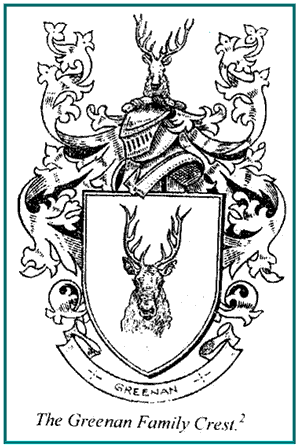
2 This crest was cut from a contemporary newspaper which Lily Greenan had kept.
3 An illustrated History of Ireland, Mary Frances Cusack, 1868.
4 See 2006 Postscript at end of chapter for second reference.
Chapter Three
EARLY GREENAN APPEARANCES
A brief look at the earliest recorded references to the Greenan name in County Monaghan
Due to the social standing of the Catholic population little remains in the way of written records prior to the start of civil registration in 1864. Some church records exist for the 1820’s but as a general rule we must look to the landlords rent book or the government proclamations to find recorded entries. The freedom given to the Protestant people allowed them to document their existence to a much greater extent. Perhaps the greatest benefit was that they had land to document. Given the inherent difficulties I have to admit at this stage that I can not go back any surety beyond 1803. However, I feel it may be not only be interesting but beneficial for the reader to have some insight into the Greenans I discovered before this date.
In 1663 Charles II introduced the Hearth Tax. 5 This was a sort of Poll Tax and was levied on the basis of the number of hearths in each house. As a rule the population tried to avoid paying it. Fortunately for the purposes of my research they were not all successful.
In 1663 we find an Edmund O’Greenan in the Parish of Killeevan and a James O’Greenan in the Parish of Currin. Later in 1665 we find a Phelim O’Greenan living in the Parish of Aghabog. Far more interestingly though, not only because of the way he spelt his name, is Cahill McGreenan in Annaghban in 1663. By 1665 he has changed to Cahill O’Greenan and given that the surrounding parishes have adopted this spelling we can draw the inference that it is about this time that it changed. More importantly from my viewpoint is that he resided in Annaghbane. This townland is adjacent to Milltown and only a mile or so from Lisnaveane, the two places where my great-grandfather was most likely to have been born in 1803. 6 History can not give way to fantasy and I will never be able to draw a link between the two yet one should not ignore that here may be a direct ancestor born nearly 400 hundred years ago.
Later that century we find the name has changed again and that at least some of the Monaghan Greenans were politically involved. Philip Oge McGrunan was outlawed and his lands confiscated for siding with James II during the Williamite wars.
The 1796 Spinning Wheel Entitlement Lists provide my next source. As part of a government scheme to encourage the linen trade free spinning wheels and looms were granted to individuals planting a certain area of land with flax. Unfortunately only the Parish is recorded and no smaller denomination given. In Ematris, particularly suited for flax growing, we find that four Grunans, Patrick, Thomas, William and James, were entitled to the awards. While I must strive to record only what I know to be fact I do not believe I’m pushing the limits too far to say that one of these ‘Grunans’ may be the father of Edward who was born in 1803, making him my great-great grandfather. Further evidence would suggest that if so it is likely to be either Thomas or Patrick. Both these names were common among the Lisnaveane and my branch of the Milltown Greenans. To go any further would be to stretch the realms of genealogy and I apologise for having done so already.
The only other relevant record that I have uncovered also happens to be, as far as I am aware, the oldest Greenan gravestone in Monaghan. In the graveyard of Clones Abbey in front of the round tower is the grave of Hugh and his brother [……] Greenan, the former having died in 1772 and the later 1800. 2 I claim no connection to these Greenans but record it out of interest as it shows that certainly by 1800 ‘Grunan’ has been superseded by Greenan. By the time of the Tithe Applotment in the 1820’s Greenan is in universal use.
1 Tax was two shillings per hearth. Many of the more remote homesteads escaped “taxing” due to both a difficulty finding them and the inadequacy of the collectors.
2 Clogher Records.
6 The locals pronounce Lisnaveane as “Liseveny”. In some old manuscripts it is
written this way. Its Irish translation is Fort of the Heros/Warriors.
Chapter Four
Early 19th Century Greenans in Milltown
All indicators pointed to Milltown initially but it then became apparent that Lisnaveane had an involvement so I expanded this chapter to include the Greenans from that townland.
Edward Greenan, my great-great grandfather was born in 1803. I cannot say for certain that he was born in Milltown, but given the difficulties of land tenure and the limitations of travel, I think it is fair to assume his family where from the immediate locality. There appears to be a link to the numerous Greenan families of Lisnaveane. I have been told that the “Liseveney” Greenans and Edward’s grandchildren were “cousins”. 1 Given the large number of Greenans in Lisnaveane it would appear that the family were at sometime resident there and Edward may well have been born in that townland. I have however failed to uncover any definite indication as to whom his parents may have been
 |
but his father would have been one of the “Grunans” recorded in the 1796 Spinning Wheel list for Ematris.
Unfortunately, it has proved
difficult to establish categorically whether Edward had any siblings, either in
Milltown or in neighbouring townlands.
The passage of time and the absence of records makes such a task very
difficult and I take Basie Greenan’s word for it that he had.
My investigations have uncovered at least
two distinct Greenan families in Milltown in the early 1800’s but neither seem
to have any connection with Edward.
If Edward had siblings, and the evidence suggests that he does, it is most
likely that they resided, a mile to the north, in Lisnaveane.
However, as the only documents I can rely on place Edward firmly in Milltown I will detail the ‘Milltown’ Greenans. The fact that none of the established Greenan families in the townland have any apparent link with my great-great grandfather adds credence to my belief that he was not born in the townland.
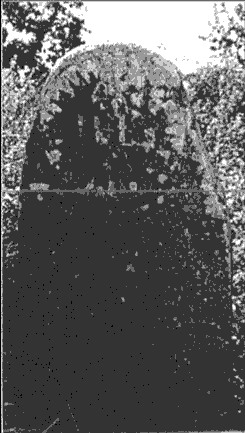
Mary and William Greenan Grave. See note 3.
|
1. Patrick Greenan I
There were two Patricks living in Milltown during this period. One of them is recorded in the Tithe Applotment Book of 1830 as holding 5 acres of land. He is recorded as “Long Patt Greenan”. Patrick was certainly older than Edward, though not old enough to be outside sibling range. He was married to Mary who was born in 1795. Mary died aged 46 in 1841 and one of his two sons, William, died during the first winter of the famine aged 28.
Patrick retained his land throughout the famine but he does not appear in Griffith’s valuation of 1858. His death is not recorded by civil registration which began in 1864. I believe he died prior to 1858. His wife and his son William are buried in Edergole Cemetery. Patrick is probably buried here too but nobody remained to inscribe his name. I have been unable to trace the other son. He was still alive in 1838.
2. Patrick Greenan II
I know very little about him. He doesn’t appear to have had any holding of his own or any offspring. He was born in 1807 and died in 1874. It is possible that he was a brother of William b. 1800 and farmed and lived on William’s holding.
3. William Greenan
He was born in 1800 and died in 1872. He farmed land adjoining Edwards’ and during the 1820’s at least was assisted by his brother Charles. All of the evidence I have uncovered to date points to the families being unrelated although their close existence makes their stories inextricably linked. William’s descendants still live on their ancestral homeland in Milltown. If there is any connection it is pre-1800 and the closest relationship is that Edward was Williams’ cousin. Mary Murray (nee Greenan), William’s great-granddaughter is adamant that he was unrelated. The records corroborate this and I accept it. 4
4. Robert G Greenan
He doesn’t appear on the tithe records but is mentioned in a letter sent by a member of the Wadsworth family in Canada in 1835 5. He farmed the land subsequently farmed by William (above) but I do not know whether they were related.
__________________________________________
1 In August 2001 I meet Basie Greenan,, a descendant of William b. 1800, and she told me that “Eddie” Greenans line were cousins of the Lisnaveane Greenans.
2 I can identify at least three Greenan families in the townland at the beginning of 1800s.
3 Here lie the remains of Mary Greenan wife to Patrick Greenan of Milltown a most affectionate wife and tender mother who depd. This life on the 28th day of Oct. 1841 aged 46 yrs also remains of his son William Greenan who depd. This life the 28th day of Dec. 1845 aged 27 yrs.
4 Both Berty Mills and Johnny Greenan deny any direct link between the families.
5 See Appendices
Tithe Applotment Record, List of Tenants, Milltown 1823.

Figure 1.
Tithe Applotment Record, List of Tenants, Lisnaveane 1823.
|
|

Figure 2.
Chapter Five
Edward Greenan 1803 – 1868
My great-great grandfather

This is the farm that Edward first rented between 1847 and 1858 as seen from the air in 1999. The farm was still lived in by the Greenan family up until the late 1980’s.
Whilst Edwards family had survived the turbulent 18th century, young Edward would not have been born into any kind of modest midst. His parent’s house, constructed from stone and mud, would have provided nothing in terms of comfort or cleanliness. One storey, it would have been divided in three, two portions for the family and a third enabling them to house their animals. Small glass-less windows allowed for light and ventilation.
The family, regulated by high infant mortality, would have lived predominantly on a diet of potatoes and buttermilk. Wild rabbits and hares would have provided the meat supplement. The more luxurious foodstuff, the wheat and the pig, was passed on as rent or for the upkeep of the foreign church by way of the Tithe.
A Royal Engineer recorded as part of a survey in 1835:
“Well fed pigs nowhere suspended in fletches from their dingy rafters for the purpose of kitchen to their vegetable diet. All are transported to make up the rent and nothing remains but the light, gay and cheerful spirits of the emaciated frames of a half-starved population…”
Edward’s father, despite having no tenancy, would have held some land in payment for work done for one of the tenant farmers. Living in a house of sods and stones, he could with a spade and seed, sustain his family’s existence.
Whilst it is unlikely he held enough land as a cottier to grow flax it is clear he had access to land for flax or helped in the preparation of a neighbouring farmers flax.
“The spinning wheels and looms occupied a large space in every dwelling and produced by their activity and occupation not only the full amount of the yearly rent of the holding, but a considerable surplus of income…” 1
The slow running waters in the area were perfect for maturing the stalk and one can easily imagine the ‘bleaching greens’ in the fields down near the streams. Even in 1999 one can see the remains of the old ‘lint’ holes on Edwards land.2 However the industry was in rapid decline and by 1835 the Ordnance Survey remarked on the ‘ruins of the bleaching greens’. The collapse of the trade from 1820 was to have severe consequences for the cottier tenants in Ulster as it took away his main source of income and employment.
 Soaking Flax in the Stream |
Edward’s opportunities would
have been very limited. Life would
have been his educator. Any formal
lessons probably involved the short walk to the school at nearby Unshinagh. 3
When physically old enough to be a help to his father he would no longer
be afforded the ‘luxury’ of school.
|
Life for the cottier tenant was harsh. During the spring and the harvest, young Edward, after assisting his father, would have gathered with the rest of the landless tenants to work on the neighbouring farms. In return for his toils, a corner of a bog may be his to graze a pig. His living may have been supplemented by the weaving during the winter months. Life as certainly tough and in 1835 William Wadsworth, in a letter to his ungrateful son in Canada, was fit to describe the Lisnaveane Greenans’ as being ‘the most low, petty, mean, and illiterate creatures’ when praising one of their sons who had sent home money from America when his own son had forwarded nothing.4
Despite being surrounded by Presbyterianism, the Greenans, like the rest of the Catholics, would have traveled to mass in Edergole. The open persecution of ‘papists’ had receded and the natives were allowed a long, low thatched building on the hill at Edergole for worship. Very soon, the expanding population could no longer be accommodated, and with the old Church building falling into disrepair a new church was built at Corravacan, on the road to Monaghan town.5
The English Protestants made one last attempt at converting the locals. By the 1820’s any of the catholic children looking for a good education were traveling to school in Rockcorry. Here, under the cloak of a Charter school, proselytising was carried on aggressively. The clever perpetrators of this crime even had the foresight to preach to the children in Irish. There can be little doubt that Edward, too old to be caught up in this would have, for the most part, held onto his mother’s tongue. He was probably one of the last native speakers. The National school system, which followed, abandoned the religious undertones but it insured the rapid downfall of the Irish language and the destruction of the Old Irish music and songs. The native tongue, in this part of Monaghan, was virtually extinct by 1835.6
Edward resided on the “Milltown Estate” centred on the Corn Mill, under the auspices of the Right Rev Lord Plunkett.7 The Plunketts had bought the estate from Lord de Clifford in 1808. The family held numerous small estates in Monaghan. Whilst they were absentee Landlords I have found nothing to suggest they were harsh and in fact some evidence to the contrary. My investigations have uncovered little of the estate records, and almost nothing in relation to Milltown, but incredibly the Rent Books for the years leading up to the famine are intact and I have had the pleasure of reading them in their original hand.
In May 1838 both William and Patrick Greenan are shown holding land in Milltown. It is clear that nearly a decade before the famine, times were already tough. As early as May 1839 Patrick is recorded as being behind in his rent to the extent of 2 ½ years salary (£20 12 6). Thankfully for him the Ulster Custom had been ‘won’ and the land agent very diligently made an entry that allowance was to be given for “work at parts for seep”. The fact that he had two sons is also recorded. That he had to drain the land is of no surprise. The land sloping down to the millrace is particularly boggy. The Valuation Survey, undertaken by Robert Bell on 29th September 1837 records the land as “Green bog pasture” with smaller areas of “meadow and soft, cold, moory arable.”8
 The Greenan farmstead as seen from the Wadsworth's farm |
I can offer no reasonable explanation for it, but Patt seems to have got on exceptionally well with the Land Agent. He paid no rent in 1840, yet by November of that year his arrears stood at only £3 11 8 ½. For some reasons 2 ½ years salary had been cleared in a year. The land agent, less informative this time, merely records “Allowance to be given”.9 Patrick though needed all the help he could get at this state. In 1841 his wife Mary |
died, to be followed during the first winter of the famine, December 1845, by his son William, aged 27. The rent book of 1846 is the last record we have of Patrick. He is not recorded by Griffith’s Valuation of 1858 and I would surmise that by this time he had been laid to rest with his family in Edergole cemetery. I do not know what happened to the other son, though he never held land in Milltown.
William, farming a much larger area of land, albeit “steep cold clayey arable of fair depth”, had just as much trouble with his rent. He was supporting at least two children (William & Eliza) but never seems to have evoked the same sympathy that Patt could muster. He paid his May 1838 rent on time but his November rent is over a year late and by which state a decree has already been made against him. The costs of this decree are added to his arrears. He made a number of small payments in November and December 1840 and a further one in January 1841, but it wasn’t enough to please the land agent and another decree for non-payment followed. One of these payments was by “Charles”.10 He continued to ‘help’ out until his disappearance in 1844. William, unlike his neighbour Patt, continued to pay, albeit in small, inadequate amounts until the crunch of November 1844. By this time he was £14 8 11 in arrears and at the height of the famine, January 1847, a third decree was made against him.
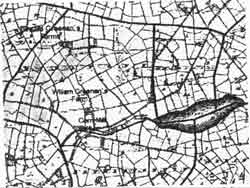 Edward's farm are coloured blue. Williams's farm is coloured Green. Note the corn mill, centre left |
Unfortunately our records stop
there. Somewhat surprisingly, given his record, is that William is still there
in 1858. He had weathered the storm,
and was certified as dying of “old age” on 29th June 1872.
His son William, who now took over the mantle of the farm, registered his
death. It is a credit to the family
that in 1999 the land still remains in the hands of William’s descendants. One possible explanation for the Greenans continuing tenure may have been the arrival of Robert Nesbitt in Milltown in 1839.11 He was supposed
|
to have been very generous by nature and it was said that he kept 9 of Milltown’s families supplied through the famine. The entry “Nesbitt goes bail” featured prominently in Milltown’s estate records. Robert Nesbitt bought the mill in 1858.12
Edward, married to Brigid from about 1830 and with at least six children held no land in Milltown until 1847.13 Up until this time his subsistence and that of his young family depended solely on what work he could get as a ‘cottier’ tenant. Edward, in return for labour, would have been given a small area of land by the tenant in possession, which he would have hired in conacre. On what usually amounted to no more than bogland he would have erected his home and grown his potatoes. As potatoes required little maintenance he was free during spring and harvest time to work the land of his neighbours At other times of the year he would have reverted to weaving to supplement his income.
Ironically, it was the famine that gave Edward the chance to drastically improve his fortunes. The sign of Edward Greenan in the rent books is in January 1847. The previous tenant, Edward Feagan is in debt of £29 9 2 and a decree has been made against him. His name is stroked out and in pencil above it Edward Greenans inserted. Feagan had only been in possession of the land for a year. John Wadsworth had been in occupation previously and for some reason Feagan had been saddled with Wadsworth’s enormous debt of £30 4 8.14 The slate was wiped for Edward’s arrival.
Edward’s 1847 farm was 9 acres of steep, cold, clayey land that ran down from the ridge above the road to Milltown right down to the slow flowing millrace. The land was of fairly good quality and certainly gave Brigid and Edward and their young family a chance to subsist. There can be little doubt that Edward was successful. At a time of great agrarian difficulty Edward, within 11 years, had taken possession of another farm on the other side of the townland. Both of these farms were taken from Protestant tenants at a time when the opposite was the trend.15 While, Edward, Brigid, my great grandfather Peter and the rest of the family headed over to the bigger and more lavish farmstead nestled into the hillside below an ancient ringfort, John, the eldest son was left behind in the ‘herds house’ on the original farm.16
Edwards family, now spread throughout the townland, continued to make a living in their isolated but beautiful surroundings. The Irish economy remained in decline and while virtually all employment was on the ‘land’, opportunities were extremely limited. In this respect the Greenans were lucky. In most Irish families, the eldest inherited the land and the rest left to seek employment elsewhere. As Edward had two farms to bequeath his eldest sons could both afford to stay. Peter’s plight was more characteristic of a 2nd or 3rd son. His options were minimal, the clergy, the Constabulary, or a foreign soil. Peter chose the second option and like thousands of other young, landless, labourers he sought a living within the ranks of the Irish Constabulary. He left the homestead in 1862.
Given Peter’s choice of career it is interesting to note Robert Nesbitt recorded that Edward Greenan had confided to him that he was a Ribbonmen.17 Edward indeed seems to have been something of a character and was known affectionately as “Cocker Neddy” due to his pursuit of cockfighting.18
Edward died on the farm on 29th June 1968 from sclerosis of the liver. This almost surely points to a poteen ‘still’ on the farm or to the existence of one nearby. Posterity would show that he wasn’t the first Greenan to fall foul of the drink. His son Patrick Greenan was the informant of the death.
After having visited the area one can easily imagine his funeral cortege, drawn by horse and cart passing down the lane, unto the road, along the mill race, and past the land that had come to his rescue in 1847. From here they took the left turn into Annaghbane, the land of the Greenans since the 1660’s, before rising up the gentle slope to the Church at Edergole. Here, at the spot, were he had attended the hedge schools in the days of the persecution of his faith, and the hill used so frequently by the ancient Irish, Edward Greenan was laid to rest.
Slightly over a year, on the 23rd August 1869, at 61 years of age his wife Brigid followed him to her eternal reward. Strangely, the civil registrar did not record her death. Some
 |
time later, probably when
stationed in Fermanagh, parts of which are less than eight miles from Milltown,
their son Peter returned to Edergole to erect a headstone for his parents.
The size and nature of this memorial are clear indicators to the rewards
of Peter’s travels. Now cracked and
broken, the tablet, on its erection would have been outshone only by the
monument to the two McMahon brothers, the Archbishops of Clogher. The family names of Thomas and Patrick are prevalent among the Lisnaveane
Greenans at the turn of the century.
I believe that Edward hailed from there.
The fact that that connection is still known in Dartrey today would
indicate that Edward must have maintained some relationship with his family in
Lisnaveane21. Was the
Lisveney Greenan living in the
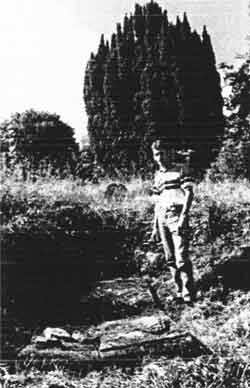
The author at the grave of his great-grandparents, Edward and Bridget. |
- Edward b. 1803 had siblings in Lisnaveane. Lackey was descended from them and therefore him and Yellow Pat were second cousins.
- Edward b. 1803 had another son whom I have not identified who went to live in Lisnaveane and from whom ‘Lackey’ descended. I think this unlikely given the nature of land ownership after the famine when it became more difficult to obtain a lease or tenancy. Three of Edward’s sons remained on the land in Milltown, Peter to the RIC and it would be strange indeed if a fifth son managed to obtain a tenure.
 |
The family names of Thomas and Patrick are prevalent among the Lisnaveane
Greenans at the turn of the century.
I believe that Edward hailed from there.
The fact that that connection is still known in Dartrey today would
indicate that Edward must have maintained some relationship with his family in
Lisnaveane21. Was the
Lisveney Greenan living in the
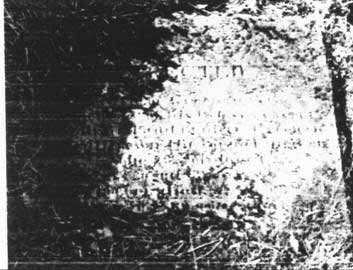
The Greenan grave inscriptions |
In an effort to clarify the position regarding Edward’s origin I returned to the PRONI during the summer of 2002. I trawled the rent books for the Milltown estate during the 1840’s. Under the tenancies for Unshinagh22, a small townland between Milltown and Lisnaveane, I noted the entry for May 1840 “Edward Greenan’s sons” Edward and Thomas holding a tenancy alongside a Pat Daily. By May 1844 Daily and Robert Nesbitt were holding the tenancy.
Where Thomas and Edward searching for a tenancy after an eviction from Unshinagh?
A year later a Thomas Greenan emerges in the townland of Rakeeragh holding a joint tenancy with James Brady. Was this the same Thomas who had left Unshinagh?
Perhaps it is a different family altogether. In 1830 there is one Edward Greenan on the records in Lisnaveane and none in Milltown. By 1847 there are two in Lisnaveane and one in Milltown.
The precise origin of the ‘Milltown’ Edward, my great-great grandfather, remains a mystery.
____________________________________
1 Lieutenant P Taylor, Royal Engineers 1835.
2 These were pointed out to me by Berty Mills in May 99. They form the ‘ditch’ adjoining the laneway.
3 That’s assuming that he hailed from Liseveny. If not he probably went to school in Edergole.
4 Contained in a brilliant letter from a father to an ungrateful son, 1835. Indicates that at least one Liseveny Greenan was in US pre-1835.
5 “The Emetressess”, Peter McKenna.
6 I have only discovered on Protestant Greenan in the area. Samuel Greenan is shown on the 1901 Census as CoI living in Annaghbane. He was born approx. 1845.
7 The estate was comprised of the townlands of Claddagh, Corglass, Caragarry, Unshinagh, Rakeeragh, Coolkill, Drumsaul, Drumavaddy, Drumloughlin and Glenhorrick.
8 Valuation compiled by Robert Bell 1837. Records in Valuation Office Dublin.
9 Milltown Rent Books. PRONI.
10 William Wadsworth’s letter 20/4/1835 indicates that Charles was William’s brother.
11 “The Emetressess”, Peter McKenna.
12 During the famine of 1881 he went to court on behalf of the tenants and achieved a 30% reduction in their rents.
13 They were Mary, John, Edward, Patrick, Pater, and another daughter. He may have held a short tenancy in Unshinagh.
14 The Wadsworths are said to have descended from the McDonalds of Glencoe. They once owned all of Milltown. Bertie Mills is descended from the Wadsworths.
15 The only other Catholic tenant at the time was William Greenan.
16 John Greenan’s descendants still own this land.
17 A Ribbonmen was the word used to describe those involved in the Republican movements throughout the 1800s. In Edward’s case it referred to his involvement in the 1867 Fenian Rising.
18 From History of the Nesbitt Family, Linenhall Press, 1930.
19 Erected by Peter Greenan to the memory of his beloved parents Edward and Bridget Greenan Milltown, the former died on the 29th of June 1868 aged 65 yrs the latter died on the 23rd of August 1869 aged 61 years…..repase.
20 The McMahon Clan controlled this part of Monaghan from about 1250 to the invasion of Cromwell. The Tombstone was erected in 1750 by Roger McMahon.
21 Fort of the Warrior
22 Hill of the Fox
__________________________________
The Greenan Farms of Milltown and Lisnaveane
The respective positions of the Greenan farms in Lisnaveane and Milltown in 1858.
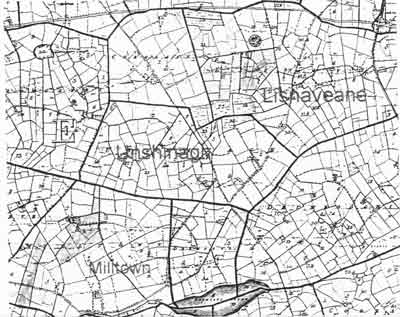
Lisnaveane;
Green--- Patrick Greenan
Blue ---- Edward Greenan
Yellow—Bernard Greenan
Red ------Thomas Greenan
Milltown
Blue ----Edward Greenan
Green---William Greenan
Unshinagh is the townland where the unidentified brothers Edward and Thomas, sons of Edward Greenan held a tenancy in the early 1840’s.
Figure 3.
Extract from Griffith’s Valuation 1858.
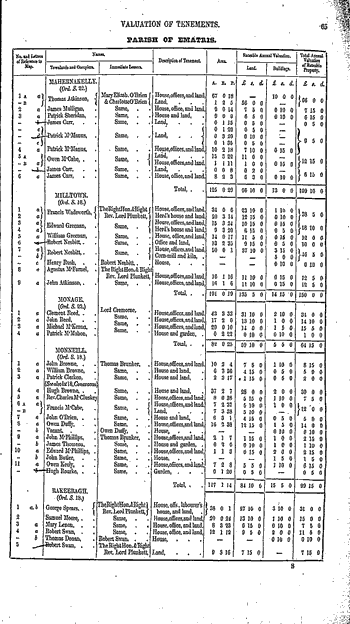
Figure 4.
The Death Certificate for Edward Greenan 1803 – 1868
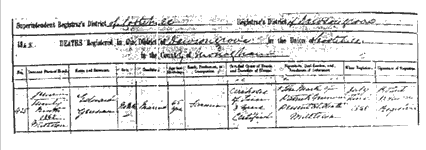
Figure 5.
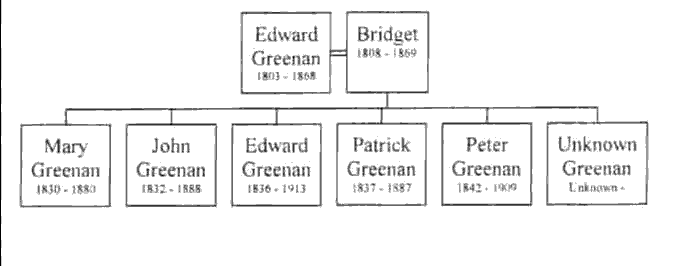
Direct Descendants of Edward Greenan
Figure 6.
***********************************************************************
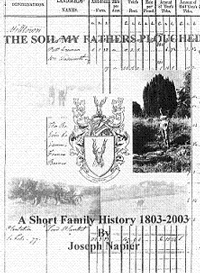
(Editor’s Note: Above is the front cover for Joseph Napier’s book,
The Soil My Fathers Ploughed.It is the History of the Greenan Family. Everything you read in this document came directly from Joseph Napier’s book.
************************************************
Chapter Six
The Famine in Ematris
A short synopsis of the effects of the Irish famine on Ematris
The fist signs of the Great Famine “arrived” in the Ematris area during the first week of August 1846. Ulster’s part in the famine is often overlooked due to the severity which accompanied it in other parts of Ireland, but the destruction of the crop in Monaghan like the whole of Ulster was universal. Potatoes were widely cultivated in the areas were smallholders and cottiers were most numerous and the pressure on the land greatest. The larger farmers, at the first sign of failure, had the ability to seek alternatives. The small farmers had no option but to rebuild his ‘drills’ with enforced optimism. The north-eastern districts of Monaghan and west Dartrey (Ematris was in this Barony), where the land was poorest, and the population highest were the worst hit.
Ematris was the fourth worst hit parish in Monaghan and recorded a 37.2% loss in population. Below are details of the other badly affected parishes; 1
Magheraclone 43%
Currin 38.8%
Drumnally 38.4%
Ematris 37.2%
Individual townlands sometimes show even more harrowing results and two on Milltown’s southern border were particularly badly affected. The population of Annaghbane fell from 109 to 42 and Cornawall in a similar manner from 131 to 52. Milltown appears to have survived the period somewhat better than other areas of the Parish. I do not know why this was the case but maybe the location of the corn mill resulted in substantial alternatives to the potato. The population fell, but not as drastically as in neighbouring townlands. 114 people in 1841 had fallen to 78 in 1851, a decline of 31.6%. The number of houses fell from 16 to 14, so we can safely say that two families left or disappeared from the area altogether. By contrast the population of Lisnaveane fell from 209 to 141. Did Edward and his young family account for eight of this number?
The deterioration of the flax and linen trades since the 1820’s mirrored the general decay of agrarian fortunes. This part of Monaghan, like Ireland as a whole, was being asked to employ and feed more and more people. Each family was trying to eke out a living on a smaller and smaller plots of land. Luckily for Edward, by the time the famine had taken its tightest grip he had managed to grab himself a tenancy. As the flax trade ebbed, the cottier class that Edward had emerged from, were left underemployed and stranded. These cottiers with their tiny plots of land were legacies of a vibrant past and were the most vulnerable of all. For Edward and his family at least there was some security.
The famine changed more than lives. It altered cultures and traditions. In this part of Monaghan the pre-famine people were commended on how “any wayfarer could call at night and be sure of food and a place to sleep”. In the dark days of desperation and fever this ‘charity’ was, through necessity, sadly driven from the people. The only realistic alternative for many was to head to the workhouse in Cootehill. Here the lucky ones may have found work, lodgings and most importantly food. Unfortunately, many found only disease, fever and ultimately death. Disease followed the footsteps of the famine that had weakened the people. Fever was first reported in Rockcorry on 29/7/1847, dysentery in 1847 and cholera in August 1846. The Irish, forever enchanted with strange beliefs, scorned a death in the workhouse and many on the ‘brink’ would struggle out into the countryside to die.
One such lady was recorded by the coroners report at the time. Ann Megharry, and “old inform woman” of 90 arrived at the house of Judith Greenan in Milltown. She had been weeks in the workhouse but died within three days of leaving it. She arrived at the Greenan household with a blanket and was recorded as being “virtually naked except for an old coat and shawl about her shoulders”. She is recorded as having died on the 15/3/1850.2
The Greenans of Cladone, in the parish of Clones also became involved with the coroner. At the inquest of Mary McDermott, Mary Greenan, gave evidence of seeing a woman at the gate weak with hunger. Mary offered the woman ‘stirabout’, but she was unable to hold her spoon and so Mary put the spoon into her mouth. The woman was incapable of swallowing. She died shortly after, but not before begging Mary to feed her children, one of whom was called Catherine. The coroner recorded death from “want of proper and nourishing food”.3
I located another interesting coroners report during my research and add it here, not for any historical purpose, but as a warning. The coroner of Rockcorry recorded the death of a “wealthy beggar”. James Williamson was found to have died from “voluntary destitution”. A dealer in rags and old iron he was found dead in an open shed. Congestion of the lungs brought on by lack of nourishing food was cited as the reason for death. On the body was found £5 16 1 ¼. 4
Whilst many died, countless numbers left. I have come across various entries for Greenans crossing the Atlantic, but unfortunately have not been able to trace them to any specific locality in Ireland. Similarly, many went to the favoured Irish haunts of Liverpool and Glasgow. One of these was surely James Greenan of Drumloughlin, bordering Milltown. In the rent books the land agent has recorded, perhaps prophetically, “Last Cow? ... to go to England.” James’s arrears were £26 13 3. A cow was worth £3 - £5. 5
_____________________________________________
1 The Famine in Ulster, Ulster Historical Foundation
2 I do not know who Judith Greenan is. She appears in the Catholic Parish records. On the 18th April 1854 she is recorded as being a witness to the marriage of Catherine Greenan and Conor Bernardo Duffy. I have found no evidence that she was related to Edward but she appeared as a sponsor to a lot of Mary Larmer’s children. Was she a sister? Did she marry Briens?
3 Mary was the daughter of Barney and Kate Greenan
4 Clogher Record.
5 PRONI, Belfast.
Chapter Seven
Peter Greenan 1842 – 1909
My great-grandfather
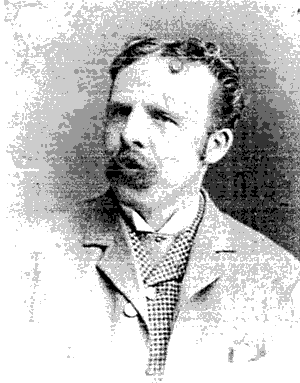
Peter Greenan was born in Milltown in 1842. I know nothing of his early life and can only surmise that was no different to the other young men in the region. Given his later success in life there can be little doubt that Peter was well educated. Perhaps, like his father before him, he attended the school in Edergole under the guise of the parish priest. Without facility for further education, and the constant demands of his father’s farm, Peter probably left school when he was about 12 or 13. The schooling was basic and short but the evidence suggests that Peter was intelligent and bright and that his educational standard was very high.
 |
As a young boy, Peter, having survived the rigours of the famine, would have worked alongside his brothers John, Edward and Patrick on his father’s farms. Everything was manual, labour intensive work and Peter would have been well used to tilling the cold, clayey soil of Milltown. The flax he would reap by hand, before collecting it and placing the stalks in the lint holes down near the lane. After it had matured he would then have the unpleasant task of recovering it from its watery resting place. The stink was apparently unbearable. Here, he learnt about horses and their behaviour, the trade that, unbeknown to him would eventually employ him. Time for relaxation was limited but on can easily imagine Peter playing with his brothers and the neighbouring children |
among the fields and the old ring fort that crowned his father’s land. Journeys into Rockcorry were probably common but it is unlikely that before his enlistment to the police he had traveled any further than Monaghan Town. Indeed the monthly fairs in Rockcorry would have provided much of his entertainment. Monaghan didn’t have the reputation for music and storytelling that was inherent in Irish society but I’m sure that there was certainly a bit of it going on around the poteen still in Milltown.
Land was everything to the young Irish. Without it, or the promise of it, there was nothing to keep a young man in rural society. The usual rule was that the first son remained on the family farm, the second joined the clergy and the rest emigrated. Peter’s family was somewhat different in that his father’s relative prosperity allowed his three older brothers to stay on the land.
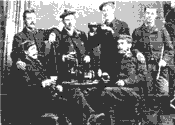
However, Peter was faced with the traditional ‘third’ scenario and like an increasing number of his compatriots took the decision to join the Irish Constabulary. His father’s political persuasions suggest it was not a decision he took lightly, as although the Constabulary were not openly opposed by the populace at this time they were seen as an instrument of British rule. It is very possible that the amicable relations he had with his Protestant neighbours influenced him somewhat essentially it was a pragmatic move.
 |
In early 1862 after a visit to
Corcovan to collect a reference from the Parish Priest Fr. Francis McVeagh, 1
Peter, on horseback, rode into Rockcorry to present himself to the Sergeant
commanding the small barracks in the town.
The Sergeant would have ensured he was at least 20 years of age, that he
was at least 5’9” and that his chest was at least 36 inches.
After satisfying these criteria the application would have then been sent
to the Depot in
|
On the 24th June 1862, Peter with three others took the Oath and signed up. He became recruit No. 27839. As a requisite of his enlistment he took with him from Monaghan four linen shirts and £2 for the purchase of the necessary kit and to support him until his first issue of pay. At the Depot Peter underwent a full examination. Men had to be in top physical condition and those accepted were regarded as being the cream of Irish manhood. There was an exam in writing and arithmetic and finally the oath was sworn. The oath took the following form:
I, Peter Greenan, do swear that I will and truly serve Our Sovereign Lord the Queen, in office of Sub-Constable, without Favour or Affection, Malice or Ill Will; that I will see and cause His Majesty’s Peace to be kept and preserved and that I will prevent, to the best of my power, all Offences against the same; and that while I shall continue to hold the said Office, I will, to the best of my skill and knowledge, discharge all the duties thereof, in the execution of Warrants and otherwise, faithfully according to Law; and that I do not now belong, and that I will not while I shall, hold the said Office, join, subscribe or belong to any political society whatsoever, or to any secret society whatsoever, except to the Society of Freemasons, So Help Me God.
After five months of tough physical training Peter passed out as a sub-constable. Recruit training in the Irish Constabulary was far more intensive and extensive than any of their English counterparts. Training started with lessons in arithmetic, orthography, geography, grammar, bookkeeping and first aid but soon progressed to include drill, musketry, police duties and physical exercise.
The Irish Constabulary became renowned for the thoroughness of its training and its emphasis on cleanliness. Indeed the RIC had the toughest and most uncompromising code of regulations of any police force in the world.
On the 19th of November 1862 Peter received his first posting. Along with Edward Duffy (No. 27837) who had enlisted on the same day as Peter, he was sent to County Down.2 He must have impressed quickly however as within three years he had been promoted to the rank of full constable (before 1883 equivalent of Sgt). At this stage of Ireland’s post famine revival the common police work was not agrarian related as one might expect but rather the combat of petty crimes, theft and drunkenness. The Irish Constabulary was by this stage also carrying out the duties of the Revenue Police and spent much time searching for illicit potion stills. Despite being an armed paramilitary force much of their work was for civil authorities. They compiled agricultural statistics, carried out surveys, performed weights and measures inspections, and prevented wakes for those who had died of infectious diseases. On top of this they maintained order at the contentious elections and escorted prisoners to and from the assizes.
In 1867, while Peter was still in Down, the Fenians lead by William Smith O’Brien took on the might of the English establishment once more. Down survived the rebellion relatively unscathed and although the police stationed there were on high alert they were not tested. In recognition of their part in quelling the revolt Queen Victoria granted the force the prefix ‘Royal’ and gave them their badge, the harp and the crown of the Most Illustrious Order of St. Patrick.3
On the 7th of November 1868, five months after his father’s death, Peter was on the move again and was transferred to Fermanagh. While I suspect that Peter was always in the Mounted Constabulary the first tangible evidence of such involvement appears in 1869. Within six months of arriving in the county he is rewarded for good work with a ‘favourable record’ and as well as being mentioned in the Half Yearly Supplement he is given a 2 shilling reward. Alongside 1st Head Constable, Micheal Doherty, Peter’s actions are recorded as follows;
27839 Peter Greenan Sub Const (M) “Recovery of stolen flax, detection and subsequent conviction of offenders under circumstances of difficulty.”4
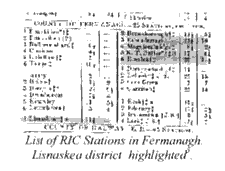
Micheal Doherty was the Head Constable for the district of Lisnaskea and Peter was almost surely the mounted policeman for the district. At this time in Ireland there were only 380 mounted men for the whole country allotted on a ratio of one per District Inspector and two per County Inspector. By sheer coincidence Peter’s area of responsibility took in Newtonbutler station, which was at this time in the charge of Constable No.12883, another Peter Greenan from Monaghan. It was during his time at Lisnaskea that Peter’s mother died. Given that Milltown was now a short ‘horse’ journey it is quite possible that Peter on his leave made the journey home before her death. He certainly traveled back to the farm and Edergole later and it was probably during his time in Lisnaskea, and with his RIC money, that he erected the fabulous memorial to his beloved parents.
Peter remained another 10 years in Fermanagh before being promoted to Constable of the Mounted force on 16th September 1879. A week later he was transferred to the Northern HQ of the RIC at Armagh. He stayed here only eight months and I suspect it was for training purposes. Land agitation was beginning to sweep across Ireland once again and for Peter, like the rest of the mounted men, it was to be a very busy time. In response to increasing tensions he was sent to Donegal in May 1880. His stay was however extremely brief and he was back in Armagh before being transferred to Louth on 1st October 1880. Peter’s family talked about him spending a lot of time in Greenore and it is clear he was operating under the Dundalk district but probably attached to Greenore given its prominence as a port. This transfer was to bring momentous changes to Peter’s life.
 |
While stationed in
|
£30 in savings and your proposed wife was of good character and had been approved by the local District Inspector.
While stationed in Dundalk he soon started a romance with a young dressmaker called Ellen. The authorities within he RIC were very keen to see the men remain single and one couldn’t marry until achieving at least seven years service. In practice most men were not married until after 12 to 15 years of service. Permission to marry had to be sought from superior officers and only be granted if you could prove you had 30 in savings and your proposed wife was of good character and had been approved by the local District Inspector.
Ellen was the daughter of Patrick McGuinness who farmed 54 acres of land at nearby Dromiskin. Three months before his marriage to Ellen, Peter blemished his RIC record for the first and last time. Unfortunately the records recording the offence have been destroyed. I suspect however, given the proximity to his marriage that he may have been carried away with his courting and have been marked absent without leave. I have checked other surviving RICK records and most offences seem to carry a ‘dismount’ as punishment. Peter retained his mount, leading me to believe the offence was trivial. I’ll never know the true story but, as a victory for romantics I’ll stick with that one. Ellen still managed to obtain the approval of District Inspector Edward Supple.
On the 30th of May 1883 Peter and Ellen were married in the Catholic Church in Dundalk. Mark Brady and Bridget were the two witnesses. By this time a change in the rank structures meant Peter was now Sergeant Greenan. Following the marriage Peter was posted to the Reserve in Dublin. As a reservist he would have been a member of the No.2 Section (Ulstermen) under the command of the Depot at Phoenix Park. The Reserve, comprised of senior men had been set up to aid other constabulary forces throughout Ireland that were under strain. It was to be ready on the order of the Inspector General to travel to any part of Ireland at a moments notice and consisted of 200 constables and sub-constables. Of this 200 a quarter were mounted men. By July however he was back in active service in Louth, which is highly unusual as an RIC member was generally not allowed to serve either in his own native county or in that of his wife.
The Land War in the west of Ireland was by this time at crisis point. Peter, forming part of a mobile support type unit was soon on his way to Galway West Riding which included the areas the RIC were under sustained pressure and working long and unsociable hours. The position the RIC found themselves in, openly supporting the Landlords in their campaign to evict tenants for non-payment of rent led to them being the target for local fury. Two members of the force were killed in the county during 1881 and 1882. Ellen, left behind in Dundalk while Peter traveled on his most distant posting, was undoubtedly relieved when the news arrived that she could rejoin her husband on a more ‘normal’ posting. However, when word did arrive that Ellen, six months pregnant with her first child, and Peter were to be reunited it was not an easy posting. Letterkenny, Co. Donegal. It was Ellen’s first taste of barrack life and it must have been a terribly traumatic time for both of them.
Peter was part of the Letterkenny district and was stationed in Letterkenny station, home to both the district and county headquarters. Whilst married members often slept outside the barracks the senior sergeants often got two room accommodation within police grounds. Peter as senior sergeant, in a large station was probably offered accommodation in the barracks. I don’t know if he took it. Either way married men were still required to sleep in the barracks and took turns on a rota system. For every married man outside the barracks there were to be five inside.
 |
In the early1880’s the Landlords
of Donegal, like those elsewhere, had raised the rents on many estates to
exuberant heights. With the tenants
unable to meet the higher demands the Land League initiated the Plan of Campaign
on the “No Rent Manifesto”. British
forces, Landlords and their agents were boycotted.
In isolated counties like Donegal, more and more RIC were drafted in to
support the beleaguered system were, given the size and remoteness of the county
high on the priority list. The landlords immediately sought to evict their
non-paying tenants. The Land Agents
carried out most of the evicting, but the RIC were responsible for their
protection. At one eviction site on
the estates of Captain Hill and Mr. Nixon in Gweedore in August 1886, 5 officers
and 675 RIC men were required to attend.
The RIC no matter how much they detested and hated eviction duty found
themselves standing in the gap between the landlords and the people.
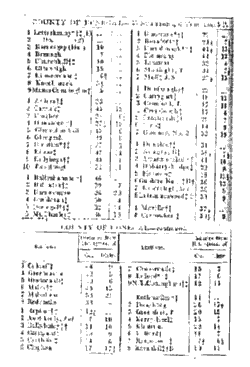
List of Stations in Donegal 1880s. The stations coloured blue fell under Peter's primary responsibility. |
In the early1880’s the Landlords of Donegal, like those elsewhere, had raised the rents on many estates to exuberant heights. With the tenants unable to meet the higher demands the Land League initiated the Plan of Campaign on the “No Rent Manifesto”. British forces, Landlords and their agents were boycotted. In isolated counties like Donegal, more and more RIC were drafted in to support the beleaguered system were, given the size and remoteness of the county high on the priority list. The landlords immediately sought to evict their non-paying tenants. The Land Agents carried out most of the evicting, but the RIC were responsible for their protection. At one eviction site on the estates of Captain Hill and Mr. Nixon in Gweedore in August 1886, 5 officers and 675 RIC men were required to attend. The RIC no matter how much they detested and hated eviction duty found themselves standing in the gap between the landlords and the people.
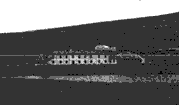
Peter Greenan’s involvement cannot be proved, but given the situation that prevailed in the county at the time I feel it safe, if not historically accurate, to assume some involvement. The fact that his son Paddy, in 1986, was so keen to destroy his father’s RIC papers leads credence to this hypothesis. Whilst Peter was stationed throughout this time in Letterkenny, and therefore outside the main eviction areas of Gweedore and Cloughaneely there can be little doubt that he was often ordered across the mountains on “eviction duty”. The old RIC barracks at the lower end of Lough Veagh was inside Peter’s district and his visits here would have been frequent. A ½ days journey by horse would have brought him to the military and police garrison at the Gweedore Hotel at the foot of Lough Dunlewy and under the shadow of Errigal Mountain.
Peter’s ultimate superior in Letterkenny was the County Inspector William Lennon, and Lennon took personal charge of the large-scale actions. There is a strong possibility that Peter was in Gweedore during those evictions of August 1886 and also at Crolly in February 1888 when about 1000 men from the Rosses barred the land agents way and forced the RIC through weight of numbers to retire. Despite the trouble, casualties were few and things remained relatively under
 |
Peter’s ultimate superior in
Letterkenny was the County Inspector William Lennon, and Lennon took personal
charge of the large-scale actions.
There is a strong possibility that Peter was in Gweedore during those evictions
of August 1886 and also at Crolly in February 1888 when about 1000 men from the
Rosses barred the land agents way and forced the RIC through weight of numbers
to retire. Despite the trouble,
casualties were few and things remained relatively under
The Gweedore Hotel in 2008 (see note 8) |
control until October 1887. In that month Lennon led a force of 1000 RIC to the house of Mary Bonner in Middletown, Bunbeg. When the Land Agents were refused entry, a fight ensued and after injuries were sustained on both sides the police were ordered to fix bayonets. Despite the protests of the local priest, Father James McFadden, who at 45 the same age as Peter, became a real figurehead for local opposition. The authorities became very keep to subdue his increasing influence.
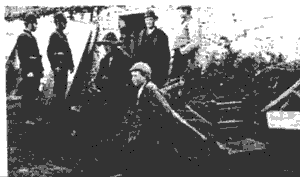
At the beginning of February, the police acting on a summons surrounded the parochial house in Derrybeg. They remained here for six days, and then after mass on Sunday they moved in to arrest McFadden. Inspector William Martin of Ballyshannon led the arresting force but a scuffle soon ensued and after the area had been cleared, Martin was found dead. The extra troops and police from the Gweedore Hotel were sent for and McFadden was arrested.9 County Inspector Lennon even brought a force from Letterkenny by sea. During a blinding snowstorm, the mounted troops were ambushed at
 |
If what has gone before is a grounded suspicion I can be more confident of Peter’s involvement in the next states of the story. On the 23rd February 1888, Fr McFadden was brought to Lifford for trial. This small town was inside Peter’s district and force led by the Divisional Commander Cameron and County Inspector Lennon consisted of 250-foot police and 50 mounted police as well as detachments of Scots Greys. |
There can be little doubt Peter was among the guard. The trial continued in Letterkenny on the 8th March and the need for police so large that the neighbouring counties had to supply detachments. Fr McFadden was returned on a charge of murder but in October that year was thankfully acquitted after the trial collapsed at Portlaise.
Throughout this dramatic period Peter’s first four children had been born, but tragically his second daughter died aged only 13 days. By 1890, Peter, nearing fifty was surely relieved to accompany his district inspector Francis Augustus White to the quieter surroundings of Omagh. Francis White had been promoted to County Inspector and I believe it was more coincidence that peter was still under his command in Omagh. It is clear that Peter was highly respected and trusted by his superior. Peter was now a very senior Sergeant and Peter’s family always maintained that he had refused further promotion due to his desire to stay close to the men and the horses.
 |
On the 1st August
1892, Peter called time on his eventful career, and after 30 years and 1 month
he retired. He and Ellen packed up
and headed for Louth to raise their young family and a healthy pension of
£72. I’m unsure of what
exactly Peter did for the next seventeen years and I assume that he either
helped out on Ellen’s family far or partook in some farming of his own.
He almost surely paid frequent visits to the RIC station across the road
for craic and reminiscences and he definitely retained his interest in horses,
and succeeded in passing the legacy to the following generations.
The weathered inscription in memory of Peter and his son Thomas (see note 11) |
It is not clear whether Peter retained contact with Milltown or indeed whether he returned there after his mother’s death. I believe he did. In August 2001 I discussed the issue with James Greenan of Rockcorry and he told me he could distinctly remember his father, Patrick Greenan, talking about Peter Greenan.12 On the 29th October 1909, his son John found him dead in the yard of the house at Dromiskin. He had died of a stroke and was buried in the cemetery in nearby Dromiskin.
_______________________
- Fr. McVeigh died on 28th September 1864, aged 72 and is buried in Carrickmacross.
- Unfortunately, I have been unable to identify the station to which he was attached.
- This was the badge used by the Royal Ulster Constabulary until 2001.
- Recorded in the Half Yearly Supplement for 1869.
- Lisnaskea, Brookeborough, Ballinamallard, Maguiresbridge, Newtonbutler, Rosslea.
- The Irish Constabularies, Donal O’Sullivan.
- Letterkenny, Barnesgap, Brenagh, Glenveigh, Churchill, Kilmcreanan, Knockbrack and Manorcunningham.
- Now a plush hotel and leisure complex this building was the centre of RIC and military activities during the land war.
- McFadden had been sheltered by Fred Coll in Stranacorcragh before his capture and a memorial to the feat has recently been erected in the townland.
- History of Landlordism in Donegal.
- It is interesting that Thomas is recorded on the headstone. The family left the area in 1910 but obviously felt it was a fitting place to remember Tom after his death in 1916.
- Patrick (Yellow Pat) was born in the 1880s and his son James certainly got the impression that he had met Peter Greenan. Yellow Pat would have been a first cousin of Peters.

Figure 7.
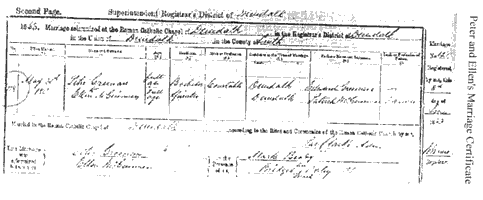
Figure 8.
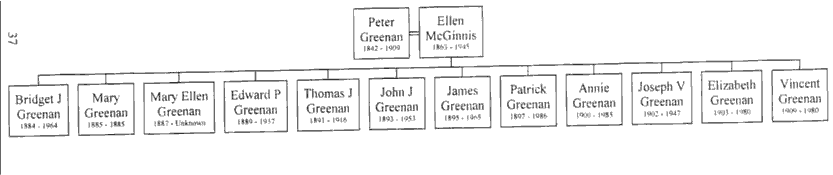
Direct Descendants of Peter Greenans
Chapter Eight
Ellen McGinnis 1863 – 1945
My great-grandmother
Ellen was born in 1863 and was the daughter of Patrick McGinnis1 a farmer of 54 acres at Dromiskin, south of Dundalk. The McGinnis’s were, I suspect, well educated and comfortably off. In addition to the farm, Patrick owned a Public House, and a Drapery shop in Dundalk. It was in this shop that Ellen learnt her trade and she was well known for her dressmaking.
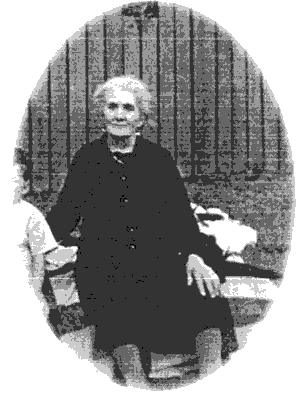 |
It is clear that Ellen had many
siblings though I do not know her position in the family.
I do know that while in
|
I know nothing of Ellen’s childhood. It was surely filled with hard work but sheltered in comparison with the road ahead. In May 1883, this lovely blue eyed girl was married to Peter Greenan, the local RIC sergeant, in the Catholic Church in Dundalk. Ellen was 20, Peter 41.
Life would never be the same again and for the next ten years Ellen, the sergeant’s wife, followed her husband on his postings. Within a year of the marriage their first child was born in Letterkenny, CO. Donegal. Her stay in Donegal would have been a traumatic one. Peter was often away overnight on eviction duty and Ellen, burdened with her new family no doubt realised the seriousness of the situation.
As a Sergeant Peter was entitled to accommodation outside the confines of the barracks and may have stayed in a house near the station, rented privately by the RIC. Unfortunately, for them both their second child Mary, born December 1885, died aged only 13 days. Separated from her sisters, and with Peter so entwined in the agrarian troubles, things were no doubt tough.
More children quickly followed and in May 1887 a third daughter was born, followed by their first son, Edward, in 1889. It was surely a relief for all involved when Peter’s transfer to Omagh came through in 1890. Peter’s niece, Susan Bryans, from Milltown came up to help. Later in life she was to tell proudly, about her coming to Omagh to look after the “Sergeants family”.2 Whilst stationed in the town I believe the family may have stayed in what is now the Royal Stewart Arms Hotel, and it was here “McConnells Place” that Thomas was born on the 2nd March 1891. In August 1892, after Peter had retired from the force, the family packed up and headed back to Dromiskin.
 |
It was undoubtedly a great
relief for Ellen to be back among her friend and family in familiar
surroundings. The family quickly
settled into the “Coachhouse” on the main Dundalk-Dublin road, directly opposite
what is now the Coachman’s Tavern.4
The house was tiny and it was not long before the rapidly expanding
family had filled it. While Ellen’s
family was nearby I have no evidence to suggest close contact.
It seems strange that Peter and her were forced to rent a house from
James Corrigan and that none
The House in Dromiskin (see note 3) |
of her children ever spoke of cousins in Dundalk. Peter however, must have continued working in some capacity. It is possible that he helped on neighbouring farms, maybe even Ellen’s fathers. The house he chose to rent included many outhouses, and presuming that the coach trade had stopped, or moved across the road, I believe it fair to surmise he returned in some capacity to working the land. He never lost his love for the horses, and both he and the family must have been very popular in the area. Even though the family left in 1909 there was a close affinity between the people of Dromiskin and the Greenans right up until the 1970’s.
Whilst at ‘Lurgangreen’ seven more children were born to the marriage. Thankfully, as the last were arriving the first had started to move out. The house itself was small, a simple hallway, led to two small rooms on either side, with a few more rooms upstairs. The 1901 Census rated the house “2nd Class”, an average dwelling in the area and showed that the family were occupying all four rooms. Ellen’s occupation was given as that of a “housekeeper”.
As the reader is already aware Peter died in October 1909. This left Ellen with four children under 10, including one, Vincent aged only six months. To culminate matters, without Peter’s regular pension the family was no longer able to stay. Once again there appears to have been no financial help from her family and the landlord James Corrigan “put” the family out. The family moved across the road and stayed upstairs in the tavern. It was here in the 1960’s before my mother and father had started courting that my father met a man who had noticed the “Greenan Motors” sticker on this car and who had remembered the Greenans “upstairs”.
 |
The family started to break up.
Thomas headed for Australia and Paddy, for a reason I have never found,
headed to Monaghan Town.5
Ellen, no doubt influenced by Bridie, who was already north, headed for Belfast.
Ellen’s sister Katie had been in
The family arrived in
Joe and Ellen in Dublin, 1941. |
By all accounts Ellen was a lovely person. Whilst I cannot find any evidence of being close to family in Dundalk it is clear that she kept in contact with her sisters and her brother John in New York. She was clearly devoted to her son Edward, who tragically developed Parkinson’s Disease and specifically asked in her will that Lily look after him. She was musically gifted and reputed to have been terrific on the mouth organ. She was particularly proud of her collection of three.
She continued to live in Belfast until she died apart from a week she spent in Dublin with Joe and John during May 1941 at the height of the Blitz. She had planned to stay longer, but didn’t like life in the south and quickly returned to Belfast. Ellen was a great collector and hoarded piles of newspapers and clippings and amassed boxes of photographs. Sadly she developed breast cancer in the 1940’s. She must have been ill for sometime as both Lily and Paddy ended their respective romances to tend to her and on the 17th September 1945 she passed away. She was buried in Milltown Cemetery.
__________________________________________
1 For years I had assumed the family name was McGuinness. Ellen’s father was recorded under this name in Griffith’s Valuation and it appears on all the birth records for her children and her own marriage certificate. It was only October 1999 when I was provided with a copy of an original letter Ellen had written in 1937 referring to her sister as Katie McGinnis that it became apparent the family used this variant of the name.
2 I am indebted to Father Gallagher of Rockcorry for this information. He met Susan Bryans in Buffalo USA during the 1950’s. When he retired to Rockcorry he tried to find out more about the Sergeant. A request from the altar during mass for clues drew no response. I was only too happy to help.
3 Paddy and Jimmy outside the house in which they were born. Circa. Late 1950’s early 1960’s.
4 New Dundalk bypass means that no longer the main Dublin road. The tavern is closed and for sale.
5 It is possible that Paddy had met his extended family in Monaghan and through them may have lined up a job.
Figures.
|
|
|
|
|


