Francis McPhillips - Aghabog Civil Parish, County Monaghan


Once in awhile we find unusual information that is interesting although not family significant. This is one of those stories. You may have seen gravestone inscriptions for Aghabog Parish on our website. One gravestone inscription for Francis J McPhillips reads as follows: By the Ancient Order of Hibernians and friends of the late brother Francis J McPHILLIPS shot on March 09, 1921 age 19. For us this was a mystery.
Was Francis related to our own McPhillips’ kin? Maybe. The McPhillips clan is predominant in this parish. This is still an interesting story about someone from this parish. Aghabog Civil Parish is where “Irish” John Smith and Susan McPhillips were born and raised.
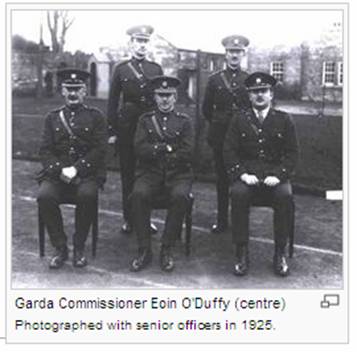
Francis McPhillips’ story was found in a book about Eoin O’Duffy. From this book one learns the circumstances surrounding Francis McPhillips’ untimely death. His story is added as an interesting historical footnote to a turbulent time in Irish history.
|
-----------------------------------------------------
|

***************************
Eoin O’Duffy: A Self-Made Hero by Fearghal McGarry; pp. 66 - 68
Published 2005
Oxford University Press; 448 pages ISBN 0199276552
O'Duffy's responsibility for the broad policy of executions is confirmed by his involvement in the death of three Hibernians during this period. The most controversial of these was the killing of Francis McPhillips, whose corpse was found alongside that of Larmer. McPhillips, a Catholic youth, was abducted from his mother's farm by five masked men at 4 a.m. on 9 March. After a court martial, which O'Duffy presided over, he was brought to a laneway and shot. The process took some time, as O'Duffy had difficulty procuring a priest willing to hear his confession. He was discovered with a notice pinned on his breast declaring "Tried. Convicted and executed by the IRA"; Local Volunteers insisted that he was killed for informing. His mother claimed it was because he was a member of the AOH. The county inspector, who acknowledged the circumstances behind Larmer's execution, claimed there was 'no reason known for the murder of McPhillips'.
Seamus McPhillips, who researched the executions of the three Hibernians killed during this period, noted that it was believed locally that McPhillips was killed for passing information about republicans to his Presbyterian neighbours, a deed which was uncovered when an IRA raid on the mail produced an incriminating letter. It was claimed that McPhillips, like Carr, inadvertently revealed his guilt to IRA men posing as RIC officers. Whatever the truth - and the common elements involved in each appear suspicious - the killing divided the local community for decades. Some republicans had believed it unnecessary: Johnny McKenna had pleaded for his life on the grounds that he was 'inoffensive and innocent'. In 1934, when O'Duffy returned to Monaghan as president of Fine Gael, he unwisely raked up the killing. Irritated by the AOH's support for Fianna Fail, he hinted that the blame lay elsewhere: 'The AOH should be careful of their new found friends in Monaghan. Things had happened in the parish of Aghabog. It was singular that some people should attribute to him many things that happened...There were certain people in that hall that night who had appealed against the shooting in Aghabog: there were certain people prominent in another organisation who had ignored that appeal.'
O'Duffy's reopening of such a sensitive issue for political purposes was deeply resented, as was his crude attempt to deflect the blame onto his Fianna Fail rival, Dr. Conn Ward. His speech prompted Fr Maguire, the Aghabog parish priest who had heard McPhillips' final confession, publicly to accuse O'Duffy of responsibility for the execution:
After the court-martial the boy was brought to me. I was convinced then, and since I have got no evidence to change my opinion, that the boy should not have been put before the squad, I appealed to his guard to have the sentence revised, but I was told that it was final. I suggested that the boy should be sent out of the country and that the course should meet the case...To my judgment the deceased was deserving of every human consideration, because he was generally acknowledged as not up to the normal mental standard. Moreover, it was commonly stated then and since that local bitterness influenced the evidence and court-martial decision.
His death, as Fr Maguire hinted, was bound up with the bitter tensions between local Hibernians and republicans. The AOH, in contrast to the moribund UIL, had remained a vibrant movement, as had been demonstrated by the beatings meted out to republicans during the 1918 election campaign. Its condemnations of the IRA's policy of assassinating policemen led republicans to suspect that the Hibernians could not be trusted and, ultimately, to accusations of spying.
*****************************************
April 2008