

The Historical Hill Family
Our County Tipperary Ancestors
The Hill Family
Introduction
Ireland’s 1845 Potato Blight is credited with launching a wave of Irish immigration to America. The fungus which decimated potato crops created a devastating famine. Starvation plagued Ireland and within five years, a million Irish were dead while half a million had left Irish shores for America. One of the families caught in these deplorable times was the Edward Hill family of County Tipperary. Before the nineteenth century was half completed, Edward and his family emigrated from Ireland and by 1850 were making their home in Concorde, New Hampshire.
Years ago our mother, Ruth Ryan Smith, talked about her Irish heritage. We heard all these Irish sounding surnames and then she would talk about the Hill family. “This isn’t an Irish name”, we thought. She told us an old family rumor suggested English descent. Perhaps, but this family surname can be found in Irish records long before the famine years.
What will you see in this document? The first part shows general information about the Hill family and County Tipperary. Next, we search for Edward and Margaret Hill in Ireland. Then we look at other Hill families who lived in Northern Tipperary County. Finally, we look at Hill families living in nearby Irish Counties.
Tipperary Facts
The following was taken from a description from Lewis's Topographical Dictionary of Ireland, 1837:
TIPPERARY, (County of), an inland county of the province of MUNSTER, bounded on the east by the Kings (Offaly) and Queen's (Laois) counties, and that of Kilkenny ; on the south, by that of Waterford ; on the west, by those of Cork, Limerick, and Clare, from which latter it is separated by the river Shannon and Lough Derg ; and on the north, by that of Galway and Kings (Offaly) county. It extends from 520 12' to 530 9' N.Lat., and from 70 20’ to 80 26’ W. Lon.; comprising an area, according to the Ordnance survey, of 1,013,173 statute acres, of which 819,698 consist of cultivated land, 182,147 of bog, mountain, and unimproved waste, and 11,328 are covered with water. The population, in 1851, was 346,896 ; and in 1831, 402,363.
The following chart shows the population of County Tipperary as enumerated in the Irish Censuses from 1821 to 1851. As you can see the population declined significantly during the time of the Irish famine. However, this decline in population lasted for many years. By 1921, for example, the population for this County was less than 80,000 people.
ANALYSIS OF THE CENSUS FOR COUNTY, 1821-1851
|
Year |
Males |
Females |
Total Pop. |
|
1821 |
172,468 |
174,428 |
346,896 |
|
1831 |
197,713 |
204,850 |
402,563 |
|
1841 |
216,650 |
218,903 |
435,553 |
|
1851 |
160,024 |
171,543 |
331,567 |
How large is County Tipperary? Again, the following was taken from a description in Lewis's Topographical Dictionary of Ireland, 1837.
Length from the corner of the Araglin River on the boundary southwest of Clogheen to where the Little Brosna River enters the Shannon is 74 miles; breadth from the western boundary between Hospital and Emly and Carrickdoon Hill on the eastern boundary is 45 miles.
Our Family Tree
The following is a simple version of our family tree. The Hill and Ryan families all emigrated from County Tipperary, and eventually made their homes in Allamakee County, Iowa. Allamakee County is located in the extreme northeast corner of that state.

Edward Hill Family in America
We will not trace the Hill family and its movement in America. That is for another time. We only look at Irish origins; therefore, we analyze the data below to determine when this family may have immigrated to America.
What do we know about Edward Hill's family in America? We know they were living in Concorde, New Hampshire, by at least the 16th day of August, 1850. The following information was found on Schedule 1 US Census for the free inhabitants of Concorde in the County of Merrimack, State of New Hampshire. It is unclear what type of abode they resided; however, there were many Irish families living in this same location. The census enumerator identified this location as ‘Rail Road Shanty’.
|
Name |
Age |
Sex |
Principal Occupation |
Place of Origin |
|
Edward Hill |
31 |
M |
Laborer |
Ireland |
|
Bridget (Margaret?) |
31 |
F |
- |
Ireland |
|
Mary |
7 |
F |
- |
Ireland |
|
Bridget |
2 |
F |
- |
New Hampshire |
|
Anna |
9/12 |
F |
- |
New Hampshire |
Based on this information we might assume they were living in America by at least mid-1848 and possibly as early as 1847. We surmise this because little Bridget was two years old when this census was taken, and she was born in New Hampshire. The 1900 US Census does answer this mystery for us. One of the questions asked in that census regarded year of immigration. The following information was taken from Schedule 1, Twelfth Census of the United States for Allamakee County, Taylor Township, and State of Iowa. This census was taken on June 1, 1900.
|
Name |
Birth Year |
Age |
Number of Children |
Place of Birth |
Year immigrated |
Years in Country |
|
Margaret Hill |
1823 |
77 |
5 |
Ireland |
1848 |
52 |
Both census returns are consistent with each other. With this in mind we try to find Edward and Margaret Hill in County Tipperary. (According to the 1860 US Census Edward and Margaret had the following children, all girls: Mary, Bridget, Ann, Eliza and Margaret.)
Griffith Valuation Survey
The first modern census for Ireland began in 1821 and a census was taken each year. Unfortunately, war and fires destroyed most census records, and the earliest records to be found are dated 1901. Due to this lack of census information, genealogists rely on ‘census substitutes’ such as the Griffith Valuation Survey when seeking distant relations. This survey would have collected dust and long forgotten had the census returns been intact. This survey was taken from 1847 to 1864, and lists only heads of household.
Edward Hill Family in Ireland
Where do we start? We know the Hill family left Ireland in 1848; therefore, we look for any relevant records dated 1848 and prior. For County Tipperary there is only one record listed for Edward Hill, and that was recorded for an occupant living in Knockacappul townland, Parish of Kilnarath. The following valuation survey was published in 1848; however, it was probably compiled a year earlier (1847) as this was when the assessment began.
Looking at the Griffith Valuation Survey one sees Denis Kennedy listed as Lessor. Actually, this property was part of the Ballyvowne Estate located in the Barony of Owney and Arra. The owner, George Kinahan, leased this land to Anna Molony on April 25, 1816, for a period of 31 years or life. Denis Kennedy represented Anna Molony in these proceedings and that is why his name and not her name appear on this list. One of the tenants was Edward Hill, who had a house but no land in Section 1A.
Griffith Valuation: Printing Date, Wednesday, November 29, 1848
 |
 |
 |
Earlier we mentioned that the Hill family moved to America sometime in 1848. The next Griffith Valuation Survey was taken several years later and printed in 1850. Notice that Edward Hill no longer lived in this townland. In fact, by this time Matthew Hartigan and Edmund Ryan also left this townland for parts unknown. This information is consistent with the US Census information. By 1850 our Edward Hill family was living in New Hampshire. We believe these Griffith Valuation records show where our great ancestors lived in this part of Ireland.
We find it interesting that the same ‘Observation’ is written for Edward Hill, Matthew Hartigan and Edmund Ryan. In the 1850 Valuation Survey it reads ‘Down – struck out of valuation
Griffith Valuation: Printing Date: Tuesday, May 14, 1850
 |
Unfortunately, we could not find a map to show you where the Hill family lived. For whatever reason these maps are unavailable; however, we will continue to look for a map and present it to you at a later time.
We found the notation, ‘Down – struck out of valuation’, in other valuation lists. There were many evictions in this part of Tipperary. In 1847 for example, one quarter of the tenants in this part of Ireland were evicted from their land. In 1849 alone 90,000 people were evicted from their homes in Ireland. There were 109,000 evictions in 1850. These evictions lasted for several years. Local relief was paid for through the ‘Poor Law Union’, which was funded by landlords on the basis of how many tenants they had. As the famine worsened taxes increased. Landlords evicted tenants to control their own taxes. The ‘Poor Law Union’ provided relief to needy families as best they could. The landlords were still required to pay into the ‘Poor Law Union’ to ensure the starving masses were clothed, fed and housed. This was inadequate and many, many died as a result. To avoid further payments, landlords provided these outcasts passage to foreign lands in what became known as the ‘Coffin Ships’. Many emigrants already weak from starvation or disease, died during the passage to America. It is very likely Edward Hill was evicted from this land.
You may ask if the Hill family from Knockacappul townland was relatively new to that area. The Hill surname can be seen in an earlier census for this part of Tipperary County. In the 1766 Religious Census for Ireland we see the following two names:
This shows us evidence that the Hill family lived in this section of Tipperary for approximately a hundred years prior to the time of the Griffith Valuation Survey. In the 1766 census we see an Edward Hill listed. Perhaps this Edward Hill was the grandparent to Edward Hill found in the 1848 valuation survey. Who was this Pat Hill? Was he a relative of Edward Hill? These are questions that will be investigated further. The 1766 survey shows the notation ‘RC’, which means ‘Roman Catholic’. This is a kinder and PC version of how it was written in an earlier time. Then Catholics were identified as ‘Papists’.
Kilnarath Civil Parish
 |
|
 |
Two maps above show portions of northern Tipperary. The color map shows the main towns; whereas, the black and white map shows the Civil Parishes as they would have appeared in the nineteenth century. Kilnarath Civil Parish is located between Newport and Rear Cross in Northern Tipperary.
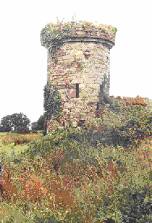
Kilnarath in 1841 had 3,386 people living in its boundaries. Above are the ruins of the Kilnarath church and cemetery. Down the road from these ruins is Newport Town, the largest market town in the area. Even so, it was never considered a major center in the nineteenth century. The church dates from circa 1823. The Kilnarath church ruin and graveyard are up the Nenagh road from Ahane Crossroads.
  |
|
Other Tipperary Hill Families
The following shows all Hill surnames found in the Griffith Valuation Survey for northern County Tipperary. Also, you will see duplicate entries for these valuations. The reason is due to the dates these valuations were taken.
|
HILL |
SAMUEL |
ARMSTRONG |
WM. B. |
TIPPERARY, NORTH RIDING |
HOLYCROSS |
RAHEEN |
|
HILL |
MICHAEL |
|
|
TIPPERARY, NORTH RIDING |
KILCOMENTY |
BALLYKINLALEE |
|
HILL |
MICHAEL |
|
|
TIPPERARY, NORTH RIDING |
KILCOMENTY |
BALLYKINLALEE |
|
HILL |
MICHAEL |
YOUNG |
JOHN |
TIPPERARY, NORTH RIDING |
KILCOMENTY |
BALLYKINLALEE |
|
HILL |
MICHAEL |
YOUNG |
JOHN |
TIPPERARY, NORTH RIDING |
KILCOMENTY |
BALLYKINLALEE |
|
HILL |
WILLIAM |
CAREY |
MICHAEL |
TIPPERARY, NORTH RIDING |
KILCOMENTY |
BIRDHILL |
|
HILL |
WILLIAM |
|
|
TIPPERARY, NORTH RIDING |
KILCOMENTY |
BIRDHILL |
|
HILL |
PATRICK |
|
|
TIPPERARY, NORTH RIDING |
KILLOSCULLY |
AUGHAVEHIR |
|
HILL |
PATRICK |
RYAN |
THOMAS |
TIPPERARY, NORTH RIDING |
KILLOSCULLY |
AUGHAVEHIR |
|
HILL |
WILLIAM |
MOYLAN |
HONORIA |
TIPPERARY, NORTH RIDING |
KILLOSCULLY |
ROSSAGUILE |
|
HILL |
WILLIAM |
HILL |
MARY |
TIPPERARY, NORTH RIDING |
KILLOSCULLY |
ROSSAGUILE |
|
HILL |
EDWARD |
|
|
TIPPERARY, NORTH RIDING |
KILNARATH |
KNOCKACAPPUL |
|
HILL |
EDWARD |
KENNEDY |
DENIS |
TIPPERARY, NORTH RIDING |
KILNARATH |
KNOCKACAPPUL |
|
HILL |
WILLIAM |
STRADBROKE |
EARL OF |
TIPPERARY, NORTH RIDING |
KILVELLANE |
TOOREENBRIEN, UPPER |
|
HILL |
WILLIAM |
HILL |
WM. |
TIPPERARY, NORTH RIDING |
KILVELLANE |
TOOREENBRIEN, UPPER |
|
HILL |
WILLIAM |
STRADBROKE |
EARL OF |
TIPPERARY, NORTH RIDING |
KILVELLANE |
TOOREENBRIEN, UPPER |
|
HILL |
MARGARET |
In Fee |
|
TIPPERARY, NORTH RIDING |
MODREENY |
GARRAUNORISH |
|
HILL |
JOHN |
DUNALLEY |
LORD |
TIPPERARY, NORTH RIDING |
MODREENY |
TOWNFIELDS |
|
HILL |
MICHAEL |
RYAN |
JOHN |
TIPPERARY, NORTH RIDING |
MOYALIFF |
MOYALIFF |
|
HILL |
MARIA L. |
BOURNE |
RICHARD |
TIPPERARY, NORTH RIDING |
NENAGH |
NENAGH, NORTH |
|
HILL |
MARGARET |
DELANY |
JOHN |
TIPPERARY, NORTH RIDING |
NENAGH |
NENAGH, NORTH |
|
HILL |
MARY |
DELANY |
JOHN |
TIPPERARY, NORTH RIDING |
NENAGH |
NENAGH, NORTH |
|
HILL |
THOMAS |
DELANY |
JAMES |
TIPPERARY, NORTH RIDING |
NENAGH |
NENAGH, NORTH |
|
HILL |
MARIA L. |
SMITH |
FELTHAM |
TIPPERARY, NORTH RIDING |
NENAGH |
NENAGH, NORTH |
|
HILL |
MARIA L. |
WATSON |
FELTHAM |
TIPPERARY, NORTH RIDING |
NENAGH |
NENAGH, NORTH |
|
HILL |
WILLIAM |
GRUBB |
|
TIPPERARY, NORTH RIDING |
TEMPLEREE |
GORTEENDANGAN |
|
HILL |
WILLIAM |
GRUBB |
|
TIPPERARY, NORTH RIDING |
TEMPLEREE |
GORTEENMAGHER |
|
HILL |
WILLIAM |
GRUBB |
|
TIPPERARY, NORTH RIDING |
TEMPLEREE |
GORTEENMAGHER |
The following valuation surveys show other Hill families living in northern Tipperary during this time period. What you will see are extracts from the Griffith Valuation Survey taken between 1847 and 1864 for Tipperary County. In some cases there are maps, in other cases there are none. No maps could be found for areas which experienced the greatest number of evictions. However, we will keep looking for them and will publish them when found. In the meantime you may find the following information interesting.
Samuel Hill, Raheen Townland, Holycross Civil Parish
No maps are available. (This is a family question. Who said, ‘What in Sam Hill…”?)
 |
 |
Michael Hill, Ballykinlalee Townland, Kilcomenty Civil Parish
No maps are available.
 |
 |
William Hill, Birdhill townland, Kilcomenty Civil Parish
No maps are available.
 |
 |
Patrick Hill, Aughavehir Townland, Killoscully Civil Parish
No maps are available.

William Hill, Rossaguile Townland, Parish of Killoscully
No maps are available.

William Hill, Upper Tooreenbrien Townland, Kilvellane Civil Parish
No maps are available.

Margaret Hill of Garraunorish Townland, Modreeny Civil Parish
 |
 |
 |
|
John Hill, Townfields Townland, Modreeny Civil Parish
 |
 |
 |
|