Revised IJS Geneology
Irish John Smith Genealogy
Another year has gone by with one more family mystery solved. In 2004 we began researching “Irish” John Smith’s family tree, and ran into roadblocks along the way. He was born to Peter Smyth and Catharine Greenan in Rossnaglogh East Townland, Aghabog Civil Parish, County Monaghan.
We knew some facts about our County Monaghan relatives:
- “Irish” John’s brother, Owen, died in Sauk County, Wisconsin, and it is from his tombstone we learned our ancestors lived in Aghabog Parish.
- In one of his Civil War pension forms John wrote he was born in “Russnaglogh”.
- “Irish” John’s uncle and aunt, Owen and Bridget (nee Greenan) Smyth lived outside Edinburgh, Scotland.
- In 1850 John immigrated to America with his two siblings, Bridget and Owen, and they were accompanied by their uncle, Terry Green or Greenan.
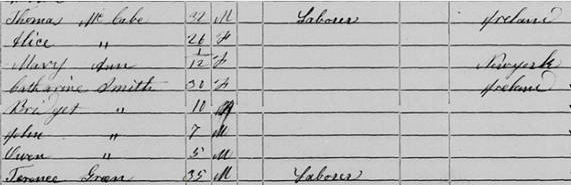
- Their ship anchored in New York City, and all four travelers made their way to Walworth Street in Brooklyn where they lived with John’s mother, Catharine, and her sister’s family (Alice Greenan and Thomas McCabe). See the following census record.
1850 US Census; E.D. 1, 7th Ward, Brooklyn City, Kings County, New York, United States
- John visited many cousins in Ireland, Scotland and America. He saw Terry and Bernard Greenan in Urcher Townland (Kilmore Parish); John Greenan in Tullycorbet Parish; Edward Greenan in Milltown Townland (Ematris Parish); Peter Greenan in County Louth; Thomas Greenan in Buffalo, New York; and John Smyth in County Monaghan. Edward, Peter, and Thomas Greenan’s parents were Edward Greenan and Bridget Smyth.
- Other cousins included four McCarville brothers, three who lived in Sauk County, Wisconsin, and Catharine (nee McCarville) Lyons in Richmond Hill, New York. Their parents were Hugh McCarville and Bridget Greenan. Bridget’s parents were Bernard and Alice Greenan.
Did you notice how often the surname, Greenan, appears in our family tree? Early on we deduced that our family tree contained several different Greenan family lines. How confusing, right?
Peter Smyth and Catharine Greenan Marriage Record
“Now if we only could determine where our ancestor, Catharine Greenan, lived in Ireland before her marriage”, we thought. Then it might be possible for us to create a family tree that made some sense. As luck would have it, the National Library of Ireland placed old Roman Catholic parish records online this past summer. Unfortunately, Aghabog parish records are scarce and really do not start until 1875.
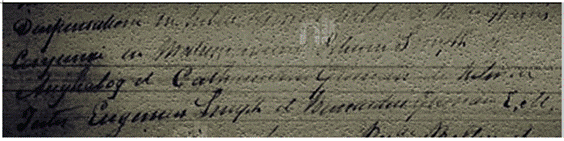
We long suspected Catharine Greenan’s family lived within Kilmore Civil Parish in County Monaghan. Kilmore parish records begin in 1836. In very short order we found the record we had been seeking. On January 5, 1837, the parish priest entered a marriage record for Catharine (Catharinium) Greenan and Peter (Peterus) Smyth of Aughabog. (See below.) Witnesses included Eugenius Smyth and Bernardus Greenan. “Eugenius” is Latin for “Owen”. “Irish” John’s uncle, Owen Smyth, eventually moved from County Monaghan to Scotland.
Although these records are maintained at St. Mary’s Church near Threemilehouse, we assume the wedding took place at St. Mary’s subordinate church, St. Michael’s Catholic Church, in Corcaghan Townland, Corcaghan is the nearest church to Urcher Townland in Kilmore Civil Parish, and approximately 2.8 miles apart. Urcher is where our Greenan ancestors lived.
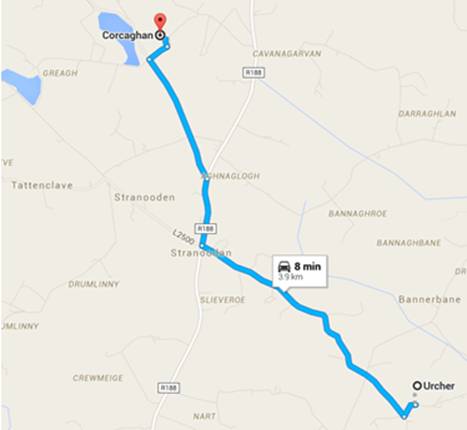
It makes you wonder how Peter first met Catharine since Rossnaglogh is six and half miles west from Urcher. Did he meet her while wandering the Irish countryside looking for work? Did they meet at a church event or town fair? Perhaps a matchmaker introduced Peter to Catharine. We’ll never know for sure.
Alice Greenan and Thomas McCabe Marriage Record
To prove Kilmore Parish is where our Greenan ancestors lived, we looked for other relevant parish records. Many parish records are absolutely unreadable; however, we did find a marriage record for Alice (Alicium) Greenan of Kilmore and Thomas McCabe of Tullycorbet Parish dated October 24, 1845. You may remember that our ancestor, Catharine Greenan Smyth, and her family lived with Thomas and Alice McCabe in Brooklyn. Wedding witnesses were Bernardo and Fransius Greenan.

Irish Clothing
How did Catharine, Peter, Alice and Thomas dress at their weddings? I doubt seriously our 19th century ancestors could afford anything other than simple and functional clothing at their wedding. Early 19th century men wore knee breeches, a linen shirt, wool stockings and heavy shoes. Many wore tall top hats made of felt, and some men wore top coats with a swallowtail shape in the back. County Monaghan women wore line undergarments or chemises that were basically long skirts topped by a woolen skirt or dress. They also wore aprons and kerchiefs. Many women did not wear shoes because they could not afford it. If one could afford footwear women might wear brogues with wool stockings. Some women wore linen headscarves on their heads in cold weather, and often wore a hooded cloak made of heavy wool during cold weather.
Our Family Trees Deciphered...
The previous records helped us resolve lingering questions about our Greenan family lines all related to “Irish” John Smith. What did we learn? The Drumsnat-Kilmore parish records tell us there are at least two separate Greenan families in our family tree. One line came out of Urcher Townland, with linkages cousins in Tullycorbet Parish and Edinburgh, Scotland. “Irish” John met James Greenan in Edinburgh, who links back to Urcher. John’s uncle and aunt, Owen and Bridget (nee Greenan) Smyth, lived outside Edinburgh. Bridget Greenan Smyth’s family line probably isn’t related to our own Greenan kin, although we do know her parents’ names (Patrick Greenan and Margaret McCarvel). The Milltown Greenan family includes cousins in County Louth, Belfast, Dublin and Buffalo, New York.
The Urcher Greenans were related to “Irish” John’s mother, Catherine Greenan, while the Milltown Greenans linked back to “Irish” John’s father, Peter Smyth. We believe the Milltown Greenan’s ancestor, Bridget (nee Smyth) Greenan. was Peter Smyth’s sister. As best as we can determine, the Milltown Greenans are not related to the Urcher Greenans.
Revised Family Charts
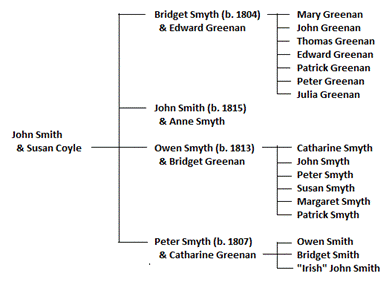
Now that our research clarified relationships in our family tree, it was time to revise our family charts to include relatives left out previously. Although we had known about many of John Smith’s Irish kin, we did not include some on any family chart because we did not know how these lines fit.
The Revised Smyth/Smith Family Tree of Rossnaglogh Townland
The Revised Greenan Family Tree of Urcher Townland
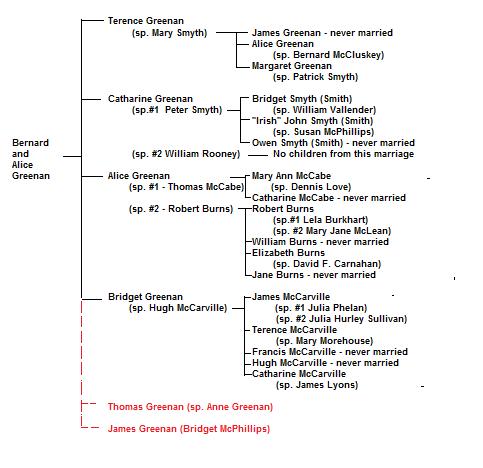
Are we missing names in these family trees? Absolutely! We include names which are known to us at this time. Several names appear in ‘red’. Although I am certain these names are listed correctly, I highlighted these names in red to indicate that these are not fully proved yet. Thomas and Anne Greenan were “Irish” John’s baptismal sponsors, and lived in Urcher too. We suspect they were John’s uncle and aunt since close relatives normally served as baptismal sponsors. James and Bridget (nee McPhillips) Greenan lived in Urcher before moving to Tullycorbet Parish. In 1908 “Irish” John visited their son, James Greenan, in Edinburgh.
Scenes from Urcher Townland
The landscape around Urcher is very rural, perhaps much of it unchanged over these many years. Would our Greenan ancestors recognize these landmarks and landscape today?
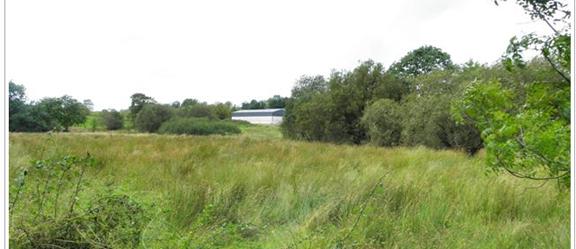
From Urcher looking West towards Nart
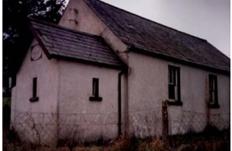

The Old Urcher School Urcher Road
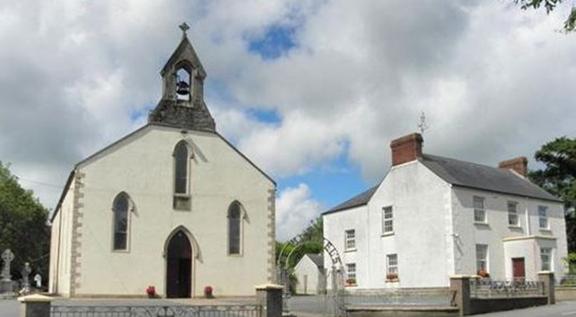
St. Michael’s Roman Catholic Church in Corcaghan
Our Greenan ancestors attended this church. Although remodeled in 1842, possibly retaining the front and interior of the original 1806 chapel, it would still be recognizable to our early relatives. The following was taken from the National Inventory of Architectural Heritage’s website about this old church.
Freestanding gable-fronted barn-style rendered Roman Catholic church, built 1842 (possibly retaining 1806 chapel). Consisting of five-bay nave and attached single-cell sacristy to west and attached boiler room and shed to south internal angle. Pitched slate roof, angled blue/black clay ridge tiles, replacement half-round gutters, stone verge. Gabled bellcote with Celtic Cross finial over rock-faced base with offsetting, pointed-arched aperture containing bronze bell embossed 'Sheridan Foundry Dublin 1868'. Painted roughcast walling over plinth with V-jointed sandstone quoins. Sandstone plaque to apron of central east gable window over entrance, framed and inscribed 'Deo Uni Trinoque/Sub invocatione/B. Mic. Arc/A. D. 1842'. Sacristy west gable
plaque inscribed: 'IHS (Jesuit monogram with cross over H)/This chapel was erec/ted under the inspection/of The Rev. Edmund Malone PP/Pastor of Killmore A.D/1806. Pointed-arch diagonally lazed lancet windows with splayed sandstone surrounds with flush sills (those to east gable have label-ended hood-mouldings). Pointed-arch modern stained timber vertically sheeted double-leaf door with timber tympanum and hood-mouldings. Interior fully remodeled c.1980. Access via narthex into nave under east gallery supported by timber stanchions, stained panelling and raked modern benches. Exposed replacement stained timber king and queen-post truss post roof structure on moulded corbels with diagonally sheeted panelled ceiling. Painted plaster walls with timber sill course and skirting board, modern benches flanking central carpeted aisle, modern liturgical
furnishings with west end three lancets (that to centre heightened) containing stained glass (c.1890, possibly by Mayers of Munich) over modern reredos. Surrounded by graveyard (modern to rear elevated site), except to west (front) bitmac parking lot; Jubilee Mission Cross to rear (dated 2000). Set back from road by modern mild steel dwarf railing between square brick piers and mild steel gate with overthrow lettering 'St. Michael's'.
Appraisal
Although apparently built (or remodeled) after Catholic Emancipation, this building retains the spatial arrangement of an earlier chapel of 1806. Despite reordering and the loss of original detail, the building retains some fine external features,such as plaques and the bell. There is also a stained-glass window in the style of Mayers of Munich.
St. Michael’s Gravestones
Parishioners are buried outside the church walls. It is not clear when the first burial was made in this graveyard, perhaps there are graves there as old as the church itself. The most common names found on gravestones are McPhillips, Clerkin, Duffy, McCabe, McCarville among others. One gravestone marked ‘McConnon’ interested us. “Irish” John Smith married Susan McPhillips, and Susan’s maternal grandparents were William Smyth and Mary McCannon. The McCannon or McConnon surname is extremely rare in Monaghan. I have only seen it listed twice, once for a Protestant. Unfortunately, we found no Greenan gravestones in this cemetery; however, that does not mean they are not buried there. There are quite a few plots either unmarked or marked with a simple metal cross.

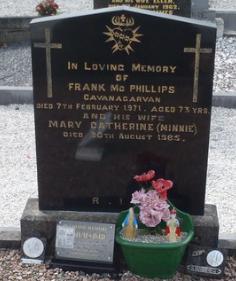
Owen McPhillips Family Frank McPhillips Family
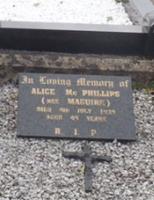
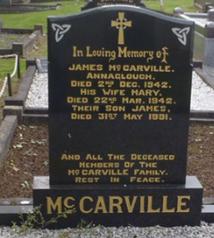

Alice McPhillips James McCarville Family McPhillips Family
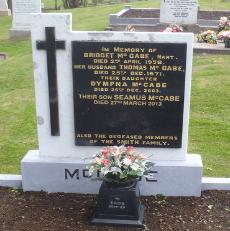

Smith and McCabe Family Typical Plot Marker
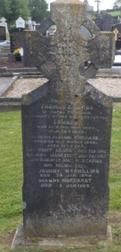
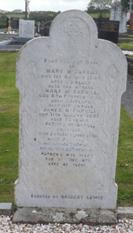
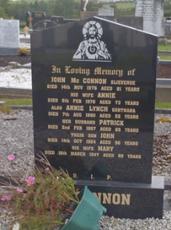
Kearns and McPhillips Old McCarvill Marker McConnon Family
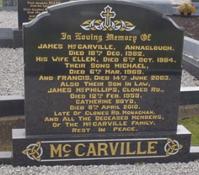
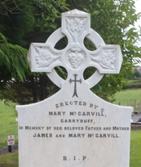
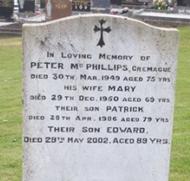
James McCarville Family James & Mary McCarville Peter McPhillips Family
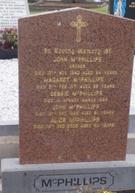
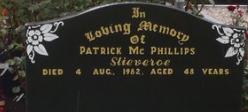
John McPhillips Family Patrick McPhillips
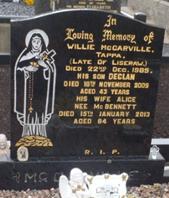
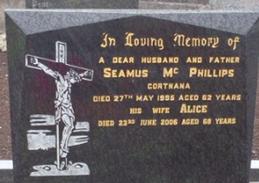
Willie McCarville Family Seamus McPhillips Family
Many of these gravestones indicate where parishioners lived in life. Those from Urcher Townland interred in St. Michaels Cemetery include Sarah Kierans, Arthur Kierans, Ellen Duffy, Pat Duffy, Bridget Connolly, Johnny and Margaret McPhillips, John Connolly and Lily Connolly. Perhaps the Duffy family “Irish” John visited in Buffalo, New York, came from this Townland.
Threemilehouse - St. Mary’s Catholic Church Cemetery
St. Michael’s Roman Catholic church was attached to St. Mary’s Catholic Church at Threemilehouse about three miles away. Threemilehouse has one of the oldest graveyards in the country, Drumsnat, which dates to 600 AD. One Greenan grave marker is quite old and reads, “Here lies Edmond and Catherine Greenan Died 1793 aged 10 and 15.”
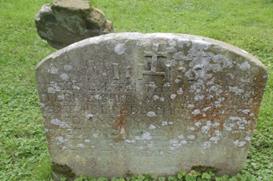
Tullycorbett Parish Cemetery
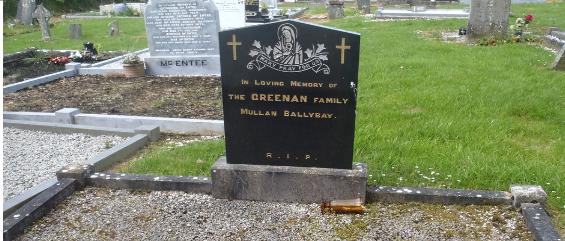
Finally, we found one grave marker for the Greenan family of Tullycorbett Parish. In 1908 “Irish” John visited John Greenan and his family at Tullycorbett, which he wrote as Terrecorbitt. Perhaps John Greenan’s parents, James and Bridget (nee McPhillips) Greenan, are buried here too.