

Lillian Langtry, aka Jersey Lil
Lillie Langtry of Jersey Island
Lillie Langtry and Judge Roy Bean

One of the more colorful characters of the Old West was Judge Roy Bean of Langtry, Texas. Judge Bean, self-styled as the "Law West of the Pecos", named his town after the stage siren, Lillie Langtry. She was known as ‘Jersey Lillie’. Lillie was the 'It' girl during the latter part of the nineteenth century and was considered one of the great beauties of her time. In 1896, after his first house was destroyed by fire, Judge Bean rebuilt the Jersey Lilly Saloon and constructed a home for himself across the street which he called the Opera House. Judge Bean saw Lillie perform in San Antonio but never met her. Roy sent Lillie a real live bear, but fortunately for her the bear escaped. Roy Bean became infatuated with Lillie after seeing her picture. It was lonely out there in the Old West!
Contrary to what you may have seen in the movies or read in old western novels, Roy Bean never met Lillie Langtry. Roy was said to have gone on a drinking binge in Del Rio on or about March 14, 1903. The following afternoon friends found him wandering aimlessly around his saloon and a doctor was summoned. It was too late as Judge Bean died the following day in his own bed of "heart and lung ailments". Ten months after his death, the Southern Pacific stopped at Langtry with Lillie onboard. She decided to take the judge up on his invitation. She visited the Jersey Lily saloon and listened as locals told her how Roy Bean had fined a corpse, freed a murderer and lined his pockets by shortchanging train passengers. Roy Bean once said, "I know the law...I am its greatest transgressor."
This story is not so much about Roy as it is about Lillie. She was notorious in her own right.
Her Life
Lillie Langtry was born Emilie Charlotte Le Breton in St. Saviours Parish church rectory, Jersey, on October 13, 1853. Our Trachy ancestors also lived in Jersey and can be traced there as far back as 1275 AD. The Le Breton family was well respected locally. Her ancestors served with William the Conqueror at the Battle of Hastings. Her ancestry was Norman, as are most people who live on this island. Her father was William Corbet Le Breton, who was the local rector for the parish. Her mother was born Emilie Davis Martin.
Emilie married Edward Langtry, who was much older than she. Edward and Emilie Langtry moved to London and in London Emilie drew fame for her great beauty. Later she met the Prince of Wales, Albert Edward, future King Edward VII of England. For years Emilie carried on an illicit affair with the future king. The king's wife and Edward Langtry were aware of these dalliances. Edward Langtry's solution was to either go away on extended fishing trips or simply stay home drinking. In 1880 Edward Langtry was declared bankrupt, and Edward left his wife to deal with the creditors. A pregnant Emilie left London for Jersey with two Buckingham Palace guards. Who was the father? It was not Edward Langtry. To pay these mounting debts she became an actress and took the name 'Lillie Langtry'. By 1898 Lillie gave up her stage career and married Hugo, the son of Sir Henry de Bathe. He was 19 years her junior.
Lillie hated the name ‘Emilie’ and ‘Charlotte’. She maintained the surname ‘Langtry’ even after her divorce from Edward.
In 1906 Lillie came out of retirement and appeared in both vaudeville and films. She also wrote a book. Lillie died in Jersey on December 2, 1929, after a bout of bronchitis turned into pleurisy. The "Jersey Lily" is buried on this island. She was never considered the best actress of her time; however, she made several memorable performances that catapulted her career in the theater.
Le Breton Genealogy
How is Lillie's family related to our own? The Channel Islands, including Jersey, were never overpopulated in earlier times. For example, in 1821 the population of these islands was 49,430 souls. The 1788 census, taken on April 9th, shows 20,025 people living on Jersey Island. Our own Trachy ancestors were Anglican as were most people living on these islands. Although Norman in descent, the Channel Islanders were considered English. Sometimes the Trachy surname appears as Tracy in Channel Island records; however, these names appear interchangeable. The chart below shows the Le Breton family tree:
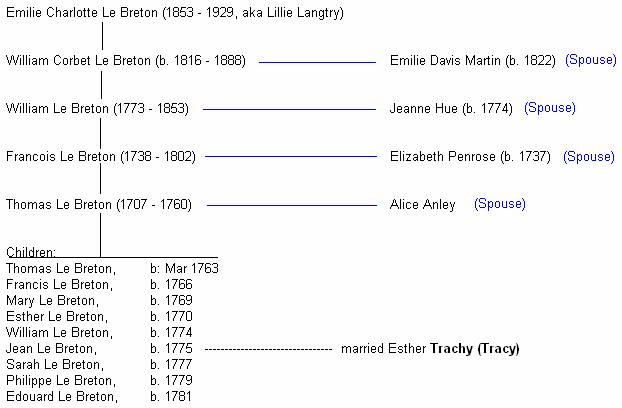
We do know the Channel Island surnames associated with our own family. The Trachy family can trace its lineage to Richard Trachy born in Jersey by 1275 AD. The early Trachy family appears to have been landowners and had considerable influence in Jersey. This set them apart from the peasant class. Richard may have held a royal title. Richard’s oldest son was named Guillaume (William). We are related to all Trachys.
Lillie had six brothers; however, I have not been able to find any information regarding their spouses. I have found little marriage information for any Le Breton family member from 1750 AD forward. Sara Anley married into the Trachy family in 1740. Sara was sister to Alice Anley, who married Thomas Le Breton. Jean Chevalier (1580 – 1612 AD) married Perrotine Trachy. We find evidence later where the Chevalier family married into the Le Breton family. Due to the small population of this island it is very likely most residents are distantly related to each other in some form or fashion.
An Odd Bit of History – Thomas a’Becket
Lillie Langtry was a direct descendent of Richard Le Breton, one of four knights who assassinated St. Thomas a’Becket.
St. Thomas a’Becket (1118 – 1170 AD) was Archbishop of Canterbury from 1162 to 1170 AD. Thomas argued with King Henry II over the rights and privileges of the Church. Henry wanted more control over church affairs, while Thomas held firm in his belief that the church was sovereign.
Later, St. Thomas would be killed by the King’s followers. The King was angered after his meeting with Thomas and reputedly made the following comments – “Will no one rid me of this meddlesome priest?” and “Who will rid me of this low-born priest.” This was interpreted by his four knights (Reginald Fitzurse, Hugh de Moreville, William de Tracy and Richard le Breton) as a royal command. On Tuesday, December 29, 1170, they carried out their plan by murdering Thomas a’Becket at the entry of the Quire in Canterbury Cathedral as he was attending Vespers with the monastic community.
Later, Richard le Breton retired to Jersey and quietly lived out the rest of his life. One assassin’s name, William de Tracy, is of interest to us. Is this William de Tracy also found in our family tree? The name William (Guillaume) appears frequently in the early Trachy (Tracy) records. It is possible there is some distant relationship but I don’t think a direct one can be found.