The Lost Children



| 1832 cholera hospital, Pointe Ile |

| Port Grosse Infirmiry |
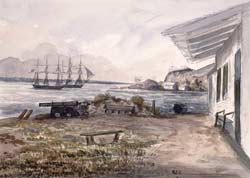
| Officers Quarters, Pointe Grosse |
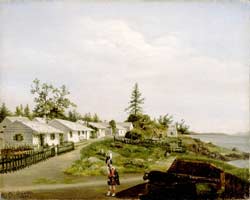
Quarantine Section
| When the Ryans came to Canada they most likely came thru Pointe Grosse. It was Canada's version of Ellis Island. |
|
The Children of Nancy Ann and James Ryan |
U.S. Census “Age” |
Baptismal Records (Day/Mo/Year) |
Baptismal Sponsors |
|
Mary |
1837 |
24/9/1837 |
John Campbell, Nancy Conners |
|
Dennis |
1845 |
Jan 1844 |
Patt Conel, Bridget Ryan |
|
James |
1845 |
31/1/1847 |
Mary Ryan, John McKeogh |
|
Margaret |
1849 |
5/4/1846 |
NMS, Bridget Russel |
|
Nancy |
1854 |
17/4/1854 |
Henry Cummins, Catherine Campbell |
|
Catherine |
1856 |
11/3/1856 |
Russell Garrett, Mary Commons |
|
Bartholomew |
1850 |
No Record |
|
|
Bridget |
|
29/9/1839 |
Bart Campbell, Mary Casey |
|
Daniel |
1861 |
1/1/1861 |
John Russell, Mary Russel |
The Lost Children
While our great-great grandmother Nancy was still bearing children in 1860, her eldest daughter Mary was producing children of her own. Mary and John Boney’s eldest daughter, Mary Boney, was born in 1854. Nora Boney was born in 1857, presumably in Lacamore, Ireland. Her daughter Margaret Boney was the last child to be born in Ireland, and she was born January 9th, 1863. Mary Ryan Boney was most likely the daughter that the James Ryan family waited for in Canada- the Ryans finally made their way to Allamakee in 1864. It was also in Canada that Margaret Ryan met her future husband, Patrick Ryan.
Based on what we have in our possession, it appears that Mary was married to John Boney at the age of 15 or 16. Based on Catholic church records, Margaret was about 16 when she married Patrick Ryan. This is contrary to their family legend which says she met Patrick when she was 10 and married him when she was 12. As we have seen in our earlier research, the Irish never cared much about keeping track of their ages.
James and Nancy Anne also had a daughter by the name of Bridget, but she is never referenced in any family trees. She was born in 1839 (see Red above). If Bridget made it to adulthood and married, it is possible that she would have been bearing children by 1857. If she was still alive in 1863, we would have to wonder why she never came with her parents to Canada. Marriage and death records were maintained by the Church; and unfortunately the information contained in these records is not specific enough to link back to our families. So finding out what happened to Bridget may be something we’ll never know for certain.
1837 – 1839 - Lost Record – 1844 (may be late 1843) – 1846 – 1847 – 1850 – 1854 – 1856 – 1861 (may be late 1860).
There was a five year period between 1839 and 1844 with no recorded births. There was most certainly a child whom was born in either 1841 or 1842, and if one of them was a son, then he would have been named after our great-great grandfather James Ryan Sr.’s father. Because the first male child bore the name of the child’s paternal grandfather, and because there is this 5 year gap, the Tipperary Genealogical Society believes that the eldest male child born to the Ryans was “Daniel”, even though our historical records never reflected this birth. Their research suggests our family links to Daniel Ryan who lived in Cully, more specifically the Daniel Ryan who lived on Waller townlands. This elder Daniel was born in the late 1700s and was a tax collector in Bird Hill and Newport. Eventually he became a large landholder along with his sons, and one of these sons was our James Ryan. Even though "James Ryan" was not an uncommon name, we only see one James Ryan in Fidane, Waller and Gortnaskehy townlands in the Griffiths census records, and this "James" also held land in common with the elder "Daniel". So the census records supports the genealogical society's assessment.
As a footnote, the genealogical society thought this "unknown" Daniel may have died in infancy. As was the customary practice of the day, a son who died was oftentimes honored by giving a later son the same name. We know that in 1860, the youngest child of James and Annie was born, and he was named "Daniel". There were three other sons born after the first "Daniel's" death, so it doesn't seem likely that this Dan Ryan died in infancy. Interestingly, there was a 10 year span between the last son (Daniel, Dan or D.J.) and his next youngest brother - that was Batt Ryan in 1850. It seems more likely that the first Daniel died in the 1850s, and most likely as a result of the famine.
It is unfortunate that no newspaper account exists that talks about this family. The baptismal records have allowed us to correct some inaccuracies regarding birth years, but it also raises questions as to how many children were really born to James and Annie Ryan. And did any of these children remain in Ireland, particularly any older children born of this union. We may never know.