Eureka Atlas 1911


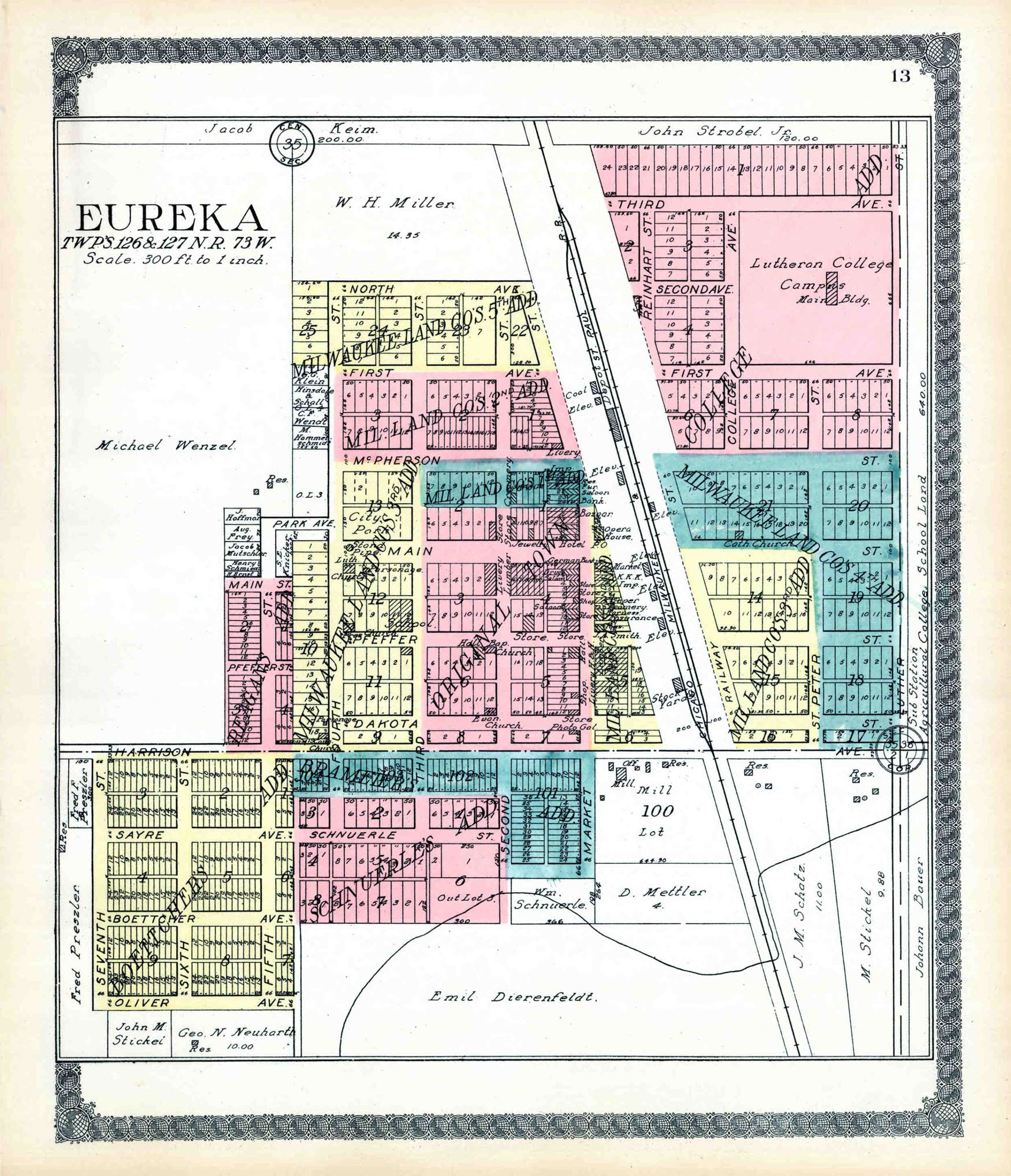
Below are some points of interest in Eureka that were part of our earliest memories of this city.
Catholic Church
The Catholic congregation in Eureka was organized in 1888, as a mission, under Rev. Jos. A. Stephen from Ipswich. In the summer of 1893, the congregation built the church, 24 X 36, 14 foot posts. The church was dedicated on July 16, the feast of St. Mary of Mount Carmel, for whom it was named. At the time there were 33 families and active members.
The Catholic Church was located a few yards from the MDU building located east of downtown on Main Street.
The Lutheran College
None of the Smiths remember a time when the "college was a college", although there were people in Eureka who attended this school. We called it the "old people's home", although its official name was The Good Samaritan Home of Eureka. The Home officially opened its doors on November 1, 1934. After its doors opened, it's "inmates" included 40 old folks and five children, according to the book describing Eureka's centennial.
Eureka State Experiment Farm
The farm was approved by the 1907 State senate. In 1909, the South Dakota legislature set aside $6,000 for improving the farm and erecting the buildings. One of the crops it helped improve was ATLAS Corn, which originally was created in Highmore, South Dakota.
Eureka Lake. & Parks
Eureka Lake and Park System had its inception in 1933, and became a reality due to Roosevelt's WPA program. What you may not know is that the Lake was Eureka's original sewage reservoir. One of the first things they had to do was move the sewage pipes from the lake and redirect the refuse to a field north of Eureka. Think about that the next time you take a dip...
Eureka - World's Greatest Wheat Market.
We had always heard that Eureka was the largest Wheat market in its early years. Interestingly, this was true for a period of 15 years (1887 and 1902). At the time Eureka had 32 grain buying concerns. - 10 of which were elevators, 22 were large grain storage houses. Farmers from 50-75 miles brought their grain into Eureka and year after year, 200 men worked day and night shifts to handle the 4 million bushes of grain the area produced.