

The Smith and Fox families descend from Charles Turgeon, the first Turgeon to step foot on North American soil. Charles was born in Mortagne, France, which is located in the Perche region of Normandy. His parents were Jean and Sebastian (Liger) Turgeon. Charles was baptized on September 3, 1627, in St. Jean de Mortagne Catholic Church. This church no longer exists but was located at 42 Rue de Paris in Mortagne. Today a veterinary clinic sits atop the basement of this former church.
Historical data suggests Charles had several siblings. He had a brother named Charles who died on October 20, 1626, a year before our ancestor, Charles, was born. He also had another brother, Gilles, who was baptized on October 22, 1635. His sisters were Charlotte, Jeanne and Anne.
Charles married Pasquiere Lefebvre in 1649 at Notre Dame church in Mortagne. Pasquiere may have been born circa 1627. A 1667 Beauport, Quebec, census suggests both Charles and Pasquiere were born in the same year. In that census Charles and Pasquiere listed their ages as 40. Their children were born over a 20 year period from 1650 to 1670. Four of their children died young. Six of their children were born in France, and four children were born in the new world. Of the four children who died young, three were born in France and died in France.

Notre Dame Catholic Church in Mortagne
Charles and Pasquiere, with their children, Marie Clair, age 14; Jacques, age 10, and Anne, age 4, emigrated to New France in the summer of 1662, settling in Beauport near Quebec City where he took possession of a parcel of land. However, Charles traveled to the Americas at least once, perhaps many time before finally emigrating. Charles lived in Perche, a rural area located in inland France far from any seashore. A police report dated 1657 listed Charles’s occupation as sailor.
"Jean Chausse dit Lemeine, while was making his rounds around nine o'clock at night near the Place-Royale in Quebec, when passing by the home of Charles Turgeon, a sailor, had urine Thrown on his head that Turgeon was in the process of throwing into the street from his balcony/” For this impoliteness, Turgeon was brought before the courts.”
Andre Lachance
Crimes et criminels en Nouvelle-France,
Montreal, Boreal express, 1984, p. 29

The Perche region lies mainly in the present-day Department of Orne in Normandy.
We find many amusing stories regarding Charles.
This is not the first time Charles Turgeon had trouble with the law. He was known as a difficult and somewhat quarrelsome neighbor. In another incident dated January 12, 1677, Charles took wood from Jacques Marie’s land, and removed a stake from the ground which identified Marie’s property line. When Jacques confronted Charles about his sordid deed, Charles removed Jacques’ cap from his head and then struck Jacques several times with a stick. Notary Vachon heard the case and fined Turgeon 20 livres and gave him eight days in jail.
Charles was solvent enough to lend money to another Mortagne area resident who also wanted to leave France for Quebec. The following information is reported in a genealogical dictionary of original
Quebec families: Robert Boulay (Boule, Boulet), who was a plowman from the St. Germain de Loise parish in Le Perche, decided to leave his country with his wife, Francoise Gamier and their three-year old daughter, Jacqueline. On June 23,1662, he borrowed 20 pounds from Charles Turgeon to help pay for his trip from the Mortagne area to La Rochelle, where the ship to Quebec was to embark. The Boulay family boarded a sailing ship of 300 tons named the Golden Eagle at Chef de Baye near La Rochelle. (Charles and his family were on the same ship.) Apparently the trip across the Atlantic was "restless and longer than usual." On November 8,1662, some months after arriving in New France, Robert repaid the money he had borrowed from Charles.

A view of the city of Mortagne in Perche
Many new colonists were recruited to work in this new land for a period of three years. Most were bachelors and paid anywhere from 40 to 120 pounds (livres) per year. In addition they received free passage to New France where they would receive land. Most were unskilled and illiterate. Upon completion of their 3 year contract, most stayed in Quebec.
Charles Turgeon in Perche
We can still see the house Charles Turgeon purchased in Bignon outside of the village of Revillon. He bought this house on October 22,1670, from Toussaint Giroux. Toussaint Giroux was born in Le Bignon in 1633 and came to Quebec in 1653 when he was only twenty years old.

On the Internet someone added the following note about this house: "The farmer who described it to the royal notary Romain Becauet, says the Perche house was surrounded with ‘garden, a small enclosure and about two arpents of a little tillable land.'"

The Turgeons in Quebec
Beauport, Beaumont, Lambton
The Beauport census of 1667 indicates Charles and his wife, both 40 years of age, had ten arpents of land under cultivation. (An arpent is an old French unit of land measuring approximately an acre.) Their children included Jacques, 14; Anne, 9; Zacharie, 4, and Pierre, 1. Daughter Marie Claire married Abel Sagot in 1665 and lived in Quebec City. Zacharie and Pierre, as well as their last child, Jean, were born in Quebec following the family's emigration. The Smith and Fox families descend through Zacharie’s family line.
Stomping on a Bonnet: Charles Gets in Trouble Again
Still more trouble for Charles. In 1669, Charles purchased 40 arpents of land with a hut and barn in the village of St. Joseph, which is across the St. Lawrence River from Beauport. This land was bordered by land owned by Jean Lemarie and Pierre Lefebvre. St. Joseph no longer exists but was located just west of Beaumont, on a site where Levis now exists.
Below is an account related to this land purchase and may explain why Charles and Pasquiere returned to France and purchased the Giroux home. This account was written by a genealogist researching the Turgeon ancestry and is roughly translated from French:
"Charles Turgeon was something of a character. Here is an anecdote transmitted by a woman named Lemaire who was a genealogist in Ottawa at the time during a visit with genealogist George Henri Temblay: "Jean Lemarie [who apparently owned the land next to the 40 arpent parcel Charles Turgeon had purchased] had one day an argument with Charles Turgeon concerning the limits of his property. It so happened the wife of Lemarie got involved with the discussion. Charles Turgeon, not appreciating this intrusion of a woman in the discussion of men, then tore off the bonnet of the lady and trampled it, which, at the time, was a supreme insult.
"Mrs. Lemaire carried the bonnet in front of the courts, which helped her prove her case. Turgeon was thus forced to pay court costs and a fine appropriate for such circumstances. "Would this be the reason which caused Turgeon to return to France? The history does not say, but one can certainly suppose that [following the disagreement with the LemariesJ it was very difficult to have good relations with his neighbors."
More Bad Behavior
On Monday, December 4, 1679, Charles Turgeon learned that, his complaint against Pierre Toupin dit Lapierre and Rene Siret dit Lafleur, was accepted by the Sovereign Council. It seems that, the latter had cut pine trees on Charles' property. The accused then asked for an official report of the survey, by Jean Le Rouge, on January 8.
Charles Turgeon and Jean de Rainville reached an agreement on September, 18, 1681. Rainville promised to give Turgeon 46 livres, 36 for legal expenses and 10 for bandages and medications. A doctor prescribed the bandages and medications for wounds Charles received from his fight with de Rainville. Furthermore, Jean de Rainville broke Charles’ gun. The court order obliged de Rainville to pay for the gun’s damage.
Turgeon farmed the land, in the village of Saint-Joseph, between the properties of the Lord of Beauport and the village of Saint-Michel. On August 17, 1683, he had a neighbor named Joseph Vandandaigue dit Gadbois, a master carpenter who lived in Quebec. The latter offered his land as a farm lease and an amount of grain for five years. Charles accepted this offer in the spring of 1683.
In 1688, in the bailiwick of Charlesbourg, Charles Turgeon managed to obtain payment for services rendered to Pierre Parent for 19 livres. He had also done business with his son, Jacques Parent, by selling him two oxen. For a second time the uneasy relationship between Jean de Rainville and Charles Turgeon turned sour before the Sovereign Council on January 31, 1689. Charles did not accept the decision of the Provost of Quebec, namely that Turgeon had to use the large path to go from the village of Saint-Joseph to the meadowlands of Fargy or Beauport. The high court ratified the decision of the Provost. It even gave it some teeth! Our Ancestor had to resign himself to use the public road.
Some Cultivated Land, 2 Guns, 5 Horned Animals
We do not know how long Charles and Pasquiere stayed in France following the purchase of the Giroux property in Le Bignon, but we do know that in the census of 1681 the couple was back in Beauport.
The census of 1681 also reports that Charles and Pasquiere were both 55 years old; Zacharie was 18; Pierre, 15, and Jean, 10. The family had the following modest possessions: 2 guns, 5 animals with horns and 12 arpents of land under cultivation.
Son Jacques had left home and was residing across the river at Beaumont. Jacques had six arpents of land cleared. Zacharie followed his brother there at some later date. According to the same genealogist who provided the Lemarie account, Zacharie became a benefactor of the church at Beaumont and had a mass said every year "for the rest of his heart." Exactly what is meant here is not clear, but we speculate that Zacharie left some money to the church and requested that a mass be said each year at the church in his memory. With the two eldest sons in Beaumont, the younger brothers — Pierre and Jean — stayed in Beauport. They married and some of their offspring went to Beaumont to be among their cousins. This seems to have displaced the seat of the family in Beauport to a great degree.
The Final Years of Charles and Pasquiere
Jacques, the eldest son and the first who moved to Beaumont, remained a bachelor for many years until finally marrying in 1704 at the age of 51. Charles and Pasquiere also had two daughters — Marie Claire, mentioned earlier, and Anne, who became a nun. Anne resided at Hotel Dieu, a hospital in Quebec City.
On June 8, 1677. at the age of 18 she became a novice in the order of the Sisters of Ste. Marthe. Anne was designated "professe" on January 31, 1679, at the age of 21. In 1691 Charles and Pasquiere, both 64 years old, returned to France on one of the last ships of the year leaving Quebec. They remained there until the fall of 1693, when they returned to New France once again. Jean, their youngest son, married Anne-Therese Vachon of Beauport on Nov. 8, 1691. Did Charles and Pasquiere attend the wedding?
With the marriage of their son, Pierre, in Lauzon, Quebec, on Nov. 16, 1695, Charles and his wife are listed as residents of Beauport. When Jacques was married in Beaumont on Nov. 26, 1704, they are listed as deceased. We do not know the exact date of their deaths, but we do know that they both died sometime between 1695 and 1704 — the time between the two marriages.
Charles and Pasquiere are probably buried in Quebec. A priest at the church of the Nativity of Notre Dame in Beaumont says early settlers were buried in unmarked graves behind the church and beneath it. We can only assume Charles and Pasquiere are buried within this church or grounds. Beaumont ("beautiful mountain") is a place where some of Charles Turgeon's children and their descendants became established, with the exception of his son, Jean, who remained in Beauport.
Historic Places in Beauport and Beaumont
THE NATIVITY OF NOTRE DAME CHURCH, BEAUPORT: The existing church is the fifth built on this site and is located in the heart of Beauport and, as we have mentioned earlier, is the likely burial place of Charles and Pasquiere Turgeon.

HOUSE OF NICHOLAS BELANGER AND MARIE DE RAINVILLE, BEAUPORT:
Constructed in 1660, it now serves as the Historical Center in Beauport. Since Charles Turgeon arrived in Beauport in 1663 and lived there, it's likely he visited the house. You may recall from earlier accounts where Charles had altercations with a fellow by the name of de Rainville.
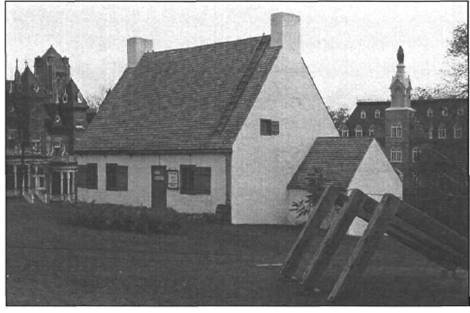
JACQUES TURGEON HOME, BEAUMONT: A visit to Beaumont should include the municipal library dedicated to a local folklorist, Luc Lacourciere. Luc's ancestors owned a home built by Jacques Turgeon, Charles's son, in 1715. The home has been restored, is still occupied and is an excellent example of early French Canadian architecture. Other Turgeon ancestral homes are featured in literature available at the library. One can also browse through historical books on Beaumont for information on early settlers and their families.

FINALLY…
Finally, you may want to know how the Smith and Fox families are related to Charles and Pasquierre Turgeon. The chart below shows our most direct Turgeon line:

**********************************************************************
February 2010