Houries, Shannons, Ryans - Manitoba & Saskatchewan


First Generation: Thomas Hourie, and Margaret Eunson.
Uncovered in an Edinburgh Scotland church record stating: " Hurry 8th Aughust was born John lawful son of Thomas Hurry in Scapa and Margret Eunson his spouse bapt 11th August 1775" There are two other entries one is 1770 spelled Hurie (but the same Thomas and Margret Eunson) and the other 1776 spelled Horrie with the same parents.
Second
Generation: John HOURIE b: 1779 in Orkney Isles,
Scotland d: August 15, 1857 in Poplar Point District, being buried in
St. Andrew's Anglican Church Cemetery, Manitoba
.. +Margaret-BIRD b: 1787 in the
Snake Indian Settlement, North West Territories m: 1809 in North West
Territories, where they were married according to the Custom of the
Country -- they were formally married, May 10th 1825, in St John's
Church, Red River Settlement (see Metis Families CD136 edition: Vol.3,
pp.89-95 for history & descendants..... d: 1847 in Poplar Point
District, being buried in St. Andrew's Anglican Church Cemetery,
Manitoba
Third
Generation:
Robert HOURIE b: 1815 in Red River Settlement d: 1911 in St. Catherine's
District at age 95, Rural Municipality of Prince Albert, Saskatchewan.
Robert was buried in St. Catherine's Anglican Churchyard Cemetery, west
of Prince Albert.
....... +Angelique RACETTE b: Abt.
1817 in North West Territories m: Abt. 1835 in Red River District
(Manitoba) d: Unknown
... *2nd Wife of Robert HOURIE:
....... +Christiana-Jane-"Christy"
ANDERSON b: 1816 in Brandon House Settlement (Denney Papers), being
baptized on May 27th 1821 in St. John's Parish Anglican Church, Rupert's
Land (Manitoba) m: November 28, 1837 in St Andrew's Anglican Church in
Poplar Point, Red River Settlement, Rupert's Land d: 1876 in Kinosota
District at age 60, Manitoba. Another year of birth recorded in the book
"Descendants of George ADAMS & Ann Heywood" is 1825 for Christiana; the
year 1825 is also in her Manitoba Scrip C-14929. Father: James ANDERSON
Mother: Mary-Suzette-DeMORAN SAULTEAUX
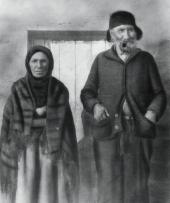 |
Pierre Hourie and wife Margaret Thomas. Pierre was a son of Robert & Christi Houri. He was a brother to Catherine Houri, whose daughter married John Ryan. |
Fourth
Generation: Catherine HOURIE b: December 24, 1845 in St
John's Parish District [another date of birth, December 29th 1843,
provided by Family], Red River Settlement [Manitoba] d: Unknown
....... +William SHANNON b: Abt.
1843 in Red River District (Manitoba) m: Abt. 1862 in Red River
Settlement [Manitoba] d: Unknown Father: Timothy SHANNON
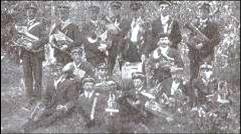 St. Rose Band, 1907, Rose du Lac, Cattle Capital of Manitoba. |
Members of the first band were: Charles Angot, Jean Audic, Emile Bedu, Joseph and Martien Hamelin, Edouard Lahaie, R. Laplanche, Francois LeGall, Raymond Lussier, Jules Lecomte, Georges Jeannotte, Joseph Molgat, Duhamel Neault, Alex, Isidore and Raphael Pinvidic, Salomon Ramsay, Xavier Ritchot, Emile, Richard and James Robinson, John Shannon, Henri Fouchard (Director). |
Fifth Generation:
1881 Census (Manitoba)
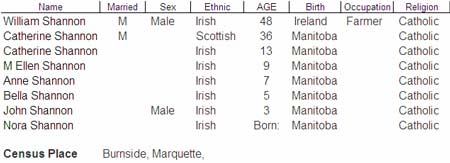
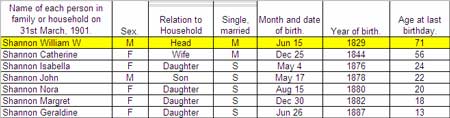
1901 Census (Manitoba)
On May 22, 1892 Mr William Shannon from Ste Rose, wrote a letter to Archbishop Tache in Winnipeg. Stating in this letter that the community was steadily growing and they were far from any church; and any children being brought up in the area would be sadly lacking in religious instruction, and the Sunday devotions were not as they should be, due to lack of guidance. It was estimated that about 40 families would assist at mass if their was a priest. They had built a small church in readiness for the possibility of the coming of a missionary or resident priest. In the years preceding, a missionary, Father Dupont came by occasionally and celebrated mass. He celebrated for the first time on March 24, 1890, baptized children and performed weddings. Then in August 1892, Mr Firmin Hamelin also wrote to the archbishop, also begging him to send a priest, because it was rumored that a public school was soon to be opened and a protestant had come to the area with the view to it being a protestant school. As most of the residence were French and Catholic; this was not to their liking! And so in the fall of 1892, archbishop Tache, in answer to these and other demands, named the Rev. Joseph Alexis Prosper Magnan, OMI resident priest for Ste Rose du Lac, and he was to also have as missions, Sandy Bay, Ebb and Flow, Alonsa and Dauphin. It was by this priest that the name of the parish became known as Ste Rose du Lac. Father Magnan was born in Berthierville, PQ on May 27, 1858, was ordained priest on June 19, 1886, was in Ste Rose (1892-93) and died in Lowell, Mass. USA June 22 1916 at the age of 58. Father Magnan was a small man in stature, but great in courage!
On January 29, 1893 the first confirmation took place: 21 young boys and girls whom Father J. A. P. Magnan, OMI had prepared, were ready to be confirmed but Archibishop Tache who was ill and unable to travel delegated Rev. Father Charles Camper, OMI as his representative to administer the sacrament of confirmation in the chapel at Ste Rose du Lac to the following: Elise Allary, Myriam Dupuich, Elise Houde, Catherine Hourie, Catherine Lacouette, Cecile Lacouette, Marie Lacouette, Baptiste Lacouette, John Lacouette, Auguste Lacouette, Marie Lecomte, Patrice Neault, Duhamel Neault, Cleophee Neault, Charles Porter, Victorine Ritchot, Valerie Ritchot, Napoleon Richot, Arthur Shannon and John Shannon.
Sixth Generation
.....Geraldine Shannon , b. 1887 near St. Rose du Lac, Manitoba.
m. John Ryan. In 1911, John Ryan was living in Humboldt township (26) with a brother and his parents. His sisters had moved into the town of Watson, Saskatchewan - Mayme with her children plus Winifred her sister.
In 1911, Wm. Shannon was no longer living; and the head of household was listed as his wife, Catherine (daughter of Robert and Christi Houri). The Houris and Andersons were regarded as among the premier families living in Manitoba, and they are also prominent in Canadian history.

Winifred was a music teacher, and later we see her in the Cushing, Oklahoma, census listed as a musician as part of an orchestra.
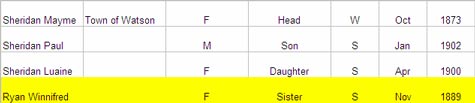
In the 1911 census, John is still listed as single. Interestingly, his wife is nowhere to be found in the Canadian census logs.

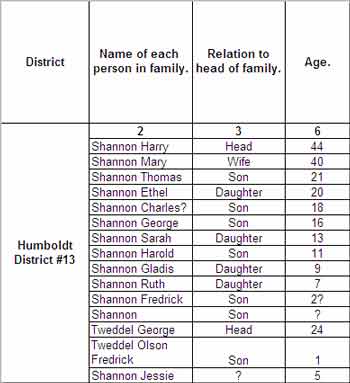
There was a Shannon family living in Humboldt township living near the Ryans (Saskatchewan, Canada), a number of Andersons (most appear to be Scandanavians in origin) and no Houries. The Harry Shannon family living in District 13, Humboldt township, does appear to be related to the Shannon family living in Manitoba.
Peter HOURIE
Camped in the Qu'Appelle Valley, Peter HOURIE and his companions
watched with astonishment as a herd of shaggy black bison waded into a
ford, crossed the slow-winding stream and climbed the opposing hillside.
The watchers' vigil lasted a full 24 hours. The number of animals in the
herd was estimated at one million. When HOURIE died in Regina at the age
of 83 years, the surviving bison in all of North America numbered less
than one thousand.
Peter HOURIE was born in 1827, the son of a British veteran of Waterloo
and a full blooded Snake Indian woman. He grew up in the Red River
Settlement and joined the service of the Hudson's Bay Company as a young
man. In 1864, he choose the sight of Fort Qu'Appelle for the Hudson's
Bay Company and erected the first establishment there. Later, he left
the Company of Adventurers and became a free trader among the Indians.
His knowledge of their ways led to employment by the government in 1874
as a special agent whose function it was to induce the Indians of
Western Canada to enter into treaties for that and suceeding years. He
was very sucessful in these negotiations and treaty commissioners all
paid tribute to his work. Later, Mr. HOURIE acted as a confidential
adviser to Indian Commissioner (later Lieutenant Governor) A. E. Forget
at Regina.
During the rebellion of 1885, Peter HOURIE was employed as interpreter
to General Frederick Middleton, a function which led to his being
present at many of the majer engagements of the campaign. His eldest son
Tom, carried dispatches for the government troops and it was to Tom,
that Louis Riel surrendered at the conclusion of the hostilities.
In his later life, Peter HOURIE was in charge of agricultural
instruction at the Piapot Indian reserve. He was a familiar figure in
Regina when he died in 1910."

Back row, left to right: O’Soup (Chippewa Chief) and Peter Hourie. Front row, left to right: Ah-tah-ka-koop (Starblanket), Kah-kiwistahaw (Flying in a Circle), Mistawasis (Big Child). Photo taken on October 16, 1886, on their visit for the unveiling of the Brant Memorial, October 18, 1886.
Mr. Peter Hourie sworn as Cree interpreter. 1885. Peter was a son of John Hourie and Margaret Bird.
Saskatchewan Archives Board
Peter was Catherine Hourie's uncle, great-uncle to Geraldine Shannon.
Peter HOURIE,
Camped in the Qu'Appelle Valley,
Peter HOURIE and his companions watched with astonishment as a herd of
shaggy black bison waded into a ford, crossed the slow-winding stream
and climbed the opposing hillside. The watchers' vigil lasted a full 24
hours. The number of animals in the herd was estimated at one million.
When HOURIE died in Regina at the age of 83 years, the surviving bison
in all of North America numbered less than one thousand.
Peter HOURIE was born in 1827, the son of a British veteran of Waterloo
and a full blooded Snake Indian woman. He grew up in the Red River
Settlement and joined the service of the Hudson's Bay Company as a young
man. In 1864, he choose the sight of Fort Qu'Appelle for the Hudson's
Bay Company and erected the first establishment there. Later, he left
the Company of Adventurers and became a free trader among the Indians.
His knowledge of their ways led to employment by the government in 1874
as a special agent whose function it was to induce the Indians of
Western Canada to enter into treaties for that and suceeding years. He
was very sucessful in these negotiations and treaty commissioners all
paid tribute to his work. Later, Mr. HOURIE acted as a confidential
adviser to Indian Commissioner (later Lieutenant Governor) A. E. Forget
at Regina.
During the rebellion of 1885, Peter HOURIE was employed as interpreter
to General Frederick Middleton, a function which led to his being
present at many of the majer engagements of the campaign. His eldest son
Tom, carried dispatches for the government troops and it was to Tom,
that Louis Riel surrendered at the conclusion of the hostilities.
In his later life, Peter HOURIE was in charge of agricultural
instruction at the Piapot Indian reserve. He was a familiar figure in
Regina when he died in 1910."
Tim writes: I have attached an addendum you can add to the Ryan Family in Saskatchewan story you wrote earlier. This or a version of it can be added to the website. It is about the James Ryan in 1911 as told by census records. One of their daugthers was named Mary or Mayme. Mayme Sheridan lived in Watson area at the same time as the other Ryans. I found Mayme living in Chicago in 1900 with her husband, William. One of the boarders was Margaret Ryan. Margaret Ryan was one of James and Bridget's daughters. I still don't know where James and Bridget Ryan were in 1900
|
||||
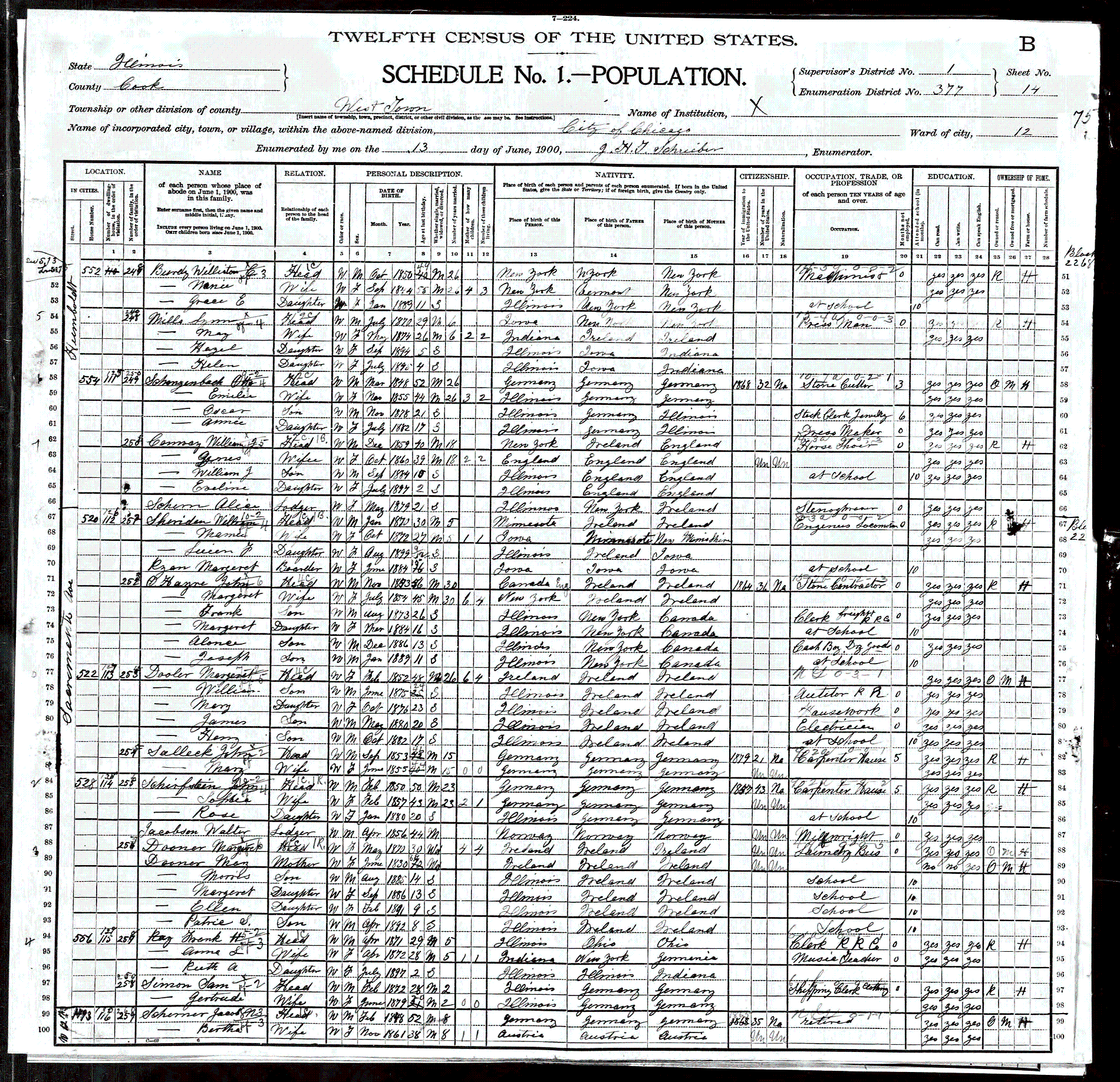
Sheridan Census
It looks like they all went back to Allamakee County, Iowa, before heading up to Canada. You can add that to the other Ryan stuff I sent to you earlier.
|
||||

1920 Cushing, Oklahoma Census
Interesting Story of Peter Houri in Saskatchewan written by Thomas Falkner Miller in 1924:
PETER HOURIE
"Peter Hourie built the log building which stands
in the yard as part of the Kennedy farm. Peter was
a clean living man. I camped with Peter on the
South Saskatchewan. We camped and he put up
a good prayer right in the open. In those days it
was sometimes difficult to get a plough point fixed
or an axe ground. Peter Hourie had two
grindstones; I tried to buy one of them, but couldn't
get it. The first deal I had with Peter was buying
an ox from him. At the time, cash was of very little
good. You could buy much more with furs, produce,
etc., than you could with cash. We set a date to kill
the ox and I went down to Peter's; Moore was going
to take half of the ox and I was going to keep the
other half of the meat for myself. I took my ox and
cart with me to bring away Moore's meat and mine.
The ox was killed buffalo fashion. The guts were
taken out and were lying on the ground. Peter was
pulling out the kidney tallow, and I said the kidney
tallow went with the meat. He was pulling it out
with the guts. He said, 'Take it or leave it.' I could
not help myself. I went to cut the head off. He
unjointed the head just behind the ears. I said,
The half of the head goes with the neck any-
how.' Peter said, 'Take it or leave it.'
BIG TOM HOURIE
(of special interest in Prince Albert, Humboldt, Qu'Appelle, Regina, Batoche, Dawson City, Yukon)
A 19th century Paul Revere galloped across Saskatchewan plains and parklands carrying vital messages for the government side during the Northwest Resistance. "Big Tom" Hourie was said to have raced through a blizzard of bullets on the battlefield, and to have swum the ice-choked South Saskatchewan River. But Hourie made his mark in Saskatchewan history as one of the three scouts to whom Louis Riel surrendered at the end of the rebellion. Then he joined the legions of gold-seekers who laboriously trekked into the Yukon in the late 1890s. His name pops up in history books like a prairie gopher, and yet few people have ever heard of him!
Home Guard Indians - In the earliest years of the Hudson's Bay Company (at the trading posts dotting the shores of Hudson Bay), the tentative inexperience of the HBC workers together with the pervading fear of French attack, resulted in the common practice of relying upon the Indians to supply the posts with "country provisions." This practice resulted in the emergence of the "Home Guard" bands of Cree whose lives became associated with the ebb and flow of life around the HBC posts. The close proximity of the Home Guard Indians also contributed to the ongoing development of intimate contact--with the resultant Metis offspring--between HBC men and native women. Hourie, Thomas - Thomas Hourie, a Metis scout employed by General Middleton, arrested Louis Riel on May 15, 1885.
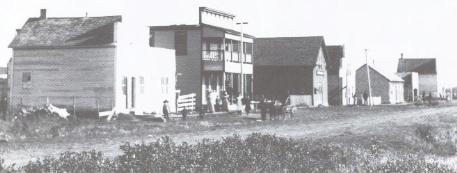
Main St. St. Rose du Lac, Manitoba, 1906
"Sask. Pioneer Dies in Regina"
"Harry HOURIE, a bronco-buster and rancher and brother of the man who
captured Louis Riel after the rebellion of 1885, died in hospital here
Wednesday at the age of 82.
Born in 1881 on the north bank of the North Saskatchewan River near
Prince Albert, he came to Regina in 1886, went to school here and
graduated into the saddle.
At rodeos across Canada and the United States he became a familiar
figure in the winners circle. He operated a range on which roamed 700
horses and 300 cattle.
Mr. HOURIE was one of the last of the old-timers in this area who could
say they had ridden a horse into a bar.
He was said to have faced down a man threatening to shoot him with a .32
calibre revolver.
Mr. HOURIE'S riding career came to an end in 1939 when a horse he was
riding rolled on him cracking his backbone and breaking his pelvis.
Doctors said he would never walk again without crutches but he threw his
crutches away in two years and manoeuvred his six foot three inch frame
around with the aid of a stick."