Aghabog Oral History
The following comments were taken from “Duchas.ie”, a website which stores written and oral Irish histories. Many of these stories were written in 1938 by Peter Smyth, age 14, who lived in Liscumasky (or Liscumaskey) Townland, Aghabog Civil Parish. His father was Edward Smyth, aged 66, also from Liscumasky, Aghabog. Young Peter also mentioned his grandfather, Peter Smyth, and his great grandfather, Edward Smyth of Corravilla. Our great great grandmother, Mary Smyth McPhillips, was born in Corravilla and about the same age as the oldest Edward. We believe Mary and Edward were siblings. No doubt our County Monaghan ancestors would remember many of these stories written below.
My District (written by Peter Smyth)
My Grandfather came to Liscumaskey sixty-six years ago. He was born in the Townland of Corravilla about a mile from Liscumaskey. He was thirty two years of age when he married. There was a new slated house built on the farm by his father, the first slated house in the Townland.
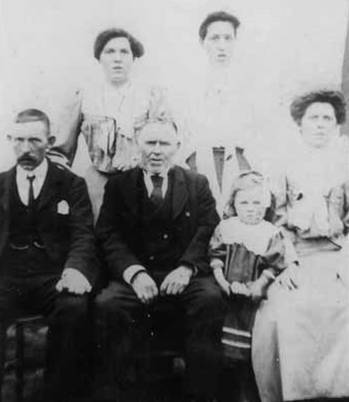
Picture above is Peter and Bridget Smyth’s family of Liscumiskey
I am living in the Townland of Liscumiskey in the parish of Aghabog and in the barony of Dartree. There are nine families and thirty four people living in these families. McCabe's name is most common. Some of the houses are thatched, others slated and some iron. They were all thatched at one time but one; that is my house. The thatcher's name is McCabe. He lives in the next Townland of Corleck. He is known as McCabe the thatcher.
The Townland got its name from the fort. There are two people over seventy living. They know no Irish. Their parents knew a little such as Cluain lois. ... There are not half the houses now as were long ago. The most of them are in ruins. Some of the people went to Scotland, others to America, some to England and New Zealand. The Townland is not mentioned in any history.
The land is heavy and hilly. The ash tree is most plentiful. The Townland is divided from other Townlands by a small river. The fences are made of clay and bushes.
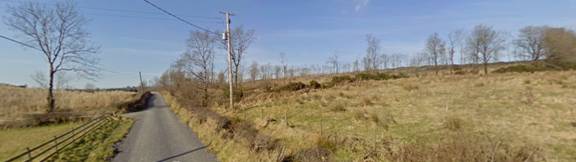
Panoramic View of Liscumasky Townland, Aghabog Civil Parish, County Monaghan
Famine Times (written by Peter Smyth)
The people were starved in this district at the time of the Famine 1845. Before this the people used to put in a lot of potatoes. When the famine came the people had no potatoes because the blight came on them, and rotted them. So that was the start of the blight.
There was a good lot of people died. The people had to eat raw turnips and weeds. When there were no potatoes the hens laid no (i.e. few) eggs. The people had to sell them to make money to pay the rent. A great lot of children died of hunger. Some days the people had nothing to eat, and thousands of them died.
There is some ruins of old houses which were there in the time of the famine. There was a good crowd of people in this district before that.
The government gave no relief to the people till 1847. When the people were fasting for three or four days they took sick and died. Some people were buried in the graveyard and others were buried in the fields near where they died.
The people took the dead bodies to the grave in carts. Their friends were too weak to carry them. The back of the ditches were spotted black with dead and dying people. They had to sell all the grain they had to make up rent to give to the land lord. They had to scatter their potatoes like corn. (I got that from Peter Carroll 69, farmer, Liscumaskey)
“Famine Times” Informant Pat Smith of Aghabog:
A good deal of people went to America because they could not pay their rent and the landlord put them out of their houses but some of them went with their own free will. An old man said there was a landlord called Lord Rossmore and he was very bad and there was an old woman called Brigid Murray. She could not pay her rent because she was poor. He put her out on the roadside and seeing nothing before her but starvation, she lived with her friends until she died.
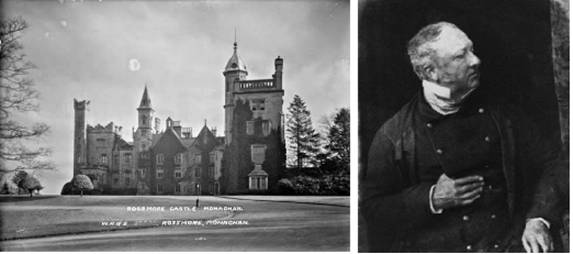
Rossmore Castle in County Monaghan alongside 1860 photograph of Henry Westenra who was 3rd Baron Rossmore from 1842 to 1860.
Famine Times (parts written by Mary Murphy}
“The landlord for this district was Lord Rossmore. His family had been in the district for over ninety years. They were bad landlords for the Catholics and put them out of their farms and only gave them five pounds an acre for their land. The landlords would put un-Catholics into their good places. They made the people pay heavy rents and would not let them make turf in their own bog”.
While these sentiments were almost universal, James Ward from Latnamard said Rossmore wasn't bad but that the bailiffs and agents were bad and wicked, and their activities were not known to Rossmore. The presiding lord's grandmother in 1938 was a Catholic and owned a seat in Three Mile House church. Her name was Lady Westenra Rossmore or Brigid Sherry.
Mary Murphy continued her story. “A man was transported for shooting a hare. He was only married six weeks. His wife became mad and got the nickname of Orange Susie”.
One of worst agents in 19th century Monaghan was Arthur Gamble Lewis, who not only was one of Rossmore's agents but married the widow of the Hon. Richard Westenra of Ballyleck. He was so disliked that Lord Rossmore dismissed him as agent, but Arthur Gamble Lewis still managed land rentals for his wife. Although he was universally despised in Ireland by both tenant and landed class alike, Lewis believed God ordained him to single handedly convert Monaghan Papists and other heathens to the true church.
In fact, the local Aghabog parish priest, Reverend Mr. Carolan of Latnamard wrote a scathing letter on September 24, 1847, to Lord Rossmore about this landlord’s (Lewis) and his subordinates’ practices. Part of the letter reads as follows:
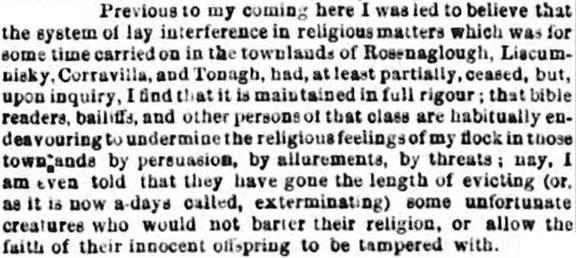
The Evening Freeman; Dublin, Ire.; November 24, 1856; page 3
He punished the faults of all Catholics who were brought before him with the greatest severity, while he treated Protestants with the very reverse. He had spies throughout his estate who kept Lewis informed of any tenant who bad mouthed him. If you said anything bad about him, you were evicted. He was a great proselytizer who left bibles and religious tracts across the country. If you did not accept his religious tracts or bibles then you were evicted. Arthur Lewis Gamble managed our Smyth, Greenan and McPhillips ancestors’ land leases. Lewis died in Dublin in 1869, aged 79 years.
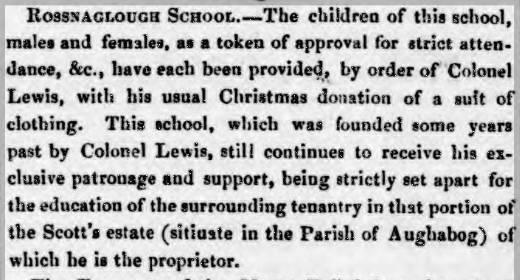
Newry Telegraph; December 29. 1846; page 3; Newry, County Down, Ireland
Old Schools (written by Peter Smyth)
There was a school in Francis McPhillips barn in Tattenclave about one hundred and twenty years ago, till it was moved to another house in Tattenclave. It was in McPhillips' barn for sixteen years. It was to James McCarvill's house it went after McPhillips. It was in McCarville's house thirty years. Then it was moved to McPhillips' barn in Liscumaskey. It was there four years. It was Master Sreenan taught in the school when it was in McPhillips barn till they built the new school in Liscumaskey - that is here at present. It is here seventy years now. The first master that taught in it was Master Kelly and the second one was Master Courtney.
There was a hedge school in Mick McGoodwins land in Drumlinney. The people called it the ash school because it was under an ash tree. The children were taught Irish at it. My great grandfather, Edward, was at that school. The children were taught Irish at it. My great grandfather, Edward lasted for one year and a half. The children used to sit on the branches of the ash tree. In the winter they would make a fire of moss, hay, straw, rushes and sticks and sods.
There was an old school in Rossnaglough in a house where John Smyth lives at the present time. My grandmother used to go to it. It was in Rossnaglough for sixteen years. It started in 1902. There used to be one hundred and ten children at it. The children stayed at school till they were seventeen or eighteen years. There used to be night school in it and the school could not hold all the children. The half of them had to stay outside. Master John Cunningham taught in it. Then there had to be a new school built in Descart and they called it St. Brigid's. Is is there at present.
There was a hedge school in Corragarry. It was held under a rock in James Dickens' field in Corragarry. There was four bushes growing on the top of the rock. The school was under the bushes. There is a spot on the rock yet where the children sat. (I got some of that from Patrick Smyth 79, Tonagh, and some from Edward Smyth in Liscumaskey.)
When my father and grandfather were going to school every child had to take a turf with them to light the fire. There was no coal in the schools at that time. The masters that used to be in this school that is here at present got their tea made in McPhillips' house in Liscumaskey. My grandfather was taught his Catechism at school, but my father was taught only some of his Catechism.
In olden times every child had to take a drop of milk, day about, for the teacher. The bread they took to school was hard-bread made out of oaten-meal. It made them strong and healthy. The meals the children got were: their breakfast, which was porridge; their dinner, which was mostly milk and potatoes, or porridge, and the last meal they got was their supper, which was porridge also. Then they had to take a walk and go into the house again and go to bed. They had to rise at seven o'clock in the morning and go to their work. (from Peter Carroll 67 farmer, Liscumaskey)

Saunders’ News Letter; Dublin, Ire.; March 7, 1836; page 2
Ring Forts (written by Peter Smyth)
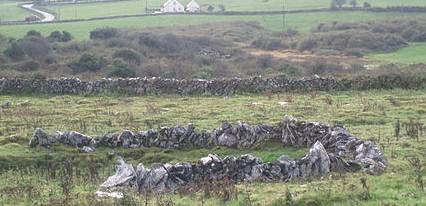
There is a good many forts around this district. There is Tonagh fort. It got its name from a man named James Hogan who lived there long ago (?). There is Liscumaskey fort. Rossnaglough fort also. They are all in sight of each other. They are all round in shape. There is a fence around them all. There are holes in the earth in the middle of these forts. John Smyth dug into Rossnaglough fort. He dug down about five feet. He got nothing but fairy pipes. He left the hole open. He meant to come back the next day and dig down further. But when he came back the hole was closed.
He tried to get in another place in the fort, but when he put in the spade, and he could not get it out of the ground, he turned round to see what he could do. When he turned his back the spade was away.
There was lights seen on Tonagh fort. Peter Carroll Liscumaskey heard music on Liscumiskey fort long ago. (I got that from Peter Carroll 69 farmer, Liscumaskey. He got it from his grandfather Pety Carroll who died fifty years ago, aged ninety.)
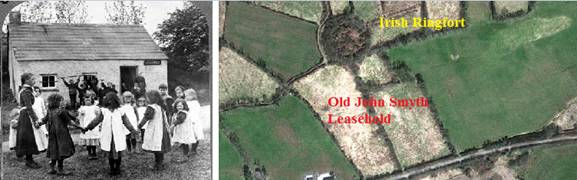
Photographs from Left to Right: (1) 1900 photograph of school in County Monaghan; (2) Satellite map showing John Smyth family land lease in East Rossnaglough Townland; Aghabog Parish. Above the Smyth land is an old Irish ring fort.
November 29th 1937
Fairy Story (Peter Smyth)
Long ago there lived a man by the name of Owen Lennon of Faltagh. One day he and James McAdoo were ploughing near Rossnaglough fort. This time when they came to the head they saw a churn staff and the handle out of it. Owen Lennon took it into the house and fixed it and left it where he got it.
The next time, when they came to the head (of the field) there was a buttered cake on the head-rig. Owen Lennon started to eat it, and McAdoo would not let it. Three wee men with red caps appeared on the head-rig. They said that it was a better cake then his mother ever made. (Got from Johnny McCabe 69, farmer, Corbyfinn)
Fairy Story (Peter Smyth)
There lived a girl in Corlick named Marg Greenan. She always herded the cows on Tonagh fort. She had no shoes on her because she was very poor. The people told her to watch the fairies on the fort and when she would see one, grip it, and it would tell her where the gold was, and she could buy a pair of shoes.
This day she was herding the cows on the fort. She saw a wee man fixing shoes in the bushes. She took him in her arms and went towards the house. So she was going through the gate the fairy turned round to her and cawred (made faces) at her, and she threw him down and ran into the house then she took sick and she died before that day week. (Got from Johnny McCabe 69 farmer, Corbyfinn)
Penal Times (Peter Smyth)
James Chapman turned Protestant in the Penal times. Three Protestant people from Dublin came to him and said if he would not turn Protestant they would take his farm off him. He said he would.
Before this they asked Johnny Keelan and James Hunter to turn Protestant and they would not. They lived beside Chapman's house. They put them out of their houses and lands and gave them to Chapman. Every night after that Hunter and Keelan would break Chapman's windows and annoy him all night.
After one month Chapman gave them back their lands. When the English Protestants in Dublin heard this they took Keeland and Hunter to prison for a year. Then they escaped and came back and took their own lands back. Keelan died a month later. Hunter died in a year after that.
Priests used to say Mass in McCabe's glen in Corby-finn. There was a priest said Mass in Cliffords’ house in Drumhilla in the Penal Times. He died before the Protestants heard of him. He lived in that house at night. He said Mass outside sometimes.
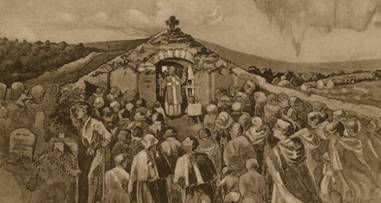
Penal times (written by James McPhillips)
There was five shillings for a priests head. And ten for a bishop. A priest said mass in McEntee's field in Loen under a rock. No one would touch it for it is holy. Mass also said in Murphy field beside old walls. No one would touch it because it is holy. Priests would be killed while sleeping. Many times priests would say mass between midnight and prior to day break. Protestants would not let Catholics light a candle at night. Sometimes the Protestants would come to the Catholics house, pull out the man and hang him in a Catholic neighbor's garden and then blame the Catholics for the killings. They also would steal their shoes if worthy of being stolen. Tradition says the Hibernians formed a body guard for the hunted priests on many a hillside in Ireland. There was mass said in Multy Galvin's glen in Latnamard about two hundred years ago. In Corcaghan in Pat McCabe's land there were was mass said. The Anglican church site in Aghabog used to be where the old Catholic church once stood.
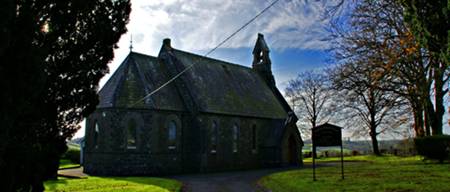
Aghabog Anglican Parish Church; County Monaghan
There is a graveyard at Aghabog Protestant Church and in the penal days Protestants and Catholics were buried in it. One time there was a priest hunter named Patrick Burke. Father Daly was hunted and died and was buried in the Catholic graveyard. Protestants did not like it and dug the body out and dragged it to John McKenna's land in Genagh and hung the body on an ash tree. the tree was chopped down and the body reburied by the police and guarded to make sure it was not dug up again.
Fairies (Urcher Collection)
In Urcher one writer said people in the area believe fairies live in the old forts.
"In connection with Lisnavane fort this story is told. Some years ago the former owner, Mr. Clarke, cut a birr on the fort and he died suddenly in a short time after wards, the neighbours in a short time after wards, the neighbours attributed his death to the cutting of the birr. The birr remains there till this day and no one ever interferes with it in case ill -luck might befall them.”
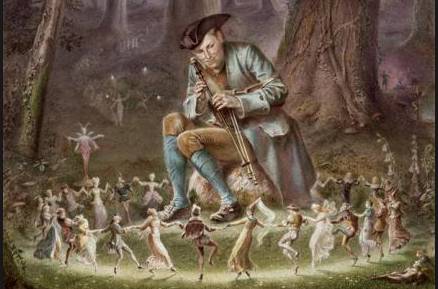
Fairies (Nart Collection)
Liseveny or Lisnaveane (collector A.F.M. McAdoo, informant Miss A. Abbot from Lisnaveane): A man called James Greenan living in Liseveny was out hunting one day and jumped off the fort. He felt something hit his leg (his hinch). The leg got smaller and smaller until he died. It was supposed the fairies had bewitched the leg.
In Descart, Parish of Aghabog, there lived a witch woman called Moll Pogue. On May Morning she used to go to a neighbour well to get water and so take the luck.
Many, many May Eve nights these people sat up, but in spite of them Moll got to the well first. They used to chase her but she always managed to get the water first, and they never succeeded in catching her. (reported by John J. McMurry, male, age 13, Corravilla, Co. Monaghan. Information from his father, George McMurry)
Another story is told about her. One day a man out shooting saw a hare in his meadow. He shot at it, and struck in the leg. He followed after it and found Moll Pogue seated on a stone a few fields away looking at her heel which was slightly wounded. She had taken the form of a hare for the time being.
A man was driving cattle from Cootehill to Monaghan. He reached Nart Hollow about 3 AM. The cattle stood still and would go no further. He heard a voice say, "Stay here and sleep the night." Then he saw that the cattle were enclosed in a secure pen. Contented, he lay down and went off to sleep. In the morning he awoke to find the cattle quite safe and proceeded to Monaghan. The fairies had guarded them during the night. (Told by the school children.)
Place Names (written by Peter Smyth)
There is a field in our farm called the crockin. It is called the crockin because a priest name Croakin preached on it one day long ago (? Curraicin?)
There is a stream running through Johnny McMurray's Corravilla. It is called McMahon's stream because a Bishop named McMahon lived there. (I got that from Johnny McCabe 82, farmer, Corbyfinn).
There was a bush in Denard's field Drumlinny. It was called Fluck's lot because one day a priest named Rev. Tom Fluck was going through this field. When he came to this bush, he was tired. He sat down under the bush and he stayed all night there. From that on it was called Fluck's bush. (Got that from James Kierans 69, farmer, Liscumaskey)
Local Roads (written by Peter Smyth)
There was an old road going from Rossnaglough to Lisseveney. The old people called it Brien's road because it run by a house that a man lived in by the name of O'Brien. It was built after the Famine by the English. It was made of some stones and sods. In the time of the Black and Tans it was covered and filled by them.
There was another road going from Tonagh cross to Lismagonway cross. It was called the wee road long ago because it was very short. It is used still and is called the Rossnaglough road now. It was built in 1748. It was built by a man name Bradys from Lismagonway.
The people in the Famine times worked for relief money at the roads. They used to get 3/6 (?) every day. They were paid every three days. Before bridges were made people used to make fords over the shallow places in the rivers. They used to be made of planks bushes and rushes (these constructions across streams - there are no big rivers in this district - are here known as "Kish") The planks were put across the river and then the bushes were put on top of the planks, and then the rushes were put on top of all. There was some clay put on top of the rushes to keep them down.
There was a ford across a river in Corravilla called Harry's ford, because it was built by a man named Henry Henistern.
There was a new road made from Murphy's cross Corcaghan to four-crosses beside Corcaghan creamery. It was made in 1902. There was a lot of boys walking about in that year and they could get no work. The government sent word for a road to be made there, and for these boys to work at it. The road was made. It is not much used now but long ago there was a lot of traffic on it. It was very useful. The boys used to get three shillings a day for the work. They made it in two months.
Long ago cross-roads were made very big because people used to dance at them every Sunday evening after dinner.
Cures (written by Peter Smyth)
The people used to cure toothaches with rasan (?) flowers. It is a flower that grows on top of a clay wall. It is still to be found. The people used it by rubbing against the teeth. They also used herbs for curing pains in the back and in any part of the body.
There is hole in a tree beside Aghabog Church. It cures warts. The people used it long ago.
There is a holy well in Dooskey in a rock. The people used it for curing biles (boils) and rheumatism long ago.
Mrs. Greenan of Killygraggy has the cure of strains and Mrs. McCarvill of Annaghlough. They cure by rubbing the ground three times with their hands and rubbing it against the strain and say some words while doing so. Hugh Beagan Liscumaskey had the power for curing rheumatism. (I got that from Peter Carroll 69 farmer, Liscumaskey)
Old Crafts (written by Peter Smyth)
The people in this district long ago used to plough with spades. They had to take the manure out on their backs in bags. There were no carts that time. Every two farmers used to plough together with spades. When they would finish one man they would go to the other man and finish him When the second man was finished it was time to put in the potatoes.
They used to make candles. The way they made them was they mixed wax and meal together. They used to make baskets out of sallies by weaving them in and out.
The forge men made the graips out of iron. They put three prongs on them. They also made forks, shovels, ploughs, gates, crane-crooks, scythes, candle-sticks, griddles and made them all out of iron. These implements were far better than they are nowadays. Johnny Connolly Aughclay made all these implements long ago. He is dead now.
There was a spinning wheel in nearly every house long ago, for weaving (?) flax. First they scutched the flax. Then they wove it and made cords. (I got that from Peter Carroll, 69, Liscumaskey.)
Marriage Customs (Peter Smyth)
On Shrove Tuesday weddings mostly take place in this district nowadays. The people say it is unlucky to marry on a Monday and the month of November is unlucky also. The people say anyone who marries on Shrove Tuesday will live till they are ninety-six. It is unlucky to meet a red-headed woman and her hair not combed and her shoes open. To throw an old shoe or a piece of tin after the groom or bride is lucky. The people used to make matches out of sluse (?) and soap on wedding days.
The bride has to get money from the groom when they are being married. In olden times they used to get a sheep or a young six-months calf.
Straw-boys used to visit the houses on wedding days. They wore straw hats and straw round their shoes and trousers. They had hairy-ned (their hairy ropes) ropes wrapped around their jackets. They had a false face on them. One would go into the house first and shake hands with the bride and say "A happy house till you and good luck."
Then the rest would go in and give the groom tin rings and the groom would give them four pence each. There were six of them altogether. Then they would dance for awhile. After that they would get a penny from every many in the house. They would go home then with the money.
The people used to go to weddings on horse-back to race. There was a race one time from Patrick Beagan's lane, Drumlinny, to Calliagh. There was always four horses racing. The groom always had a good horse and they used to take the bride before them on the horse. (I got that from James Kierans 69, farmer, Corlick.)
Lore of Days (Peter Smyth)
The people say Friday is a lucky day for going to a new house, Wednesday is a lucky day for going on a journey. The people say that people that journey on a Wednesday are the luckiest in the world/
People that borrow on New Year's Day will never have any luck and they will be borrowing all that year round. It is lucky to have to borrow something on Good Friday. (Got that from James Kierans 72 farmer Liscumaskey.)
Holy Wells (Peter Smyth)
There is a holy well in Descart. There is one supposed to be in a glen in Corlick. The one is Descart is in a big rock in James Clery's field. It is supposed to cure rheumatism. It is not used nowadays. The rock fell into the well and covered it over. People have gone to find out where it is, but they could not find it.
People do not know much about the well in Corlick, but they say that it was St. MacCarten found a well there long ago. He was supposed to pray there for three days. The people say that there is three bushes round a low place in the glen in Corlick and that the well is between them three. The old people say it cures boils and other diseases like that. People used to go to it for cures. The sick people had to bathe in the well for to be cured.
Johnny McCabe Corby-finn was cured from four boils on his neck and face when he was eight years of age. He minds his mother and father taking him and bathing in the well. Three days after there wasn't a trace of a boil on him. (I got that from Johnny McCabe 73, Corby finn and I got some of it from James Kiernans 70 Corlick. He heard his grandfather, Patrick, talking about that well. He was ninety years when he died.)
Weather Lore (written by Peter Smyth)
If the weather at the change of the moon is good the next quarter will be good. Soot falling is a sign of rain. Smoke going up straight denotes rain next day. Signs of rain are: The wind blowing from the south and west; A blue blaze in the fire; The clouds black; the sun sets pale in the evening; The moon hiding in the clouds at night: The stars shooting and the seam of the plough pointing down; A rainbow after six o'clock; The swallows flying low on the grass; The walls damp; The cat washing her face at the fire; The cat scratching; The dog eating grass; The thrush and blackbird singing; The sea-birds coming inland; The pigs grunting; The dust blowing on the road; The flies in a cluster over your head; on the road; The crickets singing very sharp; The spiders creeping from their beds; The frogs turning black; The smoke thick and muddy; The smoke coming out through the house; The ducks quacking.
If the sun shines very bright in the evening it denotes storm. The wind from the west is a sign of good weather. (I got that from my father Edward Smyth, 66, farmer, Liscumaskey)
Potatoes (written by Peter Smyth)
Some people help each other in sowing potatoes. They helped each other very much long ago. Three or four men used to join and take one field between them. One would help the other until that man was finished and then the man would help he other men. They would all work till they would have the field all set. Then they would take their share until every man got what he wanted.
They put the potatoes in ridges all that time. They would gather together in the summer time and mould them twice. They would pull the weeds out of them before they would mould them. The way they moulded the potatoes was: they dug a deep furrow on back side of every ridge and made the clay fine by hitting it with the back of a spade, until it was very fine. Then a man would come with a shovel and shovel the clay through the stalks of the potatoes.
Local Poets (written by Peter Smyth)
The names of the poets about here were James Murphy, Drumlinny, Thomas Hunter, Drumlinny, Phil McGuigan, Drumlinny, James Mulligan, Corlick and James Greenan, Killygraggy. These poets were buried in Aghabog graveyard. James Murphy made a hunting song about Chapman, Drumlinny. It was about one morning that Chapman went out to hunt and about what happened to him when he got his first hare. It ends by telling what time he went to bed. The name was "The Foolish Hunter."
They were all over seventy when they died. They got the power of making poetry from their ancestors. They were all very clever and they were very poor. Sometimes they all met together and made songs. Some of them used to go about begging and the people would give them a few pennies. (Got from John McCabe 69, farmer, Corbyfinn)
They used to sing songs in people's houses if they would give them lodging for a night. These are the names of some songs they used to sing: The plain: The fair hills of Caon: The wild banks of Stranooden: The rocky hills (got that from my father Edward Smyth 66 farmer, Liscumaskey)
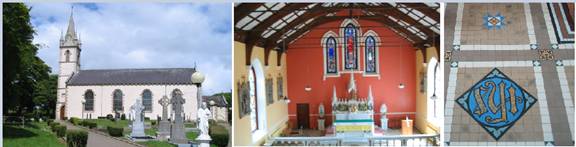
Aghabog Catholic church (written by Peter Smyth)
There are some very old tombstones and headstones in the in the Aghabog Catholic graveyard. The tombstones are so old that it is impossible to recognize the date on them. Tradition tells us that under one of these tombstones lies the remains of Father Coyle who was buried in eighteen twelve, the year the church was built. The other two tombstones are over two other brother priests who were reared in Corlick, Father McPhillips. They were buried during the time of the "Keening" at funerals and we are told that the cries of their bearers would pierce your heart through lamenting the death of their brave Father Hugh. Unbaptized children were buried in a field in Latnamard now owned by Philip O'Neill. In olden times the people were buried in Drumsnat Mass was said at Drumsnat at the gate. There was a stone for the purpose of the leaving the coffin down on, which can be seen yet. The people in Aghabog also buried at Killeevan church which is overgrown with briars now. (got from Francis and Kathleen Kierans)
There is a mass-stone in the Townland of Faultagh. It was first found by the McMahons.
Aghabog Catholic Church - (written by James Carolan)
Aghabog Catholic Church was built in 1812. At that time there was no road over from Corlick Cross. The wood used for the building was brought from Newry by carts and was unloaded on the road at Ned McPhillips, Latnamard, Newbliss and carried across the fields. The land for the building was got from Marty Gavan and was called Murty's acre. The landlord - a Protestant - gave it rent free so that the plots for graves have not be paid for.
The church then had no tower. The altar was to the South and there were two doors on the East and one on the West. There was a smaller altar of Our Lady. The seats went in a semi-circle round the altar like this.
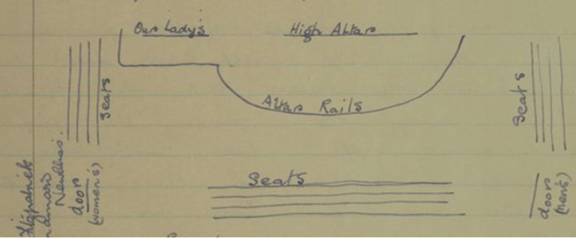
(from Phil O’Neill, Latnamard)
Corcaghagen Catholic Graveyard
Corcaghagen School in Kilmore: Drumsnatt graveyard. Drumsnatt Graveyard is situated about two miles from Three Mile House Catholic Church. It is one of the oldest in the district. In olden days the people had no burying place so they prayed to God to send them one and strange to say on a June morning this little hill was covered with snow and that is why it get the name of Drumsnatt which means the ridge of snow. The people still bury here and at the entrance there is a large flat stone where the coffin is laid down for a few moments before burying.
(Another variation: St. Pat went to Drumnsatt and asked a local chieftain for a burial place. The Chieftain said no but if your God points out a place I will give it to you. Then on the 21st of June a little hill in Drumsnatt was covered with snow.) There is also a place where mass was said long ago. This graveyard is not well kept although there is a family paid for cleaning it. A couple of years ago the priests of the parish were going to close it as it was overcrowded but the people objected. There is a lot of headstones in it and also a lot that had disappeared with old age. It is said neither worms or slugs are found in it.