St Patrick & Bridget's Connection to our Family


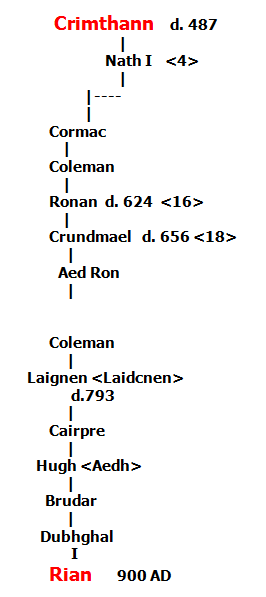
...Crimthann was a distant ancestor of Rian's (Ryan)...and one of our great Celtic ancestors...
Little information exists which describes Crimthann's reign. The annals reveal that he was High King of Ireland when St. Patrick came to Ireland, and St. Patrick's journals mentions that he baptized two kings of Ireland: Dungalach, king of Connaught; and Crimthann, son of Enna, the ruler of Leinster. A later entry in the Irish journals cites that St. Patrick lived "in the 122nd year of his age died in 489." Other journals witnessed that he arrived in Ireland in 432 and died in 461, and these conflicting dates regarding St. Patrick's life eventually spawned multiple theories including one that suggested Patrick was actually two individuals. Another theorized that he never lived at all. The latter is not well supported because "Patrick" left a manuscript entitled 'Confessions' that detailed his evangelical mission in Ireland.
St. Patrick's arrival into Ireland was one of the most significant events that occurred in this island kingdom. He undoubtedly was not the first Christian missionary to enter the Ireland as the annals mentioned others who tried to spread the Christian faith among the Celts, but his efforts represented the most significant attempt to convert the inhabitants of Ireland to Christianity. The 'Confession' is one of the earliest biographies of Patrick, and it outlines his life as a youth, his captivity and eventual slavery in Ireland, his escape and finally his missionary work. Along with the biographies, unusual or mystical stories surrounding his life developed in Irish legends. These stories were created over the centuries to personify Patrick's (Padraig) saintly stature, and the more creative stories surrounding his life were written several hundred years after he died by Muirchu a cleric at Armagh. Muirchu had written fantastic tales of Patrick's conversations with a dead man concerning the placement of a grave-cross, his miraculous resurrection of a horse killed by poison, and other fabulous wonder tales which strengthened the proposition that Patrick was no mere mortal when he wandered the wilds of Ireland. As Patrick traveled throughout Ireland, he converted hundreds of Hibernians including many of the royal families and their following. Many historians have speculated that Christianity had a foothold in Ireland long before St. Patrick's arrival, moreover, his manuscripts, supported by the ancient Celtic journals, clearly authenticated his missionary work showing that he converted the royal families, and subsequently their descendants, to Christianity. These early annals also showed that Crimthann and his wife bestowed gifts to St. Bridget:
Of the multitude of presents that were given to Bridget and her monastery and her church by those who were constantly thronging there, it is recorded that the queen of Crimthann, the son of Enna Ceannselach, gave to Bridget a silver chain of which the Book of Lismore says: "The semblance of a human shape was on one of the ends thereof, and an apple of silver at the other end."
Brigit, a Leinster saint who died in 524, established a convent at Kildare, and during her ministry was closely associated with the north Leinster tribes, especially the emerging Fotharta sept. Most of what remains of her life today has been fictionalized through a laundry list of miracles and undocumented fables associated with her unfaltering logic, and it appears that stories surrounding her personal healings and saintly wisdom were accelerated during mediaeval times to accentuate her chastity and devotion to the christian church. The romanticism surrounding her life nearly rivals the stories associated with St. Patrick, but one thing is certain: she must have been an exceptionally holy person, perhaps in the same genre as Mother Teresa of Calcutta, as the peoples of the Fotharta, being so impressed with her Christian spirituality, carried her religious message and saintly devotion to other Leinster tribes.
Crimthann, as shown by his acceptance of Patrick and Brigit, helped stimulate the conversion of whole tribes to Christianity, and the cult following surrounding both saints would flourish into the 6th and 7th centuries. He died in 484 before both saints would finish their evangelical activities in Ireland. The 'Chronicum Scotorum' and other registers showed that he died from a mortal wound inflicted by Oichaidh Guinech of the Ui Barrache and the men of Aradh Cliah, both distant relatives of the Leinster royal family.
Genealogy of Rian
the Progenitor of the Ryans, O'Ryans and O'Mulryans