

Turgeon Biographies
Introduction
I found three Turgeon biographies in the Library and Archives of Canada (Dictionary of Canadian Biography Online). You will see biographies for Louis Turgeon, Adelard Turgeon, and Archbishop Pierre-Flavien Turgeon. In addition, you will see a photograph of Adelard Turgeon and Archbishop Turgeon.
How do these three people fit in our family tree? I added a chart showing these three people and their relationship in our family tree. The biographies that follow were copied from the Archives of Canada and have not
Louis Turgeon
This biography describes the life of Louis Turgeon, who was a notary, JP, politician, militia officer and seigneur. Louis was born on April 10, 1762, in Beaumont, Quebec. His parents were Louis Turgeon (merchant) and Francoise Couillard. Louis Turgeon, Jr., married Genevieve Turgeon on November 23, 1796. Genevieve was his cousin, and they had four children. Louis Turgeon, Jr., died on September 26, 1827, in Saint-Charles, Lower Canada.
The following chart shows how we are related to Louis Turgeon, Jr. His name has been highlighted below. The purple line shows our ancestral line beginning with the earliest known Turgeon, Jean Turgeon, of Perche, France.
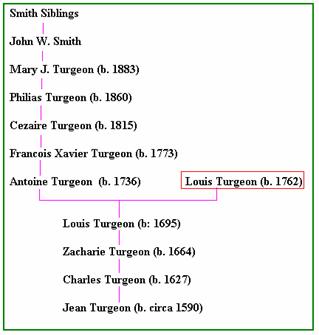
Louis Turgeon belonged to the fourth generation of a family living at Beaumont since the late 17th century. Shortly after he was born his father moved to Quebec. Louis attended the Petit Séminaire de Québec, as did his half-brother Pierre-Flavien* subsequently. He studied there from 1772 till 1782, and then articled to become a notary. Licensed to practise on 25 Sept. 1792, he opened an office near Quebec, at Saint-Charles, the place from which he would draw most of his clients, who were largely farmers.
Even during his years of notarial training Turgeon had taken an interest in the political life of the province. In 1790, for example, he had signed a petition for a non-sectarian university [see Jean-François Hubert*], and in 1791 he had come out against a plan to replace seigneurial tenure with free and common socage [see Thomas-Laurent Bédard*]. In 1804 he was elected to the Lower Canadian House of Assembly for Hertford, along with Étienne-Féréol Roy. Turgeon was an assiduous member and took part in most crucial debates in the fourth parliament, which lasted from 1804 to 1808. As a general rule he supported the Canadian party. In addition he participated, often as chairman, in committees dealing with such varied matters as the organization of the militia, navigation on the St Lawrence, assembly accounts, fisheries in the district of Gaspé, road works, the administration of justice, and weights and measures. In 1805 he introduced a bill that was passed prohibiting the sale of goods and alcoholic beverages on Sundays.
Turgeon ran again in Hertford in the 1809 election but was defeated by physician François Blanchet. His retirement from political life was temporary, since he was returned for that riding in the 1816 election. His parliamentary activity was, however, limited to sitting on a few unimportant committees. He quit the assembly in 1818 on his appointment to the Legislative Council.
In the uneasy year of 1794 Turgeon had signed a declaration of loyalty to the crown. He had received a commission as justice of the peace for the district of Quebec that year, and obtained similar commissions for the districts of Montreal, Trois-Rivières, and Saint-François in 1821, and for Gaspé in 1824. On 8 April 1812 he attained the rank of major in the Saint-Vallier battalion of militia. He served in the War of 1812 and in 1821 became lieutenant-colonel of the 1st Saint-Vallier battalion.
Turgeon had inherited part of the seigneury of Beaumont through his mother, who had died in 1768, and as a result of various transactions between 1816 and 1819 he became the principal seigneur. He personally managed his fief, which, by the time he took possession, had been almost entirely granted out, and he saw to it that the domain reserved to him as seigneur made a profit. In 1819 he was the agent in the parish of Saint-Charles for the Quebec District Agriculture Society.
Louis Turgeon had four children. His sons, Louis, who died in 1826, and Hubert, became notaries. One of his daughters, Geneviève, died in 1818; the other, Marie-Ermine, married the Patriote Louis-Michel Viger*. When he died in 1827, Turgeon, who was by then a widower, left the seigneury of Beaumont to his son Hubert’s first male heir. Hubert, however, had the right of possession and also inherited Turgeon’s other real and personal property, but he died the following year. Marie-Ermine received £3,000.
Céline Cyr
The following information was found online in the Wikpedia website:
Louis Turgeon (April 10, 1762 – September 26, 1827) was a notary, seigneur and political figure in Lower Canada.
He was born in Beaumont, Quebec in 1762, studied at the Petit Séminaire de Québec, articled as a notary and was licensed to practice in 1792. He set up his office at Saint-Charles near Quebec City. He was named a justice of the peace in Quebec district in 1794. In 1804, he was elected to the Legislative Assembly of Lower Canada for Hertford, usually supporting the parti canadien; he was reelected in 1808 and then in 1816. He served in the local militia during the War of 1812, becoming lieutenant-colonel in 1821. In 1818, he resigned his seat when he was appointed to the Legislative Council of Lower Canada. He had inherited part of the seigneury of Beaumont in 1768 when his mother died; by 1819, he had become principal seigneur for Beaumont.
He died in Saint-Charles in 1827.
His daughter Marie-Ermine married Louis-Michel Viger. His cousin Joseph-Ovide Turgeon also served in the legislative assembly.
Adelard Turgeon
The biography below is about Adelard Turgeon. Adelard was a lawyer, politician, businessman and philanthropist. He was born on December 18, 1863, in Saint-Étienne-de-Beaumont (Beaumont), Lower Canada. His parents were Damase Turgeon (sailor) and Christine Turgeon. Adelard married Marie-Eugénie Samson in Lévis, Quebec, on July 19, 1887. They had no children. On November 14, 1930, Adelard Turgeon died in Quebec, and he was buried on 17 November in Saint-Étienne-de-Beaumont.
The following chart shows how Adelard Turgeon is related to the Smith siblings.

Adélard Turgeon, who was of Norman ancestry, came from a modest background. He attended the Collège de Lévis from 1874 to 1884 and following graduation entered the Université Laval at Quebec. While studying, he articled in the law firm of Isidore-Noël Belleau, Lawrence Stafford, and Eusèbe Belleau. After obtaining his llb and being called to the bar of the province of Quebec in 1887, he began his career in Lévis with Charles-Albert Lemay. The partners moved to Quebec in 1889, but he left Lemay that year. Turgeon, who would carry on his practice at Quebec until 1917, had other partners over the years: Henry George Carroll from 1890 to 1897, Arthur Lachance from 1898 to 1906, Ernest Roy (who would also act as his secretary) from 1899 to 1901 and from 1906 to 1917, Auguste Tessier from 1902 to 1903, Michael Joseph Ahern from 1903 to 1906, Roméo Langlais from 1906 to 1917, Oscar-Jules Morin from 1910 to 1916, and François-Xavier Godbout from 1916 to 1917. Turgeon quickly became an important figure in Quebec legal circles and he was made a kc on 26 Aug. 1903.
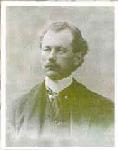
Like many novice lawyers of his time who had political ambitions, Turgeon took up journalism. Along with 150 young Liberals, in 1888 he founded L’Union libérale, a feisty Quebec weekly that provided them with a training ground for future struggles. The paper, which called for a return to the great principles of liberalism, would cease publication in 1896. Under the pseudonym of Donoso, Turgeon contributed a number of articles to it between 1888 and 1890. He would also be listed as one of the five directors of Le Soleil in January 1897, shortly after this newspaper was founded.
Turgeon ran for the Liberals in Bellechasse, the stronghold of Conservative Narcisse-Henri-Édouard Faucher* de Saint-Maurice, in the provincial election of 17 June 1890. He was successful, and he retained his seat in 1892, although the Liberal party lost this election. Like François-Gilbert Miville Dechêne and Jules Tessier, he was among those who stoutly defended the integrity of Premier Honoré Mercier* at a time when it required some courage to do so. Following the Baie des Chaleurs Railway scandal, in which Mercier’s government was accused of bribery, the premier was fiercely attacked by the Conservatives, whose powerful political machine he had to face virtually alone. Lieutenant Governor Auguste-Réal Angers*, a former Conservative minister, dismissed him from office on 16 Dec. 1891. Following the general election of 8 March 1892 which came at the end of an aggressive defamatory campaign, Mercier, now ill, abandoned, and ruined, found himself in opposition with 18 mlas, including Turgeon. The debates at that time contained particularly acrimonious attacks on Mercier, who was even taken to court. During his years on the opposition benches, Turgeon rose a number of times to defend him and his government. The general election of 11 May 1897 returned the Liberals to power under Félix-Gabriel Marchand*. Re-elected, Turgeon was named to the cabinet because of his prominence in the Quebec region and the fighting spirit he had shown while in opposition. He was made commissioner of colonization and mines. Returned by acclamation in 1900, he was offered the same post in Simon-Napoléon Parent*’s cabinet that year. Turgeon refused at first, but then accepted the office, which he would retain until 1901, when he was appointed secretary and registrar; in 1902 he became minister of agriculture. He was again elected by acclamation in 1904. In the Legislative Assembly in the period 1897–1904, he passionately championed the creation of a department of public instruction, and had to face frequent accusations that he was selling public resources to the Americans for a song. Forgoing this revenue (more than $15 million in 1901, according to the census), he told the assembly in 1904, would necessitate direct taxation to finance education, agriculture, and colonization.
The minister seemed headed for a brilliant career. On 27 March 1904 Olivar Asselin*, who knew Turgeon and his colleagues, wrote in the Montreal newspaper Le Nationaliste that “Mr Turgeon is virtually the head of the ministry. He has talent [and] ambition. We will judge him by his work.” But Turgeon was actively involved in the revolt against Parent and he resigned on 3 Feb. 1905, along with Lomer Gouin, whom he had known at school, and William Alexander Weir. His move was motivated by his sense of personal dignity and, given the discredit into which the Parent government had fallen, by the public interest. He was convinced that Parent had hatched a plot to humiliate them and force them to withdraw. A number of people thought that Turgeon might become premier, amongst them Senator Philippe-Auguste Choquette* (who reportedly supported his appointment) and parliamentarian Godfroy Langlois (who, by contrast, did not look kindly on this possibility). Turgeon was, however, too fond of his peace of mind, his comforts, and his travels, and he was not eager to assume too onerous responsibilities. It was Gouin who took over the office, with Turgeon’s support. In 1905 the new premier appointed Turgeon minister of lands, mines, and fisheries and then minister of lands and forests, a position he would retain until 1909.
Turgeon’s talents – his eloquence, his breadth of knowledge, his business and administrative sense – were recognized in Ottawa. In 1906 Sir Wilfrid Laurier* offered him a seat in the Senate and Charles Fitzpatrick*’s post as minister of justice and attorney general; he would also be put in charge of the Liberal forces in the Quebec region, which meant, among other things, responsibility for organization and political appointments. Because of Laurier’s friendly attitude towards Parent’s supporters, Turgeon refused this flattering offer and remained at Quebec to administer the province’s public lands. In this capacity, his principal tasks were to open new areas for colonization, create forest reserves, establish tighter control over logging, and fight forest fires more effectively.
At the height of Turgeon’s career, what became known as the Abitibi affair occurred. In 1905 the government, which was trying to attract French-speaking immigrants, wanted to establish a Belgian colony in the Abitibi region. The minister of lands and forests was sent as a delegate to the universal exposition held that year in Liège, to extol the province’s riches and attract investors. Some 15 financiers showed an interest. The influential Ferdinand-Dieudonné-Henri De L’Épine, Baron De L’Épine, acted as intermediary between a Belgian syndicate and Turgeon. According to the correspondence between De L’Épine’s wife and Mme Turgeon, the relationship between the two men took on “an intimate character” during Turgeon’s stay in Belgium. The baron filed an application to purchase 200,000 acres of land. The government gave him an option to buy at 70 cents an acre. In the course of discussions there was, however, talk of an additional sum of 30 cents an acre for the election fund. The money was to be paid to the intermediary, who would turn it over to the appropriate party. The negotiations led to an exchange of letters; one of these, from the baron to Turgeon, marked “confidential” and dated 28 Jan. 1906, proved disastrous for the minister, since it confirmed that a contribution had been solicited. Turgeon would assert that he had not received this letter, but rather another one, which did not contain the reference to the election fund. Though he was unable to provide the original, he would maintain that the letter brandished by Baron De L’Épine was a forgery, written after the fact for the purpose of ruining him – which may have been the case.
The affair came to light in 1907 during a libel suit brought against Olivar Asselin by Jean Prévost*, who had recently offered Gouin his resignation as minister of colonization, mines, and fisheries. Asselin was just waiting for this opportunity to expose the Abitibi scandal. Defence counsel Napoléon-Kemner Laflamme, who was advised by Armand La Vergne* and Charles-Alleyn Taschereau, succeeded in grilling Turgeon (who had been called as a witness because the famous letter was addressed to him), but in the end he did not uncover any misappropriation of funds, only instances of negligence and imprudence, and a few suspicions about the Liberal government. Le Nationaliste, which had extensively reported on the trial, would not let the matter drop. For weeks, under the byline of Pierre Beaudry (a pseudonym used by Jules Fournier*), it accused Turgeon of perjury. Exasperated, Turgeon sued the newspaper, and this second trial ended with a conviction on 16 Oct. 1907.
Exonerated by the courts, but weary of all the attacks, Turgeon demanded a commission of inquiry. He immediately resigned his seat as mla for Bellechasse, in order to submit his case to his true judges, the electors, and he pushed Henri Bourassa*, the leader of the Nationalistes, into a trap by challenging him to run against him. How could Bourassa, who had never set foot in this rural constituency, win against one of its own, who knew its every nook and cranny? Bourassa resigned his seat as mp for Labelle and took up the gauntlet. It was a memorable campaign. All the political powers criss-crossed the riding and Turgeon defended himself brilliantly. The municipal council of Saint-Étienne-de-Beaumont supported him. At Gouin’s request, Laurier expressed confidence in him.
On 4 November the voters made their choice. Turgeon was re-elected by a majority of 749 votes. Gouin set up the royal commission Turgeon had asked for when he resigned, naming judges François Langelier* and Napoléon Charbonneau to head it. Turgeon, who was called before it, testified that “never, at any time, was there any discussion between the Belgian syndicate, or any of its members, and myself of a contribution that was to be paid into the election campaign fund.” Given too narrow a mandate, the commission did not manage to shed any light on the matter. The evidence, which on the whole gives the impression that it was the baron who had lied, remains incomplete.
Turgeon and his party were returned in the general election of 8 June 1908. In a dramatic move, he resigned again. His resignation made it appear that he was running away, since he left the Legislative Assembly one month before Bourassa and La Vergne took their seats there. Many people saw this act as an evasion. On 16 June 1925 L’Événement would give health problems as his reason for moving to the Legislative Council, with its calmer atmosphere. Circumstances having changed greatly since 1906, he would gladly have gone to the Senate, to a position of prestige, that, moreover, was in Ottawa, where he could more easily have disappeared from public view. Although Gouin wanted to keep Turgeon in Quebec, he nevertheless contacted Laurier on his behalf, but to no avail. This “tall, handsome figure,” he wrote on 3 Aug. 1908, would do honour to Quebec. Two days later Laurier replied that he did not understand why Turgeon wanted to “fade into the background,” when, as a minister, he was “in the thick of the fray.” The upshot was that Turgeon had to be satisfied with the provincial upper house, where he took his seat on 2 Feb. 1909 at the age of 45. He represented the division of La Vallière and acted as speaker for the remaining 21 years of his life, the longest term ever served in this office,
Turgeon’s years in the upper house were happy ones. An art collector who enjoyed reading, receptions, good wine, golf, hunting, and business, the easy-going former minister lived the life of a dilettante. He travelled a good deal in Canada, France, Belgium, and New England. His oratorical skills, his charm, his “aristocratic distinction and his urbanity,” as Le Soleil would note on 14 Nov. 1930, met with success wherever he went. Turgeon cut a figure as a great lord and, thanks to his annual salary of $5,000 (in 1930) and the money his property is thought to have brought him, he became a philanthropist. For example, he gave $1,000 to the Collège de Lévis and contributed to the fund for erecting historical monuments to Samuel de Champlain* and Octave Crémazie*, among others. When Hector Fabre* died in 1910, Turgeon’s name was put forward for the post of Canadian high commissioner in Paris, but Philippe Roy, a senator from Alberta, was chosen instead. It is believed that in 1911 he wanted to succeed Sir Charles-Alphonse-Pantaléon Pelletier* as lieutenant governor of Quebec, but Parent, who was still influential, opposed the appointment. In 1917 he was rumoured to be moving to federal politics.
Along with his political life, Turgeon was involved in various organizations. In 1907, after strong opposition stemming from rivalry, during this period, between Liberals and Nationalistes, he was elected president of the Société Saint-Jean-Baptiste of Quebec City. He was named to the executive of the Quebec Technical School in 1916. In 1922 he became president of the Conseil Supérieur des Beaux-Arts and founding president of the Commission des Monuments Historiques de la Province de Québec. He was also a member of the National Battlefields Commission. Many honorary titles were awarded him: officer of the Order of Leopold in 1904, knight of the Legion of Honour in 1904 and officer in 1928, companion of the Order of St Michael and St George in 1906, and commander of the Royal Victorian Order in 1908. On 24 June 1901 France made him an officier de l’instruction Publique.
Turgeon also sat on numerous boards of directors. He was president of the Laurentian Water and Power Company, the Frontenac Realty Company, the Nor-Mount Realty Company Limited, and the Quebec Land Company (in which he was active in the division and sale of lots in Limoilou). He was vice-president of Provincial Securities Limited from 1918 to 1926 and of the Quebec Cartage and Transfer Company Limited, and a director of the Quebec Power Company. In 1900 he had been vice-president of the Quebec and Lake Huron Railway Company and he afterwards became a director and shareholder of the Compagnie du Chemin de Fer Saint-Laurent et Mégantic and the Compagnie du Chemin de Fer Montréal et Baie James, founded in 1902 and 1903 respectively. He had played a key role in the creation of the Quebec and Lake St John Railway [see Horace Jansen Beemer*] and he had been instrumental in founding the village of Honfleur (Sainte-Monique) in the Lac Saint-Jean region in 1898. At the beginning of the century, Turgeon put all his political weight behind Alphonse Desjardins* when the caisses populaires were being established. The federal government appointed him to a consultative committee to study the proposed St Lawrence canal system, and in 1927 he endorsed the minority report of fellow committee member Beaudry Leman, who recommended that the development of hydroelectric power be put in the hands of the state rather than of private enterprise. In so doing, as Télesphore-Damien Bouchard would state in the Legislative Assembly in 1935, Turgeon became one of the first defenders of at least partial nationalization of the province’s hydroelectric resources.
Turgeon died in office at Quebec on 14 Nov. 1930 at the age of 66 years and 11 months, following a long illness, probably of a pulmonary and respiratory nature. He had often been praised for his ability as speaker, which had been evident from his student days. His eloquence took its inspiration from French politicians and it was often compared to that of Laurier. He was tall, slender, naturally elegant, and haughty in bearing, with wavy hair that was thinning somewhat at the front. He was also a man of culture who enjoyed reading, especially history.
Given the offices he held, Adélard Turgeon played an important role in the political life of his time, but he could have gone further by becoming premier of Quebec or an influential minister in Ottawa. His carelessness and lack of willpower, the laxity of the Liberal government, circumstances, and the political practices of his day made him the whipping boy of the Nationalistes and Conservatives and marred a career that might have been even more brilliant. This highly talented son of Bellechasse in the end was a second-rank political figure, behind Wilfrid Laurier, Henri Bourassa, Lomer Gouin, and Louis-Alexandre Taschereau*.
Jocelyn Saint-Pierre
Archbishop Pierre-Flavien Turgeon
The biography below is for Archbishop Pierre-Flavien Turgeon. He was a priest, educator, and archbishop. Archbishop Turgeon was born on November 12, 1787, in Quebec. His parents were Louis Turgeon (merchant) and his second wife, Louise-Elisabeth Dumont. Archbishop Turgeon died in Quebec on August 25, 1867.
The following chart shows how Archbishop Turgeon is related to the Smith siblings.
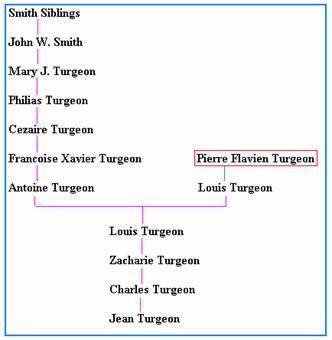
Pierre-Flavien Turgeon belonged to the sixth generation of a family from the department of Perche whose ancestor settled at Beauport, near Quebec, in the summer of 1662. His half-brother, Louis Turgeon, who was the first of three descendants to sit on the Legislative Council, acted as his guardian after his father’s death in 1800. Pierre-Flavien had been admitted into the Séminaire de Québec the preceding year. As a youth he attracted attention by his unusual intellectual and moral precociousness. In 1806, before his year of rhetoric was completed, Joseph-Octave Plessis*, who had become bishop of Quebec in January, noticed him and appointed him his secretary. While acting in this capacity Turgeon was obliged to take philosophy and to pursue the regular ecclesiastical studies before being ordained a priest on 29 April 1810, the age limit having been waived. The Séminaire de Québec claimed his services, although he did not give up his post as the bishop’s close assistant in the administration of the diocese.

At the Séminaire de Québec, where he was to stay for 22 years, Turgeon soon undertook various duties. He was fully qualified to teach by the autumn of 1811, professor of philosophy (1812–15), director of the Grand Séminaire (1815–18) and of the Petit Séminaire (1820–24). His intellectual capacity, special gift in psychology, and never-failing kindness made him a master revered by his pupils and a counsellor valued by many ecclesiastics. In the conduct of diocesan affairs he enjoyed the bishop’s complete confidence. Between these two very different men a friendship was created that death alone would sever. Bishop Plessis clearly was preparing Turgeon to succeed him. The intense activity Turgeon was involved in proved too exacting, however, and illness, from which he was to suffer all his life, forced him to take periods of rest. Acting on this need he accompanied Bishop Plessis to Europe in 1819, his only voyage overseas. In the summer of 1822 he went to the diocese of Boston for another rest cure. His health did not permit him to resume teaching, and he was appointed bursar of the Séminaire de Québec in 1824. During his nine years of management, he inaugurated administrative reforms that improved the temporal affairs of the seminary which had been in a precarious state since the Conquest.
In 1825 Bishop Plessis was preparing to call Turgeon to the episcopate, to succeed Bishop Bernard-Claude Panet*, who wanted to give up the office of coadjutor because of his advanced age. But Plessis died before he did so. Turgeon was barely 38. Panet, who had become titular bishop, urged him to accept the mitre, reinforcing his request with a laudatory letter from the governor, Lord Dalhousie [Ramsay*]. From the Hôpital Général where he was confined by illness, Turgeon firmly declined in favour of Joseph Signay*, parish priest of Quebec. His action saddened his friend and travelling companion in Europe, Bishop Jean-Jacques Lartigue*, who at that time was assistant to the bishop of Quebec in the district of Montreal.
When Bishop Panet died in 1833, Turgeon could not continue to resist the pleas of the clergy. Signay, the new bishop, succeeded in having him elected as coadjutor and the election recognized by the civil government early in 1833 in spite of the insidious opposition at Rome of the Séminaire de Montréal. The French faction of the latter was trying to obtain the appointment of bishops who were firm supporters of their cause, favourable to recruiting French personnel, and prepared to negotiate with the government to obtain compensation for the Sulpicians’ seigneurial rights. As a result of this faction’s intrigues in Rome, Jean-Baptiste Saint-Germain, a great friend of the Sulpicians and parish priest of Saint-Laurent near Montreal, was selected by the Propaganda to be Bishop Signay’s coadjutor. But as Pope Gregory XVI delayed approving this choice, Bishop Signay sent Abbé Thomas Maguire* from Quebec to offset the influence of the Sulpician Jean-Baptiste Thavenet* at Rome; Thavenet had described Turgeon as a personal enemy of the Sulpicians, and maintained that he had not been approved by Rome but had been appointed coadjutor by the governor. Maguire’s mission secured the appointment of Turgeon. Gregory XVI in the end decided in his favour, and by a brief dated 28 Feb. 1834 appointed him bishop in partibus of Sidyme and coadjutor to Bishop Signay, with right of succession. Bishop Signay had already announced his election as coadjutor on 25 Feb. 1833 in his pastoral letter of installation. This move had been thought ill timed by Bishop Lartigue, who did not know that, in accordance with directives from Rome concerning the method of election of bishops, Turgeon had been recognized as early as 1829 as one of three priests worthy of elevation to the episcopate. Because of this action, which had been kept secret out of fear of antagonizing a Protestant government, Turgeon was actually the first Canadian bishop whose selection was approved by Rome and then by the civil government.
On 11 June 1834 Pierre-Flavien Turgeon received episcopal consecration from Bishop Signay, assisted by Bishop Lartigue and Bishop Rémi Gaulin*, coadjutor to the bishop of Kingston. Bishop Turgeon began his duties when the diocese of Quebec was struggling to recover from the confusion that followed the unexpected death of Bishop Plessis. During the 16 years of authority shared with Bishop Signay, he worked with fervour and zeal to consolidate the work Bishop Plessis had begun for the maintainenance of the faith and the advancement of the church. He gave of himself unsparingly, despite the illnesses that were to put a premature end to his career.
Bishop Turgeon was responsible for directing religious communities, particularly the Ursulines of which he was the ecclesiastical superior for 19 years; he also was entrusted with much of the temporal administration of the church: the incorporation of parishes, building and repair of churches, and work with the government on legislation relating to religious matters. He won his case with the Propaganda in 1844 in the dispute concerning the accounts for the income of religious communities in Canada which Thavenet had rendered. He was conscious of the role of the church in public life and believed it should intervene in the solution of any problems facing the country where, in his view, the interests of religion were at stake. Thus in February 1838, in a petition he had the clergy sign, which was presented to the imperial parliament, he emphatically objected to the projected union of the two Canadas and asked that the constitution of 1791 be maintained. When the anti-union movement was organized at Quebec in January 1840, under the presidency of John Neilson* [see René-Édouard Caron*], he joined the clergy in signing a new petition, and personally canvassed for money to meet the expenses incurred in London by Vital Têtu, the bearer of the citizens’ address.
The bishop made the spiritual renewal of the diocese the cornerstone of his work as an apostle. He played a large part in establishing pastoral retreats and developing popular retreats by bringing Bishop Charles-Auguste-Marie-Joseph de Forbin-Janson* to Quebec in 1840. In his determined struggle against intemperance, he applied himself to promoting campaigns in the diocese and temperance associations in each parish. In 1844, following his pastoral visits to the missions in the Gulf of St Lawrence, the Oblates of Mary Immaculate were brought into the diocese, to assume responsibility for preaching the gospel in the Saguenay missions and at the king’s posts as far as Labrador. In 1849, to assist the clergy of the episcopal city, he obtained permission for the Jesuits to return to Quebec.
Bishop Turgeon was primarily a priest devoted to social causes. Throughout his whole career he took an interest in education. For many years he was special procurator and member of the corporations of the Séminaire de Nicolet and the Collège de Sainte-Anne-de-la-Pocatière in order to place these educational establishments on a sound footing. He supported the parish council schools, and in 1842, through Bishop Forbin-Janson, he introduced the Brothers of the Christian Schools into the diocese. He actively assisted Bishop Signay in setting up the Ladies of the Congregation of Notre-Dame in the faubourg Saint-Roch at Quebec [see Marie-Louise Dorval]. He urged that the income from the Jesuit estates be devoted to the work of Catholic education and strenuously fought the system of non-denominational education proposed by Lord Durham [Lambton*] and defined by Arthur William Buller. Impelled by both religious and patriotic motives, he strongly favoured encouraging colonization, and for a time (from August 1848) was president of an association in the district of Quebec which encouraged settlement in the Eastern Townships. His pastoral letter of 11 Aug. 1848 earnestly recommended this work to the clergy as the most effective means of curbing emigration to the towns and to the United States.
His concern for the poor and underprivileged was so great that he rightly acquired the reputation of being an apostle of charity. After the cholera epidemics in 1832 and 1834, Quebec was laid waste by two conflagrations that levelled the faubourgs Saint-Roch and Saint-Jean. In 1847 typhus brought heavy casualties, then a new cholera epidemic struck in 1849. The bishop spared neither energy nor money in the effort to meet the immense needs of the destitute and the orphans. His urgent appeals for charity never went unheeded. He was anxious also to provide the diocese with charitable organizations. Thus he supported in 1846 the timely initiative of Dr Joseph Painchaud*, founder of the Society of Saint-Vincent-de-Paul. He also helped to establish two religious communities. In 1849 he recruited the Sisters of Charity of the Hôpital Général de Montréal, who under the direction of Sister Marie-Anne-Marcelle Mallet* came to open a house for the care of orphans and the education of poor children. In 1850, with the assistance of Marie Fisbach*, he founded the Asile du Bon-Pasteur for the moral reformation of young girls.
When he had agreed to be coadjutor to Bishop Signay, Turgeon had taken on a post requiring tact. As assistant to a zealous but autocratic and aloof bishop, who through excessive prudence resisted both innovations and easy sharing of responsibilities, Bishop Turgeon managed to control numerous vexatious situations in the immediate entourage of the head of the diocese. Since his concern for preserving the bonds of solidarity between the local churches was well known, Bishop Lartigue and Bishop Ignace Bourget* left to him the task of pleading their case before Bishop Signay. By his patience he was instrumental in protecting unity in church government in a period when the district of Montreal was at the height of its development and relations between the heads of the two dioceses were often strained. It was largely his courageous intervention that brought to a successful conclusion in 1844 a long debated project, the establishment of the first ecclesiastical province with a metropolitan see at Quebec. Bishop Signay had long been opposed, alleging among other reasons that without a bishop’s palace he would not have a place in which to assemble the suffragans. Bishop Turgeon volunteered to assume all responsibility for building a palace, and urged his superior to seek incorporation of the bishopric of Quebec; this was granted in January 1845. Construction, which was begun in the spring of 1844 following the plans of the architect Thomas Baillairgé*, was interrupted by the 1845 fire at Quebec and by lack of resources. In November 1847, however, the edifice, which still stands, was finally ready for inauguration; Bishop Turgeon had himself directed its construction.
In the autumn of 1846, Bishop Bourget went to Rome to ask for the resignation of Bishop Signay, who in his opinion had totally failed to take up the duties of a metropolitan. Bishop Turgeon thought he could discern in the sharp reactions of Bishop Signay a suspicion of intrigue, which dismayed him so much that he sent a telegram to Bishop Bourget, urging him to ask Rome to accept his own resignation as coadjutor. There were no results from Bishop Bourget’s agitation.
On 10 Nov. 1849 Bishop Signay, increasingly in ill health, entrusted the administration of the archdiocese to his coadjutor, who was then 61. An essential difference between Bishop Turgeon’s approach and the archbishop’s quickly became apparent. The ecclesiastical province had existed for five years, and Turgeon was too devoted to the interests of the church in Canada to postpone further bringing the suffragans together. Although he was only an administrator he obtained authorization from Rome to convoke the first provincial council to be held in Canada. To spare Bishop Signay’s feelings, he presided over a preliminary assembly of bishops at Montreal, which fixed 15 Aug. 1851 as the opening date of the council. But on 3 Oct. 1850 Bishop Signay died. Five days later Bishop Turgeon assumed the authority of the metropolitan see of Quebec. He obtained as his coadjutor Charles-François Baillargeon, then agent for the bishops of the ecclesiastical province of Quebec in Rome. After the first provincial council, which marked an important stage in the organization of the church in Canada, Bishop Turgeon called a second council in 1854.
Bishop Turgeon’s name has remained closely linked with the founding of Université Laval, in which he played a decisive part. His predecessors and Bishop Bourget had wanted to found a Catholic university earlier, and the aim had been expressed at the first provincial council. The negotiations initiated by Bishop Turgeon at the end of 1851 with the Séminaire de Québec and Bishop Bourget were brought to a successful conclusion with remarkable dispatch. In its plan Montreal proposed a provincial university under the jurisdiction of the bishops; Turgeon countered with the more realistic project of a diocesan university under the authority of the archbishop of Quebec, with affiliation open to the other colleges of the ecclesiastical province. His plan was accepted. Bishop Bourget advocated only papal recognition of the establishment, but Turgeon had already secured civil recognition in the summer of 1852 [see Louis-Jacques Casault]. The archbishop’s pastoral letter announcing the creation of Université Laval shows the fundamental importance he attributed to this undertaking, and the lofty conception he had of classical and university studies.
Turgeon’s career as an archbishop lasted barely five years, but the stimulus he was able to give to his diocese made it significant. In order to reorganize the upper level of the administration, he created a special council of seven members and a general council of 13, displaying by the thrust of these structures of consultation and coordination an unprecedented example of collegiality in the church in Canada. The formation of the dioceses of Trois-Rivières and Saint-Hyacinthe in 1852 apparently lightened his pastoral task, but the rapid growth of the population and the attachment of the Labrador coast to Quebec in February 1853 added to his cares. As well as the six vicars general already in office, he was able to add two excellent men to his staff: Charles-Félix Cazeau*, his vicar general, and Jean-Baptiste-Antoine Ferland.
In addition to ensuring that regular pastoral visits were conducted, Bishop Turgeon created ten new parishes and founded several missions. He continued also to promote charitable works and gave particular attention to the spiritual renewal of his clergy, by maintaining pastoral retreats and re-establishing ecclesiastical conferences. The archbishop carried out enlightened revision of theological studies and the training of ecclesiastics, and for the first time in the Canadian church he sent priests to Rome and Paris to pursue advanced studies. He promulgated and immediately put into effect the prescriptions of the provincial councils, chiefly its decrees concerning discipline, the catechism, and ritual.
His written work includes pastoral letters and instructions that reveal the extent of his doctrinal and pastoral concerns. It also contains notes, never published, evaluating Bishop Plessis. He drew up these notes in October 1849, at the request of Édouard-Gabriel Plante, the vicar at Quebec, apparently to end slander circulating about the bishop. The document provides a portrayal of the personality of Bishop Plessis unmatched anywhere, and makes one regret that Turgeon, at the death of the archbishop, declined the invitation of his friend Jacques Viger* to draft a biographical notice for La Bibliothèque canadienne.
At the time when Bishop Turgeon was exerting himself to the utmost, illness and exhaustion prevailed over his aptitude for hard work and his extraordinary apostolic spirit. On 19 Feb. 1855 he suffered an attack of hemiplegia. As the disease proved incurable, he handed over the administration of the diocese to his coadjutor, Bishop Baillargeon, on 11 April. He lived some 12 years longer, partly deprived of the faculty of speech. He died on 25 Aug. 1867.
Tall, with an expressive face, Bishop Turgeon was remembered as a remarkable man who, “by his keen intelligence, his affable behaviour, his gentle and likeable character, had won the esteem even of those who did not share his beliefs.” Those who knew him regretted, with Bishop Lartigue, that he had not accepted the episcopate immediately after the death of Bishop Plessis in 1825 so that he could have presided over the destinies of the church in Canada at the time when, after gaining her autonomy, she was entering a decisive phase of expansion and development. In his pastoral letter of 18 Dec. 1843 to his diocesans, Bishop Turgeon proudly stressed their zeal for “the relief of suffering humanity, [and] the furtherance of religion and education in this country.” These words sum up both his ideal of ministry and the most outstanding achievements of his episcopate.