

Book of Ryans - The Middle Kingdom Years
The Middle Kingdom Years
Chapter Two
Laigin Rule
"Worthy are the Irish to dwell in this their land,
A race of men renowned in war, in peace, in faith."
Translated by Liam de Paor, Oxford Book of Mediaeval Latin Verse,1928
The accounts of the Leinstermen during the 6th and 7th centuries develop a picture of religious extremism and sometimes inhumane atrocities. Undoubtedly it was a time when many religious orders were created by inspired men and women, and the land seemed to be an ideal setting for them to seek a life of solitude and reflection in prayer and sacrifice. Yet Ireland was also a contradiction because the preservation of life and human rights was held in low regard. Even the old Brehon laws, the ancient codes which defined acceptable behavior in Irish society, viewed property theft as a greater infraction than murder. St. Cainneach, the abbot of the Achadh Bo monastery in the latter 6th century, wrote a letter to his superiors condemning the violence protected by the Brehon law; and he was particularly appalled by the cruel activities of a group of Leinstermen whom "were sacrificing a boy by flinging him into the air so that he would fall on the points of their spears." [1]
The regional lordships were becoming more hereditary in nature even though the Brehon laws in theory allowed any member of the family group to become king. After the death of Crimthann, his son Nath I (nephew of Eo meaning tree or champion) found himself as the fourth king of the Ui Chennselaigh to rule Leinster. His reign was either short or uneventful as little is known about him. Insufficient information also survives Nath I's son Cormac, his grandson Coleman and also his great-grandson Ronan. The most prominent of this group was perhaps Cormac who must have been an heroic leader because one the more powerful divisions of the Ui Chennselaigh, the Sil Cormaic, was named in his honor. The registries acknowledge Coleman, his son, as a king of North Leinster which presumably included the peoples of the Ui Faille, Ui Dunlainge, and other less prominent north Leinster tribes.
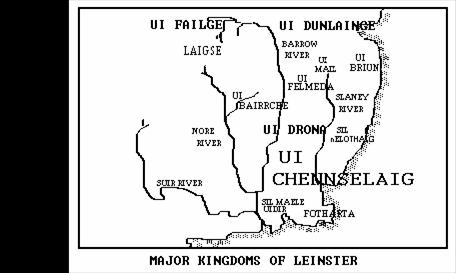
The kingship of North Leinster governed by Coleman, and subsequently held by his son Ronan, has puzzled historians for centuries. The tribes in the North traced their lineages to descendants of Cathair Mor which incorporated the Rossa-Failge <Ua Faile> and Dunlaing <Ui Dunlainge>, while the progeny of Ronan and Coleman traced their origins to Enna Ceinnselaigh, ancestor of the Ui Chennselaigh, the dominant kingdom in south Leinster. Some of the earlier journals described Ronan, who died in 624, as belonging to the Ui Dunlainge; though his children have been clearly identified as being of the Ui Chennselaigh. Several theories have been developed to explain this mystery, yet the most likely explanation is that noble family borne from Enna Ceinnsealigh's children grew in large numbers, and warfare erupted among the royal families competing for new lands to settle. As the descendants of Coleman assumed the kingship of North Leinster, they probably forged a descent to Dunlaing which gave their kingship legitimacy which was a customary practice at this time. The confusion surrounding Ronan's descent to the Ui Dunlainge rather than the Ui Ceinnselaigh, resulted from the similarity of names found among the major families of Ireland. The 'Chronicum Scotorum' recorded the death of "Ronan, son of Colman, king of Laighen"[2] in 615, and related historical records described this 'Ronan' as of the Ui Dunlainge. Because other journals showed Cormac, his grandfather, as king of North Leinster, the lineage to Dunlainge seemed to be the only genealogy which made sense. The difficulty of embracing the Ryan's relationship to the Dunlainge places into doubt the legitimacy of the Ua Riain's lineage to Enna Cheinnselaigh, and this would be inconsistent with their status among the free tribes of the South. The prehistoric traditions link the Ui Chennselaigh, Ui Drona, Ui Dega, and Sil Chormaic to South Leinster; and it is these tribes which Ronan's progeny and kinsmen would subsequently dominate. The tribes of North Leinster which included the Ui Dunlainge, Ui Maine, Ui Faelan, Ui Muiredag and others represented unique lineages distinct from their Southerly neighbors; and concluding that Ronan was of the Ui Dunlainge while his children were clearly described as belonging to the Ui Chennselaigh would have meant that somewhere in the ancient manuals a genealogical manipulation would have been documented. Even after the Sil Cormaic assumed control of the Ui Drona lands, the Book of Leinster still heralded this tribe as one of the chief Ui Chennselaigh lines in the Book of Leinster: "Genelach Rig Hug nDrona"[3] The clues to uncovering this mystery can be found in unrelated events that provide the aristocratic autonomy and succession of this early Leinster tribe. The "Fothairt of Carn' and the 'Life of Fintan of Taghman' provides a curious, and perhaps circuitous, commentary regarding the clash between the Ui Bairrche and Colman son of Cormac Camsron. The Ui Barrache were powerful neighbors of the Ui Chennselaigh, and during this time became the most important tribe in the Laighen by assuming the kingship of South leinster. According to these two documents, the Ui Chennselaigh, although subordinate to the Ui Barrache, were described as lords of North leinster:
Cormac of the Ui Bairrche was imprisoned by Colman son of Cormac Camsron of Ui Cheinnselaig. Cormac (Ui Barrache king) was king of South Leinster (and Ui Cheinnselaig) while his enemy Colman and Ui Cheinnselaigh proper, was king of North Leinster. ("Vita" of Fintan of Taghman - source)[4]
The invasion of the Ui Cheinnselaigh into Ui Bairrche lands resulted in transfering Laigin rule to Colman, son of Cormaic Camsron, and subsequently yielded significant influence for the people of the Sil Cormac. Cormac of Ui Bairrche was imprisoned at the fortress of Rath Mor by Colman, and the Ui Bairrache, as a result of Cormac's capture, were displaced as rulers of South Leinster. This explains why some early annalists were sure that Colman was a lord of South Leinster while others recognized him also as a king of North Leinster.
Dathi nHogain chronicled an Irish folk tradition regarding Ronan Mac Colman's son, Maol Fhothartaigh, whom as the tale enlivens was well loved by his fellow Leinstermen. This tradition describes the events leading up to Ronan's death, and even though the events were ficticious, it was perhaps created to explain the causes of an uprising involving Ronan and the Leinstermen.[5] This tragic tale begins with the death of Ronan's wife Eithne. Maol Fhothartaigh convinced his father to remarry, but against his advice, married the daughter of Eochaid Iarlaithe at Dun Sobhairce (Dunseverick, County Antrim). The king brought the new queen to his Leinster court, and immediately Ronan's new bride lusted after his son by sending her maid to solicit his affections. Maol Fhothartaigh rejected her advances, but slept with the handmaiden anyway. Shortly after this encounter, he left for Scotland with a band of soldiers in an attempt to avoid her further advances. After a while his soldiers yearned for their Irish home, and he was forced to return to the sexual yearnings of his father's wife. He entrusted his problem with his friend Conghal who promised to find a solution, and pretending to be Maol Fhothartaigh sent a message to the Queen to secretly meet him. She hastily made preparations to meet Maol Fhothartaigh, but upon her arrival she found Conghal instead. He scolded Eithne for her adulturous behavior, and for punishment began striking her with a horse whip. She promised vengeneance, and later that evening told Ronan that his son tried to force his affections on her. At first Ronan disbelieved his wife's story, but he spied a brief conversation between them and mistook it for another romantic interlude. He became furious and ordered Aodan, a Leinster warrior, to kill his son. Aodan slew Maol Fhothartaigh, his jester, and Conghal who sought to protect his friend. After viewing this slaughter, Ronan realized that he made a great mistake, but it was too late to stop the series of events which would sweep Leinster. Conghal's brother went to Dun Sobhairce and killed Ronan's father-in-law Eochaid, his wife and son. He returned to Leinster and threw their heads at the Queen who immediately took her own life. Two of Ronan's sons pursued Aodhan and killed him, and greatly angered by the death of the popular Maol Fhothartaigh, Leinster rose up in rebellion against Ronan. Ronan, as these ancient stories relate, died of a broken heart because he caused so much distress in Leinster. This brought the Ui Bruin's to power until Ronan's brother, Faelan, later deposed the Ui Bruin king. Faelan was succeeded by Crundmael, and it may have been his tribe which attempted to rationalize his father's irrational behavior. This story was concocted and perhaps embellished over the years to distance Ronan from the civil disturbance that he created.
The wonder tales surrounding Irish saints also provides interesting interpretations to historical events. As with most early Irish saints, the lore surrounding their lives were laden heavily with miracles and mysticism, and anecdotes surrounding them were intertwined with the local residents which helped rationalize unexplainable historical events. Ronan's sept, the Sil Cormaic, was located at Ferns where a great monestary was founded by Saint Maodhog while Bran Dubh was king of the Ui Chennseleigh. Maodhog, whose death was recorded in 626, undoubtedly was closely associated with the Sil Chormaic after Bran Dubh's death, particularly because the monestary would have served the sept's spiritual needs at Ferns. A local story shows that St. Maodhog provided refuge at the monestary for the Ui Chennseleigh during a siege at Ferns, and through his powers prevented the invading army of seizing the Sil Chormaic's cattle by drawing a ring around the herd with his crozier. In another story concerning a peer of Maodhog's, the related Ui Dega sept was commanded by one of St. Moling's students, Goban Saor, to contribute all their grain to fill a newly erected oratory. When St. Moling was originally asked by Goban to collect this tribute, Moling only granted the request if he inverted the oratory - a feat he did not feel was possible. Goban, through clever construction methods, built the oratory to Moling's specification, and while tradition says that he carried the rye happily to his oratory, it "turned into a heap of maggots on the morrow."[6]