Book of Ryans - The Middle Kingdom
Years
Book of Ryans - The Middle Kingdom
YearsBook of Ryans - The Middle Kingdom
Years


Below represents the lineage of Dermod "Mac Morough" as compared to O'Rian:[1]
Mac Morough (right side) & Ryan (left side) Pedigrees
Crimthann

 Sillan Cormac

 Faelan
Coleman
Faelan
Coleman
Faolchu Ronan
Onchu Crunneasil <Cronhmeal>
Rudgal Aedarein <Aed Ron>
Aodh <Hugh> Coleman <Colum>
Dairmaid Laighnan <Laidcnen>
Cairbre Carbry <Cairpre,Cairbre>
Ceneth Hugh <Aedh>
Ceallach Bruadar
Donal Durgilla <Dubghilla>
Diarmaid Rien <Riain,Ryan>
Morough <Murcha>
Donoch
Diarmaid-n-nGall Dermot O'Riain
In 1152 Turlough O'Connor and Muichertach Mac Lochlainn signed a treaty of peace and friendship with MacMurrough, and shortly after pledging their alliance the three monarchs led an army into Meath to discipline Murchad, the king of Meath. This coalition successfully defeated the armies of Meath, and they divided Murchad's province equally between Murchad and his son. This triple confederation permitted another leader to partner with them just prior to the battle, Tiernan O'Rourke (Ua Ruairc) the Prince of Breffeny, and after their victory he contested the settlement as he felt some entitlement to the spoils of victory. Ua Ruairc criticized MacMurrough over his plans to divide Meath, and Dermod, including the other members, remained resolute with their plan because O'Rourke’s reputation as being untrustworthy and a liar. O'Rourke continued his bitter argument which led the exasperated O'Connor and MacLochlainn to destroy his fort at Dangan, and MacMurrough, as an added touch, abducted his wife, Dervorgilla, whom many believed was more "than a willing victim."[2] Tiernan O'Rourke was greatly angered by this abduction and went to Connaught to seek help in getting his wife back. The monarch of Connaught agreed to avenge Dervorgilla's abduction, and with their combined armies defeated Dermod. His authority and princely title was taken away, and his land was divided between several princes of Leinster. Dermod became disgraced and isolated, and he fled to England to seek help from Henry II. In England, he found Henry II and offered him Ireland if he would help regain his land and title.
After much persuasion, Henry granted a license to his English subjects to aid Dermod's campaign to recover his kingdom. With this grant, Mac Morough sought help from Richard de Clare, better known in Irish history as Strongbow. Through Strongbow's influence, he raised an army guided by Robert Fitzstephen, Myler Fitzhenry, Harvey De Monte Marisco, Maurice Prendergast, Maurice Fitzgerald, and Raymond `le Gros' <the fat> Fitzgerald. In May 1169, these invaders landed at the bay of Bag-an-bun or Bannow, in County Wexford, near the bay of Waterford. Here they were joined by Dermod MacMurrough and his loyal army. With their armies joined, they moved into the interior to conquer and regain Dermod's lost territories. Under the leadership of Robert Fitzstephen, they made their way to Dublin and Limerick and successfully routed the Irish in each battle they encountered.
|
|
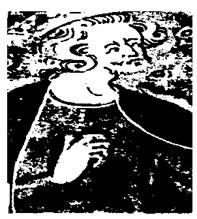
England's Henry II authorized an invasion into Ireland at the request of MacMurrough. The invasion of 1152 was later declared lawful through a papal decree. Source: The British Library |
This small Norman army defeated the much larger Irish army with spectacular successes, and they prevailed for several reasons. Chief among these being the superior weapons used by Strongbow's army. The Irish were still using hand weapons, such as knives and pikes, while Strongbow had the use of bows and arrows. The invasion force which landed on the coast of Wexford May 2nd consisted of only 200 archers, but with these two hundred archers and other foot soldiers, they were able to easily defeat a much larger Gaelic resistance. Interestingly, one of Raymond le Gros' first military actions was to send his army into the countryside to raid Leinster provinces of its cattle and food supplies. This provided the Normans with a large supply of meat and other food supplies to withstand the long marches into the Irish wilderness. Because cattle was the basic monetary system in Ireland, these raids angered the Gaelic and Danish families living in Leinster, and they wasted no time in planning their attack of the Norman camp at Dun Domnaill.
The Leinster chieftains united under the leadership of prince Mael Sechnaill Ua Faelain of the Deise, Dairmot Ua Riain of the Ui Drona, and the Norsemen of Waterford. The tripartite formulated a military strategy against the Norman invaders, and after sketching their military maneuvers they moved their armies just outside of Dun Domnaill. The annals, which often exaggerated the size of the battle forces, described it as an uneven match between 100 Anglo Norman archers and their opponents consisting of 3000 Dane and Gaelic warriors using crude hand weapons. The tripartite originally surprised the sleeping Anglo-Norman army, and in their confusion retreated from the encampment. The Irish were overjoyed with their success, and started celebrating their apparent victory over the Normans. Unfortunately, the English army regained their composure and defeated the now disoriented Irish army. The casualties suffered by the Normans were very small, yet the Gaelic and Danish tripartite left over 500 dead with 70 Norsemen taken as prisoners. The Waterford Norse perhaps expected to be released with certain members retained as 'hostages', but the Normans were not interested in hostage-taking. The Norse were sentenced to death, they had their bones broken, and each prisoner was personally beheaded by Alice of Abergavenny. Alice, a woman who lost her mate during the raid, was so consumed over his death that the ancient journalists expressed horror over the gruesome orgy that followed. The ferocity of these executions must have pleased the Normans because as one Irish annalist commented, "She used the axe without pity."[3]
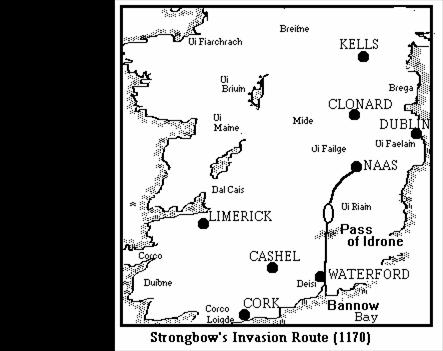
At the insistence of Henry II Strongbow entered Waterford Bay in 1170 with two thousand soldiers. One of his objectives was to relieve Fitzstephen, and as Strongbow marched his army to the town of Wexford where Fitzstephen camped, he passed through the barony of Idrone, home of the Ua Riains. His march took him through Scollagh Gap sometimes referred to as the Pass of Odrone which led into the kingdom of the Ui Chennselaigh. In Idrone (also known as Odrone) he was assaulted by Dairmot O'Rian, Chief of this territory. The Ua Riain led by Dairmot O'Rian "made an energetic attack on the foreigners, crying out 'to your destruction, Englishmen you come!'"[4] During this brief battle, O'Rian was slain by an arrow shot by Nichol the Monk, one of Strongbow's men. O'Rian's troops scattered, and in the confusion that followed many were slain. This attack was one of the more significant battles against the Norman forces; nonetheless, Giraldus Cambensus in his manuscript 'Expugnatio Hibernica' only briefly mentions the Odrone battle.
The history of Ireland may have taken a different path has this battle gone the other way. The book "Civil Wars of Ireland" speculated that if O'Rian had not been killed, the Normans could have been forced to leave the tiny island country:
On his march <Strongbow>, he escaped imminent danger from an abuscade prepared by the Sept of the O'Ryans at Hydrone <in the modern County of Carlow>. The Normans were assailed in a narrow pass, where their superior discipline availed but little; and their defeat would have been inevitable, had not the leader of the Irish been slain by an arrow, on which his followers immediately dispersed.[5]
This was speculation of course, but in truth it was the weapons used by the Gaels which ushered in English rule. The preceding passage described how Ua Riain died from an archer's arrow, but it does not adequately describe the crude weapons used by Ua Riain's army. Meiler FitzHenry, one of Strongbow's lieutenants was wounded by one of these weapons, and as an ancient ballad noted he "was merely stunned to the ground by a blow of a sling shot from the Irish side."[6] Although the weapons were mismatched, the Irish were 'wild men' capable of spreading fear among her enemies, and men breaking rank was not unusual even among Strongbow's army. During the battle at Odrone Strongbow's seventeen year old son fled from the battle site, and made his way to Dublin. Later after learning of his father's victory, came back to congratulate him. Strongbow, scolded him for his cowardice, and then executed him "by cutting him off in the middle with a sword."[7]
King Henry II, to justify his encroachment on Ireland, declared that he had papal authority from the English born Pope Adrian IV. Henry knew that he could not win militarily in Ireland. He also knew the Irish had a deep veneration for the Pope, and that the Irish would consider it a great crime to fight Papal authority. This was exactly the effect the Bull had. The Irish never questioned its authenticity even though Adrian had died 10 years before the conquest of Ireland. Pope Adrian's declaration was designed to bring the Irish Catholic church under stricter control and advance the Christian religion among the "infidels" who had lost the faith. The Bull sanctioned the annexation of Ireland, but made no provisions for disturbing the rights of the Irish Kings, Chiefs, or their peoples. Nevertheless, the conquest of Ireland was complete; and Henry kept his promise to redistribute the Irish land to the conquerors led by Strongbow.