

Book of Ryans - The Middle Kingdom Years
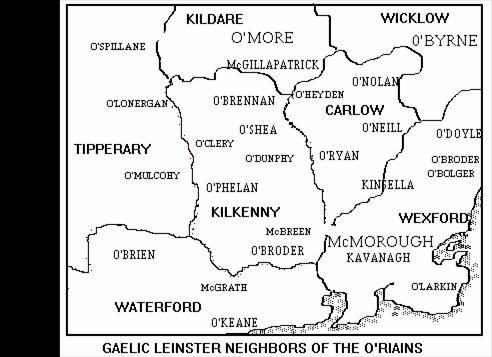
The question of 'when did the Ryans enter Tipperary' has long puzzled historians. While neighboring Leinster tribes westward migration can be documented, the Ryans mysteriously appeared on the Munster plains; and by the late 13th century they are referenced as a major sept in the territory. Some historians believe that their arrival in Munster pre-dated the Danish assault, while others contend that they were squeezed out of Idrone by their new English proprietors. In order to untangle this enigma, a chronological framework needs to be assembled to pinpoint how and why they left the territory.
The Ryans departure for Tipperary did not take place before 858 A.D. because Bruadar, the grandfather of Riain <or Rien>, reigned in Idrone; subsequently, the theory of their arrival into Munster before the Viking onslaught appears to be unsupported. Bruadar later produced offspring which assumed the name of O'Broader <Broder, or Broderick> whose ancestral home bordered Idrone. In addition, many of his progeny still dominate the local population to this day. Bruadar had a son by the name of Duhgilla <Durgilla> who was to become King of Idrone in the later part of the century, who according to genealogists was the father of Riain, progenitor of the Ryan surname.
The Ui Drona in the 10th century, as part of their consolidation effort, developed new strategies to align themselves with allies that would help them achieve their expansionary objectives. Records showed that the sons of Durgilla <Dubhgilla> along with the Osraige waged battles with the neighboring tribes in 908 and 910. In 908, Inreirge, son of Dubhgilla along with the Kings of the Ui Ceinnselaigh, Ui Bairrche, and Laeigis, were victorious against the Osraighe at the battle of Ceallach. Several years earlier his brother Aedh, then King of the Ui Drona, joined with the Osraighe and destroyed a place called Cill-na-Caillech, or Cell of the Nuns. Although the Ui Drona and the Osraige were successful, a priest was killed during this battle which as the ancient annalists described was an unpardonable act:
"The people of Aedh killed the priest which God revenged upon Aedh, son of that Dubghiioll, for some plebians of the Osraighe killed him as he was returning to his house. This Aedh was King of the Ui Drona, and of the Three Plains and Royal Heir of the Ceinsealaigh."[1]
Aedh's skirmish with the monks of Cill-na-Caillech was far from unusual as the annalists depicted a number of disagreements occurring between monasteries and the leading families of his day. One early antagonist of the powerful hermitages was Feidlimid MacCrimthainn, king and clergyman of Munster, who was described as an arsonist of churches and monasteries. Other battles at the monasteries of Birr, Clommacnois and Clonfert were recorded in numerous accounts during the 10th and 11th centuries. At Cork, the registers showed that one clash resulted in "an innumerable slaughter of the ecclesiastical men and superiors of Cork."[2] Conflicts were inevitable because the abbeys had become extremely powerful and rich, and many abbots became as influential as the local kings that surrounded them. Their growing influence was accepted for many years, but as plague and famine made its way through Ireland, the number of hostilities against these rich and powerful ecclesiastics also grew in numbers.
According to the Annals of Ireland, Aedh, son of Durgilla and brother to Rian, died in 905 or 906. This conflicts with a later reference that shows his presence at the Cell of Nuns in 910, therefore this would either suggest that Durgilla had two sons by this name or that one of the journals was incorrectly documented. It seems the latter is more plausible. Aedh was a distinguished leader of the South, and the Four Masters lamented his passing by branding him as one of Leinster's greatest leaders. The comparison to Bran Dubh, an earlier monarch of the Ui Ceinnselaigh, was complimentary of Aedh's diplomatic skills. One of Bran's objectives, which Aedh similarly shared, was to prevent the advancement of territorial claims on his neighbors, so that peace and unity could exist. Bran received his greatest notoriety after defeating the Ui Neill at the battle of Dun Bolg in 598. The Ui Neill chieftain, Aodh Mac Ainmhireach, entered Leinster to reinstate the boru tribute, but he was slain and his army deserted the battlefield. This victory made Bran Dubh widely popular among the Leinstermen and the subject of numerous legends. Aedh Mac Dubgilla's comparison to Bran Dubh was complimintary of Aedh's leadership skills, and the annalists wrote an elaborate obituary lamenting the loss of this popular ruler:
905 Aedh, son of Dubghilla, lord of the Ui-Drona of the Three Plains, tanist of Ui Ceinnsealaigh, was slain by Ui-Bairrache, of him was said:
O youth of pleasant Ailbe, mourne ye the king of noble slaine,
Slain is the populous Aedh of the Bearbha, the just king of the land of
peaceful Fearna.
To greet Fearna of the thousand noble graves there came not, if I remember
rightly, A corpse of more illustrious fame, since the populous
Bran Dubh was slain.
My shelter, my protection has departed, may shelter, my protection has departed,
may the king of king's make smooth his way,
Tis easily known by Aedhan's rath that Aedh is dead,
O youths.[3]
**Ailbe was a great plain east of river Barrow.
**Bearbha was the river Barrow.
**Fearna, or Ferns, was the burial location for the kings of Leinster.
The Ui Drona had gained prominence during the 10th century as one of the dominant septs of the Laigin, and their importance was noted by the gifts provided by the Dalcassians seeking their support. According to "Leabhar na g-Ceapt", these gifts included:
Eight steeds to the Ui Drona of Ceann Gabhra
From the hand of the king with good profit
Eight hounds for making slaughter on the plains,
Eight swords for battling.[4]
A few historians believed that the Ui Drona of Ceann Gabhra showed the presence of the Ryans in Tullaheidy, or Uaithne, already by the late 10th century. Ceann Gabra translated to the "head of the horse" which described some well-known geographic landmark. This description may have described a river’s bend, however, Dr. John O'Donovan speculated that it represented a "remarkable hill in Idrone" even though he was uncertain where it was located. The tribute made by O'Brien may have been given to the O'Rians living in the mountainous region of northern Tipperary rather than the mountains of Wexford. Still later when the O'Mulrians, chiefs of Owney, were in Tipperary, the descendants of Brian continued providing them with gifts. One entry identified the granting of six shields, six swords, richly ornamented, and six horses with gold bits and furniture by O'Brien's descendants.[5]
The Ui Drona were relatively quiet in the 10th century, and it was at this time that Rian (Rien, Rian) son of Dubghilla ruled his kingdom in Leinster. Riain's Laigin tribe underwent a period of relative calm after Aedh's death as the annals barely mention the affairs of the Ui Drona. This docile climate probably explains why little information regarding the life of Riain exists today. The annals rarely recorded anything other than the most significant events, and a single year's record was often less than 100 words. It appears that Riain ruled Ui Drona of the Three Plains, and may have commanded this kingdom for many years as one of his sons was known to have been Idrone's sovereign in 976. His historical importance has been lost; but because his son Muiredach was shown to have been king of the Ui Cheinnselaigh, it suggests that Riain must have been highly influential within this Leinster dynastic group. The name 'Rian' (or Riain) was uncommon in early Irish history, if using the Annals of Ireland as an indicator. The annals recorded its use less than a handful of times, and the earliest application of the name was recorded in 895. In this reference, it noted that the foreigners (norsemen) were raiding Irish monasteries and had taken a garment apparently worn by St. Patrick. As they continued their raids into the Irish interior, they faced a Celtic army led by Rian, son of Bruadair, whom the annals said was "slain by the foreigners."[6] The limited information contained within the annals do not indicate if this 'Rian' was of Leinster origin, but if he were it could help explain how the proginitor of the Ryan clan received his appellation. Rian, son of Bruadar, may have been an uncle to Rian, son of Dubghill mac Bruadar. As a result, he may have been named after this illustrious relative who fought valiantly against the Norse raiders.
Leinster's passive atmosphere would be challenged again before the end of the century by newly emerging kingships which more aggressively held fast against Viking expansionism. Displaced Gaelic tribes from Dublin, Waterford, and other areas moved inland in search of land, and this upheaval was felt by many kingships in South Leinster including Ui Drona. In addition, new alliances were created with the Danish invaders (often referenced in the annals as 'foreigners') to solidify and expand old Gaelic territorial claims. One such bond of friendship was made in 976 which involved Muiredach, son of Rian, but resulted in a disastrous outcome for the men of the South:
The battle of Bithlann was gained over the Lagenians by the Foreigners of Ath-Cliath, in which were slain the king of Laighen, i.e. Ugaire, son of Tuathal, and Muirdhach, son of Rian, King of the Ui-Cennsealaich, and Congalah, son of Flann, King of Leghe and Rechet and others.[7]
The chaotic conditions caused by these new alliances disturbed the balance of power in the South, and the fragmented relationships within the Laigin became even more strained, perhaps created by disagreements over how to deal with these new challenges. In 982 alone, the Chronocum Scotorum recorded two kings of the Laigin slain by the Ui Cheinnselaigh themselves [8] which would indicate that the Leinster tribes were not unified in dealing with the foreigners and the newly emerging powerhouse, the Dal Cais of North Munster. It was during this time that the Dal Cais, led by Brian son of Cinnadeigh, began conquering smaller kingdoms surrounding their own. Although the Ua Nialls historically held the Ard Ri almost to the exclusion of anyone else, the men of Munster challenged this ancestral right. This upheaval caused great agitation among the neighboring tribes, and the annalists documented several battles including one between the Osraigne led by Gillapadraig and the septs of Leinster which reflected this convulsion. The Chronicum Scotorum described an event where Tadhg Ua Riain, King of Ui-Drona, and Dunlaing, King of the Laighen, were slain by Donnchadh, son of Gillapadraig, in a battle fought at Lethghlinn. The Four Masters further wrote that, "Donncuan, i.e. the Simpleton, son of Dunlaing"[9] was also slain, and that both Tadhg and Donncuan were slain "after they had made friendship, and taken a mutual oath in the beginning of the day."[10] The oath between the Simpleton and Tadhg, the royal bard, was prophesized by Moling who foretold that it would result in their deaths[11]:
Donndurgen, and the Royal Bard of Lances,
Shall violate friendship of Glinngerg,
Mutual oaths shall not prevent bloodshed.
Within the year the alliance of the Danes and the Leinstermen fell onto hard times, and an army led by Mael Seachlainn attacked the 'foreigners' (Danes). The 'Annals of Ireland' said that the foreigners were slaughtered, and that the Leinstermen suffered serious losses among which "Dubhoabhoirenn Ua Riain was slain."[12] As the name Dubhoabhoirenn was unusual in Ireland and only referenced once in the great journals, it is possible that a legend surrounding Domhnall mac Dubhoabhoirenn is attached to the Ua Riains. Brian Boru had sent his bard to visit chiefs of the South, and after returning to Thomond he tells of the treasures he received. He described how Cian mac Maolahuaidhe had bestowed upon him a great many presents while Domhnall simply gave him a belt and a piece of flint. The bard was overly complimentary of Domhnall much to Brian's surprise. When Brian asked him why he praised the chieftain which gave so little, the poet said it was because he was the poorer of the two and that he gave a greater share of his wealth than did Cian.
In this same year the lordships of the Laigin led by Mael Morda, the Vikings, and their king, Sitric of Dublin, opposed Brian Boru's efforts to become king of Ireland. The confederation developed by Brian began to disintegrate after its first defector, Mael Sechnaill, refused to fight the men of the South. The break in the alliance did not prevent Brian from carrying out his plans to unify Ireland, and on April 23, 1014, he met the men of Leinster at Clontarf. Although there were heavy losses including the deaths of Sitric, Mael Morda, and Brian; Brian's armies came out victorious. Donnchadh, one of Brian's sons, became ruler of Ireland which the Dal Cais, under Brian Boru, had feverishly sought in his lifetime.
Before the end of the century, further pressure by newly rising tribes in the South, along with support from the Ua Brians, assisted in further disintegrating order within the Ui Ceinnselaigh. Because of restructured alliances and rearranged land distribution, civil strife intensified among these tribes seeking a larger span of dominance. This was especially the case with the Sil Onchon which assumed the kingship of the Ui Ceinnselaigh in 1042, and within 20 years the annals showed them contesting the kingships of many minor kingdoms subordinate to them. In 1071 a battle was recorded where the Ua Riains allied themselves with the Sil Onchon, but the leader of the Ua Riains was killed:
1071 A battle between Domnhnall, son of Murchadh, and Donnchadh, son of Domhnall Reamer, where Tadhg Ua Riain was slain.[13]
The battle between the Osraigh and the Laigin was not significant as far as Irish history was concerned, but it may have been the point where the Ua Riains temporarily lost their kingship of Idrone to the family of Domhnall Mac Murchadh. A later entry in 1087 showed that Domhnall's son was the lord of Idrone as noted by a registry entry describing a battle at Rath Edair between the Leinstermen and the Munstermen. The Ui Ceinnselaigh continued to challenge the authority of the Ua Briains, and reacting to this break, Muirchetech Ua Briain assembled his armies and met the men from Leinster at Rath Edair, or fort Edar, near the hill of Howeth in County Dublin. The Leinstermen suffered tremendous losses, including many of its nobility. While the lord the Ui Drona was also slain, it also represented a period in which the Ua Riains were not in possession of the lordship:
"A great slaughter was made of the Leinstermen together with the son of Murchadh Ua Dombnaill, lord of Ui Drona, and Conall Ua Ciarmaic, and Ua Neill of Magh-da-Coron.[14]
The temporary loss of the lordship of the "Three Plains" may have been the time when the Ua Riains began their major exodus westward into the Munster plains. Records maintained before this time seem to indicate that the Ua Riains possessed two major kingdoms: the Three Plains which was along the river Barrow and Ceann Gabhra, or Head of the Horse, with its whereabouts having never been successfully identified. The loss of the Three Plains may have forced many members of the royal family to leave Idrone in search of a new kingdom. If Ceann Gabhra were located in the Munster plains, this loss of provincial rule could explain when the Ryans left Idrone and may also explain why more Ryans are found in Munster today than in Leinster.
The violence which blanketed Leinster continued well into the next century; moreover before the century ended another battle occurred in 1089 where Donnchad, son of Domhnall Reamhar <Daniel the fat> and king of the Ui Ceinnselaigh, was slain by the Ua Failghe, and the following year the Munstermen were again on the battlefield with Leinster fighting Maelmordha Ua Domhnaill, son of Donnchad. By 1092, these continuous conflicts were beginning to wear the patience of many Leinster sub-kingdoms as this entry found in the "Annals of Ireland" indicated:
1092 Enda, son of Diarmada, lord of Ui-Ceinnselaigh, was killed by the Ui-Ceinnselaigh themselves.[15]
The Ui-Ceinnselaigh were beginning to feel pressure from the sub-kingdoms subordinate to it, and it also found itself being manipulated by Muirchetach O'Brian who had spent twenty years trying to dominate MacLochlainn of Connaught. To help him accomplish this end, he sought ways to influence Magnus Barelegs, King of Norway, to assist him in his battles with the men of Connaught and Ulster. A great war was fought between the North <the Cenel-Eoghain and Ulidians> and the South <men of Mumha <Munster>, Laighen, Osraighe, nobles of Connacht and Midhe, and the foreigners described as descendants of Vikings>. The Cenel-Eoghain and the North returned home victorious with numerous treasures, including the royal pavilion. In this battle Ua Riain, king of Ui Drone, and many of his men were slaughtered. The re-emergence of Ua Riain to the lordship of Ui Drone indicates that the family had somehow reassumed their princely heritage. The deaths of Ua Riain and his men could have been avoided if Muirchetach had been patient while waiting to fight the North. Irritated because they did not appear, he took his army into Aench-Macha, a region in the North, to raid the territory of its cattle and gold. The North realizing that the encampment of Magh-Cobha was vulnerable, proceeded to attack this weakened army consisting mostly of Leinstermen; and accordingly, many deaths occurred among the Leinstermen including many of the Ua Riains. John O'Donovan identified this monarch as "Rian", the progenitor of the Ryans of Carlow; however, he was more likely the great grandson of Riain <Rian or Rien> who lived about the time of Brian Boru.