

Book of Ryans - Dynasty
The Annals of the Four Masters also recorded this event, and noted that after the earl of Ormond, Lord Justice of Ireland, "broke down the castle of Owney upon O'Mulrian"[1], he entered O'Dempsey's land and was "permitted to pass to Airem to rescue the son of Mac Feorais who was imprisoned there"[2]. After Ormond rescued Mac Feorais's son, he burned the castle located at Airem. McFirbis moreover recorded that the earl of Ormond "died at Ardee after he had broken the castle of Owney-on-Mulryan and taken Ley castle from O'Dempsey and so against O'Connor Ifally and O'Farrell of Annally and then to Minfir Reilly, and MacMahons's, and caused Henry O'Neill to divorce MacWilliam Burke's daughter and take to him his own married wife MacMoragh's daughter, sister to the said earl."[3] The O'Mulryan castle referred to in these passages was located at Abington in the county and barony of Limerick, and Owney-upon-O'Mulryan was an extensive lordship comprising two half baronies in the counties of Tipperary and Limerick. This unrest continued sporadically, and the profiteering and other abuses present at this time continued well into the next century. In response to the civil unrest in Ireland, the gentry and freeholders of County Tipperary wrote to Henry VIII in 1452 to plead for his intervention to stop the fighting:
After the Earl's death his sons being in high favour in England neglected their inheritance, and so the quarrels revived by marriages and confederacies with the Irish, maintained by the Earl of Desmond, which brought the land to destruction.[4]
The border areas of Limerick and Tipperary were generally unaffected by the constant warfare between the major Gaelic lordships and the Anglo-Irish earls. The feud between the earls of Ormond and Desmond were well known, but it normally was a battle of words rather than armed conflict.
The next 20 years were relatively silent in Ireland, although the Anglo-Irish lordships continued to have their intermittent disputes with one another. The same could not be said of England which was concentrating on her own revolution, the Thirty Years War. With England preoccupied with her civil war, the O'Mulryans, as did other lordships, consolidated their land-holdings, and with the sudden departure of John Butler, they were able to quickly expand their supremacy and prestige throughout northern Tipperary. The Ryans of Carlow also became more independent in their own kingdom, which by the mid-15th century was unfettered by Anglo domination.
15th Century End
The Thirty Year's War was in reality a series of revolutions of which the most significant was between the houses of Lancaster and York. This civil war, known as the War of the Roses, found its way to Ireland, and the lords of English descent were forced to choose sides: the Butlers, lords of Ormond, sided with the Lancasterians and the lords of Desmond an Kildare identified themselves with the Yorkists. Initially the Yorkists endured many losses in combat; nevertheless, by 1461 their superior armies overwhelmed the Lancasterians. The Yorkist military successes climaxed in the overthrow of Henry VI with Edward III. This civil war spilled into Ireland and affected both Gaelic and English alike, and as Ireland seemed to be a sea of endless bloodshed, conflict was inevitable.
A year after the Lancasterian defeat, James the earl of Desmond died leaving his son, Thomas, to succeed him as earl. Before James died, one of his last acts was to create an alliance with the earl of Kildare in an attempt to counter John Butler's influence in the Southeast. Waterford, Kilkenny, New Ross and other towns tended to ally themselves with John Butler, the earl of Ormond, which greatly angered his cousins, the Butlers of Kilkenny. The enemies of Ormond joined forces with Kildare and moved 5000 men to Meath to meet Ormond's army. Additionally, the earl of Desmond in an effort to salvage King Edward's position in Ireland raised 20,000 men, and for 17 days Desmond completely devastated Ormond, parts of which were the traditional homelands of the O'Mulryans. After destroying large portions of Ormond, Desmond faced Ormond at Baile-an Phoill, near Carrick-on-Suir, and crushed the armies of Ormond. So complete was Desmond's victory that he later wrote "for certain it might not be known how great a number was slain, and sir John himself was discomfited and put to fight."[5] After his humiliating defeat Ormond retreated to England, and without his strong leadership his farms and various interests in Kilkenny and Tipperary disintegrated. The collapse of Ormond was good news to the Gaelic chieftains who seized the opportunity to further cement their control of the local population, and as R. Dudley Edwards observed about the changes in the ruling hierarchy, "some passed to minor Butler's, the rest passed into the control of new Gaelic families, such as the O'Ryans, O'Glissanes, and O'Dwyers."[6]
The only area where the English remained in control was an area around Dublin called the Pale. England was paranoid about losing her only foothold in Ireland, so she enacted a law in 1465 that required the Irish living within the Pale to assume an English surname. The names were to be "of one towne as Sutton, Chester, Trym, Skyrne, Corke, Kinsales; or colour as White, Black, Brown; or a science as Cooke, Butler"[7], and if they refused to change their name they would lose their possessions. This apparently had little impact among the more prominent Irish families which lived near the Pale, as the "MacMurroughs, O'Tools, O'Byrnes, O'Mores, O'Ryans, O'Conor Falys, O'Kellys, etc., seem to have been in the least influenced by it."[8] The English created more acrimonious legislation in 1493 designed to limit Gaelic influence in the Pale by declaring it illegal to speak the Irish tongue, and this was enforced by letting only men of English descent to administer justice in the court system. These acts would be reintroduced many times before Irish emancipation occurred in the 19th century.
O'Mulryan Ancient Neighbors
The heart within my breast tonight is wild with grief
Because, of all the haughty men who ruled this place,
North Munster and South Munster to the wave beneath,
None lives, and where they lived lives now an alien race.
Egan O'Rahilly
Ireland was divided according to the interests of those who possessed it. The decedents of Milesius divided Ireland into three parcels: Heber along with the descendants of Ir were allocated Munster <in the southern part of the island>; Heremon was given Leinster and Connaught; and Ulster, the northern portion of Ireland, was given to the descendants of Ir. It was not until Eocha I that the island was divided into the four divisions, or provinces, which remained in place for most of Ireland's history.
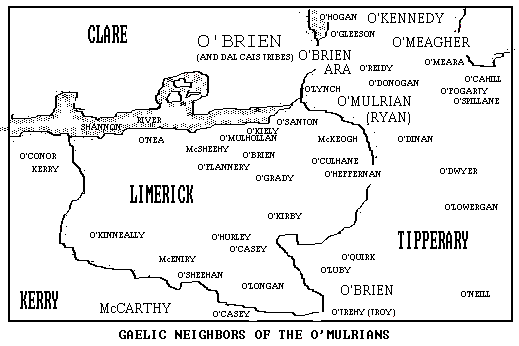
The following is a brief summary of the ancient Irish families who neighbored the O'Mulryans in Munster. The territories and their principle septs were recorded by the Abbe Mc Geoghan in medieval times, and these descriptions, although slightly altered for this text, provide an insight to the historical placement of the O'Mulryans' ancient neighbors.[9]
The Dalcassians
The Dalcassians and the Eoganachts traced their lineage to Oilioll-Olum, of the race of Heber. Oilioll-Olum became the first absolute monarch of Munster after defeating the Earnochs early in the third century. He laid down a law that stated that the kingship of this province would alternate between Eogan and Cormac-Cas, his two sons. From these two Munster chiefs rose the great races of the Eoganchts and the Dalcaiss.
Their territories and principal septs included:
Aradh-Cliach, northeast of Limerick located in the barony of Ara in the County of Limerick. This territory belonged to the O'Briens, race of the Dalcassian. The O'Cullens also claimed this land as part of their ancient patronage. Cullen (O'Cuilinn) means descendent of Cuileann from the Gaelic 'holly'. They originally came from Wicklow, but were driven out by the O'Byrnes and the O'Tooles. This family has produced important clergymen throughout the centuries.
Hy-Fogarta, located in the barony of Eliogarty in the County of Tipperary. This belonged to the O'Fogarthys or O'Fogartaidh, a branch of the Eoganachts. The origins of this name suggests that the ancestor of the Fogarty clan had a criminal past as the name means banished or outlawed.
Hy-Kierin, or IKerin, located in upper Tipperary bounded by Upper Ormond and Eliogarty. This territory belonged to the O'Meaghairs, descended from Kiann, son of Oilioll-0llum. Their history is described in great detail in the book 'Records of Four Tipperary Septs.'
Muscraigh-Thire, northwest Tipperary located in the baronies of Upper Ormond and Lower Ormond. This land is the primeval possession of the O'Kennedys, whom descended from Cormac-Cas. The Kennedy's claim kinship to Brian Boru whose brother, Dunchad, was elected high king of Ireland after Brian's untimely death in 1014. The Kennedy name derives from Brian Boru's father, Cean Eidig, which in gaelic means "ugly head". This name suggests that the primate of the Kennedy clan was far from handsome, although later translations claim the name derives from the Gaelic "cats head". Another sept of the Muiscraith Thire were the O'Donegans. They traced their origins to Heremon, and were the original princes of this area. They were the styled princes of Muiscraith Tire and Aradh Cliach. Other families living here included the O'Donnellys and the O'Fury( or the O'Fuirigs). The Gaelic origin of Fury - O'Fiura or O Furreidh - is unknown. Among the territory's more important claimants, the most illustrious was the 19th century boxer, Dan Donnelly, who won three major fights by 1819. His most impressive was in England, and tradition has it that King George II personally congratulated him for his fighting skills and called him the best man in Ireland. He is said to have responded, "that he was the worst man in Ireland, but was the best man in England."[10]
Poble-Hy-Brien, located in Limerick in a barony of the same name, belonged to another branch of the O'Briens. The O'Hurleys, also of the Dalcassian race, lived within this territory, also. Their principle settlement was found in the parish of Knocklong, barony of Coshlea, County Limerick.
Thomond, also known as Towoin-Hy-Brien, comprises a very large portion of the Counties of Limerick and Clare. This belonged to the O'Briens, who were also the chiefs of the Dal-Caiss.
Uaithne Ageamar, or Owney Agamar, was located in Tipperary and Limerick, and comprised parts of the baronies of Owney and Ara. This was the home of the O'Duinechair and O'Dinan, chiefs of the Eoganach Uaithne Ageamar. Dinan - Dineen, O Duinin is a byname of the diminutive word 'donn' (brown).
Muighaghair, a territory in Thomond, County Clare. This patrimony belonged to the Mac-Con-Maras, or Macnemara who were of the race of Dal-Caiss. McNamara (Mac Conmara), comes from two Gaelic words 'cu' and 'muir' roughly translated to mean sea hound.
Muscri-Mithaine, a territory located in Tipperary and Limerick. This ancient area belonged to a number of septs including the O'Donnogains, the O'Culenains, and the O'Floinns.
O'Flahry, a territory located in Tipperary. This original patrimony belonged to the O'Cathails or Cahills. Dr. Daithi O nOgain noted that the "blood of the Cahills and Keoghs, for instance, was believed to cure the shingles if applied to the affected part of the body, and the blood of the Darcy's could cure wildfire."[11]
Owney-Hoiffernan, a territory located in the County of Limerick. This ancient land belonged to the Hiffernans, of the race of Dal-Caiss. Heffernon (O'hIfearnagh) derives from the Gaelic 'ifreanach' which means demon and whose root word 'reann' translates to the English word 'hell'.
Clann Cian
The Clan Cian was located in Ormond, or in present territory of northeast Tipperary County. The head of the Clan were the O'Carrolls whom later were known by the title 'Prince of Ely'. The other families included MacKeogh, O'Corcoran, O'Dulunty, O'Meagher, and the O'Haras.
EIy O'Carroll, a territory located in County Tipperary. This belonged to the O'Carrolls, Prince of Ely, who ruled over eight subordinate chiefs. This territory comprised part of Lower Ormond in Tipperary, the barony of Clonlisk and part of Ballybrit in Kings County. The Carrolls hail from a 3rd century king of Munster, Ollioll Olum, whose descendent Cearbhaill meaning 'warlike champion' has been designated as the father of this family. This progeny would develop into six different septs spread throughout northern Tipperary, Offaly, Monaghan, and Louth.
Uaithne Thire, located in remote Owney, the O'Linskeys or Lynchs also lived in this area and their pedigree is traced to Viking and English heritage. Their history suggests that their forbearer was de Lynch who was one of the original Norman warriors and Labradh Longseach, a mythical ancestor. The name is one of the more common names found in Ireland today, and Galway City, for example has had almost 100 mayors by this name. Another illustrious family of this territory was the MacKeoghs, or Kehoes. The MacKeoghs were the leading poetic family of Leinster after the mediaeval period, and they forged their linkage to the prestigious 6th century poet, Eochaidh Elgeas. Eochaidh was a principal poet in Ulster, but the mediaeval historians rewrote his 6th century role by claiming that he was the main satarist of the Ui Neill court.
Leinster Milesians
Of the Leinster Milesian, descended from Heremon, within Munster, the major families included the O'Felan, princes of Desies in Waterford; the O'Brics, chiefs of Waterford; O'Dwyer and O'Ryan, chiefs in Tipperary; and finally the O'Gormans, chiefs in Clare.
Hy-Aimrit, located in the present baronies of Kilnamach in County Tipperary. The O'Dwyers were the owners of this extensive area, and traced their lineage to Heremon. O'Dwyer is often seen in the ancient journal spelled as 'O'Dubhuidir' meaning 'black odar'. The O'Gormans who were related have their origin to the word 'donn' which translated means 'blue.' Interestingly, the O'Donnogains from Muscri-Mithaine trace their origin to the word 'brown', which seems to indicate that colors were very important to the early Gaels. Perhaps these colors suggested elements of strength or some other personal characteristic.
Other Neighbors
The remainder of these families identify themselves with one of the dominant races previously described:
Spillane O'Spealain meaning spear or scyth
Meara - O'Meara of O'Meadhra, meaning mirth or joy from Gaelic 'meadhar'
Quirke - O'Cuirc, from Corc or heart or Curc meaning tuft of hair.
Maher - O'Meachair or Meacher. The primate of this family tribe was perhaps a very generous and gracious host as the name is derived from the Gaelic word 'hospitable.'
Regan - O'Riagain. It is from unknown origin. It comes from the Gaelic 'riodhgach' meaning impulsive or furious. The Regan tribe claims lineage to the Dal Cassians, and their history shows lineage to a nephew of Brian Boru, Riagan. This family's origin has been confused throughout the centuries with that of the O'Ryans of north Munster.
Poynings Act
One of the more significant pieces of legislation enacted concerning the Irish was passed in 1494. Through the direction of Henry VII, the Parliament in Dublin passed the Poynings Act which extended English laws to Ireland. It also prevented new legislation from being enacted without the consent of the English Council. This law would remain in effect until 1782, and throughout its history, Kings and Queens of England would invoke it to justify their conquest of Ireland by replacing Irish laws and traditions with those of the English.