

Book of Ryans - Dynasty
Relations between the Gaelic Irish and their Norman overlords degenerated because of England's inability to control its Irish lordships. England especially lost confidence in de Burgo, and as he tried to demonstrate his authority among the Gaelic lords, it merely irritated them further. In 1329 William de Burgo was murdered by one of his own, and it forced his wife and daughter to flee the country. With the de Burgo legal heiress gone, many Gaelic chiefs reoccupied their traditional homelands which were confiscated several centuries earlier. The Burkes recognized that they were losing control of their royal patrimony, so they divided the lordship among several family members to prevent further deterioration. Ulick Burke received Galway; Edmund Burke received Mayo, and another group of de Bergs received large portions of Tipperary and Limerick along with the title 'earl of Ulster'. The "Accounts of Liberty of Carlow" denoted that the O'Mulrian lordship was subordinate to the earls of Ulster:
O'Molryan, O'Dwyer and their following are hibernici of the Earl of Ulster in Tipperary. In the inquisitions of the Earldom of Ulster in 1333 O'Neill, Maguire, MacMahon, O'Cahan and other Ulster chiefs are described as holding of the Earl by service of supporting armed troops assigned to them by the Earl: thus MacMahon "holds the rule of the Irish of Oriel for the said Earl by service of supporting fifty satellites."[1]
The declarations of Irish freeholders as hibernici (e.g., Irishmen, signifying they were of a substandard social class), as described by the annalists, was a method to reduce the population to servitude by taking away land which was either owned individually or in common. Several years later in 1338, the de Burgo lordship passed to Edmund Burke, the earl of Clanrickard. His lands included central Tipperary and northeast County Limerick, later called Clanwilliam, which was sandwiched between the Ryan lordships of Owney and Sologhead. During these turbulent years the Gaelic Irish became increasingly militant and again forced the Norman settlers to the cities. The unpredictable actions of the Irish also led to internal disputes within the clan, and the annals noted that in 1339 the O'Briens, for example, quarreled over who was the legitimate heir of Thomond. The English supported several O'Brien pretenders which irritated Bryan O'Brien, so he gathered an army and swept ruinous destruction over the English settlements of Limerick and Tipperary. The internal conflicts of the O'Briens and the Burkes opened the door for the Gaelic princes to seek greater autonomy; and unfortunately this independence revived demands for ancient claims of Norman settled lands. Ethnocentric feelings surged which ignited a growing hatred towards the Englishmen who settled central Munster, and large armies forced the English from their settlements. Ironically, the English State Papers were destroyed by fire, and the next several hundred years the affairs of the Munster English seem to "vanish" from sight.
One of the more significant assemblages of Gaelic chieftains was in 1336 which gathered all the significant native princes of Leinster including the O'Ryan. The Leinster Gaels saw an opportunity to attack Norman outposts after Lord Remundus Lercedekne's died in 1336. Laoiseach (Lysagh) O'More, lured all the Leinster Irish to Momonis and enticed them with persuasion, promises and gifts to join him in recapturing their confiscated tribal lands; but only Scanlon McGilpatrick and Harry O'Ryan <lord of Idrone> resisted because they insisted on maintaining peace. The registers documented that O'More ignored O'Ryan and McGilpatrick's pleas for reconciliation, and that his backers pushed forward and "expelled nearly all the English from their lands by force, for in one evening he burned eight castles of the Englishry, and destroyed the noble castle of Dunamase belonging to Roger Mortimer, and usurped to himself the lordship of the country."[2]
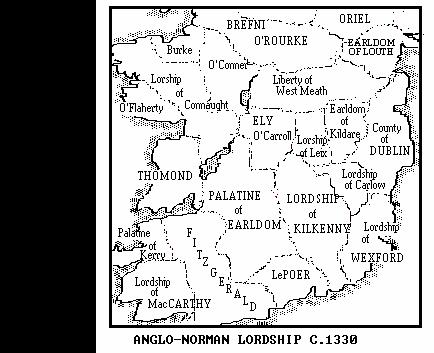
The chronicles were filled with events demonstrating wide-spread atrocities aimed at the English of Ireland. The O'Carrolls vigorously cast out the Brets, Milbornes and other Englishmen who settled their 'country' through violent means. The Irish of Leinster in 1346, particularly the O'Mores, O'Conors and O'Demseys captured three English castles in battle, and elected Donal Kavanagh as king of the Leinstermen. They argued that their coalition was one where "all the Irish of Leinster as one man set themselves to war against the English and the lovers of peace,"[3] and reasserted their ancient claim to the dominions of Hy Kinsella and Idrone. In 1347 Donald, son of Philip O'Kennedy, aided by the Irish of Munster, Connaught, Meath and Leix rose in rebellion and destroyed all the castles of Ormond except Nenagh which was so strongly held that they could not penetrate its walls. The locum tenens for the Earl of Ormond, de Freyne, brought the uprising under control. Though it doesn't state specifically that the O'Maoilrians participated in the records, historians have inferred that they must have "participated in this upheaval with the O'Dwyers."[4]
The successful military ventures against the Norman settlers raised the spiritual hopes of the Gaelic chieftains, but in 1348 a greater destroyer of Ireland would enter the island nation - the Black Plague. The Black Death affected the main towns and ports of Ireland, principally in the lowlands where crop production was greatest. The more pastoral districts of the West were not affected as severely as the more urban areas of the country. Friar Clyn maintained a journal during this period, and wrote that there was great human suffering and death in the heavily populated cities such as Dublin and Drogheda. The plague was widespread, and the historian Friar Clyn believed that the end of the world was near. His last journal entry before he was consumed by the plague leaves the impression that mankind had little hope for survival:
Among the dead expecting death's coming, I have set these deeds down in writing...I leave parchment to carry on the word, if perchance any man survives or any of the race of Adam may be able to escape the pestilence..."[5]
The mortality probably approached the same levels as the great famine of the 1840's, and by 1400 consecutive outbreaks of plague had apparently reduced the population of Ireland by half. One of the effects of this plague was the creation of the Statute of Labourers in 1349. Because of the shortage of Irish laborers, tenants began searching for better employment conditions and wages in neighboring lordships. Some of the lordships found themselves without a sufficient workforce to operate their farms, and they complained to parliament that "servants, ploughman, carters, threshers, and others refused to serve as accustomed."[6] The men who left one landlord for another were frequently abducted and brought back to the original landlord's land. This law was created so "that no lord should give greater liveries or larger wages than heretofore, or draw away the servants of another without his will."[7] The demand for labor was substantial as the plague devastated large portions of the island, and in Dublin alone 14,000 people were estimated to have died.
English Rule
Life has conquered, the wind has blown away
Alexander, Ceasar and all their power and sway;
Tara and Troy have made no longer stay--
Maybe the English too will have their day.
Kings, Lords, & Commons, by Michael O'Donovan
The deleterious effects of the plague in the border settlements, combined with the advent of the Gaelic Revival permitted many Irish chieftains to procure new territories and re-establish the antiquated Irish laws, the Brehon laws. This crisis caused concern to the English monarchy, and it forced Edward III to enact legislation designed to bring Ireland to obedience. These laws were codified under a series of enactments called the Statute of Kilkenny which held that no laws were valid unless approved by the sovereign power of England. Edward assured that the newly emerging 'countries' ruled by Gaelic princes would adhere to these laws by sending troops into their territories to bring the Irish element to submission.
Although England sent in reserves to quell the hostilities, they were ill-equipped to police the countryside. King Edward sent his second son, Lionel of Clarence, to settle the disputes, and he was able to capture Art More MacMurrough, king of Leinster, and in Cork was able to return lands taken from English settlers. Lionel found himself in Tipperary between the feasts of Michalmas and Christmas in 1365 to quiet an uprising in Ormond, and as he made his way through Munster he wrote that the Irish of Tipperary which included the "O'Kenedies, O'Dures, O'Molrians, McBrenes, have been making war in the marches of Limerick so that the community of the County of Limerick had to garrison their borders."[8] As Lionel progressed further into Munster he recorded that these disturbances were more widespread than previously had been recorded. The lords and lesser lords united in their efforts to drive the English out of their territories, and he reported these findings to the King in 1371:
O'Brien, MacNamara and nearly all the Irish of Munster, Leinster, and Connacht, and many English have risen and are confederated to make a universal conquest of all Ireland.[9]
This universal uprising forced the English settlers to the 'Pale' which was a small territory surrounding Dublin, and as the Irish continued their offensive, they reoccupied their ancient lands that had been confiscated by English adventurers. With the exception of the four counties surrounding Dublin, possession of Ireland fell to ninety independent princes, sixty native and thirty Anglo-Irish, who exercised absolute power and followed their own laws.
Six years later, Murgh O'Brien of Mac Brian Ara, a neighbor of Owney O'Mulryan, continued to press for England's permanent retreat from Ireland. He drove a large army of Munster recruits into Leinster; however, the Justicatar offered him 100 Marks if he would leave Leinster without delay. O'Brian accepted this 'black rent', and retreated into Munster where he overran the province including portions of Connaught. He also destroyed a great many towns and villages including Killaloe, Thurles and Inchiquin. The participation of the O'Mulrians in these events was likely considering their proximity to the O'Briens. This alliance also can be indirectly supported because so much of the devastation in Munster occurred in the O'Mulryan 'country' of Owney, Ara and Kilnalongurty.
Owney, Ara, and Kilnalongurty comprised a much greater area called Ormond, a territory which was not recognized as "one country under one government and one lord"[10] until 1433. This territory was ruled by the earls of Ormond, whose independent history began with James Butler, the third earl, after he acquired Kilkenny in 1392. Over the years this family quarreled with other neighboring Anglo-Irish families, particularly the earls of Desmond including the Fitzgeralds, Fitzgibbons, Fitzsimmons, and the Fitzmaurices. The Butler's petty jealousies and frequent squabbles ultimately implicated the Ryans, especially after the Butlers appropriated the earldom of Kilkenny. Their aristocratic domain included the royal lands of northern Munster where the O'Mulrian septs of both Owney and Borrisoleigh were located. The dissension between the Norman families was often overshadowed by the violence of the original Gaelic tribesmen.
One of these formidable tribal chieftains was Art MacMurrough who became outraged in 1390 when parliament refused to pay him `Black Rent' as insurance to keep his subordinate chieftains out of English controlled land. Art Oge MacMurrough, perhaps one of the greatest descendants of Donal Kavanagh, destroyed more English colonies than any other mediaeval chieftain up to that time. Parliament's refusal to pay MacMurrough prompted him to assemble his Leinster chiefs (or urraghs) and raid the English countryside until these payments were reinstituted. Murrough may have accepted the discontinuance of 'rent', but he became impugnant when heard that O'Reilly, another great native chief, received 84 marks to maintain the peace in West Meath and parts of Kells. A.J. Ottway Ruthven commented all the major lordships of Idrone and Hy Kinsella supported Murrough, but his most trusted and ferocious allies included "the O'Nolans, O'Rians, and others."[11] The Irish tribal chiefs were the only recognized authority in these parts of Ireland, and as their raids intensified, massive destruction was leveled against Leinster, so much so, the annalists documented that even the "County of Kildare had gone up in flames."[12] The news of this disturbance reached England, and because relations with France were quiet, Richard I left for Ireland to personally silence the disturbances. Richard felt sympathy for the Irish rebels as he wrote that they "are rebels only because of grievances and wrongs done to them on one side and lack of remedy on the other. It they are not wisely trusted and put in good hope of grace they will probably join our enemies"[13], however, the disturbances in Leinster continued to plague the King as he prepared to deal with Mac Murrough and his Urraghs.
Richard II entered Leinster with 4000 armed men and 30,000 archers. The chiefs were influenced with this large show of force, and they submitted to Richard at a ceremony in Waterford attended by the Archbishop of Dublin. His journal entries further showed that in 1395 the chiefs of Owney, Kilnamanagh, Ormond and Ikerrin "abjectly making homage and swearing fealty to Richard II."[14] The O'Mulrians submitted as vassals of the Earl of Ormond as did other chiefs of Upper Ormond during this ceremony. In addition, the O'Riains of Idrone and the other Leinster chieftains were persuaded by the lord of Carlow to swear fealty to Richard along with other northern clans at this same ceremony. As the chiefs surrendered one by one, Art MacMurrough had no choice but to surrender, also. King Richard's pardons were fairly generous considering their participation in the upheaval, but he was less charitable to MacMurrough and his Leinster chieftains. Where most of the Irish chiefs were allowed to return to the territories which they had always held from the time of the Conquest, an 'English Territory' was created in south Leinster where no Irishman could live; and since these lands would be granted to only Englishmen, the royal policy demanded that the "warlike Art MacMurrough and his vassals must be compelled to quit the lands of Leinster."[15] His peacemaking was short-lived, and Richard was again obliged to return to Ireland in 1399. However, unlike his previous effort his second visit did not fare as well. His encounters with the Irish armies were extremely fierce, particularly in Leinster, where he encountered savage fighting from a revitalized MacMorrough in the Wicklow woods. The English king suffered terrible losses, and he was forced to retreat to the fortified walls of Dublin. The King's defeat by MacMurrough was the least of his worries because while he was away pursuing MacMurrough in the Wicklow Woods, Henry Bolingbroke, the duke of Lancaster, deposed him and assumed the English throne as Henry IV. Richard returned to England to regain his kingship, but was imprisoned and later murdered inside his cell in 1400.