

Book of Ryans - Late Medieval Period
The image of Catholic prelates was tarnished as many, presumably Protestant officials, complained that the militarist activities of 0'Mulryan and others was disrespectful to the principles of Christianity. English critics implied that the bishops should concentrate on meeting the spiritual needs of their parish and leave their worldly pursuits behind. They insinuated that Catholic priests should promote harmony rather than promote religious war between the Gaels and English. Because the rebellion proved unsuccessful, the Catholic hierarchy was censured for much of the destruction that shattered Ireland. These accusations were not without justification as many of its country's bishops encouraged the native Irish to take arms against England. The early Irish annalists also frequently criticized the church and Fitgerald for the economic crisis that enveloped Ireland after the Desmond wars. The 'Annals of the Four Masters' were unsympathetic towards him, and they also inferred that it was Gerald Fitzgerald's "plundering and rebelling against England that brought him to his doom, at the wicked persuasion of 0'Melryan - his evil angel."[1] O'Mulryan, ostracized and separated from his homeland, died in exile in 1617, and never saw Ireland again.
The Fiants of Elizabeth showed a number of pardons were issued in 1572 against the 0'Mulryans for their participation in the First Desmond rebellion. These included John Glass O'Mulryan, Donald McShane Glass 0'Mulryan, Kahir McShane Glass O'Mulryan, Philip McShane Glass O'Mulryan, and Mologhlin O'Mulryan. The second Desmond rebellion also included a long list of Mulryans whom were pardoned for their participation in this revolution. These pardons began in 1584 and extended until 1602 after the conclusion of the Tyrone rebellion. Although many were pardoned, the government of Munster created legislation to confiscate the property from landowners who were suspected of participating in hostilities against England.[2]
An inquisition in 1593 found that Donnell Goull O'Mullryan of Killmacoag in Owny O'Mullryan in County Tipperary entered into rebellion against the Queen, and was killed in 1585, and sentenced to high treason.
Edmund Duffe McShane Glasse 0'Mullryan, an inquisition was held, and noted that Edmund died March 18th, 1584 in rebellion, and remains Unpardoned.
William O'Mullryan was killed at Ballyshonie in Ulster on November 26th, 1584... and was attained of high treason.
That Donnell M. Hugh Mullryan and Donagh M. Hugh O'Mullryan of Moher also entered into rebellion with John Brown of Knowmoyleghyr, County Tipperary, and were attained of high treason.
English authorities justified the confiscations of land and sentences of treason because the Irish, including the Ryans, made the mistake of aligning themselves with Fitzgerald. The Ryan's seditious activities were concentrated under the leadership of Connor-na-Moinge (Connor of the long hair), son of William Caech (William the blind or half-blind), grandson of Dermot O'Mulryan (ancient head of Uaithne Ui Mhaiolrian). Connor-na-Moinge 0'Mulryan was pardoned as chief of his name, including his wife Anne in 1602, and he later attended two parliament sessions in Dublin. He sat in Perrott's Parliament, also known as the Parliament of the Chiefs of the Irish Clans, at Dublin in 1585 and later in 1601; yet according to John O'Donavan:
"He was not a member of this parliament. The Ryans of Ballymakeogh, near Newport, in Tipperary, now extinct, were the senior branch of this family."[3]
Other great chiefs in attendance included Tirlagh O'Neill, Hugh O'Donnell, Connaught Maguire, Brian O'Rourke, and others. Tipperary was allowed eight representatives: four were elected and records indicated that they were predominantly of English descent and the other four were assigned. Even in the parliament of 1613, only 18 of the 232 members of parliament were Gaelic-Irish while the rest were of Anglo descent. As can be guessed, they were only concerned for their own personal well being. These parliaments achieved little other than the creation of ill-will between Catholics and Protestant, and consequently, only two sessions were held during the latter half of this century. The aging Queen Elizabeth showed great displeasure with the outcome of the 1585 parliament, so she did not summon another session for the rest of her reign.
The earl of Ormond's authority in the Palatinate was in disarray by 1582. Almost the whole countryside from Lothra to Waterford was untilled and laid to weeds. The lands of Ormond, including Upper Ormond, Lower Ormond, Duharra, Ikerrin, South Ely, Middle-third, and Clonmel-third, had been plundered many times by Desmond. There were major battles in Ormond, such as the seige of Knockgraffon, but on the whole wars were fought on Desmond lands. By the end of 1582 the English controlled most of the Desmond towns and farmlands, and the only place secure for the Geraldine insurrectionists was in the mountain strongholds of Aherlow and O'Mulryan's country. Warham St. Leger marched his troops into Limerick, but he found the land greatly wasted filled with disease and famine. The shortage of food supplies was so severe that St. Leger could not move his armies safely into the enemy strongholds, and his delay allowed the Burkes of Aherlow and the Ryans of Owney to continue raiding additional English settlements. St. Leger requested food supplies be sent so that he could pursue the rebel leader:
August 29 - Victuals must be sent to Limerick for the rebel of Munster haunts the woods of Arlowe and O'Mulrian's country.[4]
After Ormond's return from England early in 1583, he mounted an expedition into Desmond along several different fronts. Among his primary targets was Owny O'Mulryan which his army attacked in February where it was written that "three hundred and thirty-nine of the rebels received to mercy."[5] Afterwards his army wasted enemy fortifications from Owney to Aherlow burning farmlands, destroying livestock, and killing hundreds of civilians.
It was said that, "The loving of a cow or the voice of the ploughman could scarcely be heard from Dun-Caoin to Cashel in Munster."[6] Blame for the resultant wasteland cannot be laid on Gerald Fitzgerald alone. In 1580 Ormond led an English army through Munster killing everyone they saw no matter who they were, and burned croplands and buildings. Desmond was short and nearly a cripple (he received his disability from an early battle) and was able to elude Ormond numerous times even though Elizabeth offered him a pardon if he would surrender.
Irish Traditions
The role of the Irish chieftain, or captain, remained an elected and hereditary position relegated to members of a primary family group. With the introduction of feudal laws and rights, many of the Irish traditions began to disappear, and by 1610 William O'Mulrian, brother to Honora, and son of Dermot, surrendered to the king all his rights to the Barony of Owney. Owney O'Mulrian was returned to him by letters patent from the king's representatives.
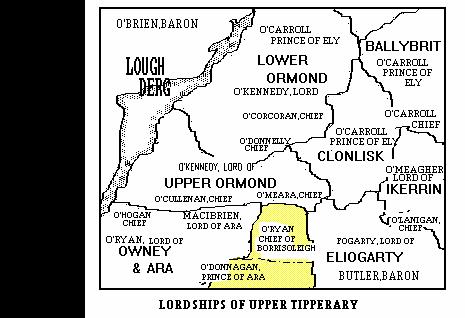
The Ryans by the turn of the century included three principle lordships: one based in Owney, one based in Idrone, and the other in Borrisoleigh. The old documents provide clues as to the strengths of these Captaincies, and as this assessment of the Borrisoleigh lordship by Queen Elizabeth's showed, the Ryans held considerable importance in north Munster:
Calluc Glassi O'Mulrian and his sept 300 foot soldiers and 60 horse soldiers[7]
In comparing this force to others in Munster, the O'Mulrians of Borrisoleigh, not to be confused with Owney, had by this time become very powerful within the region as the same Elizabethian fiants showed:
Kediagh 0'Magher; 60 foot soldiers and 30 horse
Bryan Kennedy; 500 foot soldiers and 20 horse
McCormick, O'Keefe, and O'Hay; 200 foot soldiers and 80 horse soldiers
These forces and others totaled 4730 foot soldiers and 560 horse soldiers mustered in Munster during the rebellion.