

Book of Ryans - Declining Influence
As the Commonwealth's scheme to supplant recusants (or adherents of the Catholic faith) with English loyalists evolved, many enterprising English Protestants grew increasingly wealthy from this redistribution of Irish Catholic lands. Joseph Dahmer was among the wealthiest receivers of expropriated lands, and in 1662 he bought large estates in Tipperary. He became so rich that the English government itself was indebted to him. When he died he left a half million pound estate which his heirs lost on gambling and other material pleasures. Another Protestant to aggregate a fortune on acquired lands in western Ireland was Erasmus Smith, and as the Ordinance of 1641 showed, he obtained several parcels of land in the parishes of Tipperary, Sollohomore, Currage, and Cordangan which were previously in possession of the O'Mulryans.
Erasmus Smith was a London alderman who made his fortune as an army contractor, and after the war purchased numerous assigned lands from soldiers and other adventurers. Smith was a staunch Protestant who believed that education would cure Ireland's insurrectionist tendency; however, as his schools could only be attended by those of the Protestant faith, it had little effect on those who were likely to rebel again.
The displaced Irish frequently complained about their new landlords, and many of their cruelties were eventually written in song and prose. One of the more hated landlords of this period was Colonel James Dawson from Aherlow, County Tipperary. Colonel Dawson's ill-tempered behavior touched many men and women of Gaelic descent, and surely his behavior affected some of the Ryans living in the area as well. Sean Clarach Mac Donaill, a poet-farmer from County Cork wrote a scathing poetic testimony on the announcement of Dawson's death:[1]
Keep fast under cover, o stones, in closet of clay
this grey-haired Dawson, a bloody and treacherous butcher.
Not in struggle or strife in fight are his exploits known
but ravaging and hanging and mangling the poor forever.
Though lavish his spending on the proud bright palace of Brian
his door was shut solid, locked on the meanness within.
In peaceful Eatharlach, in an angle between two hills,
Famine he fastened on the people to keep them in thrall
To the wails of the abject he opened not his gate
and answered no cry, nor gave them food for their bodies.
If they dragged off brushwood or sticks or bits of bushes
he would draw down streams of blood from their shoulderblades.
This poem continues to describe how he received this unsavory reputation from the people of Aherlow. He was described as being responsible for forcing peasants from their farms, evicting women and children from the hearth, creating death through denial of food, and was accused of causing other inhuman sufferings in Aherlow. The conclusion of this piece also pleads for justice to be served on Dawson's remains while his body lies rotting in the grave:[2]
O gravestone, grind his snarl and his yellow gums,
his eyes and skull and tongue and great black hole,
all joints and sinews (and quick!) of this hump of slime
that he or his like may never appear again.
Though arrogant ever, disdainful and avaricious,
your fortune will fall to a miser after you,
your carcass be picked by hungry and busy maggots,
and your soul boil for years without number in the Great pot.
County Clare, the Down Survey, and Transplantation
The Down Survey of County Tipperary recorded original owners, most of whom were composed of ancient Gaelic families, being replaced by loyal English colonists. The Down survey of County Clare shows a related displacement, however, many of the ancient owners were replaced by transplanted Catholics who lost their lands in other parts of Ireland. This survey is similarly formatted as other surveys found in Tipperary and other parts of Ireland after Cromwell's invasion.
County Clare ()[3]
Townlands Proprietors in 1641 To whom Disposed
---------------------------------------------------------------------
Ballyduff Donogh MacNamara Cormuck Ryan
Ballamulqueeny Colla;son of Flan; Dermot Cormuck Ryan
Oge, and Charles Mulqueeny
Toonaghmore Mahone, son of Conor Mac Teige Ryan
Namara Daniel Ryan
Doyleenacoona O'Hehirs Darby Ryan
Corracloon Teige son of Daniel Reagh Frank Ryan,
MacNamara and John, son of Richard Butler,
Dongh, son of Sheeda James Ryan
Pierce Arthur
Moanogeenagh Earl of Thomond John Ryan
Killavoy Teige, son of Sheda Mac John Ryan
Namara
Cloongaheen John Oge MacCusick John Ryan
Uggoon O'Molonys Edmond McGrath
John, Francis and
Melaghlen Ryan
Gughteryshe various including Mac Morgan Ryan
north and south Namaras and the Earl of (Transplanted from
Thomond Limerick Co.)
Donogh O'Callaghan, esq.
Dermot O'Brien
Cahergal Teige O'Brien William Ryan
Drumcharley Finola Delahoyde Melaghlen; and
Conor, son of Mahone Ryan
The Castles of Owney and Kilnalongurty
In the parishes of Killniragh and Killmillane parishes, there are found the ruins of a castle and barbican at Terryleagh. These buildings formerly belonged to William oge Ryan of Clonbrick. William oge Ryan once had the privileges of both a Court leet and Court baron. Also at Killmackoage and Cullymeenelly may be found demolished castles that once belonging to other Ryan family members. In the parishes of Killoskully and Kilcomonty according to the Civil Survey were found the ruins of a castle, at Crag, belonging to John Ryan. These, as with many other barbicans reverted to Loyalists or to the English Crown after the rebellion of 1641.
The Down Survey Map of Owney and Ara also showed a church in Kilnarath, another church and house at KillmcStully, a castle at Knockylomane, a house at lnacranagh, three houses at Gortnaskelly, a house and two houses in Burges, two castles and three houses in Ballenaha, a large castle and six houses at Carrigooghe, a church and house at Youghill, and four small homes in Castletown and Castelogh. In Owneybeg, in Limerick, castles at Annagh and Tough are found, and two churches and other houses at Abbey Ownibeg.
Tipperary
The County of Tipperary derived its name from a well which was situated near the city itself. The Gaelic form of the name was Tiobraid Arann, or the well of Ara. Tipperary was created as an English county in 1211 so that Crown lands could be administered by royal officials and sheriffs. Additional Irish counties were created around this period including Limerick in 1211, Waterford in 1207, and Carlow in 1386.
The western side of the County consists of the counties of Owney and Arra, Upper Ormond, and Kilnamanagh, and these areas are nearly all occupied by mountains. A large part of the barony of Ikerrin which is found in the northeast corner, is also mountainous. The Southwest, which includes the baronies of Iffa and Offa and Clanwilliam is surrounded by two great mountain ranges. The rest of the county is a plain, often referred to as the Golden Vale, that contains some of the best farmland within the country of Ireland.
Ruane, Regan and Others
The sept O'Ruadhain <Ruadh meaning 'red'> was a major clan of the Ua Maine. Descendants of Ruadhain, anglicized as Royan, held as their aged patriomony Gortyroyan near Ballinasloe. Over the centuries some of Ruadhain's descendants' surnames were changed to Ryan, most specifically Ryans found in County Mayo. There have been several journals written about the Ua Maine, which like the Ryans of Tipperary and Idrone, were descended of Leinster nobility.
Another name that has been confused with the Ryans is Regan (Reagan). The Regan's trace its lineage to one of the Dal Cais tribes, and its genealogical history notes that the progenitor of this great family was a nephew of Brian Boru, Raigan. The name derives from the root word 'riodhgach' meaning impulsive or furious which probably suggests that the name evolved from some personal trait. This family has produced several important individuals including Maurice O'Regan, born in 1125, who authored an account of the Norman invasion which still survives today. The confusion surrounding Regan and Ryan surnames presented itself because of their similarities which may account why their names became intermingled. The confusion may have been further reinforced after Sir William Petty standardized the surnames of Ireland, yet its likely that this change evolved over many years. Both families were of Tipperary origin, and it's quite likely that some of these families (as was the case with other surnames) expanded to where they became indistinguishable with one another; therefore, as families lost track of their genealogical roots, familial origins became lost as well.
The name Srahane has also been mistaken with the Ryans of Tipperary and Limerick. Other derivatives of this name include O'Shrihane, O'Srean and Bywater; and it is the latter that has often been modified to Ryan. The Srahanes derive their name from an ancient Tyrconnell family, the head of which was the prince of Clann Snedhgile, located at Glenswilly. As this family grew, many of its numbers followed the MacSweenys into County Cork, and today their descendants still flourish. Still another County Cork surname has been misidentified with the Ryan heraldry: these are the Reens whose surname actually derives from an old Munster family, the O'Rinns, which were a branch of the Ui MaCailles.
The surname Ryen, while bearing a strong resemblence to Ryan, is not necessarily of Irish origin. Ryen is an evolved derivative of the surname Van Rijn of which the most renowned bearer of the surname was Rembrandt, the great Dutch painter. Rembrandt was born in Leiden, Netherlands in 1606; and his full appellation was Rembrandt Harmenszoon Van Rijn. The surname changed over the years, and by the mid 17th century it was being spelled by English writers as Van Ryen. In a diary documenting English civilization of Brazil, for example, there was a notation of a Jan Van Ryan, a Dutch Waipoco colonist, who was slain by the Carib indians in 1627. Van Ryen was shortened to Ryen as their members left the Netherlands, however, the surname Ryen has also been found as a derivative of the Irish Ryans as well.
The muddled lineages of these ancient septs breeded many of the uncertainties surrounding the authenticity of heraldic origin, and the hundreds of years under English dominance merely reinforced these incorrect assumptions. The surnames commonly assigned to the O'Maoilrian lineage (Father Patrick Woulfe, a Limerick priest, also noted that this name had many derivatives including O'Maoilriagain) are O'Mulryan, O'Mulrean, Mulryan, Mulroyan, Srahane, Royan, Regan and several other surnames. Because the Ryans are of Leinster origin, those names which are from Connaught or Ulster descent should not be confused with this noble family. Still, the massive upheaval over the past three hundred years suggests that the latter assumption may not necessarily be true. The Ryans have a history of nomadic wandering, and Riain's descendants now cover every portion of Ireland
Fitzgibbon Connection
Remove me from this land of slaves,
Where all are fools and all are knaves.
Jonathan Swift
Throughout the 16th and 17th centuries marriage alliances developed to strengthen ties between the more powerful houses of Munster. Besides the Ryans intermarrying within the Fitzgerald and de Lacy houses, nuptials with the Fitzgibbons, the White Knights and secondary branch of the Fitzgeralds, also was consummated by the O'Ryans. The Fitzgibbon line began with Thomas Mor, Lord of O'Connello, son of Maurice, younger brother to Gerald Fitzgerald. Maurice was the first White Knight, and among his earliest references the annalists cited was a battle he fought at Halidon Hill in 1333. They also recorded that Maurice also built the Church at Kilmallock and enlarged the Dominican Monastery at Kilmallock.
John oge Fitzgibbon, the White Knight, had as his second wife, Lady Penelope, daughter of the Lord of Owny O'Mulrian. Lady Penelope was probably the sister of Dermot O'Mulrian and aunt to William. Sir John Fitzgibbon's son, Edmund, later succeeded him as the White Knight, and had a daughter Amy who married William O'Mulrian, Lord of Owny O'Mulrian during the latter part of the 16th century. After William died in 1632, she married James Butler of Derryloskan. Lady Penelope had another son, Maurice, whose son Gibbon was mentioned in the 17th century inquisitions. Later records also showed that Gibbon's granddaughter, Ellen, married Morgan Ryan from Silver Grove, County Clare, a displaced landowner from County Limerick.
Edmond was perhaps the most famous of the Fitzgibbon line. He was Fitzmaurice's strongest ally in the Desmond Rebellions, and he was also one of Tyrone's staunch supporters during the Tyrone wars until Sir George Carew received his submission in 1601. His obedience was secured after the battle of Cahir castle where Carew, with his well positioned artillery, pounded the castle walls which protected Fitgibbon's rebels. However, before the actual battle began, the garrison fled by night with the English cutting down a fair number in the darkness. Although Edmond was considered an able military commander, he had his dark side as well. In Sir George Carew's Collection of Munster nobility genealogies, he names two children born of incestual relationships: one involving the Sugane earl of Desmond and his sister; and one of father-daugher incest (the father in this case being the last White Knight, the famous Edmond).[4] The incestual relationship between Edmond and his daughter may never be accurately proven, yet some historians believe that the custom of fosterage may have allowed such a condition of sexual permissiveness to exist.
One of Edmond's daughters, Amy, married William O'Mulrian, lord of Owney-on-Mulryan. William O'Mulrian and Amy Gibbon Fitzgerald produced six children: four sons and two daughters. Connor was the eldest and married the daughter of Edmond fitz Hoenrice. Both James <second child> and Edmund <third child> died without children. Unny was the eldest daughter and later married to Edmund Barrett Esquire, and Gyles their second daughter wed William oge Ryan of Clanwilliam.
William's Will and Testament produced some interesting commentaries about the times:[5]
1634. Nov. 26th. To be buried in the parish church of Owney. 48 Pounds sterling for funeral expenses. Appointed William Ryan of Salloghed (son-in-law> and John Lane of Carrigkihill Exrs. Wine, aquavitas and spices in castle to be set aside before division.
To niece Margaret Walsh, four cowes of bulling age next summer To grand daughter Gile, twelve cowes, English and 100 sheepe.
To son in law Edward Barrett all rent due of land he holds of me by lease and 23 Pounds I lent him and four score sheepe.
To 2nd son John Rian 6 in-calf cowes and 6 of bulling age and 6 steeres, 8 mates and garrans and a rick of oats now standing at Gortowley, my old harpe and lease I hold of lands of fflimocuagie.
To son and heir Conor Rian, mojety of villages, towns and lands of Rathfearnan, Tobergeoriff, three plow lands in Co. Limerick and 1/4 part of great tithe of the several parishes of Abby Owney, Cahirkenlish, Cahirkenlish, Caherally, Rathjordan and Ballirollie as demnsed to me and Lewis Walsh esq, by the gift grant and demise land of Phillip Percivall Esq, or John Walsh, every and other of them. Also my corn in and out of ground at Portaunecaske. Goods to be divided into three parts except 100 sheepe, English breed and corne at Owney and Eloens.
To wife Amy 1/3, 1/3 to Connor, other to youngest daughter ffinula Rian. Son Connor to give full payment to M. Laghlin McShane Leigh and his son Donnogh in all demands and 15/- to again Hogain, to Kearney, merchant pf Cashell. Son Connor to pay 100 pounds to William Rian of Salloghed and like amount to wife Amy Fitzgibbon, daughter of John oge also to pay to Christopher Neill of Dublin 33 , Connor 2 silver cups, the one for beere and ale, the other for wine and one silver cup now in the custody of my gossip McLaghlin Higgin. Rest of silver plate to wife Amy. 100 Pounds more to wife due on lands of Boherquill for two years and 180 Pounds more to wife and 50 Pounds due to Donnogh O'Bryan.
To son, Connor best panne I now have and enjoie, pewter and bras pannes.
To wife, bedding and grinding mill at Tulla until Connor repair mill and to enjoy lease from Rev Lord Archbishoppe of Cashell of tithes of Clonkeine of Russan.
Ryan Monument
The Abbey of Owney, at Abington, located near Owneybeg, County Limerick, was an elaborate tomb, and was described by an Englishman by the name of Dynely during his 1681 tour of Ireland. The monument, the burial tomb of William Ryan, bore the following inscription in Roman capitals.[6]
The pedigree of Amina (Amy) Gibbon, als Gerald, daughter of the White Knight.
The most noble William Ryan, chief of his country of Owney, the head and prince of the ancient family of the Ryans caused to be erected this speculchral mound to himself, his wife and his children.
The honour of his posterity and praise of his ancestors caused William Ryan with art to construct this work.
Alas, how much nobility proved in peace and war, how much holy faith, virtue and distinguished fame are enclosed in this sepulchral monument of the Ryans.
If it should be asked why things not destined to die should be shut up, the bones alone are covered in the earth, but the other parts which know not death will enjoy perpetual day.
The praise, virtue, glory and honour of the Ryan race will live for ever in his honoured name. A.D. 1632.
Ryan Arms, Crest, and Motto
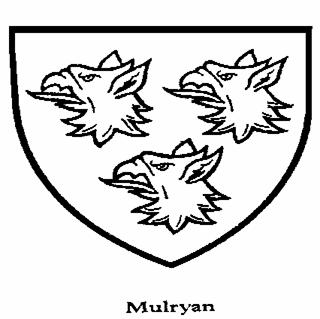
The symbols representing the O'Ryans and O'Maoilrians are nearly universal among all descendants of Rien. There are a few exceptions, but the customarily accepted symbols are as follows:
Arms - Gu. three griffin's heads, erased ar.
Crest - A griffin segreant, gu, holding in its
sinister claw a dagger, ppr
Motto - Malo mori quam foedari. Translated this means "death
before dishonor".
Line - The ancient and memorable family of the Ryans
The griffin was a mythological creature found in Celtic folk lore. The body of the griffin was a combination of several creatures: the front was represented as an eagle, the rear features were that of a lion, and tradition holds that it also contained features of a vulture. On the basis of Irish common law and custom, the arms, crest, and mottoes belong to all descendants of Rien.