Book of Ryans - Declining Influence
The Counter Reformation
The Reformation made little headway in Ireland, with the exception of Ulster where many English colonists arrived to plant the lands of O'Neill and O'Donnel who, in 1607, had fled to Spain. During this time, Catholicism was outlawed and many clergy, estimates of 200 priests and religious, were executed. This act was the result of James I efforts to appease Protestant elements whom he needed to manage the administrative affairs of Ireland, even though he was secretly a Roman Catholic himself. Another ordinance, the `Irish Act of Uniformity', demanded a fine of twelve pence for those who abstained from attendance at their parish churches. Attendance of Protestant services was made mandatory, and failure to attend in addition to failure to enforce attendance, brought prosecution:
On May 7th, 1613, Walter O'Mulryan with other members of a jury empanelled at Clonmel were fined 48 Pounds and ordered to be imprisoned for refusing to find a verdict against recusant Catholics who had refused to conform and attend the services of the Protestant church. On Nov. 12th, 1617, Teige O'Mulryan of Lisnasella was fined 28 Pounds for a similar offence.[1]
O'Sullivan Beare had written that one deputy, Oliver St. John, had levied 600,000 pounds in 1616 alone. Routh wrote that in County Cavan 8000 pounds were extracted from Catholics failing to attend Episcopalian church services. These exactions were often denied by historians, particularly English historians whom justified England's forced attendance to the church of England. Even as late as the early 20th century, they were quoting Chichester, an Irish deputy from the 17th century, who said, "That the act had been executed in no county except that of Dublin, and there only 15 pounds had been levied during the preceding year."[2] The legal records preserved show that Chichester's absurd statements had absolutely no basis for truth.
The enforcement of these anti-Papist laws relaxed over time and by 1618 full religious toleration appeared to be wide-spread, and it was later officially condoned by the English Privy Council for reasons of foreign policy. War with Spain in 1625 and France in 1626 created anxiety within the English government whom was dependent upon Catholic financial aid and Catholic loyalty in the face of an expected Spanish invasion. As an outgrowth of these events, the Irish administration quit enforcing attendance at Protestant churches and relaxed the encumbrance of penal laws.
Because many Catholics were prohibited from governmental, administrative, and legal occupations, the Catholic church benefited from the quality and number of postulants entering religious life. Ireland's patronage positions were being filled by Protestants; as a result the Catholic gentry and merchant class were greatly influenced by the counter-reformation movement and the expanding influence of the Catholic church. This exclusion from the political and legal professions did not escalate Catholic landowner's conversion to the established Protestant church; rather it created a growing sense of irritation and alienation from the mainstream of Irish cultural and intellectual circles. The historical documents showed that the Catholic church played a strong role as an outlet for intellectual Irish thought in the sixteenth and seventeenth centuries. In "A New History of Ireland", the authors noted that the major Catholic writers and latin poets were Catholic clergymen, and they further noted that:
Worthy of mention are the poem of 'welcome' published by Fr. Martin Walsh when the prince of Wales, the future Charles I, arrived in Madrid in 1624 to court the Infanta and the eulogistic verses composed in 1633 by the Dominican, Henry O'Ryan, to mark the arrival of the duc de Cregui in Rome as ambassador to Urban VII.[3]
The Reformation progressed slowly among the Irish population before 1630. This slow assimilation into the Protestant fold was identified by Lancelot Bulkeley, Protestant archbishop of Dublin:
Of every parish almost he was compelled to report with disconcerting regularity that most of the parishioners' were papists, who attended Mass in local houses. In most instances he even knew the name of the `mass-priest' who served the parish.[4]
Although many Irish nationalists wrote that Catholics 'totally' resisted conversion to the established church of England, over time there was a slow regeneration of the Gaelic gentry to Protestantism. Several of the major families switched to the Episcopalian church, primarily to salvage their economic possessions such as O'Brien, Earl of Thomond; O'Brien, Lord Inchiquin; Owen O'Connolly; Daniel O'Neill, nephew of Owen Roe O'Neill; the Limerick branch of the 0'Gradys, the Lords of Muskerry (aka MacCarthys), the Sheridans, and others. Many of them also transitioned to the recognized religion of England because it allowed them to maintain their status among their Irish peers, however, the vast majority of Ireland remained Roman Catholic even well beyond the confiscation of lands that occurred later in the 17th century.
Ormond's Scheme
The Earl of Strafford, Thomas Wentworth, conspired with Sir James Butler, 12th earl of Ormond, for the plantation of the earl`s lands by English colonists-colonists which the native Irish called `undertakers'. Ormond, a devout Protestant, desired to displace the current residents of Ormond, mostly Catholic, with new English Protestant settlers. His proposed plantation covered a vast cross-section of northern Tipperary including that baronies of Ormond (O'Kennedy), Owney (O'Mulryan), Kilnamanagh (O'Mulryan and O'Dwyer), Kilnalongurty (O'Mulryan), Ikerrin (O'Meagher), Eliogarty (O'Mulryan), and Slievardagh (Butler of Dunboyne). The names in parenthesis represent the major families in each of the baronies.
For the plantations to succeed, Butler and Wentworth had to minimize all potential resistance to these plans, and to assure minimal interference from the remaining landowners, one of their first actions was to dissolve Parliament. Wentworth succeeded in doing this on April 18, 1635, and afterwards both men wasted no time in beginning their plantation scheme. Wentworth had sent instructions to England for settlement by June, and England approved his measures in July. Opposition to this settlement occurred after the plans became public, but Wentworth dismissed the subsequent criticism as insignificant diversions. He described his opponents as conspirators engineered by the family of Clanrickard, and resorted to name-calling by claiming they were recusants (agitators or persons refusing to recognize the rites of the Anglican church) and 'natives'.
The significance of these proposed plantations was not the actual confiscations that were proposed, but the fear it created. This conspiracy resembled earlier attempts in 1613 to find defective titles, and property owners expressed concern that their ancient interests would again become exposed to potential confiscation. This was the first time after the old English and Gaelic Irish had submitted to Elizabeth, that they found themselves faced with the threat of losing their ancient patrimonies. Investigations into defective titles were aggressively pursued, and as many feared defective holdings were abundantly found by 1637. However due to the rebellion in 1641, the plantation of English settlers did not materialize.
The policy of extirpating the Irish Roman Catholics of their profitable lands also led to indiscriminate actions against the native Irish. Some of these included the slaughter of innocent inhabitants, terrifying the Irish through religious persecution, making the celebration of mass a capital offense and hearing it punishable by fines and imprisonment, and preventing the adoption of measures in parliament to preserve peace such as receiving the submissions of insurgents who wished to lay down their arms. With all of these events stirring within, it's no wonder that an insurrection occurred before the century was over.
Rebellion in 1641
Remember him, the villain, righteous heaven,
In thy great day of vengeance Blast the traitor,
And his pernicious counsels, who, for wealth,
For pow'r, the pride of greatness, or revenge
Would keep his native land in civil wars;
When murders, rapes, and massacres prevail;
When churches, palaces, and cities blaze,
And desolation covers all the land.
Rowe
The rebellion, as many had predicted, began in Ulster October 23rd, 1641, however, the Anglo and southern Gaelic Irish were not so quick to embrace another revolution. A month after the outbreak the Irish parliament described the rebels as "the enemy", and by January of 1642, sides had been drawn. The Protestant English planter and the Ulster Catholics remained undecided, and if it were not for the cruelties of Sir Charles Coote, commander of the Leinster English army, and St. Leger, English commander in Munster, an alliance between these two disputants would not have been possible. The formation of this alliance created a surge of confidence in the revolution, but the development of this coalition forced Dublin to mandate harsh and unusual legislation in an attempt to destroy this union. One of the first government edicts occurred in 1642 which advised its generals "to wound, kill, slay, and destroy by all the ways and means you may. All the rebels and adherents and relievers; and burn, spoil, waste, consume and demolish all places, towns and houses, where the said rebels are to have been relieved and harboured, and all hay and corn there, and kill and destroy all the men inhabiting, able to bear arms." <Carte's "Ormond">[5] The English Lord Justices instructed their commanders to adhere to its contents, and many added their own personal instructions. Sir Charles Coote in his devastation of Wicklow, ordered his men to "spare none above a span high."[6] A number of records have shown that English soldiers caught Irish babies upon their spears for sport, and one witness heard Coote say that he "liked such frolics."[7] These atrocities have been repeatedly told in subsequent journals, and as more knowledge of these abuses became known it painted a picture similar to the 'ethnic cleansing' that occurred in 1993 Bosnia. There were random killings and the properties of many Catholics were laid to waste so that famine would easily spread. This was perhaps one of the darkest moments in Ireland, and the native Irish had no other recourse but to fight the English. There was no other option because the courts and parliament had already stated that they were unsympathetic to their pleas. With Parliament authorizing the employment of brutal tactics towards the Irish Catholic, reckless slaughter of women and children ensued.
One of the significant events during the revolt was the capture of Cashel by rebel forces. This siege would not have been possible if the nobility had not risen in Munster, and drove St. Leger back into Cork. This uprising began when a rabble of disorderly persons had committed some robberies in Tipperary, and among those robbed was a brother-in-law to the President of the County:
Though the revolt had begun in Ulster on October 23rd of this year there was no disturbance in Munster till early in December when St. Leger the deputy of that province marched to Clonmel with a considerable force. A few days previously some horses were stolen from a Mr. Kingsmill of Ballyowen, near Cachel by some idle fellows from Eliogarty.
St. Leger who was brother in law to Kingsmill proceeded in a fury with two troops of horse to Ballyowen where he hanged three men suspected of having been implicated in the robbery. From there he rode to Grange where he hanged three innocent labourers, and continuing his course into Eliogarty executed six men at Ballymurreen and eight at Galberstown, and burned several houses.
His subordinates Majors Piesley and Brown with part of the troop marched to Ardmayle and killed seven or eight men and women standing at their doors or on the road. Crossing the river Suir they continued their march to Clonoulty where Piesley shot dead at his own door a man named Philip Ryan, a large landed proprietor who came out to salute him.[8]
There is conflicting information regarding this event as some accounts showed Paisley marching into Armaile, and there killed eight men and women who were standing in their doorways. As Paisley stormed further north to Clonoulty they came across Philip Ryan who was the chief farmer of the area. He was described as "a very honest and able man, not at all concerned in any of the robberies",[9] and Ryan unfortunately met Paisley while he was taking a plough-iron to a local forge.
When the nobility approached St. Leger to halt his murderous exploits in Munster, he treated them with extreme rudeness. In a violent rage he told the Irish gentry that, "They were all rebels - that he would not trust one of them; and that he thought it more prudent to hang the best of them."[10] St. Leger's wrath forced the gentry to assume a defensive role against possible retaliation:
Exasperated by such treatment they had no alternative but to take arms in their own defence and within a short period had recruited a considerable force in the country.[11]
Piers Butler, viscount of Ikerrin, pursued the rabble who plundered the English tenants. In the meantime he recovered their property, and captured these "idle young fellows from Eliogarty, Killemanna, and Clanwilliam"[12]. After having returned the stolen property to each of these families, St. Leger became quite agitated, calling Butler a traitor for trying to bring peace to the territory. St. Leger's actions pushed tensions higher, and many settlers began moving to the populated areas of Ireland for protection, particularly the Protestants:
A number of Protestants for protection had moved into Cashel which was then a walled city and being armed prepared to defend it in case of attack.
Towards the end of December, 1641, Theobald Purcell, baron on Loughmoe, with a force of horse and foot numbering 1500 men marched to Cashel and camping on St. Dominick's Moor at the foot of the Rock, in the houses without the gates awaited the arrival of Col. Philip O'Dwyer of Dundrum and the men of Kilnamanagh numbering 500 who joined them on December 31st.
On the following day the surrender of the city was demanded and refused whereupon an attack was made on the gates with hatchets, saws and other implements. Realizing the futility of defending the city the gates were opened and a procession of the clergy approached the leaders of the insurgents with a request that the lives and property of the inhabitants should be preserved.
These terms were agreed to and the undisciplined army entered the city. While Col. Philip O'Dwyer was endeavouring to protect the property of the Protestant inhabitants the relatives and friends of Philip Ryan of Conoulty who had been murdered by Major Piesley got out of hand and put to death fifteen Protestants.[13]
The main leaders of the insurgents were Colonel Philip O'Dwyer, Donnogh O'Dwyer, his brother, Philip Mc Thomas O'Dwyer, Theobald Butler, baron of Ardmaile, Walter Butler of Nodstown, Teige O'Meagher of Ikerrin, Philip Mc Teige Ryan of Kippenselly (Lisnaselly), Thomas Roe Ryan of Clonoulty, Hugh Mc Shane Ryan of Clonoulty, Philip Magrath of Blean in Ormond, Ulick Burke of Lowesloure, Jason Butler of Ballygriffin, and Edmund Butler of Clare. Because of their rebellious activities, they became targets of capture.
Coincidentally there was a corresponding uprising in the Silvermines in upper Tipperary in 1641, as well. These mines were held by the Crown, and produced a very pure grade of lead ore that was worked well into the 19th century. A massacre of English miners took place in that year under the auspices of the O'Kennedys and the Gleesons, and although much has been written regarding these massacres, the truth is that these events may have been exaggerated by English provocateurs. As England moved towards religious fanaticism, these exaggerations were used to justify an intervention into Ireland by those supporting Cromwelliam Puritanism. In 1641 the Roundhead Cromwellians <named for their closely shaven heads> rebelled against the throne, and rumors began to spread throughout Ireland that all Catholics were to be massacred. There were isolated cases where the old Irish had been killed by riotous Protestants, and because there were no newspapers these rumors swelled which eventually led to the murder of Protestants in Tipperary. The Irish simply believed they were justified in retaking their old lands, and that their militaristic actions were designed to protect their families from being murdered by Protestant extremists.
|
|
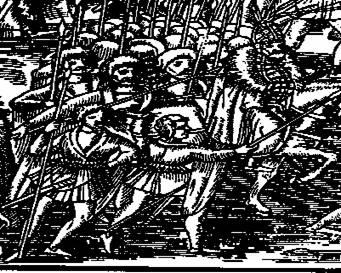
Detail of illustration from 'Image of Irelande', by John Derrick, 1581.
|