

Book of Ryans - The Penal Years
Chapter Six
Introduction of the Tory
Ho! brother Teig, what is your story
I went to the wood and shot a Tory
I went to the wood, and shot another
Was it the same, or was it his brother?
I hunted him in, and I hunted him out,
three times through the bog, and about and about
Till out of a bush I spied his head,
So I levelled my gun, and shot him dead.
"Crofton Croker's `Sketches in the South of Ireland", 1824
After Irish lands were redistributed to English settlers, the prosperity of the gentry class diminished, and the once proud captains of nations could hardly be identified from others who found themselves embroiled in poverty. They had limited rights, they were not allowed to bear weapons, and crimes committed against English settlers were borne by the Irish community as a whole. The judicial system no longer offered the Irish avenues to resolve criminal or civil suits; and the English perpetrated injustices on this population that could neither defend itself militarily nor judiciously.
The effect of these discriminatory laws and restrictions increased the number of bandits, romantically called Tories, in the frontiers of Ireland. The name `Tory' is derived from the Gaelic word 'toridhe' meaning a pursued person, and was first officially used by the earl of Ormond in 1650 in his effort to persuade the "toryes or idle boys to enlist in the Royal Army or be declared traitors."[1] The inflated taxation, the consequences of being responsible for theft of English property, the threat of being executed for not adequately defending English property (and being killed by Tories for doing so), and the enactment of unsympathetic regulations as defined by the Penal Laws were more than enough justification for young men to enlist with the Tories. There were perhaps nearly a hundred known groups of bandits known to English authorities, however, the most notorious criminal gangs which harassed English settlers were blind Donough, Dermot Ryan, Hugh Macbrien O'Hart, and Redmond O'Hanlon - "The Irish Robin Hood." These major gangs became objects of 17th century folklore, but among the earliest and highly notorized bands to develop was Blind Donough's in which Dermot Ryan would become his most trusted accomplice and lieutenant.
Dermot Ryan was a displaced landowner unwilling to transport to Connaught. Because the government exacted severe penalties for those who failed to transplant, he enlisted in one of the most notorious Tory gangs led by the legendary "Blind Donnogh" O'Derrick. O'Derrick and his men raided English settlements in Waterford, Wexford, Cork, Carlow and Kildare. They directed their destructive behaviors at the English colonist who settled stolen Irish lands, however, they also aimed their anger towards Irishmen who allied with, or provided assistance to, English authorities. One such case occurred in 1654 when O'Derrick's men assassinated the sheriff of Timolin who was also of Irish descent. This test of English authority in Wicklow greatly irritated Dublin, and they retaliated by sending every resident they found living in the area to Connaught. Their rationale for exacting this unusual penalty was to prevent the local peasants from aiding the Tories who by now roamed the countryside freely. The authorities herded the local population to the town, burned their cabins, confiscated and sold their possessions, and money received from these sales were given to the sheriff's widow. O'Derrick and his men, in retaliation for this roundup, reportedly captured eight of William Petty's surveyors while they surveyed the confiscated lands. O'Derrick's gang took these men to a wooded area, tried them as traitors, and had them executed.
Like many bandits of his day, Dermot Ryan had a price on his head, and the higher the award usually indicated how desperate the English wanted a Tory captured. The normal bounty for capturing a Tory was 40 Shillings, but it could range from 5 Pounds to 30 Pounds for a prominent leader. After news arrived in England that O'Derrick murdered Petty's surveyors, Henry Cromwell became incensed and raised the reward for the capture of O'Derricks men. A proclamation dated October 3, 1655, details the amounts for capturing primary Tory leaders in Ireland like O'Derrick and Ryan:[2]
"there was offered to any that should bring in the persons named, or their heads, to the governors of any of the counties where the said Tories should be taken, the following sums, viz: - for Donnogh O'Derrick, commonly called "Blind Donnogh," the sum of 30 Pounds; for Dermot Ryan, the sum of 20 Pounds, for Laughlin Kelly, the sum of 5 Pounds; or for any other Tory, or robber that should be hereafter taken by any countryman, and brought dead or alive to any of the chief governors of any county or precinct, 40 Shillings; and if taken and brought to any soldier, 20 Shillings.
Twenty pounds was a huge sum of money in the 17th century. To most 17th century men this value must have seemed an astronomical sum, especially since the average annual income was far less than this. Dr. Richard Boyle, a schoolteacher and the earl of Cork's son, received an annual salary of 20 Pounds in 1617 while many of his contemporaries made much less than this.[3] This reward must have been extremely tempting to the local population, which was devastatingly poor even by European standards. There were legislators who feared that this enhancement of bounty laws would encourage the murder of innocent men; however, these dissenters represented a minority opinion as the majority justified the death of any Irish Catholic because, as generally believed, they were probably Tory sympathizers anyway.
O'Derrick continued to terrorize the English and uphold disorder in southeast Ireland. The 'Publick Intelligencer', an 17th century newspaper, wrote that "two people were recently murdered by a gang of Toryies and that Colonel Hewson is sent down to the town where they were murdered and will secure them all to be sent to the West Indies." Hewson relentlessly pursued O'Derrick because of the bounty on O'Derrick, Ryan, and his men; and not because of any moral responsibility to bring these criminals to justice. Before Hewson had a chance to confront the outlaws, O'Derrick's gang left the territory, and in retaliation he rounded up 37 Irish, hung 4 of them, and transferred the rest to Captain Coleman for transportation to Barbados. By some twist of fate, one of the Irish peasants being transported was O'Derrick's wife. His wife's deportation severly affected O'Derrick's mental state because it caused him to fight recklessly, and within a few weeks he was captured and executed. This left his lieutenant, Dermot Ryan, in command of the Tory group, and he continued raiding English settlements until his capture several years later.
The English, both soldiers and settlers, were not adequately equipped to deal with these outlaws, particularly since they knew every inch of terrain including the bogs and hills. Because of these inadequacies, the English often enlisted the aid of the local Irish to assist them in capturing these bandits, principally Irish gentlemen who would be spared transplantation to Connaught if they agreed to these terms. There were also indications that English soldiers even negotiated directly with Tory leaders, specifically one who was not guilty of any actual murder, to kill any two outlaws for the price of his own pardon.
Life during these troubled times was difficult, and the country was still reeling from the effects of famine and disease that resulted from Cromwell's invasion. It was stated that "men were like wolves lying out in the woods and bogs of this desolated island, their friends and families dead or banished."[4] The armies had long surrendered themselves to English authorities, and because of the extreme poverty men were tempted to betray and kill one another. It was said that, "brothers and cousins cut one another's throats" if it offered them a way to make money. The misery of the people was great, but the changing political events in Europe brought renewed hope with the inauguration of Charles II, a Roman Catholic.
The Williamite Wars (War of the Kings)
The majority of the Irish who were transplanted west of the Shannon River eventually returned home with the hopes of recovering their estates after Charles regained the throne in 1660. Unfortunately when they returned, they found their possessions in the hands of English soldiers and adventurers (or their agents) who were unwilling to return lands that they received from the Roundheads. The displaced Irish gentry had no interest of returning to the deserts of Connaught, and with so many former proprietors returning to their ancient birthrights, the new landowners were forced to accept them as tenants. Much has been written about the forcible evictions of Irish Catholics to lands west of the Shannon, but in reality most Irish peasants never left because the English realized that they provided a cheap labor source for tending their farmlands.
The English Parliament with very few exceptions reconfirmed Cromwell's grants through the 1641 Acts of Settlement. A few of the former proprietors regained their lands as "Innocent Papists," but most would become tenants at will to the new grantees. Many tenants became common laborers possessing nothing but their worthless deeds bearing the Royal seal. After Papist claims were settled, Catholics owned only one-fifth of the land in Ireland which was a third less than they had owned before the insurrection started in 1641.
Tensions between the Catholic hierarchy and the Protestant establishment had long since become entrenched in Irish society, and had earlier in the century been magnified when the Pope declared Elizabeth I unfit to rule her kingdom. The growing Protestant elements in England were outraged over the Pope's remarks, but were especially angered when he declared that he no longer recognized her as the Queen of England. Although she was Protestant, the Puritans and other Protestants saw this proclamation as an attempt to meddle in England's internal affairs. England was certain that the Roman Catholic church was plotting another rebellion in Ireland, and the Pope's condemnation of their Queen, coupled with the greater visibility of papish religious orders, intensified England's fears that the church was planning to mobilize the peasants in another rebellion. An order was issued by the English council to compel all Bishops and other dignitaries of the church to be seized. This paranoiac behavior was ignited by fake documents being distributed in Parliament, most notably by Titus Oates, an ex-Jesuit, who claimed numerous 'popish plots' were spreading through England and Ireland. Dublin needed a plan to undermine this plot, so it sent for the earl of Ormond who was living in England at the time. After his arrival in Ireland he assessed the alternatives available, and deciding upon a course of action set about rounding up all potential agitators including many Catholic clergymen.
On the 16th of October, a proclamation issued from the board commanding all titular Popish Archbishops, Bishops Vicars General, Abbots and other dignitaries of the Church of Rome, and all others exercising ecclesiastical jurisdiction by authority from the Pope or See of Rome and all Jesuits and other regular priests to depart the Kingdom by the 20th of November next. And that proclamation did also require that all Popish societies, convents, seminaries, friaries, nunneries, and Popish schools should be forthwith dissolved and thenceforth utterly suppressed.[5]
New proclamations were issued prohibiting "persons of Popish religion" to bear arms and gunpowder. Anti-Papist legislation was nothing new for it had been around since Henry VIII, but after the 1641 revolution these laws appeared to affect everyone. The Protestant minority knew that laws were needed to prevent Ireland's Catholics the ability to acquire and finance armaments. They crafted laws which made it a crime for Catholics to own guns, and they made it illegal for Papists to inherit property and other forms of wealth. Irish legislation required all Catholics to have their weapons turned into the English authorities. New laws were enacted which left Catholics defenseless against Protestant abuses. Additional legislation defined the native Irishmen's rights, and the roundup of the Catholic ministry continued (as observed by Ormond's journals):
The Lord Lieutenant, having notice of one William Ryan to be Superior of the Jesuits in this Kingdom thought fit to have him secured and examined, and his papers seized, which accordingly was done by Captain Robert Fitz Gerald, a member of this board, in pursuance of several letters from the board of the 5th and 8th of November 1678, and the said Ryan was brought up with a guard and committed to the Castle.
One the 5th of November 1678 letters were sent from the board to Mr. Secretary Coventry giving an account of the proceedings against Ryan and one Richard Bourke, another Jesuit with the examinations of the said Ryan and Bourke in which mention was made of one thousand pounds given by one Hughes, a Jesuit, to a college of Jesuits, at Poicitiers France, which thousand pounds was said to be lodged in the hands of Daniel Arthur.
And there appearing nothing material against Ryan in reference to the plot he was by order of the board, dated the 26th of February 1678, put aboard a ship bound from the port of Dublin to some foreign parts in order to his transportation according to the proclamation to that purpose.[6]
Contrary to popularly held opinions, not all priests and bishops were exported from Ireland during the late 17th century. The English legislators felt that deporting all Papist clergy would cause widespread outrage among the Irish population, so they only exported Catholic bishops, superiors, and other ranking clergy. In examining other records of this period, clergymen entered various political and military pursuits such as Edmond Ryan who held the rank Chaplain-Major in the Earl of Dunbarton's Regiment as late as December 11, 1680. Remaining records also showed a Reverend Ryan was installed at the vicarage of Kilmore, the diocese of Meath, November 1, 1680. A year later in 1681, two nuns from the Irish Dames of Ypes in Ghent returned to Ireland to rebuild the order that had been continually experiencing financial instability since its establishment in 1665. These two nuns, Dames Alexia Mary Legge and Mary Joseph Ryan returned to Ireland and "gathered postulants and financial aid,"[7] and by 1682 another Irish nun, Dame Flavia, rejoined them became its first abbess. Even though the Catholic Church found it difficult to practice its faith in Ireland, missionary and ecclesiastical activity continued to flourish.
While the Catholic Church continued to survive in Ireland, volatile events in England precipitated another English revolution after James, the duke of York, became crowned as the new English monarch. A few years before his reign, James benefited greatly under the Act of Settlement where he received a large grant of confiscated lands in Tipperary, and when Charles died in 1685 he turned his attention to the internal affairs of England under the name of James II. The Irish must have rejoiced over this event because James was the first Catholic to become king since Henry VIII. He was sympathetic to their plight, and he quietly loosened some restrictions placed upon his Irish Catholic subjects by Oliver Cromwell and his Independents. This angered the Protestant Ascendancy which viewed his sympathetic deregulations as an attempt to gain Catholic favoritism, and subsequently they revolted which forced James to flee to Ireland and abduct his throne to William. Upon his arrival in county Wicklow, he became quite popular and was able to raise a large but ill-equipped militia. Forgetting how their fathers were treated by his brother, Charles II, and hoping that their ancestral lands would be restored, the young Irish moved to James II's aid during the struggle between the houses of Stuart and Orange. As many of his Protestant antagonists had predicted, he began interfering in Irish politics which stirred loyal Anglo Protestants to flee for England. It also incensed William's followers whom demanded retribution for allowing Catholics greater freedoms.
James II claimed that he would not have meddled into Ireland's affairs if Charles II had not assigned Porter and Coningsby as lord justices. James was outraged by their appointments as both men were anti-Catholic, and he accused them of issuing proclamations which severely limited the civil liberties of Catholics and others who opposed anti-Papist measures. One of their proclamations required Catholics to make whole any loss sustained by their Protestant neighbors whether caused by accident or warfare; and another prevented the assembly of more than ten Catholics at one place. These acts, along with other unusually stark laws limiting the liberties of the Irish Catholics, were designed to maintain order among the Catholic population.
A consequence of these laws highlighted the penalties of being "Catholic", and the general population began to fear for their families' safety. The anti-Papist laws forced thousands of young men and women, including the infirmed, to seek haven in Catholic lands west of the river Shannon. This area of Ireland which generations of historians described as a 'desert' yielded limited opportunities as the land had traditionally been sparsley populated and industry, in general, was uncommon. Because of these limited opportunities many found themselves driven into the ranks of the Raparees, or bandits, not only because of the poor economic conditions, but also because it allowed them to vent their frustrations against the Dublin government. A signficant element among these Rapparees were dispossessed Irish land-holders whose goals were to reclaim their primeval lands, and second to restore their self-respect as a nation filled with a proud heritage.
While this great upheaval occurred, seizures and confiscations of property continued at a rapid pace until a million and a quarter of acres, valued at four million sterling, were seized. The lord-justices created laws which solidified the injustices of land impoundments in Ireland. They indicted landed Irish gentlemen of high treason, and then removed them all, by "certiorari" to the Court of Kings Bench in Dublin. By this ingenious scheme, hundreds of Irish landlords had their possessions stolen and then were prevented from approaching the courts for help. Indeed, in most cases they were unaware of these accusations, and the Irish government was not required to provide proof that the Irish were guilty of high treason. The mere speculation that they could be guilty was reason enough to confiscate their property.
The English monarchy faced wide-spread problems during this time, and it found itself not effectively managing any one of them with much success. William of Orange, while involved in a civil dispute in Ireland, was also entangled in a war with Belgium against France. The French monarchy quickly realized that England's two-sided front created considerable stress within its military ranks, so King Louis IV provided munitions and support to the Irish rebels to keep William pinned down in Ireland. There were also rumors that Princess Anne suggested the recall of her father, James II, to the throne because of William's unpopularity in England. Meanwhile the continued success of Marshall Luxemburg was destroying William's chances of winning in Belgium. Even William's visits to his allies were short and unsatisfactory, and they criticized him for being unavailable to plan military ventures. They saw English military support as unreliable because they could not plan military ventures without knowing what William could commit in terms of manpower. William wanted desperately to end English involvement in Ireland, so that he could pursue a more rigorous role in military preparations to defeat Louis IV in Holland. This meant he had to accelerate the war's conclusion in Ireland by whatever resources he had available. His plan included sending a large siege train of men, horses and weapons to Limerick, with the intent of destroying Limerick and the base of the rebel`s southern forces. William assembled several regiments made up of nearly 50,000 men composed of military units from Scotland, the Irish loyalists, and a body of the British infantry led by Colonel Mathews.
This revitalized English-led militia concerned Irish rebel leaders because they realized that they were greatly outnumbered, so they enlisted the support of the Rapparees to weaken Britain's advance towards Limerick. William's forces learned of this alliance, but they mockingly referred to them as "litigious bullying fellow(s)"[8] to minimize their military importance in the revolt. During this period there were five bands of Rapparees operating in Ireland, one of which was under the command of Eamon an Chnoic, or Ned-of-the-Hill. Edmond, or Eamon, was the son of Daniel Ryan of Knockmoell in County Tipperary, and his exploits still survive among the inhabitants of the district where he held firm against the English. Eamon's exploits were magnified because of a popular 18th century, although some experts believe its origin to be earlier, love ballad called 'Eamon an Chnoic' written by Miss Brook. The song reflects a sad rendevouz between Eamonn and his young sweetheart, and laments of his Raparee life as this passage notes:
Long am I wandering under the snow and frost,
My plough unloosed, my fields unsown
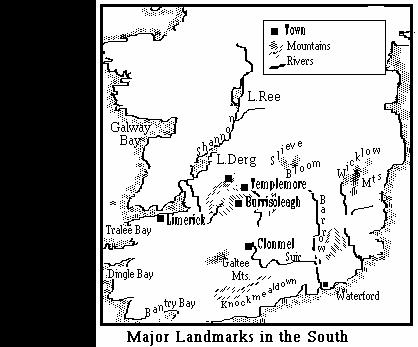
Ned-of-the-Hill was born at Atchanboy in the parish of Upperchurch, situated at the foot of the Knockalough mountain. He initially studied for the priesthood in Europe, but he returned to Ireland when the revolution began in 1689. How he became a Rapparee is uncertain, however Edmond may have been motivated by the seizures of Catholic lands after 1652 and the subsequent hardships that followed. One story suggests that he began his Tory life quite inadvertently while he was vacationing from his religious studies. Ryan, as the story goes, wandered the countryside merely to enjoy his few weeks of rest, but upon seeing a senseless appropriation "intervened to prevent a cow being taken by a tax collector from a poor widow and in the resulting fracas the taxman was killed.[9]
This fanciful legend may explain how Edmond became a raparee, however, because of its similarity to several New Testament bible stories it seems more likely that he became a bandit after his family lost their inheritance. The 'Index of Irish Papists' of 1641 supports this theory as the records show only one male Ryan in Kockmoell, and not unsurprisingly it was Edmond McWilliam Ryan who was labeled a 'papist' and in danger of losing his possessions. The loss of property along with his personal observations of Irish Catholic mistreatment can be the only explanation for why he radically shifted his life from the priesthood to becoming a bandit hiding in the hills of Tipperary and Limerick. Edmond Ryan played a very strong role in the Williamite rebellion, and following the surrender of Limerick continued his life as a Rapparee with a very high price on his head (In 1694 a proclamation issued from the Record Office in Dublin offered a reward of 200 Pounds for the capture of Edmond Knock Ryan, dead or alive). Throughout his colorful career, he was credited with many defiant adventures and escapes; however, as bold as his retreats from death were, his death was to be the result of a relative's greed. He had sought safety from soldiers at Foilaclug, in the parish of Hollyford, at a cousin's house. The story goes that Dwyer, his cousin, tempted by the reward, severed Edmond's head from his body with a single blow while he slept. According to tradition the "murderer carried the head towards Clonmel to claim the reward, but was informed on the way that Eamon had in the meantime been pardoned."[10]
Edmond Ryan was a poet, gentleman, soldier and finally a Rapparee, and as the stories surrounding his life became more grand his popularity among the local population rose. As he continued to evade local authorities, stories about his escapades elevated him to nearly magical proportions. Another widespread set of myths centered around his generosity to the poor which was a typical plot in outlaw legends. One story described how he allowed "himself to be taken so that a poor man can collect the reward for his capture."[11] He died in 1724 with his body entombed at Foilclug, but it is said that his body was removed and is now buried at Doon.
The Rapparees, such as Edmond, played a significant role in assisting the rebel cause. When the English settlements spread through Ireland, many men found themselves homeless, and were forced to find meaningful work to support themselves and their families. From the Shannon to Leinster's coast, Rapparees were constantly seeking ways to exact revenge from British detachments. The Rapparee knew that if captured, they would be dealt with swiftly, and death would be swift and certain.
They knew the land and the position of the English armies, and they usually struck at night when the English let their guard down. Romantic tales described how they were patriots who fought without pay, and while this may not be entirely true, they did sacrifice their lives while seeking liberty for Ireland.
These were the type of men, like Eamon an Chnoic, who were called up by Patrick Sarsfield for the resistance. The Rapparees, under the guidance of soldiers sent among them, formed two lines: one line moving between the English army and the coastal area, harassing the English's rear sections, and disturbing the countryside up to Dublin; the other side was in charge of destroying communications, disrupting the enemy's movements, ravaging the forage for cattle feeding, and taking herds of cattle to the other side of the Shannon River. These raids decimated the Rapparee rank and file, but the stolen merchandise provided revenue to sustain further resistance against the English.
The English did not see these exploits as heroically as the Irish did. From their point of view, they viewed them as Tories, robbers, "bogtrotters" who killed Englishmen, and marauders who stole their horses, cattle and other possessions. The English also conceived slang words to identify Tories, and one of the more prolific was 'Tiege' which was a common first name for Gaelic Irish. However, the Irish also dreamed up a deragatory name for the new English colonists as well: 'Ralph' as it was a common English first name in the country. The Protestant settlers disassociated themselves from the local population, and the detest the English viewed the Rapparees, in particular, was best exemplified by McKenzie in his "Narrative of the Siege of Londenderry." He wrote in 1698 that the Rapparees were "a sort of Irish vultures that follow their armies to prey on their spoil."[12]
The Ride to Ballyneety
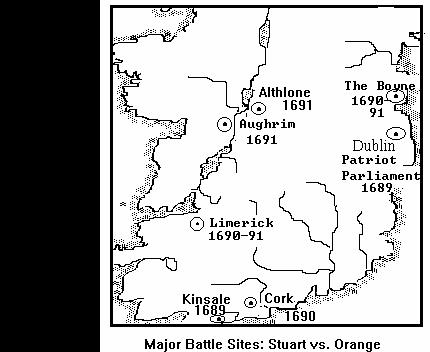
As King William and his army marched closer to Limerick, the tense situation caused the Irish and French commanders to fight among themselves. Lord Tyrconnell and the French Commander Lauzun, reacting to the size of the Williamite army, wanted to forge a peaceful settlement with the English. Sarsfield and his supporters, on the other hand, refused to surrender and temporarily convinced Tyrconnell and Lauzun to continue aiding their cause. Afterwards Lauzun sent a letter to the King of France informing him that they would continue defending Limerick, but he had cold feet and in the darkness of night withdrew his small force and ammunition to Galway. Tyrconnel recognized that without Lauzun's garrison and weapons their chances were slim for success. Tyrconnell, without consulting his generals, took his three regiments out of Limerick to avoid a defeat that seemed inevitable.
William was elated when he heard that Lauzun and Tyrconnell had withdrawn their armies from Limerick. He sent in an offer to Sarsfield that he felt was fair if they surrendered: they could practice their religion, and he would also reward those who left the walled fortifications of Limerick. He was so confident that he would retake Limerick with little resistance that he left his battering train in Cashel. As William neared Limerick the Irish militiamen attacked his royal armies at several points along the route, and after William suffered numerous casualties the rebels retreated into the fortifications of Limerick. When William demanded that he be allowed to enter its gates, the insurgents responded with a resounding 'no'. Angered by Sarsfield's arrogance, he ordered the battering train be brought to Limerick.
Limerick's walled exterior would not be able to withstand the force of the battering train, and while Sarsfield knew this, he developed a plan to prevent its arrival. He called for the Galloping Hogan, a noted Rapparee to lead a band of 500 selected men to destroy the weapon. One of these selected men was Edmund Ryan whose responsibility was to protect the Rapparee forces once the artillery was destroyed. The plan required that Edmund Ryan keep William's armies occupied while Hogan's men obliterate the seige train:
"Run the horses directly back to Limerick City. There will be no need for secrecy. You, Ned-of-the-Hill, organize a rear guard to slow the pursuit as much as you can, then melt into the forests. The English rage will be terrible. They will shoot or hang every able-bodied man they find in the area.[13]
Hogan's plan worked, and the artillery was destroyed. William in his desire to end the aggression in Ireland, offered concessions to the Irish if they withdrew from Limerick. As a result, the Treaty of Limerick was drafted and signed which provided certain rights to the Irish. As with many treaties, this one would be broken before the new century was to arrive.
Many Ryans participated in this upheaval by either enlisting in local regiments or volunteering their services through arrangements negotiated by Rapparee leaders. Hugh Brody in his book 'Inishkillane' interviewed a descendent of one of these volunteers, Michael Ryan, who claimed that his "name goes back to the local Gaelic lord who fought with the help of Spain against English colonialism." Another was Thaddeus Ryan who served in St. Ruth's Horse and Battle of Aughrim, and records showed that he also participated in the siege of Limerick in 1691. The battle at Aughrim was significantly fierce, and the Irish held the English until St. Ruth's head was decapitated by a cannon shot. The sight of this gruesome casualty seriously demoralized his troops, and a great fear spread throughout his army which allowed the English to defeat them. This was bittersweet victory for the Williamites because both sides sustained huge losses.