Book of Ryans - Rising Nationalism
The Irish parliament relaxed many of the harsh elements surrounding the penal laws, but changing centuries-old prejudices against Catholics would require more than the passage of a few laws. There were too many centuries of ill-will between them, and changing attitudes that were once part of the nation's culture would take time to cure. It was also widely believed that if the Irish peasant spoke up condemning the government atrocities, they would either be sentenced to jail, or worse, sent overseas to serve prison sentences in Australia or Van Diemen's Island.
The events over the next twenty years were confusing at best; yet throughout these years legislation designed to create emancipation for the Irish Catholic was continually being introduced in Parliamentary sessions. One Emancipation Bill that was introduced guaranteed basic human rights, but it also introduced provisions which stated that England still had the right to veto church appointments and approve all church documents regarding Ireland. This draft was sent to Pius VII for approval, but the Pope never received it as Napoleon had Pius placed in prison. One of the Pope's legates received this proposal and surprisingly endorsed it. Although it was not clear why this was approved, it has been speculated that the Church felt more could be gained by emancipation even if the Church's activities were to be more closely supervised.
Other influences were also compelling Parliament to re-evaluate its positions on emancipation and other long-standing issues between the two churches. The majority of the population was very poor, and their primary concern was feeding their families and being able to hold onto their small plots. While legislators were debating the issues of Catholic equality, several major crop failures most significantly in 1817 and 1822 appeared in several parts of Ireland. The Irish family depended upon the potato for survival, and the Irish peasant would certainly face starvation if this edible root were completely devastated. Cecil Woodham-Smith would later describe how important the potato had become to the Irish peasant: "an acre and a half would provide a family of five or six with food for twelve months."[1] These crop failures were severe enough to result in sporadic famine conditions, and it forced England to send financial relief to Ireland to minimize starvation and disease. However, the delicate balance of nature in preserving adequate food supplies was not the only problem facing the Ascendancy.
Emancipation, crop failures, and freedom to worship without government intervention were constant themes in the political circles, and one of the leading proponents for change was Daniel O'Connell. O'Connell recognized the success of northern Protestant organizations, and he established a fund to funnel political contributions to politicians or to causes that enhanced Catholic political and economic conditions. This fund, known as Catholic rent, evolved from peasants contributing a penny monthly to O'Connell's political machine, and the fund collectors were often parish priests who gathered this `rent' during church services. This reserve funded Catholic candidates who attempted to unseat parliamentary representatives who were considered 'enemies' of the Catholic peoples. This fund was also used to solicit parliamentary reform.
Parliamentary reform was a major discussion among 19th century enlightened Irishmen, and one of their first efforts was to abolish the tithe tax. Although the most vocal crusaders against this oppressive tax rose from these the middle and lower classes, there were many upper class gentlemen whom also viewed this assessment with disdain. Criticism of the tithe tax also came from landowners from other Commonwealth nations, and one of the largest and most influential landowners was the outspoken Australian magnate and "emancipist Edward Ryan of Galong who had nearly a quarter of a million acres by the 1840s"[2]. The Australian Southwest was dominated by a few wealthy personalities, and many, including Ryan, criticized the unlawful levies borne on the non-Episcopalian citizens of Ireland. In the previous century a movement was created to eliminate this oppressive tax (as noted its proceeds went directly to the Episcopal Church), and with limited success this tax was reduced for some farmers. It was not until 1836 that true reform occurred, and it happened with the passage of the Tithe Act. In the years preceding this bill, Bishop Doyle encouraged his flock to refuse payment, and while many withheld monthly restitution to the established English church, the Irish authority felt challenged by this illegal action. This irrational behavior forced the military to defend the landowner's legal rights to exact rents from their renters, and they also aided in the enforcement of Dublin's political legitimacy in Ireland. The military, made up of mostly undisciplined Protestants, was sent to the South and many local Catholics complained that they treated the general population very poorly. Their inappropriate conduct forced retaliate actions, and for the next six years sporadic fighting ensued which later became known as the `Tithe War.' This unsteady situation ended in 1836 with the passage of the Tithe Act.
Convict Hauls
I was the convict
sent to Hell,
To make the desert
a living well
I split the rock;
I felled the tree -
The nation was
Because of me.
Mary Gilmore
"Old Botany Bay," 1918
The transportation of unwanted criminals overseas became a necessity because British prisons were overcrowded with petty felons and Irish revolutionaries, so Parliament enacted legislation to send the nation's undesirable elements, usually meaning Irish men and women, to penal colonies across the ocean. Among the first Irish revolutionaries transported to the colonies occurred after the 1652 uprising, and their forced exile by Oliver Cromwell took them to Jamaica and Barbados. The transported prisoners were sold to Plantation owners, and by the early 18th century over 10,000 men and women of Irish descent were sent to the colonies to work the sugar fields of the Caribbean's and plantations of Georgia.
The English plan successfully reduced the prison population, but Britain's defeat during the American revolution forced her to find another place to send her criminal population. During the years following the revolution, England with its lack of prison space, saw its prison population increase by over 1000 inmates per year. England found its prisons overcrowded due to several factors: poor economic conditions forcing people to crime; crimes, minor crimes carried long-term sentences or even the death penalty; and with the loss of colonial rule in America there was no place to send her lawbreakers. The British House of Commons in 1779 demanded that a new penal colony be created to relieve the over-crowded conditions in state run prisons. The legislators held no affection for convicted felons, but they also knew that the prisons had to be self-sufficient. They further desired that it should not be a "mere desert, for it was essential that a colony there by able to support itself."[3] The search ended when Australia was chosen because not only did it meet its requirement of self-sufficiency, but it would remove England's worst offenders to the furthest point on the globe. It truly was 'at the edge of the world' as had been oftentimes quoted by the English parliamentarians.
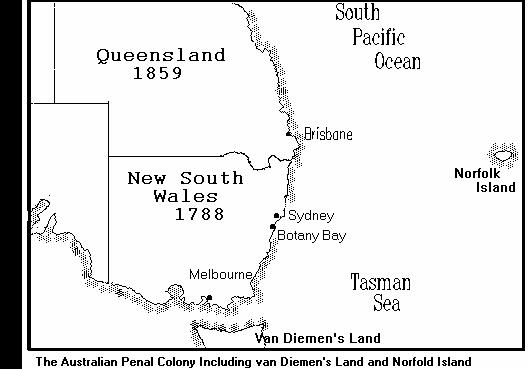
It wasn't until 1788 that Australia became an official penal colony. Instead of high walls with razor sharp wire, Australia proved to be a natural prison surrounded by ocean that was many miles to its nearest neighbor, and its interior was covered by a desert which few Europeans were equipped to handle. Australia for the next 50 years became a dumping ground for over 160,000 prisoners whom were transported for all types of civil and criminal offenses. In examining the crimes committed by the original convicts sent to Botany Bay, their offenses ranged from "murder to stealing goods valued at a shilling or more."[4] In a few years the colony at Botany Bay would also become a dumping ground for Irish political insurgents. It seemed to be a perfect solution for quieting unwanted revolutionaries, and it would perhaps make the Irishmen think twice before initiating civil disobedience. Yet, the fear of Australian exile was not enough of a deterrent to end their bid for liberty.
Many Irish men were transported for their complicity to the uprising in Ireland in 1798. This was in line with normal deportation procedures, and in general, it can be said that while England sent their overabundance of common thieves to Australia, Ireland sent her revolutionaries. The parliamentarians hoped that the desolation of the Australian landscape would break the revolutionaries zeal; however, they underestimated their unique ability to unify under adverse conditions. Even as they arrived in Australia, their clannish nature helped them assimilate to the harshness of the Australian climate. As Robert Hughes noted:
The Irish were the largest and most cohesive white minority in penal Australia, and their folkways were bound to make a deep mark on the ethos of all convicts and their descendants. The cohesion of the group is what resists pressure from outside it, and the clannish solidarity of Irishmen seems to have been experienced by many convicts who were not Irish as a way of resisting the overwhelming power of the organs of State discipline.[5]
It was not the life on Australia that concerned so many would-be exiles, rather it was the transport to this remote southern continent which caused the greatest concern. The convict ship's records supported their fears, and convicted felons, especially Irish criminals, were not provided adequate medical treatment, and death on these prison ships was not all that uncommon. They were ill-treated because the ship's captains feared that the Irish would seize control of their ships. The captain's fear of Irish insurrection was not unfounded because it was common knowledge that Irish revolutionaries had seized several ships enroute to Australia, as well as overtaking penal facilities. One such rebellion occurred at Parramatta, and after the guards recaptured the Irish insurgents, they each received 1000 lashes and subsequently sent to Norfolk Island to serve life sentences. Norfolk Island, according to many who survived, claimed it was the closest thing to hell on the face of the Earth.[6]