

Book of Ryans - The Great Famine
Chapter Nine
The Potato
Sublime potatoes. that from Antrim's shore
To famous Kerry, from the poor man's store;
Agreeing well With every place and state -
The peasants' noggin, or the rich man's plate.
Much prized when smoking from the teeming pot,
or, in turf embers roasted crisp and hot.
Welcome, although you be our only dish,
Welcome, companion to flesh, fowl or fish,
But to the real gourmonds, the learned few,
Most welcome, steaming in an Irish stew.
Thomas Crofton Croker
(1798-1851)
The population of Ireland by 1841 was over eight million, of which most were peasants who made their livlihood off rented plots. The Irish peasantry became more reliant on the potato for their existence, and the devastation of this root, as earlier famines had reflected, would cause widespread hunger and disease if blighted conditions were universally found throughout Ireland. Although the potato was the principle source of food for most of Ireland's peasants, "The introduction of this cheap root had never encountered the same unpopularity as in other European countries, where it was for a long time believed to be the cause of several deadly diseases."[1] From a historical perspective, the potato was introduced by Sir Walter Raleigh in 1583 after American colonists shipped him large quantities of plantable potato roots. As the population of Ireland increased, families began to drive their existence from the potato because it could be produced on their small parcels of land in great quantities. The delicate balance of generally favorable growing conditions and the huge demand to feed a growing population was all that stood between the Irish peasant and starvation.
This potentially damaging situation was noted in an 1843 official journal, which suggested that the plantable potato crop was of inferior quality.[2] Because so many families depended upon the potato for survival, crops were not being rotated to allow for depleted minerals to be added back into the soil, and by 1845 a blight began to appear in various parts of Ireland, particularly in Southern Ireland. As the blight continued to devastate large areas in Ireland, England found herself unable to decide what actions it should take to solve this widespread famine. Because of her indecisiveness, the machinations to provide relief to families suffering the effects of hunger came to a halt. There were many in England who wanted the natural course of events to handle the effects of the famine, and therefore, desired to maintain a hands-off approach to the great hunger. Eventually after many died, pressure from other countries and internal political pressures forced England to provide some forms of aid. One of the relief measures England introduced was the creation of public works in Ireland. However, special interest groups, such as those determined to maintain England's mercantile and trade superiority, introduced public works projects that served very little purpose. Rather than creating projects to prevent future famines, England created work to construct roads that went nowhere; built ports on the Atlantic ocean that could not withstand the tidal flows of the ocean; and built canals which went nowhere or could not contain water.
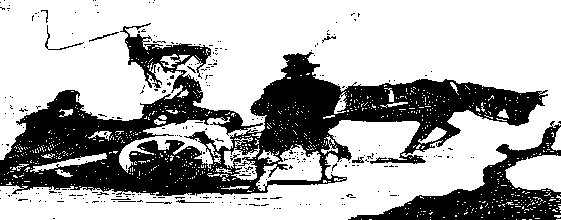
Funeral at Skibbereen, engraving after sketch by H. Smith, from 'Illustrated London News, January 30, 1847.
These public works programs provided income to roughly three million people, and continued throughout 1846 while a more severe famine occurred. Unlike other pestilences that caused earlier crop failures, this famine's origin happened in a single night and affected whole areas of Ireland. Other crops, such as corn, were not touched and were quite abundant throughout Ireland. These crops were exported in large numbers rather than be used to feed a starving nation. Special interest groups in England prevented the distribution of excess corn to feed the starving nation, and when England finally legislated in 1847 that the crop be used to nourish the Irish, these interest groups maneuvered a plan through parliament to send the surplus grains to England first. After the Irish crops were docked in England, merchants then sent it back to Ireland through English sea-faring vessels. This ensured that all British mercantile efforts were satisfied, and that each group would receive a profit in the process. Although Ireland produced a modest potato crop in 1847, the third and final crop failure occurred in 1848 which resulted in even more distress. For many farmers who survived the previous crop failures, this loss resulted in greater economic hardships and deaths in rural Ireland.
The cost of the famine was high, not only economically, but also in its effect upon the population levels within Ireland. During this period nearly a million and a half people either died or left Ireland in "coffin ships," as ships carrying immigrants were called. In 1841 the population of Ireland was 8,175,124 persons; 15 years later the population decreased to 6,552,385 men, women and children,[3] and even this number continued to decrease over the remainder of the century.
Emigration
With my bundle on my shoulder
Sure there's no man could be bolder
I'm leaving dear old Ireland without warning
For I've lately took the notion
To cross the briny ocean
I'm bound for Philadelphia in the morning.
Compulsory emigration rose sharply after the crop failures. The government began searching for ways to "reduce the surplus population", as Charles Dicken's character Ebanezer Scrooge uttered; but forcing the small farmer from Ireland would be no easy task. Parliament saw very few options because these failures, due to several years of blight, took away the peasant's plantable food source. Estimates of death and emigration ranged from 2 million to 4 million persons; however, the lower estimate is perhaps the more realistic figure.
Once the decision to emigrate was chosen, a ticket was obtained from a shopkeeper in a nearby town. The cost of a ticket to America in 1855 was approximately 25 pounds for a family of four, and significantly less for a single person. The trip ticket in addition to covering the immigrant's passage to the western continent also covered food and other incidentals. Under the Emigration and Passenger Acts, the master of each ship was required to provide daily rations of food and water, however, bedding and cooking utensils were provided by the passenger, and often they brought along other provisions to help them through their journey. The extra provisions were necessary because dishonest ship captains shortchanged the food allowances or obtained inferior food products to feed the emigrants. This buccanneering was done, in many cases, to increase the profits and pockets of ship captains and their owners. Normal voyages to America took fifty days; however, if the weather was poor it could take up to 80 days.
Emigration was not a popular alternative to select during the early years of the famine; however, as food supplies vanished, many had no choice. Once the decision was made to leave Ireland, many families had to face the potential that they would never see each other again. The future traveler would often console those left behind by telling family members and sweethearts that they would someday return. The encouragement this departing gentleman attempted to give his family was perhaps very common [4]:
Good-bye, Erin, dear!
Norah, I must leave you,
Let your heart be of good cheer,
I'll soon be back to see you,
Farewell to all I love,
Sad must be our parting,
Good-bye Erin, farewell, Norah,
Mother, dear, good-bye.
Other ballads wrote of the melancholy that consumed the emigrants after they boarded their ships, and this sadness would continue as they sailed westward to the new world. Some of these songs were so moving that even today, one still feels the grief that enveloped these migrants while surveying family and friends as they left port [5]:
Unmann'd was ev'ry loving heart,
When parting words were said -
In silence on the deck we stood,
And watched'd the daylight fade;
At length one bolder than the rest,
In accents gruff and stern,
Cried "Courage boys, what need to grieve,
We all shall soon return.
The departure from Ireland was not always a solemn occasion for the emigrant. In actuality there was much to celebrate because it offered them a chance to escape the disease and poverty which was commonplace. This excitement was elevated by letters written by family members extolling the opportunities that the new world provided, and many of these letters detailed how wealth was attainable to anyone who was willing to work hard. These stories encouraged many to leave Ireland, and the prospect of reuniting with family and friends who left before them made the trip easier to make. The letters and songs written during this period expressed this anticipation, and as this ballad suggests one Irishmen, in particular, anxiously awaited his departure [6]:
Good-by, Mike, good-by, Pat, good-by, Kate and Mary,
For the anchor is weighed, the gangway is up, I'm leaving Tipperary;
See there's the steamer blazing up, I can no longer stay,
For I am bound for New York City, boys, three thousand miles away.
The 19th century ballads also recalled the difficulty of leaving sweethearts behind. Many anticipated having their beloveds join them in America once they achieved wealth, while others planned to return after their fortunes were made. The ballad "Katie O'Ryan" was typical of the forlorn love songs that troubled young men and women separated by the Atlantic Ocean [7]:
Katie O'Ryan...
On the banks of the Shannon, in darling old Ireland,
Dwells a fair damsel, she's soon to be mine,
Shes a darling young creature and lovely in feature,
I ne're can forget her! dear Katie O'Ryan.
She's as fair as the dawn of the morning while beaming,
Her eyes soft, her lips like the ruby red wine,
Oh! she's the dear little shamrock, I'm constantly dreaming
Of my own darling Katie, dear Katie O'Ryan.
CHORUS
She's the dear little shamrock, I'm constantly dreaming
Of my own darling Katie, dear Katie O'Ryan.
I now have rov'd far to a land call'd America,
a home, Katie dear, for the honest and true,
My heart saddens tho' when I think that I am
So far away from old Ireland, and Katie, from you.
The winter is on, but I heed not its cold, dear,
The spring will bring flow'rs and joy to my heart,
Oh! for it's nearing the time when I'll bring my love out here,
CHORUS
She's the dear little shamrock, I'm constantly dreaming
Of my own darling Katie, dear Katie O'Ryan.
The fields are green as they are in old Ireland,
And all have their freedom to do what is right;
Ah! Katie, I've seen pretty girls by the thousand,
And I'm thinking of none but you, darling, to-night,
When the bright summer comes, I will hasten, sure, back again,
Take your soft tender hands gently in mine. Oh!
I'll never more leave you, but thro' life we'll wander;
Till death it will part me and Katie O'Ryan.
CHORUS
She's the dear little shamrock, I'm constantly dreaming
Of my own darling Katie, dear Katie O'Ryan.
The passage to America was treacherous, and the adventurers who sailed to the new world did so out of uncertainty and fear. One of these passengers, Stephen de Vere, described how his fellow passengers, "Huddled together without light, without air, wallowing in filth, and breathing a fetid atmosphere, sick in body, dispirited in heart."[8] Making the voyage to 19th century America was very dangerous, and it was estimated that 1 in 30 would die either from the passage or from the effects of the trip. Among the more catastrophic disasters involved the immigrant ship 'Austria' which resulted in a loss of over 500 passengers. Most of the passengers were German emigrants; however, there were also many Irish men and women, such as Patrick Ryan, on board. This disastrous fire has been recorded in several songs and news articles since this disaster occurred over 100 years ago[9]:
The most of these were emigrants
From Galway's pleasant strand;
From racking tyrant landlords,
They quit their native land;
In hope to live more happily
'Mong strangers far away,
They bent their course to New York,
All on this woeful day.
The danger of making these voyages and the mis-treatment the emigrants faced was also described by John Ryan, a laborer from Limerick, during Parliamentary hearings in 1855. John Ryan purchased a ticket for the ship "Commerce" which normally carried several hundred passengers; but instead, was assigned to the ship E.Z. that was a much smaller cargo ship capable of handling few passengers. The following was an excerpt of his testimony during these hearings:
Did You come across from Dublin to Liverpool?
Ryan: Yes.
Upon the deck of the steamer?
Ryan: Yes.
Was it a bad night?
Ryan: It was a bad night indeed.
Had you any shelter?
Ryan: None except as a man can shelter himself.
Then you were taken to the E.Z.?
Ryan: Yes
And then you were given sleeping places, where, on the Upper deck?
Ryan: Yes on the upper deck, in the bows...We had a house made with
boards over the hatchway.
There were fourteen of you?
Ryan: There were.
And several of one family?
Ryan: There was eight of one family, and another girl
who joined them, which made for nine.
What was the name of the family?
Ryan: Fitzgerald.
Now, when you were some time out, it happened that
those houses were knocked away by the sea?
Ryan: Yes quite away.
And there were persons carried away with them and drowned?
Ryan: There were, drowned altogether.
You saw no more of them?
Ryan: I saw no more of them than of a man that was at Cork.
Were you all washed overboard?
Ryan: Thirteen were washed away; every one but
myself. Had you good food?
Ryan: They gave me no drink but water, and the
biscuit was too hard for me.[10]
During the rest of these hearing, John Ryan recapitulated his loss of clothing, loss of his other possessions and general living conditions on board the E.Z. These incidents as related by John Ryan and Stephen de Vere were not isolated incidents, but rather, common occurrences on board sailing vessels of the day. Journalists wrote that the conditions on American ships were better than English ships, and that the American crewmen treated the poor emigrants with greater respect. It was also said that American shippers provided better food rations as well. Interestingly, one of the American captains of these emigrant ships was Captain D. Ryan, master of the Rio Grande, which had regularly scheduled trips between Liverpool and Philadelphia.
The passage frightened many emigrants, but they were willing to endure this journey to escape hunger and poor living conditions. Many Ryans, as did other destitute Irish, left Ireland for multiple foreign ports, but generally they found new homes in Britain, Australia and America. It was during the famine years that America, for example, swelled with new Irish immigrants; and the total number of Irish men and women by the United States census nearly doubled over a 10 year period. In analyzing the American immigration records of 1846, 406 Ryans, two Ryans, seven Rynes, two Ryens, nine Rynnes, and one Ryon passed through the New York City Immigration authority. This number coupled with the hundreds that passed through other U.S., Canadian, and other ports around the world saw many descendants of Rian leaving their ancient lands in search for better opportunities elsewhere.
Ryan Famine Immigration Notes[11]
The information contained within these charts reflect only 1846 immigration figures.
Oldest to emigrate: James Ryan, 75
Youngest to emigrate: Honora, Mary, Joseph, Michael, and Judy - all infants.
Deaths at sea: James Ryan, 75 William Ryan, 3
Total to emigrate: 435 persons
Less than 18 years old: 52
11 to 20 years old: 129
21 to 48 years old : 216
over 41 years old: 14
unidentified: 24
Occupations:
laborers (most common), servants, tailors, shoemakers, cobblers, farmers, domestics, shippers, weavers, house maids, carpenters, victuallers, butchers, grooms, clerks, and inn keepers.
Popular names of Ryans based upon emigrant list:
1. John 1. Mary
2. Patrick 2. Catherine
3. Michael 3. Margaret
4. Thomas 4. Bridget
5. James 5. Elizabeth
6. William 6. Ann
Patrick was the second most popular name for male Ryan emigrants in 1846, yet 200 years earlier it did not appear at all in the 1652 census as a name chosen for male Ryan descendants. Patrick became popular after Cromwell destroyed the Irish countryside, and as a mild protest against English repression, young males were named after St. Patrick to reaffirm their Gaelic heritage. The name became more popular after the Williamite war because more male offspring were being given the name of 'Patrick' to honor Patrick Sarsfield, the commander of the Limerick brigade.
The Poorhouse of Nenagh Union Co.
There existed in Ireland a law, the Poor Law, to handle the affairs of the indigent. These Poor Laws were designed to provide assistance to the destitute and homeless, but it also required that all able bodied persons work while living in its confines. Consequently, these Poor Houses became "work houses" where the tenants were virtual slaves to the state, and in County Limerick, for example, Newcastle, Kilmallock, Rathkeale and Croom were selected as suitable sites for the impoverished, each poor house being officially recognized as a Union. Prior to the Great Famine the Union documents of Newcastle recorded "only seventy paupers in the Newcastle West house, and that the old and infirm inmates were kindly treated."[12] By 1846 these houses were overburdened with men, women and children seeking assistance from the devastation caused by the effects of famine. The famine spread rapidly causing local aid to be nearly exhausted, and families found themselves unable to remain on their rented plots and rushed to the poor houses, many of which were already overcrowded. Kilmallock was typical of this overcrowded condition as it was constructed to house 800 residents, but malnutrition and disease caused this number to exceed 1600 persons. While many applied for admission, thousands of others were turned away. These suffering souls wandered the countryside which could not feed those already living there, and fell sick and dying along many country roads. The situation was so horrific that the grave diggers could not keep up with the death rate [13]:
When matters were becoming acute in March, 1848, the people of Penile were horrified at the state of the local graveyard near Clare Street. Two boys were bringing eight to ten corpses every day, and as they were not able to bury them, the dogs were devouring the bodies. Some of the animals were killed by their owners, while others were seen taking large pieces of human flesh across the country.
The conditions of the poor houses of County Limerick was similar to those found in other parts of the country. One such Union at Nenagh, in County Tipperary, was also extremely overcrowded and seeking methods to reduce its inmate community. The workhouse of Nenagh was created in 1842 at a cost of 8600 pounds, but as the starvation grew worse, its numbers also swelled beyond its capacity. The number of inmates according to Thomas Dooley, the clerk of the Union during the famine era, grew considerably over a five year period:[14]
January 1845 325
January 1846 349
January 1847 948
January 1848 1864
January 1849 1374
The Nenagh workhouse confined 2,164 persons by June of 1849 for their inability to pay their debts.[15] In over four years, almost a 700% increase in its residence transpired, and this bulging inmate population forced authorities to create new methods to reduce its population levels. One of these new ideas was the introduction of forced emigration, whereby the inmate had no choice in selecting their choice of destination.
Between 1849 and 1868, 753 persons emigrated from Nenagh Union poorhouse,[16] and among the bureaucrats' first initatives was the exportation of young women orphans to Australia. Australia began as a penal colony, and as the prisoners earned their freedom, there was a demand for women for prospective marriage arrangements. In 1849 the workhouse sent 85 young girls, and the following year it sent an additional 45 young girls. Of the 85 young women sent, Judy Ryan and three Mary Ryans were counted among its number.[17] Some of these young females went directly to Van Dieman's land, today known as Tasmania, which Great Britain used to house its most dangerous criminals. The deportation of females to the Australian colony also resulted from family members asking that their families be rejoined, and one such solicitation was by James Ryan, an inmate at Van Dieman's land, whom petitioned that his children be sent to him.[18] His supplication was approved January 1858, and although the names of his daughters were not mentioned, it is possible that they were also inmates of the poorhouse in Nenagh.
The records also showed other Ryans, both male and female, sent to various continents from Nenagh Union: Mary Ryan sailed from Plymouth in December of 1858 to New South Wales; James and Patrick Ryan of Kilcomenty sailed for Quebec in 1858; William and Edward Ryan of Latteragh emigrated to Quebec in 1850; Michael Ryan of Ballina in 1858, American destination unknown; Mary Ryan, age 15, of Nenagh went to the United States in 1854; Catharine Ryan of Castletown embarked for Australia in 1854; James Ryan, age 8, was accompanied by a sister emigrating to the United States; between 1855 and 1856, Judy Ryan of Templederry and Catherine Ryan of Burgessbeg emigrated to the United States; between 1856 and 1857, Margaret Ryan sailed to New York to Join her mother, and John, age 16, and Catherine, age 18, emigrated to Quebec; Judy Ryan, age 9, of Dolla joined her mother in Indiana; and in 1868 Margaret Ryan, age 12 and an inmate of the workhouse since the age of four, emigrated to the United States after her brother paid her passage.[19]
Census Figures
Kerby Miller, in "Emigrants and Exiles", compiled the staggering immigration figures caused by the Great Famine. For illustrative purposes, emigration figures for Tipperary and Limerick counties are examined, and these figures are compared to the migration patterns between 1851 and 1900.[20]
County 1851-55 1856-60 1861-70 1871-80 1881-89 1900
Tipperary 59,597 20,622 47,686 26,499 32,889 19,084
Limerick 44,423 17,217 46,667 22,026 33,166 14,166
Ireland
Total 747,999 415,419 849,836 623,933 770,786 433,526