

Book of Ryans - Rising Nationalism
To Hell or Connaught
Ye noblemen, in place or out,
Ye volunteers, so brave and stout,
Ye dames that flaunt at ball or rout,
Wear Irish manufacture.
Thus shall poor weavers get some pence,
From hunger and from cold to fence
Their wives and infants three months hence,
By Irish manufacturer.
From `Fractured Emerald: Ireland
Emily Hahn, author
After Catholics received the right to vote in 1794, landlords began wholesale evictions of Protestant tenants because their votes were no longer needed in parliament. They began leasing lands to eager Catholics "who worked harder and offered higher prices."[1] Reactions to this displacement encouraged the formation of Protestant factions to terrorize and kill Catholic farmers who received farms from evicted Protestants. One of the earlier groups that formed was the Peep-o-Day Boys; however, they were later absorbed into another Protestant secret society, the Orange Lodge. The violence and murders that surrounded the Orange Lodge was often indistinguishable from the savagery the military delivered to its Catholic citizens; but one distinguishing characteristic was that the atrocities leveled against Catholic tenants were not normally done by the military. Unfortunately these atrocities were not always directed towards Catholics by Protestant 'hate groups'. Violent actions against Catholics by other Catholics was also commonplace because of the competition for scarce farmland. Constantic Maxwell described one instance where the church, upon hearing of a potentially murderous dispute, stepped in to prevent bloodshed through the intervention of Dr. Patrick Ryan, the coadjutor bishop of Ferns:
"A man of great influence over the peasantry, hearing that two town lands in his diocese had agreed to fight a pitched battle, ordered their priest to withhold the sacrament from anyone who took part in it. Several made submission and ordered to do penance which they performed by going twice around the chapel on their bare knees."[2]
As tension between the Catholics and Protestants heightened, it ultimately caused a panic in several northern provinces, with the worst occurring at Armagh in 1795. Many poor Catholic peasants were forced from their farms, and ordered to "hell or Connaught" by the Protestants living in these provinces. Armagh's victims and their families began to wander in great numbers about the country, without any worldly goods in search of food. These sights and the rumors that they created, spread swiftly through the country, particularly in the South of Ireland. Here, as well as other parts of the country, the peasants banded together in secret armies with the intent to protect their lands and possessions. One secret organization which began was the United Irishmen and their aim (as determined by their motto) was to be united and to be Irish. The oath of membership further outlined the United Irishmen's intentions:
"I . . . . , in the presence of God, do pledge myself to my country that I will use all my abilities and influence in the attainment of an impartial and adequate representation of the Irish nation in Parliament; and as a means of absolute and immediate necessity in the establishment of this chief good of Ireland, I will endeavor, as much as lies in my ability, to forward a brotherhood of affection, an identity of interests, a communion of rights and a union of power among Irishmen of all religious persuasions, without which every reform in Parliament must be partial, not national, inadequate to the wants, delusive to the wishes, and insufficient for the freedom and happiness of this country."[3]
The society drew many of the brightest men from Ireland into its councils, and according to Thomas Reynolds, an informer, the forces within the United Irishmen numbered over 200,000 men. The Protestant elements used these figures to justify the imprisonment of anti-Dublin political groups, however, the Society estimated that only half would actually participate if warfare broke out.[4]
City/County Armed men
Ulster...................110,990
Munster..................100,634
Kildare...................10,863
Wicklow...................12,895
Dublin.....................3,010
Dublin City................2,177
Queen's County............11,689
King's County..............3,600
Carlow.....................9,414
Kilkenny.....................624
Meath......................1,400
Total...............279,896
The commander-in-chief of the United Irishmen army was Lord Edward Fitzgerald, and due to the alarming situations in the countryside the government began a policy of prosecuting and executing members of this society. This policy was instituted to silence potential convulsions inside Ireland. The Ascendency's paranoia was not unfounded as lord Fitzgerald's personal letters showed that he had set a date for a general uprising on May 23rd, 1798. His own personal army was estimated at 12,000, and to eliminate this threat the Irish government set out to capture Fitzgerald. Realizing the dangers of remaining openly critical of the Ascendancy, he went into hiding in Dublin at the Yellow Lion on Thomas Street. An informant told of his whereabouts, however, and a raiding party consisting of Captain Daniel Thomas Ryan, Major Swan, Major Henry Sirr, and a few soldiers went to arrest him while he lay asleep. Major Swan led his party upstairs, awakened Fitzgerald who put up a valiant effort to avoid capture. He leapt from his bed and struck Swan with his knife and seriously wounded him. Lady Holland wrote her account of the arrest by saying, "Fitzgerald was in bed sick with a sore throat, and laying upon his bed when Ryan fired at him through the door, burst it open, and seized upon him."[5] Other accounts suggested that Captain Ryan carried only a sword, and that it was Swan who carried a pistol. According to Mr. Murphy, an eyewitness:
Lord Edward Sprang up like a tiger and stabbed Swan
three times - in the side and under the left arm and
breast. Swan snapped his pistol , missed, shouted
"Ryan, Ryan, I am basely murdered."[6]
In truth, as soon as Captain Ryan heard those screams, he left his eight soldiers and ran upstairs to help apprehend Fitzgerald. Because Swan was wounded, he threw himself at Fitzgerald and both fell onto the bed. Captain Ryan only had a cane to defend himself, but Fitzgerald used his knife and plunged the knife a dozen times into Ryan's body. Although mortally wounded, he grabbed Fitzgerald's knees to prevent his escape waiting for either Sirr or Swan to return. Major Swan was of no value as it was noted he was "running up and down inside the house and bleating like a sheep."[7]
Major Henry Charles Sirr assembled the soldiers and marched them upstairs. The Major, keeping his distance, fired his pistol at Fitzgerald and wounded him in his shoulder. After receiving his wound he dropped his knife and calmly sat down on his bed, and the soldiers ran to Fitzgerald who continued to resist his capture. Once Fitzgerald was safely captured, Sirr turned his attention to Ryan who, as one eye-witnesses described, a "pitiable spectacle"[8], and summoned his soldiers to prepare moving him to more suitable quarters. Even though his wounds were serious, there were hopes that he would recover, but he died from his wounds eleven days later. Major Sirr felt it was his duty to write a condolence letter to Ryan's son to express his grief over the loss of a fine soldier, but Sirr was not known to communicate tacitly as a portion of his letter noted:
"Having secured the titled prisoner , my first
concern was for your father's safety. I viewed
his intestines with grief and sorrow."[9]
Fitzgerald died several weeks later in Newgate jail from the wounds he received, however, many of his closest associates said that he was recuperating nicely until he learned that he had killed Ryan. He was unable to bear the thought that he was responsible for this death, and he fell into a deep depression ultimately leading to his death.
The Protestant Ascendancy displayed their appreciation for Ryan's efforts to capture Fitzgerald by providing his 'widow a pension of 200 pounds per annum for herself and her two daughters'[10], yet not everyone shared the same degree of gratitude as visibly expressed by those attending his funeral. The underground newspapers bitterly attacked Parliament for supporting the extirpation of opposition groups, and songs were written, specifically surrounding Fitzgerald's death, which criticized the military's handling of this affair. One such ballad, 'Edward' written by William Shields, called Ryan a traitor to Ireland, and praised Fitzgerald's heriosm despite his capture. This song picks up just shortly after he had wounded Major Swan:[11]
Aloud he shirek'd , then Ryan came
Unto his aid with trembling steps;
Mean caitiff Ryan , lost to shame,
With deeds most foul was full your cup.
Like vivid lightning at him flew,
With well-aim'd point, our hero sweet,
The dastard's blood he forthwith drew,
And left his bowels at his feet.
So wide the gash , so great the gore,
That tumbling out his entrails came:
Poor grovling wretch! you'll never more
Attempt to blast unsullied fame ;
A baser death should you await ,
The hangman's rope - not Edward's hand,
The gallows-tree should be your fate,
Your life deserv'd a shameful end.
Captain Ryan whom originally began his career as an army surgeon in the 103rd regiment, eventually became editor of the 'Dublin Journal', one of the primary government newspapers, of which his wife's uncle, John Giffard, was the owner. Because of his exposure to the media, he also became a composer of ballads and folk songs, and his songs reflected the fears many Protestants felt towards the native Catholic population. One of his songs, `Croppies Lie Down', shared the same melody as an older song called `Down Down, Derry Down', and was perhaps used because the password of the United Irishmen was the word `up'. The English slang `croppies' was coined to describe United Irishmen who cut their hair short. This new hairstyle quickly spread throughout Ireland, especially among the peasant farmers and laborer's, and it symbolized one of the cruel tortures used by English authorities. One of the favorite sports used by police during this time was to pour boiling pitch over a "croppies" head. Once the pitch had cooled, it could be removed by force which pulled the hairs along with it. After the hair was removed by its roots, the police would then let the `croppie' go, and their antics became popularly known as "pitch capping."
We soldiers of Erin, so proud of the name,
Will raise upon rebels and Frenchmen our fame;
We'll fight to the last in the honest old cause,
And guard our religion, our freedom, and laws;
We'll fight for our country, our king, and his crown,
And we'll make all the traitors and croppies lie down.
Down, down, croppies lie down.
The rebels so bold - when they've none to oppose -
To houses and hay stacks are terrible foes;
They murder poor parsons, and also their wives,
But soldier's at once make them run for their lives;
Arid wherever we march, thro' the country or town,
In ditches or cellars, the croppies lie down.
United in blood, to their country's disgrace,
They secretly shoot whom they dare not to face;
But when we can catch the sly rogues in the field,
A handful of soldiers make hundreds to yield,
And the cowards collect but to raise our renown,
For as soon as we fire the croppies lie down.
While they, in the war that unmanly they wage
On woman herself turn their blood-thirsty rage,
We'll fly to protect the dear creatures from harms,
And shelter them safely when clasp'd in our arms;
On love in a soldier no maiden will frown,
But bless the dear boys that made croppies lie down.
Should France e're attempt, or by fraud or by guile,
Her forces to land on our emerald isle,
We'll show that they ne'er can make free soldiers
slaves
And only possess our green fields for their graves;
Our country's applauses our triumph will crown,
While low with the French, brother, croppies lie
down.
When wars and when dangers again shall be o'er,
and peace with her blessings revisit our shore;
When arms we relinquish, no longer to roam,
With pride will our families welcome us home,
And drink, as in bumpers past troubles we drown,
A health to the lads that made croppies lie down.[12]
The seeds of rebellion were sown, and by 1798 sporadic outbreaks of violence spread across Ireland. Before the outbreak of violence in Dublin began, rumors spread that the Irish militia had been infiltrated by members of the United Irishmen, and paranoia spread in many military units which began searching for traitors within its ranks. One such account occurred in Dunlavin in County Wicklow where a rumor spread that the local police regiment was about to mutiny. Captain Saunders was sent to Dunlavin to control the riot, and after ensuring the safety of the County, he marched 36 members of his troops to Dunlavin Green and had them executed on May 26th, 1798. Among those slain were the Duffy brothers, Matthew Farrell and Andrew Ryan; and their deaths were preserved in a ballad called "Dunlavin Green"[13]
Some of our heroes are `listed and gone far away',
There are some of them dead, and some of them crossing the sea;
As for poor Andy Ryan, his mother distracted has been
For the loss of her son, who was shot upon Dunlavin Green.
These executions performed without due process greatly angered Irish Catholics, and subsequently the government's indifference to punish the murdurers indirectly sent a subtle message to Protestant societies and the military that they would overlook their sins against Ireland's Catholic citizens. One officer, known for his brutal mistreatment of Catholics, was a Sergeant in the North Cork Regiment called "Tom the Devil" by the local Catholic population. Postgate noted that, "He invented the practice of cutting prisoner's hair short, rubbing in damp gunpowder, and lighting it."[14] In Wexford any article of clothing made of green made the wearer subject to strip searches, and newspapers frequently complained that yeomen ordered women to completely disrobe, including their undergarments, and be thoroughly searched.
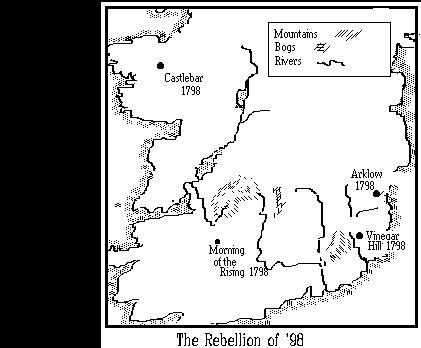
On the same day as the executions at Dunlavin, the military unleashed its fury in the Southeast, and hearing of the oncoming approach of the military, often referred to as the advance of the Yeomen, Father Murphy gathered his parishioners to peacefully greet this military outfit. However the Yeoman looted his parishoner's homes, and burned Father Murphy's home and church. Outraged by this action, he gathered the men in the town and set up an ambush waiting for the military to return. When the yeoman returned, the Irish peasants surprised them with pitchforks and scythes. This challenge surprised the Yoemen and they quickly became disorganized which resulted in severe losses among their ranks. Father Murphy later led a poorly armed group of men to battle the government forces at Wexford, and was joined by others including clergymen who volunteered their services. A surprise to many, this ill-equipped army was able to capture the city and defeat the English militia. Father Murphy's army continued to grow and be reinforced by other Irishmen armed with pikes, and together were able to win a few minor victories in Wexford and Waterford. However, they sustained severe losses at Vinegar Hill near Ennisorthy, and Father Murphy, including other militant leaders, were captured and executed. This devastating defeat quickly silenced other attempts to engage the government's militia in battle. Dublin reinforced this silence by intimidating priests to persuade their parishioners to yield their weapons and turn in fugitive rebels. Government manuscripts documented a series of 'arm twisting' techniques, and that one of their more successful intimidation efforts involved Father Ryan, a parish priest at Clontarf, who "prevailed upon his flock to surrender nine cartloads of weapons."[15]
Later when the government searched for the cause of this war; Emmet provided an explanation that seemed to echo the sentiments of many others. He said, "-the free quarter's, the house-burnings, the tortures and the military executions, in the counties of Kildare, Carlow, and Wicklow."[16]