Smith Ancestry
Home | Smith Photos | Family Stories | Ryan Data | Smith Data | News Center | SITE MAP | Contact Us
|
|
Smith, Smyth, Smythe, McGowan, O'Gowan
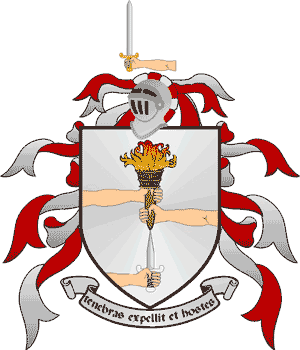
A tradition exists
that in ancient times, the
McGowans fought a battle at night with torches in one hand, and subsequently
this event has been inscribed into their coat of arms.
This coat of arms has been modified from the earliest emblem.
Initially it showed only a severed hand clutching a dagger. The history behind
the original emblem began when Ireland was first
populated by the Celts. The McGowan had wagered his
brother, on the way back from England, that he would reach the Irish shores first. As they raced
to its seashore, the stakes were increased - whoever touched Irish soil first,
would become king. As the two raced to shore, McGowan realized
that he was losing, subsequently he cut off his
hand and threw it onto the shoreline. This severed hand landed on
the sand before his brother reached the beach. He won the wager and became
king, and from that time, the clan became known as the "Sept (clan) of the bloody
hand." |
In an Irish context (which is the self imposed
scope of this feature) Smith may be the anglicized form of one of several native
septs, the name of Scottish families transplanted into Ulster or simply from
English families who settled in the country over the centuries.
Of the native Irish families, that of Mac an
Gabhain of Breffny is the most important. Mac an Gabhain literally means "son of
the smith" and has been variously anglicised as McGowan (later simply Gowan) as
well as Smith and Smyth and also as Smithson. The usual modern gaelic form is
MacGabhain. The name is still common in all its forms in county Cavan where the
many of Smiths are of this family. On the borders of Breffny, in Co. Leitrim,
and to the north west in Counties Donegal and Sligo, the true form in English,
MacGowan, is still used in preference to Smith.
A branch of the family known as Cruthnean Dail
hAraide of counties Antrim and Down, of which Hugh O Gowan was chief in the
reign of Queen Elizabeth I, was transplanted to County Cavan because they aided
the O Neills. Other families remained in County Down, Anglicizing their name to
Smith or Smythe.
In Ballygowan, County Down, an O Gowan sept
Anglicized its name to Smith, and a distinguished descendant of this family
reintroduced the original O Gowan name, with the full agreement of the Irish
Genealogical Office, in 1949. This was Major-General Eric Dorman-Smith, a
brilliant military tactician, who was born in 1895 at Bellamont Forest,
Cootehill, County Cavan. His nephew, Sir Reginald Dorman-Smith, was Governor of
Burma at the time of the Japanese invasion during the Second World War. Apart
from this family, the form O Gowan is rarely encountered in modern times. It is,
however, to be found in the census of 1659 as one of the principal Irish names
in the counties of Monaghan and Fermanagh.
In medieval times the Ghabhainn clan families of
counties Clare and Tipperary were hereditary historians to the O Loughlins of
Burren and the O Kennedys of Ormond.
Among the many alternative forms of the name
recorded in the statistical returns of the Registrar-General, the most usual,
apart from Smith, are Mageown and Magown. Further confusion arises from the fact
that the Gaelic surname MacDhubhiin, a family of Raphoe, Co. Donegal, and also
of Co. Clare, where the anglicized form is MacGuane, has become MacGowan in Co.
Mayo; while Mac Gamhna (normally Gaffney) is also rendered MacGowan in some
places.
Two MacGowans of Irish ancestry have
distinguished themselves abroad: in the U.S.A. Samuel MacGowan (1819-1897), a
Presbyterian, jurist and Confederate soldier; and in New Zealand, James MacGowan
(1841- 1912), statesman. Faelan Mac an Ghabhan was one of the scribes of the
Book of Ui Maine (1394).
Numerous Irish Smiths and MacGowans served in the
Irish armies in the seventeenth century. They also served with Charles I, and
were soldiers of the Commonwealth in Ireland and, later, in the French and
American brigades.
In Scotland the name MacGow was, in Gaelic,
MacGobha also meaning "son of the smith", was anglicised as both Gow and Smith.
There were Gows or MacGowans, a sept of Clan MacPherson, long known as Sliochd
an Ghobha Chrom, the "race of the bandy legged smith", from their ancestor Henry
Gow of the Wynd. These Smiths became a clan in their own right, being one of the
seventeen tribes of the great Clan Chattan federation. The names Gow, Gowan and
Smith are also common all over Scotland. MacGobhainn, anglicised as MacGowan and
Smith, was the name of a family, which was hereditary smiths to the Clan Donald.
Many of the Ulster Smiths descend from one or other of these Scottish families.
Many Smiths of Kilkenny and Tipperary descend
from William Smith of Damagh, who was secretary to the Earl of Ormonde. It is
recorded that the Earl "was well pleased that William Smith of Damagh, Co.
Kilkenny, should bear some parcel of his arms for diligent services done by him
to the said Earle". It is also noted that William "was brought out of England to
my service". William's son, Lawrence, was slain in the service of King Charles
at the siege of Drogheda. The family line continued through Lawrence's son,
Valentine.
Many other Smith families of English origin are
found, especially in the area around Dublin. These included Smith of Maine,
County Louth and Smith of Annsbrook, County Meath (a branch of Maine). In 1646
William Smith started his fifth term as Lord Mayor of Dublin. He was a Colonel
in a regiment of foot that protected the city and was of a Yorkshire family that
later settled in Suffolk. Several other members of this Yorkshire family are
also recorded in Ireland. In 1677, John Smith was Lord Mayor of Dublin. He was
of the same family as the Carrington-Smiths, whose ancestor was on the Crusades
with King Richard. Captain Robert Smith, who was of an English family in
Dirleton, Haddington became Athlone Pursuivant of Arms or assistant to the
Ulster King of Arms. His son, Robert Soden-Smith held a position at the South
Kensington Museum in London. The Prendergast-Smyth family help the title of
Baron Kiltartan and Viscount Gort. This family was originally from county Down
and included several clerics - Thomas Smyth was bishop of Limerick 1695-1725 and
his son, Arthur, bishop of Dublin in 1766. It was the grandson of the bishop of
Limerick, John Prendergast-Smyth, who received the titles. This family claimed
to be descended from the O Gowans of county Down, however, they bore a quite
different coat of arms. Another prominent English family of the name was centred
in Waterford.
Edward Smyth (1662-1720) of Lisburn, who was a
fellow of Trinity College, Dublin, and was expelled by James II in 1689. He was
Dean of St Patrick's, Chaplain to William III (of Orange) and, in 1699, Bishop
of Down and Connor.
Charles Smith (1715-56) of Waterford wrote
histories of the countryside and pioneered Irish topography. He took his medical
degree at Trinity College, Dublin, in 1738. He devoted most of his time to
historical and topographical researches, and was the author of county histories
of Waterford, Cork, and Kerry. They were published in 1746, 1750, and 1756,
respectively, under the patronage of the Physico-Historical Society of Dublin,
which was formed for the purpose of collecting materials for a work on the plan
of Camden's Britannia and to be entitled Hibernia, or Ireland Ancient and
Modern.
James Smith (c. 1720-1806) emigrated to America
with his father and was educated in Philadelphia. He was a lawyer, and also
raised the first volunteer company in the state to resist the British. He lost
all his money supporting the revolution. He was one of several Irish-Americans
who signed the Declaration of Independence.
Henry John Smith (1826-83) of Dublin was educated
at Rugby and Oxford. He lectured at Balliol College until 1861. He was made a
fellow of the Royal Astronomical Society and, despite many commitments, came to
be acknowledged as "the greatest authority of his day on the theory of numbers".
Vincent Arthur Smith (1848-1920), born in Dublin,
entered the Indian Civil Service. He retired early to devote himself to writing
and was renowned for his History of India, Ceylon and their Fine Arts.
Brigadier-General Thomas Smyth served under the
former Irish patriot, Major-General Thomas Meagher, in the American Civil War of
1861 to 1865.
Smithson is yet another variant of Smith. Harriet
Smithson (1800-54) of County Clare, daughter of a theatrical family, had great
success on the Paris stage, where she caught the eye of the composer, Berlioz.
He fell madly in love with her and pursued her for several years. His Symphonie
Fantastique was written for her. Alas, seven years of marriage was as much as
their clashing temperaments could endure.
Annie Smithson (1873-1948), born in Dublin, was a
district nurse for many years. A republican sympathizer, she nursed the wounded
during the 1916 rising. When she retired from nursing to write romantic novels,
she produced a series of best sellers including Her Irish Heritage and The Walk
of a Queen.
Although the Smiths-Smythes, MacGowans or O
Gowans-have not towered in the pages of Irish history, a study of Burke's Guide
to Country Houses, reveals a remarkable number of country estates belonging to
various wealthy bearers of the name. Like the innumerable Kellys, the Smiths
have assumed a variety of extra names to make it simpler to distinguish one
family from the other, for example: Cusack-Smith of Bermingham, Tuam;
Dorman-Smith; Murray-Smith of Belline; Quan-Smith of Bullock; Holroyd-Smith of
Ballynatray; Smith-Barry of Fota - and many more. There was also Smyth, whose
eighteenth-century house, Glananea, in County Westmeath, had such a flamboyant
triumphal arch at the entrance to his demesne that he became known as "Smyth of
the Gates". Growing annoyed with this name, he sold the arch to a neighbour,
whereupon he was dubbed "Smyth without the Gates".
Family Stories