Smyth Family Heritage
John Smyth Family of Rossnaglough Townland
According to lore, the forename “John” has been used in our family for as long as anyone could remember. The Smyths of Rossnaglough trace their ancestry to our shared great-great-great grandparents, John Smyth and Susan Coyle, who were married circa 1799 in County Monaghan. Rossnaglough is taken from the Gaelic ‘Ros na gCloch’, which means ‘wood of the stones’ or ‘wood of the stone building’. This might reference the old Rossnaglough fort which towers over everything else in this Townland.
John Smyth and Susan Coyle had four known children (John, Owen, Bridget and Peter) who we assume were all born and raised in Rossnaglough. Bridget Smyth married Edward Greenan and raised their children in Milltown Townland, Ematris Parish. Owen Smyth married Bridget Greenan and moved to Cousland, Scotland, where they raised their family. Peter Smyth married Catharine Greenan and they raised their family in Aghabog until Peter’s death in 1847. Within a few years of Peter’s death, Catharine Smyth moved her family overseas to Brooklyn, New York, and later moved her family to Wisconsin. John and Nancy Smyth stayed in Aghabog where they raised their family.
While we do know our great-great-great ancestors’ names we can only guess who came before them. The forename ‘John’ was the most common boy’s name used for their grandchildren. A close second choice might be ‘Peter’ as it is another reoccurring name in Smyth family trees. While circumstantial evidence suggests “John Smyth” is our earlier ancestor’s name, there is no clear choice for an earlier female ancestor’s forename.

Seventeenth Century Family
We know nothing about our ancestors before John Smyth and Susan Coyle. In the mid-Sixteen Hundreds Cromwell’s armies laid waste to much of Ulster by burning crops, root cellars, and any outbuilding used for food storage. Many Irish fled Cromwell’s advancing forces, some did not survive. Did our ancestors also flee from Cromwell’s oncoming forces?
In short order English rulers imposed severe penal laws against Catholics and dissenting Protestants. These laws were so severe that Catholics could not own land, vote, own a firearm, serve in the army, or attend mass. Priests were hunted down and murdered if caught saying mass or administering sacraments.

Map showing part of Aghabog Parish at time of Cromwell’s Invasion (Down Survey Map)
That meant sacramental records, if recorded at all, were hidden from their English overlords. For the Smyth family in particular that means we will never know who our 17th century ancestors were as no records were kept.
The 1659 Pender’s Census showed Irish and English living in County Monaghan. Full title holder names are listed in this census, but not first names for indigenous Irish. In 1659 there were 434 English and 3649 Irish living in County Monaghan. Why were so few Irish counted in this census? That is a bit of a mystery, and many have posted theories on why so few Irish were counted. No Smyth or Smith surnames are noted; however, this census shows there were ten people named McGowan and sixteen people named O’Gowan living in County Monaghan. Through Smyth/Smith family lore we learned our original surname was McGowan.
In 1641 Rossenglough and Heltagh (Faltagh) were owned by Thomas Burnett, a Protestant. By 1670 his land was owned by John Collins and Lord Massareen. In 1641 Corravilla was owned by Edmund roe McMahon, a Catholic.
The Hearth Money Rolls of 1663 and 1665 did not show any Smyth, Smith, McGowan or O’Gowan surnames listed in Aghabog Parish. Smith, McGowan and O’Gowan are seen listed in adjacent parishes however. Hearth Money Rolls were taxes levied in Ireland based on the number of hearths found in each house. If your home had no hearth then your name was not listed in these tax rolls.
Eighteenth Century Family
Due to lack of available records we know nothing about our early 18th century ancestors. Many Irish families alive during this time were poor with no visible means for improving their lot. However, with each passing year life slowly improved for our ancestors.
In the late 1700’s the Irish Linen Board offered new incentives so farmers could grow flax for the country’s thriving linen industry. Before the turn of the 18th century Catholics were given approval to build their own chapels for worship. By early 19th century our ancestors may have felt more optimistic about their future.
1796 Flax Growers List or Spinners List
Last Name |
First Name |
Parish |
Parish |
Looms/Wheels |
Smith |
John |
Aughabog |
Monaghan |
1 |
Smith |
John |
Aughabog |
Monaghan |
1 |
Smith |
Thomas |
Aughabog |
Monaghan |
2 |
Smith |
Thomas |
Aughabog |
Monaghan |
1 |
Smith |
James |
Aughabog |
Monaghan |
1 |
In 1796 the Irish Linen Board published a list of nearly 60,000 people who grew flax. As part of this scheme, spinning wheels were awarded based on how many acres of flax a farmer planted. A farmer could get 4 spinning wheels for growing 1 acre of flax. For planting 5 acres of flax a farmer was awarded 1 loom. From the list above it is unclear if our ancestor was awarded looms or spinning wheels. An economic downturn occurred when this scheme ended in 1828.
Does this list show our ancestor, John Smyth, who married Susan Coyle? While possible we believe it more likely shows his father’s name, who we believe was named ‘John’ too.
St. Mary’s Catholic Chapel
In 1812 the good people of Aghabog began building St. Mary’s chapel under the direction of Father Patrick Coyle Father Coyle died in 1816 and tradition tells us two McPhillips brothers then served as priests for this parish. The church tower was added in 1867 when Father Cassidy was in charge. Many parishioners helped build this chapel, and we believe our own ancestors did their part as well.
Early 19th Century Clothing
While we do not know anything about our early ancestors’ private lives, we can surmise what clothes they wore. Early 19th century Irish men wore knee breeches, a linen shirt, wool stockings and heavy shoes. Many wore tall top hats made of felt, and some men wore top coats with a swallowtail shape in the back. County Monaghan women wore linen undergarments or chemises that were basically long skirts topped by a woolen skirt or dress. They also wore aprons and kerchiefs. Many women did not wear shoes because they could not afford it. If a woman could afford footwear she might wear brogues with wool stockings. Some women wore linen headscarves on their heads in cold weather, and often wore a hooded cloak made of heavy wool during cold weather.
1832 Tithe Applotment
The first Irish census was completed in 1821 and conducted every ten years. Unfortunately very few old census records survive prior to 1901, and genealogists look at census substitutes to fill in family details. The following 1832 Tithe Applotment Record is considered a 'census substitute' and shows land leased by John Smyth in Aghabog Parish. Cootehill Poor Law Union records show John Smyth leased land in Rossnaglogh, Tonagh and Corravilla. The tithe records show John also leased land in Faltagh. A marshy area is just south where the Smyths lived in Rossnaglough. Did John lease marsh/bog land in Faltagh? We know one of John’s leased properties was used for ‘making turf’ (peat).
Rossnaglough East Townland Tithe Record

Tonagh Townland Tithe Record

Corravilla Townland Tithe Record

Faltagh Townland Tithe Record

“The Composition Act of 1823 specified that tithes due to the Established Church (Church of Ireland), which before had been payable in kind should now be paid in money.” That meant all land was evaluated to determine tithe tax owed by each landholder. Catholics and other non-Anglican Irish objected to this tax, which went directly to the Church of Ireland. After 15 years this tax ended. It should be noted that every land or leaseholder regardless of religious affiliation had to pay this tithe to the Established Church.
1839 Irish Poor Law Records
The Cootehill Poor Law Union was formed on August 10, 1839. Although Cootehill was located in County Cavan, this Poor Law Union included southern County Monaghan and Aghabog Civil Parish. Our ancestor’s name was listed in 1839 as one of the largest leaseholders or landowners.
- John Smith: Date of lease October 21, 1839; property assessed included house and land; Leased land in Rossnaglough, Tonagh and Corravilla Townlands.

We assume this John Smyth is the same person who married Susan Coyle.
1839 List of Voters
1839 was a banner year for our Smyth family. The following item lists John Smyth’s name waiting for approval as an eligible voter. With passage of the Great Reform Act of 1832 many Irish men now were eligible to vote. Eligibility rules required farmers to have an annual value of 10 pounds on leased property. Other rules applied to freemen or members of a guild. John Smyth would have viewed his voter eligibility as quite a feat.
John Smyth's name appeared in "An Alphabetical List of Notices delivered to the Clerk of the Peace or his Deputy, DIVISION OF MONAGHAN, pursuant to the 2d and 3d William IV, Cap. 8. APPLYING TO BE REGISTERED AT CLONES OCTOBER SESSIONS”, Northern Standard, October 5, 1839.


Irish Famine 1845 - 1851
The Great Famine wreaked chaos and devastation throughout Ireland and hit Ulster particularly hard. Ireland witnessed a potato blight in 1845, and because it was the staple food for millions in the Emerald Isle, it also signaled many would die from starvation and disease.
The Smyths of Rossnaglough felt its wrath. During this crisis, one government observer noted that the residents of Aghabog were not only poor, but miserably so. Peter Smyth of Rossnaglough died in 1847, possibly due to some famine related disease. Peter’s wife, Catharine, facing poverty and hunger moved her family to America. Owen Smyth uprooted his family from Aghabog, and moved to Scotland seeking new opportunities. Bridget Smyth Greenan continued raising her family in nearby Milltown but they too experienced hard times. Young John Smyth stayed on the family farm, married a woman named Nancy and raised a family.
To illuminate how devastating this famine was in Monaghan one only needs to review deaths recorded from 1842 to 1850. In 1842 there were 1236 deaths recorded. In 1847 during the height of the famine there were 5405 deaths recorded. In 1850 this dropped to 2804 deaths. Many Irish left this area, some moved away to other parts of the globe.
Aghabog Parish lost about 35% of its population from 1841 to 1851, much of it due to the effects of emigration and disease. As years went by much of the County’s housing disappeared as shown in the following chart.

Dundalk and Enniskillen Railway Company
The Railways’ Act of 1851 authorized new rail lines be built in Ireland In 1854 the Dundalk and Enniskillen Railway Company built new rail lines from Ballybay to Killeevan in County Monaghan. At Swans Cross a new rail depot was built, which was known as Monaghan Roads Station. People found travel far more convenient. That being said, the Smyths saw things differently as this railroad operated practically in their back yard and rail lines bisected their land. Today this rail line no longer exists.
1858 Griffith General Valuation of Ratable Property
In the absence of Irish census records we look for records which place our relatives in Aghabog Parish. Twenty six years after the Tithe Applotment list was published, Richard Griffith conducted a land survey that showed who owned and leased land in Ireland. This record showed ‘John Smith’ leased 16 acres from Arthur G. Lewis, including land used for a free school. Children, who wished free education and who did not want to attend the National School, could attend school in the Smyth family barn.

We assume John Smyth whose name appears in the Griffith Valuation was Peter Smyth’s brother. John Smyth was a farmer, and we believe he leased land highlighted in yellow on the following map. Although other Smyth families lived nearby, none are known relatives. Michael Smyth leased land highlighted in blue, Owen Smyth leased land highlighted in purple and Ann Smyth leased land highlighted in green. Please note this map shows a railroad line running through John Smyth ancestral land.

Colonel Arthur Lewis
Our ancestors would have known their landlord, Arthur Gambell Lewis of Scotstown, an agent for the Rossmore estate who handled rents and managed tenant relationships. Lewis married Henrietta Westenra, and gained ownership of large land tracts in Monaghan. Colonel Lewis maintained prickly relationships with his Catholic tenants, including relationships with his tenant John Smyth.
Arthur Lewis was fired from Rossmore's employment, but he quickly assumed control over lands gained through marriage. He was regarded as one of the worstlandlords in Monaghan, notorious for his partiality as Magistrate, and universally hated by Catholics.
He hated Catholics, and in his mind Protestants could do no wrong. He treated Catholics severely, especially those that paid him little respect. As a fanatical proselytizer, Lewis built his own schools whose only goal was to convert Catholic children and distribute Protestant Bibles. National Schools under his control all had ‘Scripture Readers’. John Smyth’s decision allowing a free school on his leased property must have irked Colonel Lewis considerably. However, John knew he had to walk carefully around this mercurial landlord, as Colonel Lewis notoriously evicted tenants at will. At some point even the press began criticizing Colonel Lewis’ actions in County Monaghan.
In 1915 a descendant of Colonel Lewis, Arthur F.O. Lewis, asked the court to eject Margaret Jane Chapman from his property. Her father, Samuel Hamilton Corbett, taught school at Rossnaglough on land leased by tenant John Smyth. John Smyth told the court this land had been in his father’s holding and he did not object to Chapman living on this property. However, the court ruled the ejection valid since there was a new tenant thus making the previous lease null and void. Corbett died in the first years of the 20th century, and it may be about this time when the Smyth school finally closed.

The 1890 Ordnance map above shows where John Smyth’s land was located, which is circled in red. To the east is a National School. In the early part of the 20th century John and Peter Smyth attended classes at Dawson National School, and old documents suggest this school was located in Rossnaglough.
Smyth Memorial in St. Mary’s Cemetery; Latnamard Townland, County Monaghan
This memorial is a genealogy road map regarding John Smyth’s family from Aghabog Parish. The memorial stone on the right side of the photograph below provides an abbreviated family history that shows when various family members died. It reads as follows:
Pray for the Souls of JOHN SMYTH, ROSSNAGLOUGH, Died 8th April 1898.
His Wife NANCY Died 14th Mar 1913
Their Son PETER, Died 31st Jan 1919
His Brother JOHN, Died 30th Nov. 1922
His Wife BRIGID Died 26th Aug. 1921
Their Daughter ANNIE Died 11th Oct 1920
Their Son BERNARD Died 3rd Mar 1927
And their Daughter Law ROSE SMYTH, Died 6th Dec 1977
And Her Daughter EILEEN Died 28th June 1979
And Her Father JOHN SMYTH Died 23rd Oct 1986
R.I.P.

Land Records for 1885 and 1886
The Eighteen Eighties land records show John and Peter Smyth leasing property in Rossnaglough. We know Peter Smyth was “Irish” John Smith’s cousin. Is John Smyth recorded here “Irish” John Smith’s cousin or his uncle?
Return of judicial rents fixed by Sub-Commissions and Civil Bill Courts, notified to Irish Land Commission, March 1885.

Parliamentary Papers, House of Commons and Command, Volume 54; By Great Britain Parliament House of Commons; H.M. Stationery Office 1886

John Smyth Death in 1896
Robert Moore, Registrar of Births and Deaths for the District of Dawsongrove, recorded John Smyth’s death as March 18, 1896, at Rossnaglough. From his death record we learn John Smyth was 86 years old, which suggests he was born around 1810. There is a slight discrepancy regarding date of death between what is seen in official records and what date is shown on his tombstone; however, this difference is insignificant.
Last Will for John Smith of Rossnaglough (1896)
John Smyth’s last will shows his name spelled as ‘John Smith’. This will bequeaths his leased lands to two sons - John and Peter. He also required his son, John, take care of Nancy (Ann) after his death. The following document had few punctuation marks and is transcribed as written.
Effects 196 pounds 10 shillings
Smith, John (Last Will and Testament)
I, John Smith of Rossnaglough in the County of Monaghan farmer being of sound disposing mind memory and understanding do hereby make and publish this my last Will and Testament revoking any will or wills formerly made by me. I give devise and bequeath to my son Peter Smith that farm of land held under Miss Henrietta Westenra at the Judicial rent of six pounds ten Shillings. I give devise and bequeath to my son John Smith that farm of land in Rossnaglough on which I reside subject to the yearly Judicial rent of nine pounds five Shilling Sterling with all the crop stock of cattle farming implements household furniture that I may designed or possessed of and I direct that my wife Nancy Smith be supported and maintained in a proper and comfortable manner according to her position in life, and should there be any disagreement between my said son John Smith and my wife Nancy Smith, I give devise and bequeath to my said wife Nancy Smith the sum of thirty pounds sterling to be paid by annual and equal installments of six per annum. I appoint John Smith the sole executor of this my will, the bequest of Thirty pounds to my said wife Nancy Smith is only to be paid to her in the event of her marriage and in such case it shall be a full and valid discharge for all claims as it is my will that she live on in the place with my said son John Smith and be supported by him but should she be dissatisfied with her support as provided by her son she shall have one room in the house the (unreadable) of cow annually twenty perches of potatoes the ground for a pick of (unreadable) and two hundred of oaten meal. I direct that my executor John Smith do pay my just debts funeral and (unreadable) expenses. In witness whereof I have her and set my name and seal this 15th day of March 1890 (ninety). John Smith
Probate 14th May 1896
1901 Irish Census
According to the 1901 Irish census three people lived in the same house: (1) John Smith, Head of Family, 32 years old; (2) Peter Smith, brother, 40 years old; and (3) Anne Smith, mother, 60 years old. This census lists John's occupation as 'Farmer' and Peter's occupation as 'Agriculture Worker'. Both men were single.

From this census we learn there were four other buildings on their farm. The Smyth home was mud walled with a thatched roof. There were at least three rooms with three visible windows in front of the house. Outbuildings included a stable, cow house, piggery and barn. From this census we learn the Smyths owned and raised livestock, so they were not strictly crop farmers.
1841 estimates showed 40% of Irish homes were single room mud cottages with natural earth floors, no windows and no chimneys. The Smyth home was bigger than typical farm homes of the day.
John Smyth marries Bridget McGorman
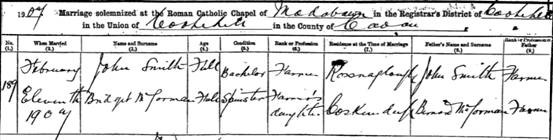
John Smyth married Bridget McGorman or Gorman on February 11, 1907, at St. Patrick’s Chapel in Maudobawn, Killatee Townland in Cavan. Father Michael Young performed the ceremony, which was witnessed by John’s brother, Peter Smyth, and Maggie McEnroe. In 1908 John Smith of South Dakota visited his cousins, John and Bridget Smyth of Rossnaglough. Bridget’s son, John, was just one month old when cousin John Smith visited them in Ireland.
1911 Irish Census
By 1911 the Smyth household was growing and noisy. In this census John’s mother, Anne Smyth aged 73, was listed as head of household. John Smyth, age 52, was a farmer. By 1911 Bridget, age 33, had two children - three year old John and one year old Anne. Mother Anne's other son, Peter Smyth, lived in this household and is listed as a farm labourer. This census says the Smyths had 8 other buildings on their property separate from their home. Not listed in this census are Peter, who was born in 1912, and Bernard, who was born in 1915.

1903 Irish Land Act
The 1903 Irish Land Act, also known as the Wyndham Act, made it easier for tenants to purchase land they had been renting. This law saw almost 9 million acres transfer from landlords to occupiers. By 1914 it is estimated that 75% of tenant farmers were buying land previously held by landlords. From the following chart it appears John Smyth bought property from the Estate of Henrietta Westenra.
Return of Advances Made under the Irish Land Purchase Acts, During the Months of January and February, 1918, published 1920 by His Majesty's Stationery Office. Monthly returns of advances made under the Irish Land Act, 1903


Rossnaglough Smyth Farm
The following picture was drawn from memory by Peter Smyth and assisted by his son, Declan. The Smyths lived in a mud walled cottage with a thatched roof. Please note there was a barn connected to their home. Although the picture does not show it, the dwelling door was a Dutch door also commonly known as a stable door. The bottom half could be kept closed while the top section was open. I was told this was one way to keep chickens out of the home on a warm day!

Unfortunately, none of the Smyth buildings still stand as they were razed many years ago. Today a grove of trees and bushes cover the ground where the old home and farm buildings once stood.

The old Smyth farm no longer exists but is marked by a grove of trees.
John and Peter Smyth
The Smyth gravestone inscription at St. Mary’s Cemetery suggests four Smyths died within a three year period from 1919 to 1921 - brothers John and Peter, John’s wife Bridget and her daughter Annie. Although the same Smyth family gravestone shows young Bernard’s death in 1927, he actually died in early 1920. So much sadness in so few years.
The two surviving boys, John and Peter Smyth, attended Dawson National School even after the death of their parents. The earliest Dawson School record found for John is dated in 1913, and the last dated 1921. In 1921 John’s residence was listed as ‘Killygraggy’ but with a line through it. In this record ‘Faltagh’ was entered above the crossed out entry. Faltagh Townland is south and adjacent to Rossnaglough. Peter’s last school record was dated 1925 and his residence appears as ‘Rossnaglough’.
The Smyth boys were minors when their parents died, and they lived in a home near the school house. (In 1938 Peter Smyth from Liscumaskey wrote: “There was an old school in Rossnaglough in a house where John Smyth lives at the present time. My grandmother used to go to it. It was in Rossnaglough for sixteen years. It started in 1902. There used to be one hundred and ten children at it. The children stayed at school till they were seventeen or eighteen years”.) John and Peter stayed with a Kieran family. Julia Kieran, who lived in the same house as John and Peter Smyth, married a Smyth boy who lived in Faltagh Townland. These Smyths could be related to John Smyth’s family due to their proximity, although this is not certain.
The Faltagh Smyth family lived in a double cottage If John and Peter Smyth did live with this Faltagh Smyth family then it was likely they lived in a double cottage. One interesting fact about John Smyth is he played flute in a marching band.
John Smyth married Roseanne Connolly, and they had eight children: Bridget, Peter, Eddie, Terry, John, Eileen, Benny and Roseanne. John died very young. Eileen, Benny and Roseanne have all passed too. John Smyth, like those who came before him, was a farmer in Aghabog Parish.

Marriage license for John Smyth and Rose Connolly
John Smyth’s brother, Peter, moved to Manchester, England, where he married and had three children named Anthony, Peter and Patricia. Peter Smyth died circa 1985 probably in Manchester, England.
Smyth Family Photographs
From Peter and Declan Smyth Collection
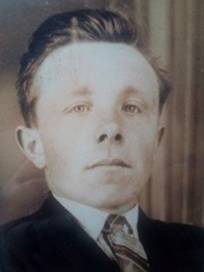

Left to Right: (1) John Smyth (born 1908) photographed in 1940’s; (2) Roseanne Smith, wife of John Smyth, with her son, Peter. Circa 1960.

Benny and Peter Smyth at Home, first two on the left. Photograph taken in 1961.

Peter with Aghabog neighbor, photograph taken circa 1956. Peter was a musician back then with the Cormegan Ceili Band.

Photograph above taken circa 1958 and shows Eddie and Terry with family horse and a neighbor.

Circa 1960 Photograph shows John Smyth in Aghabog.

Circa 1963, Peter Smyth

Circa 1961, Peter with his thrasher
The following two photographs were taken in Faltagh Townland where another Smyth family lived. At this time we do not believe these Smyths are related to our line of Smyths. The Smyths from Faltagh lived in a double cottage, which is shown in these photographs.

Motorcycle in front of double cottage.

Faltagh Smyth boy riding a donkey. This is a good example of a double cottage.