|
Finding Freedom What are you
thankful for?
The Penal Laws of Ireland
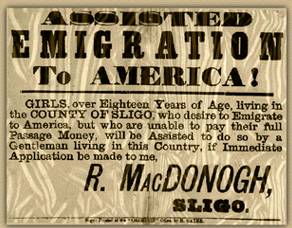
Voluntary and Assisted Emigration
Many of us know these words inscribed on the Statue of Liberty:
Give me your tired, your poor, Your huddled masses yearning to breathe free, The wretched refuse of your teeming shore. Send these, the homeless, tempest-toss to me, I lift my lamp beside the golden door!
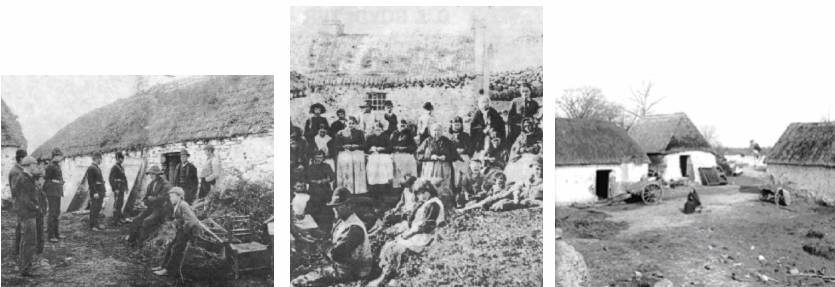
It is good to reflect on these words so close to Independence Day. Eager to escape poverty and starvation our ancestors left their cherished land for America. Were the roads really paved with gold? During the height of the Great Famine our ancestor, Catharine Smith, made a decision to move her family to America. Move they did, and by 1850 Catharine and her children were all living in Brooklyn, New York. What was Catharine leaving? Our Smith ancestors lived in Aghabog Civil Parish, County Monaghan. In 1850 the inhabitants of Aghabog were described as ‘miserably poor’. Although a majority in Ireland, Irish Catholics suffered through years of English rule. There was no love lost between our Irish ancestors and their English landlords. English laws were designed to suppress the Catholic Irish living in their own land. Some of our ancestors moved to America freely. Others were forcibly moved to ‘deplete the surplus population’. Our Hill ancestors may have been forced out of their home by their landlord, and their only option was to move overseas. Whatever the reasons, in America all were free to succeed or fail on their own merits. Penal Laws in Ireland The Penal Laws in Ireland refer to a series of laws which discriminated against Catholics and Protestants who did not belong to the Established Church (Anglican). Catholics were barred from holding public office, serving in the military and from worshipping freely. You could be fined if you did not attend Anglican services, and in the early part of the eighteenth century Catholic seminaries were banned. How the Catholic faith was able to survive in Ireland is utterly amazing. Much later Catholics were tolerated as long as Mass was conducted in private. Priests could perform their duties; however, Bishops were outlawed. Several times the Catholics revolted against this harsh rule; however, each time it was put down violently. During the Irish Rebellion of 1641 many Protestants were killed, and this was not ignored by British authorities. Oliver Cromwell stopped this revolt and slaughtered thousands upon thousands of Catholics in his wake. In County Monaghan, for example, it was estimated the population dwindled to 2,000 souls by 1660. To make matters worse Catholics were barred from the Irish Parliament, their lands were confiscated and for a short time Catholics could not live in the towns. It was during Cromwell’s time that Priests were expelled from Ireland, and executed if discovered in Ireland. Many Priests said mass at Mass rocks in the countryside. Our County Monaghan ancestors worshipped in St. Mary’s Church, Aghabog Civil Parish; however, this church was not built until 1812. Near this church stands an old Mass Rock where Catholics worshipped during these tumultuous times.
The following lists the deprivations Catholics and non-conformist Protestants endured under English rule:
The English thought Irish Catholics would convert and adopt English customs as their own. In 1641 Catholics owned 60% of land in Ireland and by 1776 Catholic land ownership in Ireland stood at only 5%. In 1735 about 30% of Irish declared themselves Protestant and it may have appeared that eventually most or all would conform, but this would not be the case. Few Catholics actually converted and only sporadically. The gentry converted to keep their family lands intact. By the early nineteenth century Catholics were required to pay tithes to the Anglican Church. Within a few years many Catholics refused to pay these tithes, and this caused tension between the poor Irish and their landlords. This was known as the Tithe War. Many Irish families still tell stories about these troubled times. One person told us his early relative was flogged to death for harboring a priest. Another person told us his distant relative was murdered while saying Mass. Still another person told us one of her relatives was shipped off to Australia for stealing food in order to feed his starving family. The following was taken from the book, The Irish Priests in the Penal Times (1660 – 1760) by William Burke. (Pages 293)
The high sheriff of the county wrote 12th March 1743 – 4:
I went round this County and have made the strictest enquiry I could about the Popish clergy, and send a list of them enclosed with the barony, parish and place of their abode. I think every Protestant ought to exert themselves. RICHARD GRAHAM.
A List of the Priests etc. Returned by the Sheriff of the County of Monaghan:
Parishes Priests Names. Monaghan Francis Duffy Lived in the town of Monaghan until about the 5 of March instant, but is run away; Has a mass house near Monaghan. Tyhallan James Duffy lives on the lands of Tullylust. Tydavnett James Murphy lives on the lands of Drumshever, has a curate called Thomas Trenor who is a friar And lives in Iteriry and has a mass house. Killmore and Drumsnatt Hugh Moynagh called vicar Generall of the Diocese of Clogher lives in Cooledarragh in Drumsnatt. Erigill Ross McKenna and Patrick Murray; priest McKenna lives in Mullyodan, McKenna is harboured by Turlogh McKenna of Corclar McKenna, is reputed a dangerous insolent fellow. Donagh James McKenna lives in Cloncare and has a mass house and a chapple of ease.
The titular Bishop of Clogher Ross Roe McMahon otherwise Ennis lives in Corvally in the parish of Amatris.
Clonenish James Ward lives in Anaghgulgan lying in County Fermanagh, has a curate that stroles through the Parish called Patrick Ruckagh McDonald – both very dangerous men. Amatris James Clearkan, lives in Cornwall and has a mass house. Aghabogg Patrick McQuaid lives in Corleck. Currin Michael Connolly lives in Aghnafin. Killevan Tole Connolly lives in Kinturk. Clontubritt Philip McArdle priest of the lower part lives in Carrickanure. Upper Clontubritt Pierce Duffy lives with one Charles Molloy near Castleblaney. Aghnamullen Patrick Brockagh Duffy and Owen Tray nor Duffy, has no residence but stroles through the Parish. Trenor resides with one Patrick Roe Reddy. Duffy near Loghegie. Tullycorbett Roger McMahon lives in Lisdoe. Mahaross Patrick Ginor resides with one Richard Hand of Carrickmacross and has a curate called Patrick Boyland who resides with one Bryan Byrn of Lurgann. Dunamoine Patrick McCabe otherwise Freeman lives in Longfield, James O’Neill and James Cassidy are assistants. O’Neill lives in Shankaloe, Cassidy has no residence but stroles Through the parish. Freeman has a mass house (added) Neill and Cassidy are friars. Eniskeen Hugh McMahon otherwise Hugh Roddy lives in Ballyrush and has a mass house. Maghracloony James Callan lives in Dromboe. Killany James McMahon lives in Tullyultun in Co. Lowth Drunamoine James Clinton a friar lives in Coas where a popish fryary or convent was lately held.
|