

The McDonalds of Tipperary
The McDonald Family
County of Tipperary
Introduction:
At its height there were perhaps 2,600 McDonald families living in Ireland. There were also several variants for the McDonald surname: McDonnell, McConnell, and McDonough among others. No evidence suggests these surnames are connected. The McDonald clan probably moved to Ireland as a result of the gallowglass movement as well as from later immigrants. Perhaps reflecting the mixed Scots-Viking ancestry of the clan, McDonalds are found all down the east coast of Ireland, an area settled by Scandinavians. A large number of McDonalds also live in Northern Ireland.
In the first part of this paper we discuss Margaret McDonald Hill and her family. The middle section reviews all the McDonald reference we could find in County Tipperary. Lastly, we discuss where we think Edward and Margaret Hill lived in County Tipperary. Maps are included.
Gallowglass
During the 13th to 17th century Irish and Scots Highland chieftains hired elite bands of mercenaries, skilled in the use of heavy hand held weapons, to supplement their forces. These mercenaries were known as ‘gallogladh’ or gallowglass, which in Irish Gaelic means ‘foreign warrior’. Generally, they were Viking in origin. They were known by their huge stature along with their distinctive long coats of padded cotton (or chain mail) and conical-shaped helmets. Their look set them apart from ordinary Irish warriors, and they became the scourge of the Irish war machine. They were also recognized by their Claymores (great two-handed swords) and by their Sparths (great battle axes). .
Not all Gallowglass were mercenaries. Some such as the Mac Donalds and the Mc Rorys were loyal to the Scottish king Robert the Bruce, and helped Bruce to overthrow English rule in Scotland. While invading Ireland in 1318, Bruce's brother Edward was accompanied by both a Mc Rory and a Mac Donald chieftain who were killed on either side of him.
Margaret McDonald Hill
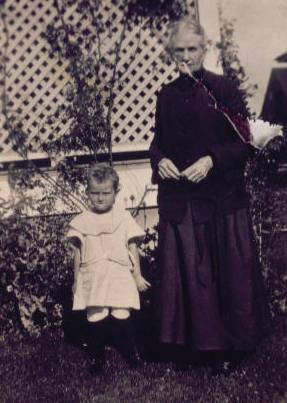 |
Margaret McDonald Hill was our great ancestor.
She is the older woman pictured to your right.
Margaret McDonald was born in 1816 or 1817 in
Within 5 years the family moved from
More detail on the Hill family appears in another
document.
|
Our Family Tree
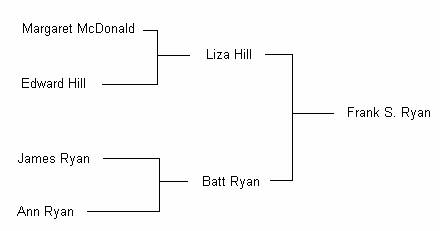
The following is a simplified version of our family tree. The Hill and Ryan families all emigrated from County Tipperary, and eventually made their homes in Allamakee County. Allamakee County is located in the extreme northeast corner of Iowa.
Griffith Valuation Survey
The first modern census for Ireland began in 1821 and a census was taken each year. Unfortunately, war and fires destroyed most census records, and the earliest records to be found are dated 1901. Due to this lack of census information, genealogists rely on ‘census substitutes’ such as the Griffith Valuation Survey when seeking distant relations. This survey would have collected dust and long forgotten had the census returns been intact. This survey was taken from 1847 to 1864.
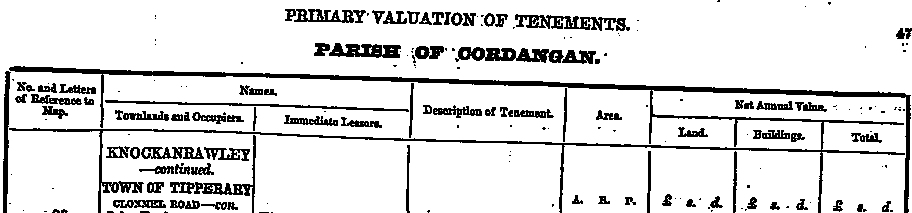
How does this information help us? Genealogists use this information to search for distant Irish relatives. In this case there are very few McDonald families enumerated in this survey. We could only find 4 McDonald families listed for County Tipperary in this survey. This would indicate that the McDonald clan was not indigenous to this area. It may also indicate that by the time the first valuation was conducted (1847) most McDonald families left Ireland for other lands. The Ryans were still pretty plentiful in this part of Ireland. What is interesting about this group of McDonald families is that none of them appeared to farm any land. From what we can see each of these McDonald families lived inside market towns in County Tipperary. In many ways it is a mystery why so few McDonalds are found listed in Tipperary during this time period. Who are these McDonalds? Are they in any way related to our family tree? Perhaps yes. Perhaps no.
|
|||||||||||||||||||||||||||||||||||
|
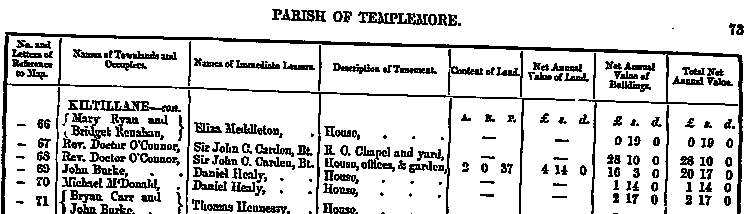
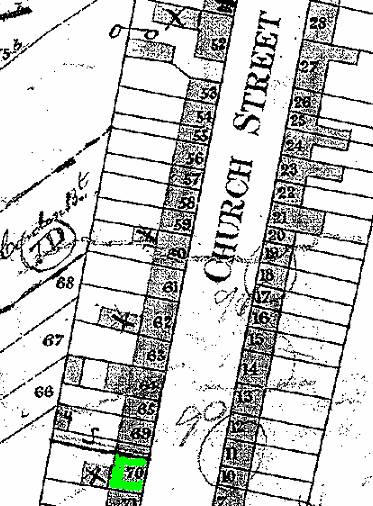
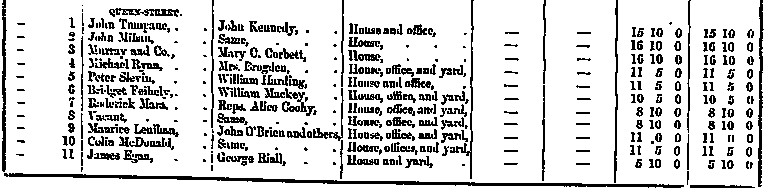
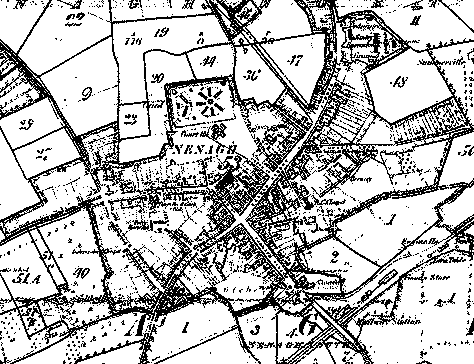
In the following examples you will see a portion of the Griffith Valuation Survey and maps
Parish of Templemore – Kiltillane Townland
|
||||||||||||||||
 |
||||||||||||||||
 |
|
|
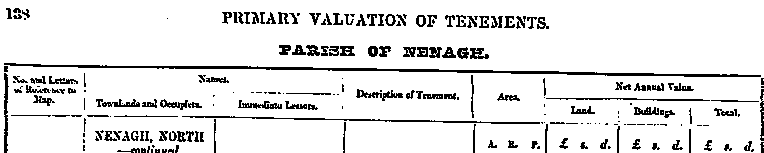
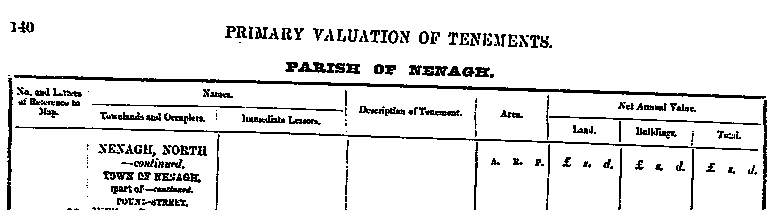
Parish of Nenagh – Nenagh, North
|
||||||||||||||||
 |
||||||||||||||||
 |
 |
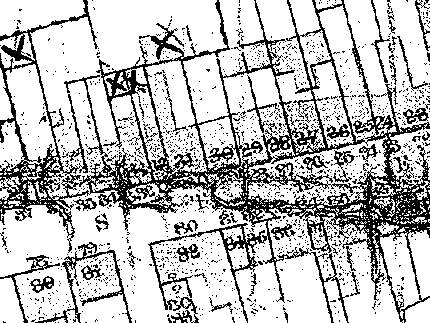
| If you look at the Valuation Survey it shows Colin McDonald living
on
|
 |
 |
 |
|
Parish of Thurles – Thurlestown Parks
|
||||||||||||||||
 |
||||||||||||||||
 |
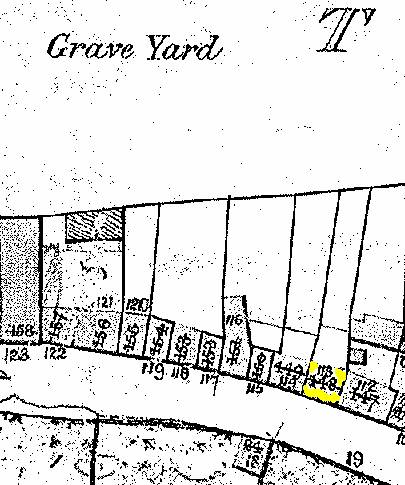 |
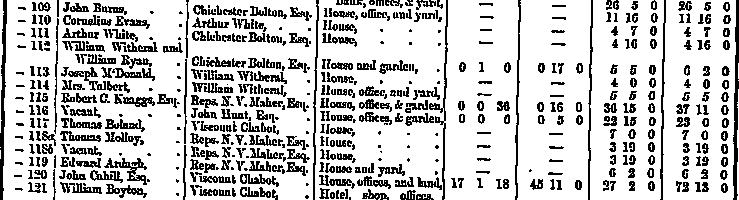
In Thurlestown Parks there lived a Joseph McDonald.
He lived in House #113, which was located next to the grave yard.
We have highlighted his house in ‘yellow’.
Also, it appears the enumerator changed the house number
designation. It is not clear when
this change was made; however, this is the map associated with the
Griffith Valuation Survey taken about 1851.
|
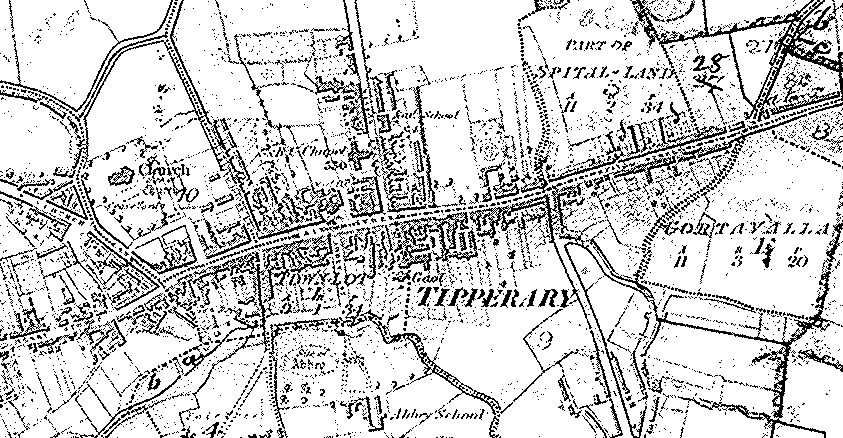
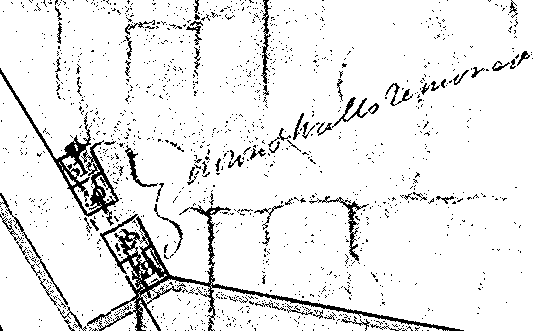
Parish of Cordangan – Town of Tipperary
|
||||||||||||||||
 |
||||||||||||||||
 |
 |
 |
|
Early Tipperary Census Substitutes
The best I was able to get was partial abstracts for the Tithe Applotment Records and 1766 Religious Survey for County Tipperary. Every tenant was required to pay a tithe to the Church of Ireland regardless if a member or not. Many Irish in this area did not contribute to the tithe and their names were added to the ‘Tithe Defaulters List’. In some areas of Ireland this last latter list was longer than the Tithe Applotment Record. Many Irish took great pride in finding their names added to the latter list. Unfortunately, I cannot find a copy of this defaulters list anywhere. The ‘Tithe Defaulters’ list may be published in our website at a later time. In our search we could only find the following McDonalds listed in the Tithe Applotment Record of 1823.
This entry was recorded at Templemore in 1823. ‘Farrenderra’ is probably ‘Farranaderry, which is a townland in Templemore Civil Parish. More specifically, Thurles market town.
|
McDonald |
Bryan |
221 |
16 |
Farrenderra |
This Tithe Applotment Record was recorded for Templeree in 1824. We could not find a ‘Gurtadangan’ but did find a Civil Parish named ‘Gorteendangan’, which is located in Templeree Civil Parish, County Tipperary, North Riding. This probably is the same location.
|
McDonald |
John |
Gurtadangan |
The 1766 religious census was taken for most of Ireland. It was taken to determine the religious leanings for those who lived in this land. For Tipperary we could find only the following listings; however, please understand that we could only find a partial listing for this survey. An entry exists for a John McDonald, Protestant, living in Tipperary town. All Catholics were referred to as ‘Papists’. Since this is only a partial listing, we assume there were other McDonalds living in County Tipperary during this time period.
|
McDonagh |
Dan. |
Papist |
Newport |
|
McDonald |
John |
Prot |
Tipperary |
|
McDonnell |
Sandy |
Papist |
Newport |
|
McDonnough |
Dan |
Papist |
Newport |
|
McDonnough |
Jim |
Papist |
Newport |
|
McDonough |
Mich |
Papist |
Newport |
Other McDonald References
Due to the dearth of information from census substitutes we try to find other references to McDonalds living in Tipperary during this time period. The Griffith Valuation lists 4 McDonald families in Tipperary, and should be almost a complete listing. In neighboring Clare County the Valuation Survey lists 3 McDonalds; however, there are 23 McDonald families listed in neighboring County Limerick. We list other references for McDonalds we found in our search and these are shown below. We use these references to determine where the greatest number of McDonalds lived in Tipperary during the mid-nineteenth century.
1839 Nenagh Guardian Express newspaper (Index 3): Elizabeth McDonald arrested at Cool for conspiracy to murder Mrs. Maher. Where is Cool? We suspect the newspaper is referring to the townland, Coole, located in Castletownarra located in the Barony of Owney and Arra. This Barony is located in North Riding Tipperary and can be found in the northwest section of this County. It is part of the Nenagh Union.
1839 Nenagh Guardian Express newspaper (Index 1): Julia McDonald, daughter of Lt. General Sir John McDonald married Rowland Stanley. This happy event occurred in Nenagh market town.
1839 Nenagh Guardian Express newspaper (Index 4): Edward McDonald, who lived in Mountrath, provided evidence in the Worrell trial. Court papers identified his trade as confectioner. The only places we could find a reference to Mountrath was a street name in Dublin or a townland in County Queens. County Queens is adjacent to and east of County Tipperary. Perhaps it is an old placename found in Tipperary but no longer used.
On October 10, 1848, William Smith O'Brien was sentenced to death by hanging for treason. His sentence was commuted to transportation to Tasmania by June 28, 1849, but in 1854 he was granted a conditional pardon on the basis that he not return to Ireland. He received a full pardon two years later, and briefly returned to Ireland. He died in Bangor, Caernarvonshire, Wales, on June 18, 1864. A petition circulated Ireland, Scotland, Wales and England requesting his life be spared. A McDonald from County Tipperary signed this petition.
1848-1849 William O’Brien Petition
|
McDonald |
James |
Tipperary |
Nenagh |
Another genealogical tool used is the 1889 Bassett’s Directory of Tipperary. It is used to determine where various family groups clustered. McDonald surnames appear only for listings in southern County Tipperary. Earlier we saw a number of McDonalds listed in and around Nenagh; however, northwestern Tipperary was and still is a rural area. Very likely there were fewer businesses located up north. In any event, the following list is still interesting.
1889 Bassett’s Directory of Tipperary
James McDonald Schools National Eager Lane Cashel
Francis McDonald Schools National Eager Lane Cashel Males
Kate McDonald Schools National Knock
Rev. Michl McDonald Churches RC Golden PP
MI McDonald Post Office Clonmore PM
Another place we looked was emigration logs for McDonald references. We found the following that are also interesting.
James McDonald was paid to travel to Australia in October 1859 and settle there. The emigration information shows he was 22 years of age and from Kilcooly. Kilcooly was a townland located in North Riding County Tipperary, Barony of Eliogarty, Thurles Union, in Kilcooly Civil Parish.
The following two McDonalds were born in Tipperary, Ireland, and immigrated to Sydney, New South Wales.
Bridget McDonald emigrated 1842, 23 years of age. She was originally from Thurles in North Riding County Tipperary. Her parents were Jack and Honora McDonald. She was baptized at Glankin and left aboard the ship ‘Woodbridge’
Margaret McDonald emigrated in 1855, 27 years of age. She was originally from Toomyvara. Her parents were Michael and Mary McDonald both dead. She is identified as a Roman Catholic and left on the ship ‘Gloriana’. Where is Toomyvara? It is located in the Barony of Upper Ormond, Union Nenagh, Aghnameadle Civil Parish, in the townland of Bunacum.
Another petition circulated Ireland during the mid-nineteenth century and was called the ‘Cormack Petition’. Daniel and William Cormack from Tipperary were tried and found guilty for the murder of John Ellis, a local land agent in February 1858. Motivated by growing unease at the convictions and executions, a petition was organized and sent to Parliament with a request to set up an inquiry surrounding the circumstances of these convictions. In addition, the petition asked that Parliament review the administration of criminal justice in Ireland generally. One of the signers of the petition was a McDonald from County Tipperary.
John
|
McDonald
|
Templetuohy
|
Templetuohy is part of the Archdiocese of Emly and Cashel and found in the general area of Thurles.