The Turgeons - Initial Paper written 12/04.
Contains inaccuracies and unconfirmed family lore. It is continued so that
the family can see where Tim started - and where his research finally took him
Home | Smith Photos | Family Stories | Ryan Data | Smith Data | News Center | SITE MAP | Contact Us
|
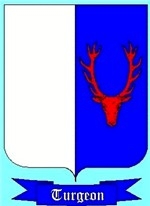
|
The Turgeons in South Dakota -
Initial Research by Tim Smith
The
earliest recorded Turgeon enlisted in the Civil War. with the Dakota
contingent. His name was Ferdinand, and most likely was a brother
to Edward (Edouard) and the other brothers who lived in Dakota territory.
At this time, we are not sure how long they were in the territory,
although we know that the Turgeons were among the first 100 settlers in
Quebec. We also know that all Turgeons in Canada and the United
States are distantly related, but all share a common ancestor:
Charles Turgeon.
|
Charles Turgeon
In the spring, of the year 1662, Robert
Boulay, before his departure for Canada, borrowed 20 livres from Charles
Turgeon, to buy a few necessary articles of life and to pay for his journey to
La Rochelle. On June 23, of the same year, the debtor and creditor met at the
port of La Rochelle. At that time, Charles required a paper signed, in the
presence of the notary, Moreau, as guaranty of his loan to Boulay, verbally
consented to, a few weeks earlier.
Who was this Charles Turgeon? A Percheron
like Boulay. Charles Turgeon, the son of Jean and Sebastienne Liger, had been
baptized, on Saturday, September 3, 1627, at the church of Notre-Dame, in the
city of Mortagne, today, it is the head town in the Department of the Orne, in
the former Province of Perch. Historian Archange Godbout informs us that,
Charles had as brothers Charles, buried October 20, 1626 and Gilles, who was
baptized, on October 22, 1635; as sisters, Charlotte , Jeanne and Anne.
 |
"October 22, 1670 Giroux and his wife, Marie Godard sell the 'The Giroux
House' in the hamlet of Bignon, in Revillon, in the old province of
Perche to Charles Turgeon of Beauport |
FRENCH HOME
Charles Turgeon was married, about 1649, to
Pasquiere Lefebvre, probably at Mortagne. The marriage record has not been found
and because of this, the parents of the future Canadian Ancestress are not
known.
Charles and Pasquiere began to raise their
family at Mortagne. The eldest, Jeanne, was baptized, on July 18, 1650, in the
parish of Saint-Jean and she was buried two days later. Also baptized, in the
same place were Marie-Claire, on September 29, 1651; Jacques, on September 29,
1653; Francoise, on November 18, 1656 and buried, in April 1657; Anne, on August
28, 1658; Michel, on September 3, 1661; Michel, who presumably died in France.
Of the six children born at Saint-Jean de Mortagne, three survived and came to
New France; Marie-Claire, Jacques and Anne.
In June 1662, 100 soldiers and 100 workmen
were at the harbor, of Chefdebaye. His Majesty had chartered two ships, the 300
ton L'AIGLE D'OR, commanded by Captain Gargot and the 150 ton SAINT-JEAN
BAPTISTE. About 300 passengers, including Charles Turgeon and his family, were
aboard these ships to come to Canada. However, no document allows us to verify
the date of the departure or the list of passengers of each ship. Other ships
making the passage, from La Rochelle to Quebec, that year were L'AIGLE BLANC and
LA FLUTE ROYALE DE BROUAGE. What we do know is that, the Turgeons arrived, at
the capital, of New France, in the summer of 1662.
SEIGNEURIE OF BEAUPORT
It is difficult to determine the schedule
of Charles Turgeon and his family, upon their arrival, in Quebec. No one has yet
found his contract for the acquisition of land, in 1663. Afterwards, Charles
Turgeon always said that, he was from the Seigneurie of Beauport. This was
confirmed by the census of 1667. The censustakers recorded them as having 10
arpents of land under cultivation, without more details. His neighbors, at that
time, were Claude de Berman, Sieur de Lamartiniere and Francois Guyon dit
Despres. The rest of his story tells us that, Charles had a few pennies in his
pocket.
On December 9, 1669, Jean Gibault and
Marie-Suzanne Benet, living in the town of Fargy, sold to Master Charles
Turgeon, also a resident of the seigneurie of the said Beauport, 40 arpents of
land, in the town of Saint-Joseph, with cabin and shed, bordered by Jean Lemarie
and Pierre Lefebvre. Charles paid 200 livres cash and 25 livres "in pots of
wine" for the wife. Witnesses: Pierre Vallee, master surgeon and Denis Avisse,
bailiff.
On the last day of December 1669, Charles
acknowledged a debt of 194 livres to Pierre Pellerin dit Saint-Amand, merchant
of Quebec. The creditor was fully paid off, on October 16, 1670.
Toussaint Giroux, a resident of Beauport,
had just learned of the death of his mother, Marguerite Quilleron, during her
lifetime, a resident of the hamlet of Bignon, Parish of Reveillon, in Perche,
France. Heir to a house, a small garden and an enclosure of two arpents of land,
under cultivation, land which bordered Barouil and the heirs of the late Sieur
Gabillon. Giroux wanted to sell this property. Charles Turgeon paid cash to the
said sellers, in silver coin and 300 livres, on October 22, 1670. Why did our
man invest in France?
Surprise! The day after this purchase,
Charles found himself again at the home of Notary Becquet. We learn that, on
July 31, 1669, he had sold a house to Zacharie Cloutier senior, from Beauport.
Well, the latter still owed 300 livres for "Remainder of Sale & delivery of a
homestead Located in the fief of la Cloutterie". Turgeon gave a receipt to
Nicolas Dupont, Sieur de Neuville, who paid in the name of Cloutier. However, on
October 20, 1670, Charles and Pasquiere Lefebvre borrowed 150 livres from
Toussaint Giroux.
During a period of several years, the
Turgeons seem to have made an effort to educate their children, including their
last child, Jean, baptized at Quebec, on May 17, 1670.
VARIOUS FACTS
Charles Turgeon was a difficult neighbor,
somewhat quarrelsome. Jacques Marie, a resident of Beauport, knew something
about this. On January 12, 1677, the latter set, in motion, the legal machinery
against Our Ancestor. Charles had taken wood from his land, removed the stake
from the ground, on the boundary line and even removed the cap from the head of
the said Marie and then gave the offended party a number of blows, with a stick.
According to the documents, written by Notary Vachon, which is difficult to
read. Turgeon got eight days in jail and 20 livres in fine, one-third of which
was given to the church, a second third to the poor and one-third to the court.
On March 31, 1670, David Asselin and his
wife, Catherine Baudard, had received 44 livres from Charles Turgeon, to
reimburse them for passage to this country, for Etienne Beaufils. Beaufils
returned to his homeland, in 1673. Had he worked for the account of Turgeon? On
March 4, 1677, Asselin gave a receipt to Charles. The matter of Etienne Beaufils
surfaced again, on March 20, 1679. Turgeon admitted that, he had been paid by
Beaufils and Louis Dsesmoulins, after an accounting was made between them.
On Monday, December 4, 1679, Charles
Turgeon learned that, his complaint against Pierre Toupin dit Lapierre and Rene
Siret dit Lafleur, was accepted by the Sovereign Council. It seems that, the
latter had cut pine trees on Charles' property. The accused then asked for an
official report of the survey, by Jean Le Rouge, on the following January 8.
Gradually, this case seems to have been thrown into the waste bin of oblivion.
Charles Turgeon, habitant, living in the
village of Saint-Joseph de Beauport and Jean de Rainville...in order to maintain
peace and friendship...and to avoid a long lawsuit, reached an agreement
together, on September, 18, 1681. Rainville promised to give Turgeon, before All
Saints Day, 46 livres, 36 of them spent for the expenses of the lawsuit and 10
to pay for bandages and medications, which the surgeon provided to Turgeon, for
his wounds...The two adversaries had come to blows...Furthermore, Jean de
Rainville had broken Charles' gun. He was obliged to pay for it.
Turgeon farmed the land, in the village of
Saint-Joseph, between the properties of the Lord of Beauport and the village of
Saint-Michel. On August 17, 1683, he had a neighbor named Joseph Vandandaigue
dit Gadbois, a master carpenter living at Quebec. The latter offered his land as
a farm lease and an amount of grain for five years, on condition of giving him
25 minots of wheat each year. Charles accepted this offer. In the spring of
1683, on April 29, Charles had also obtained, at the rate of 10 livres annually
for three years, the land of Claude Graton, Sieur de Villefort, who was on a
journey to France.
In 1688, in the bailiwick of Charlesbourg,
Charles Turgeon managed to obtain payment, for services rendered, to Pierre
Parent, 19 livres. He had also done business with his son, Jacques Parent, by
selling him two oxen.
A second time, the good understanding
between Jean de Rainville and Charles Turgeon turned sour before the Sovereign
Council, on January 31, 1689. Charles did not accept the decision of the Provost
of Quebec, namely that, the appellant Turgeon had to use the large path to go
from village, of Saint-joseph, to the meadowlands of Fargy or Beauport. The high
court ratified the decision of the Provost. It even gave it some teeth! Our
Ancestor had to resign himself to scrupulously use the public road...
How difficult it is when one does not get
along!
THE TURGEON FAMILY
1) Jeanne was baptized July 18, 1650, at
Saint-Jean de Mortagne, France. She died and was buried two days later.
2) Marie-Claire was baptized September 29,
1651, at Saint-Jean de Mortagne, France. She married Abel Sagot, the son of
Guillaume and Marie Marchand, on October 15, 1665, at Quebec. They had one son,
Louis. Louis was killed by the Iroquois, in August of 1689, at Lachenaie.
Marie-Claire died August 20, 1711 and was buried the next day, at Quebec. Abel
remarried to Marie-Madeleine Sasseville, the daughter of Pierre and Marie
Seigneur and widow of Augustin Normandin, the son of Jacques and Catherine
Boismoreau, on May 25, 1712, at Quebec. This couple had no children.
3) Jacques was baptized September 29, 1653,
at Saint-Jean de Mortagne, France. On November 26, 1704, at Beaumont, he married
Marie Jean, the daughter of Vivien and Elizabeth Drouet and widow of Pierre
Bourget dit Lavalle and the son of Pierre and Marie Rioux. Four children were
born to this family, 2 girls and 2 boys.
4) Francoise was baptized November 18,
1656, at Saint-Jean de Mortagne, France. She died and was buried, in April 1657,
at Saint-Jean de Mortagne, France.
5) Anne was baptized August 28, 1656, at
Saint-Jean de Mortagne, France. She became a lay sister, on January 31, 1679, at
the Nursing Sisters of the Hotel-Dieu of Quebec. She became Sister Marthe. She
died, at the Hotel-Dieu, on April 15, 1725.
6) Michel was baptized September 3, 1661,
at Saint-Jean de Mortagne, France. He probably died in Mortagne, France,
sometime before his family's arrival in Canada and the 1667 census.
7) Zacharie was born May 7, 1664 and was
baptized the 22nd, at Quebec. He married Marguerite Roy, the daughter of Nicolas
and Jeanne Lelievre, on October 21, 1691, at Beauport. This couple had thirteen
offspring, 7 girls and 6 boys.
8) Pierre (1) was October 19, 1666, at
Beauport and baptized the 24th, at Quebec. He died and was buried February 10,
1667. He was four months old.
9) Pierre (2) was born and baptized in
1669, where? He married Marie-Anne Carrier, the daughter of Jean and Barbe
Halay, on November 16, 1695, at Lauzon. They had two sons. Pierre died November
9, 1699, at the Hotel-Dieu. Barbe married again. Louis Lemieux, the son of
Gabriel and Marthe Beauregard, became her husband, on May 4, 1700, at Lauzon.
They had one son, Jean.
10) Jean was baptized May 17, 1670, at
Quebec. He married Anne-Therese Vachon, the daughter of Paul and Marguerite
Langlois, on November 8, 1691, at Beauport. Sixteen babies were fed at their
supper table, 6 girls and 10 boys.
The third generation was made up of
thirty-six children, recorded in our Canadian registries.
RETURN
In the autumn of 1693, Charles Turgeon and
Pasquiere Lefebvre had just made a serious decision. They were on the point of
leaving for Old France. In the presence of the notary, Louis Chambalon, on
December 3, they appointed their son, Jean, as their general and special
administrator, in this country of Canada. On the same day, Charles and his wife
admitted owing Jean a debt of 500 livres, which he had lent them to facilitate
their passage back home. Jean could pay himself from the first money, which he
will receive from their effects or leases, whenever he wants. Signing, as
witnesses, were Jean de Lestage, clerk in the bureau, of Quebec and Jacques
Philippeau.
The Turgeon parents, after coming to New
France, returned to their country, of origin, by one of the last ships, which
left the harbor of Quebec, in November 1691. How many months or years did the
Turgeons remain in France? At the time, of the marriage of Pierre, at Lauzon, he
was said to be the son of Charles and Pasquiere, of Beauport. But, at the
marriage of Jacques, on November 26, 1704, at Beaumont, his parents seem to be
deceased.
On April 9, 1699, at the time of a serious
request presented to the Sovereign Council, by Gabriel Lambert, the paternal
uncle, of the minor children, of the late Eustache Lambert, his brother and
Marie Vanech, the wife, in the second marriage of Louis de Niort, for the
purpose of preventing the latter from misusing the property left by his brother.
There was mention of Charles Turgeon, Gabriel stated:
"that on the homestead for which Charles
Turgeon paid forty livres in rent, land Which will be able to Be redeemed by the
said Turgeon from the said Minors for the sum of eight hundred livres..."
Conclusion: Charles and Pasquiere Turgeon
had returned, to New France before the beginning of the new century.
The love of our country is a Christian
value because Christians are the ancestors of New France. Our origins are
sources of fertility. A son lives because of the faithfulness of his fathers.
FAMILY NAME VARIATIONS
Turgeon has the following known variations:
Hubert, Thurgeon and Turgen.
This biography was taken from "Our
French-Canadian Ancestors" by Thomas J. Laforest; Volume 28- Chapter 21- Page
205 8-20-99