

McGonigle and Allied Families
of County Donegal
 |
Our Family History
Much of the following information was sent to us by Mary Rita Jacobsen. You will see the intials ‘MRJ’ in front of various sections, and this indicates information submitted to us by Mary Rita. These pages contain general information about the following families: McGonigle, Murrin, McCloskey and Timoney. You will also find general information about County Donegal, which is unlike any other part of the Irish Republic. This document has been divided into the following sections: County Donegal General Information; Our Family Tree; Census Substitutes; McClosky family of Donegal; Murrin family; and McGonigle family in America.
We found this information researching various sources including the National Archives and the worldwide web.
You will see that the family surnames have changed over the years. Catholic parishes, dioceses and arch-dioceses have changed over the millennium, and this makes genealogical research challenging to the say the least. It is possible to trace our family through baptism, marriage and death certificates in Ireland, but that would involve a trip abroad or paying someone to do the job.
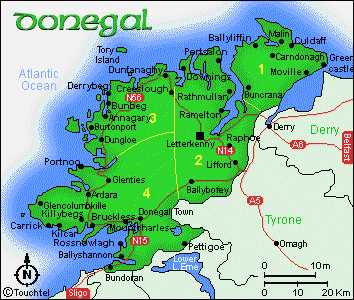
County Donegal General Information
A Brief History of County Donegal
(Copied from a website describing the history of County Donegal.)
In the second century A.D. Ptolemy identified this area as the home of the
Vennicnii and the Rhobogdii. County
Donegal was known as the Kingdom of Tirconnell in the old Irish administrative
system. It was the territory of the powerful O'Donnell family. The other major
families in the county were O'Boyle, O'Doherty, O'Friel, O'Sheil, MacWard,
McLoughlin, McDunlevy, McGillespie, MacRearty, McGrath, McGonagle, O'Mulholland,
O'Harkin, O'Derry, and O'Strahan. The McSweeneys, also a relatively common name
in the county, were a Gallowglass or mercenary family who arrived in the county
in the thirteenth century.
The passing of the name Tir Conaill into distant history has an unfortunate story behind it. The change commenced in the year 1584 when Sir John Perrott assumed the deputy Lordship of Ireland. Within a year, he had assembled a parliament in Dublin, which according to the Four Masters included the following Septs: Hugh O’Neill, chief of Tir Eoin; Hugh O’Donnell, chief of Tir Conaill; John Og O’Doherty, chief of Irishowen; Turlough O’Boyle, chief of Boylagh; and Owen O’Gallagher, O’Donnell’s marshall.
The parliament passed a decree which stated that the area has to be known henceforth as Donegal (Fort of the Strangers). This measure was strenuously resisted by O’Donnell who refused to accept any interference in the running of Tir conaill to the effect, he forbade the entrance of the English sheriff into his territory. However, by the time of the Flight of the Earls had occurred some twenty years later, the name Donegal started to prevail in the vernacular.
This county was little affected by the Norman invasion in the twelfth century and it was not until the late sixteenth century that the English gained any foothold. This was lost again in 1592 when the O'Donnells, under their chief Red Hugh O'Donnell, joined with the O'Neills in a rebellion against the English. This rebellion ended in the defeat of the Ulster Chieftains in 1602, and the county was subsequently included in the plantation of Ulster. Under this scheme the lands were confiscated from the native Irish owners and given to undertakers, i.e., to persons who were granted land on the agreement that they would bring over settlers from England or Scotland.
A general indication of the proportion of native Irish, Scottish, and English
can be estimated from the religious persuasions of the inhabitants as the native
Irish were generally Catholic, the Scottish Presbyterian, and the English
Protestant or Episcopalian. In 1861, when the census first ascertained religion,
the proportions of each religion were 75, 11, and 13 percent respectively. Most
of the surnames in the County are gaelic, some such as
Friel and McGonigle are names long associated with
this County.
In the eighteenth century the county remained relatively remote. Contemporary
maps show few roads in the county, and the accounts of various travelers tell of
the unique customs of some of its people. The Penal Laws were specifically
enacted at the beginning of the eighteenth century to suppress Catholics.
However, they also disadvantaged Presbyterians. For this reason there was
considerable emigration of the so-called Scots-Irish from Donegal and other
Ulster counties during the eighteenth century.
The density of population on the arable land in county Donegal was one of the
highest in the country in the early nineteenth century. The county was not as
badly affected as many others in the Great Famine of 1845-1847. The population
was 296,000 in 1841, and by 1851 it had fallen to 255,000. Almost 28,000 people
died in the county between 1845 and 1850, and further thousands emigrated.
Killybegs
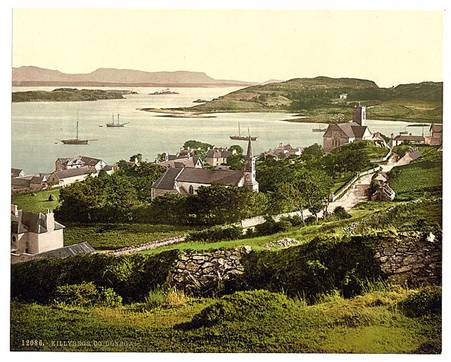
The McGonigle, Murrin and McClosky families can trace ties to the Killybegs area. The parish name has remained unchanged; however, there has been slight variations in spelling through the years. It has appeared as Killbegg, Killebegg or Killebeggs. The following information was copied verbatim from an 1837 description of Killybeggs.
Description from Lewis's Topographical Dictionary of Ireland, 1837
KILLYBEGS, a sea-port, market, and post-town, and a parish, (formerly a parliamentary borough), partly in the barony of BOYLAGH, but chiefly in that of BANNAGH, county of DONEGAL, and province of ULSTER, 38 miles (S. W.) from Lifford and 127 miles (N. w.) from Dublin, on the road from Ballyshannon and Donegal town to Rutland ; containing 4287 inhabitants, of which number, 724 are in the town.
This place, which is situated on the north-west coast, was at a very early period one of the principal sea-ports in this part of the country, and formed a portion of the territories of the chiefs of Tyrconnell. The emissary of Philip II., King of Spain, landed here in 1596, and in April of the following year, a vessel from that country, laden with supplies for O'Donnell, and having some confidential agents on board, arrived for the purpose of conferring with that chieftain. In 1600, another vessel from Spain, with supplies for O'Donnell and O'Nial, landed here, and brought also a large sum of money, in order to promote the object they had in contemplation. On the plantation of Ulster, 200 acres of land were granted by Jas. I. to Roger Jones, Esq., on condition of his laying out the site of a town, building 20 houses with lands for burgesses, and assigning convenient spots for market-places, a, church and churchyard, a public school and playground, and 30 acres of common.
The town is situated at the head of a beautiful and safe harbour, to which it gives name, and at the base of a vast mountainous tract extending northward; and consists of 126 houses. It is the head of a coast-guard district, comprising the stations of Dooran, Tribane, Tiellen-East, Tiellen-West, Mallinbeg, Daurus, Port Noo, and Neptune Tower, with a force of four officers and 56 men, under the control of a resident inspecting commander. A constabulary police force is also stationed here. The market is on Tuesday, and fairs are held on Jan. 15th, Easter-Monday, May 6th, June 2lst, Aug. 12th, Sept. 15th, and Nov. 12th, for general farming stock. The harbour is nearly circular in form, well sheltered, and accessible to ships of considerable burden; vessels not drawing more than ten feet of water may anchor near the town, but the best anchorage is in 8½ fathoms near the west side At sea the harbour is known by the remarkably sharp pointed summit of Cruanard Hill, which is higher than any other in the neighbourhood, and to the south of which is the entrance.
By charter of Jas. I., in the 13th year of his reign, the inhabitants were incorporated by the designation of the “Provost, Free Burgesses, and Commonalty of the Borough of Calebegg." The corporation consisted of a provost (elected annually) and twelve free burgesses appointed for life, who had the power of admitting freemen; and under their charter the portreeve and free burgesses continued to return two members to the Irish parliament till the Union, when the borough was disfranchised, and the £15,000 awarded as compensation was paid to Henry, Earl of Conyngham. A court of record, with jurisdiction extending to £2, was also held every third Thursday; but it has been discontinued for many years, and the corporation has become altogether extinct. Petty sessions are held irregularly.
The parish, from which a portion (38 townlands) has been separated to form the district parish of Ardara, is for civil purposes distinguished into Upper and Lower Killybegs. It comprises, according to the Ordnance survey, 30,962 ½ statute acres, of which 4304¼ are in that part of Lower Killybegs, which is in the barony of Boylagh ; 11,074¼ , including a detached portion, and 51 covered with water, are in the other part, in the barony of Bannagh ; and 15,583¾ , including 41¾ covered with water, are in Upper Killybegs, and the barony of Bannagh : 30,160 statute acres are applotted under the tithe act, of which about two-thirds are mountain and uncultivated land : agriculture is in a very unimproved state.
The principal seats are Wood Hill, the residence of Major Nesbitt ; and Fintra, of J. Hamilton, Esq.
The living is a consolidated rectory and vicarage, in the diocese of Raphoe, and in the patronage of the Bishop ; the tithes amount to £300. The church, a neat small edifice, was built on rising ground to the east of the town in 1829, at an expense of £1000. The glebe-house is of recent erection, and the glebe comprehends six town-lands, comprising together 2000 Irish acres.
In the Roman Catholic divisions the parish is the head of a union or district, comprising also the parish of Killaghtee ; the chapel here is a spacious and neat building, and there is also a chapel in Killaghtee. About 250 children are taught in two public schools, of which the parochial school is supported by an annual donation from Col. Robertson's fund, and the other by ??? Murray, Esq., of Broughton; there are also three private schools, in which are about 140 children, and a Sunday school.
A small Franciscan friary was founded here by Mac Swiny Bannig, but there are no remains. Some ruins be of the ancient castle of St. Catherine yet exist.
 |

Na Cealla Beaga - The Little Cells
The little cells gave Killybegs its name - stone buildings believed to have been built by monks many centuries ago. The whereabouts of these cells is officially unknown but many believed the buildings uncovered at the site of the new pier in Killybegs were the 'little cells'.
St. Catherine of Alexandria
St. Catherine of Alexandria, patron saint of Killybegs achieved martyrdom in the 4th century, never actually set foot in Ireland. Being the Patron Saint of Seafarers, it was natural enough that the people of Killybegs should invoke her protection. This dedication to the saint is said to have begun back as far as the 4th century A.D., when a group of monks who were traveling in a boat along the west coast got caught up in a fierce storm. The prayed to the saint and vowed to erect a well in her honor if they reached land safely. This they did by erecting St. Catherine's Well. It is thought these monks were the first settlers to the area and they set up their monastic cells - hence the Gaelic name for Killybegs - Na Cealla Beaga (The Little Cells).
|
Our Family Tree
|

Adelaide McGonigle married Francis S. Ryan of Kimball, South Dakota.
McGonigle Surname
(Copied from a website describing the McGonigle surname.)
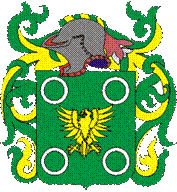
The McGonigles hail from County Donegal. Variants include McGonagle, Gonigle, McConville, and Conwell. Their territory was Donegal and Derry and the sept were counted among the warlike followers of O'Donnell. A sept or clan was a collective term describing a group of persons whose immediate ancestors bore a common surname and inhabited the same territory. They were an erenagh family and their church was at Killaghtee. In the diocese of Raphoe we find two bishops of the name in the year 1589. In the history of the Raphoe diocese Canon Maguire mentions a Magonagle and this name has been anglicized from the Irish MacConmhaoil but the usual anglicization of the name is McConville. The homeland now of the latter name is counties Armagh, Down and Louth. Here we find people of the name recorded in James II's army and after his defeat they were all attained around the year 1690.

(I copied the following from another website describing the surname McGonigle and related surnames.)
Cunningham is not always the old Irish 0 Coineagain (which is a Munster sept) or Mac Coineagain (a Connacht sept). McLysaght states the Cunningham who bore arms, were members of families who were in the company of several landed Scottish proprietors of the Plantation in their many branches. There may be an intermingling of the Irish and Scottish families here. This is most probable in the case of a sept originally named Mac Dhonnagain from Co. Down who changed their name to Cunningham. Although it is not adverted to by McLysaght, there is considerable affinity between the Inishowen name of Mac Dhonaigle (or McGonigle) and Mac Dhonnagain. The latter is equally likely to have been the basis for Cunningham and McGonigle in that area where the names are widespread. Various other names appear there in the Anglified form of Cunningham, notably an original Conaghan. MacGiolla Domhnaigh and 0 Droighneain gave other byeforms such as Coonaghan, McCuinnagan, Kinigan, Kinahan, and Coonaghan. These occur now only rarely if at all in Donegal but may have done so in the past. The basic meaning is "King's Manor" (Coyning Ham) originating with the Anglo-Saxon occupation of Galloway from which most of the Cunningham settlers came.
In south Donegal the Erenaghs of the Killybegs monastic site were MacConghaill or MacComhghaill (St. Coimhghell). This family name was at first anglicised as McGonigle, under the influence of McSweeney's Scottish retainers of the name Cunningham, (or later mainly under the influence of Murray-Broughtons retainers and those of the Marquis of Cunningham the two great proprietors of the Plantation of Bannagh). It just as often appears as Conaghan in the Killybegs-to-Donegal-Town district nowadays.
Erenaghs
Erenachs, or hereditary wardens of churches, were explained by the Jury of an Inquisition at Dungannon in 1609 as: “…the erenach land was att first given by the temporall lords immediate to the first founders of the churches; and that those founders did give the same to severall septs, for payinge rents and other duties to the bushopps, and for repairinge and maynatayninge their parish church, and for keepinge of hospitalitie; and that these seps or eregaghs have tyme out of mynde, inherited the said lands accordinge to the Irish custome of tanistrie, and that neither the lord archbushopp or any other bushopp nor their predecessors, could att any tyme heretofore, or nowe can, remove the said herenaghs out of the said land, onelye they differe in that the termon land had often tymes more privileges, as sanctuarie and the like, which wass not allowed to many of the herenaghs.”
The erenagh’s duties were to provide from his revenue for the support of the clergy and the maintenance of the religious services,” churches and chapels. He was often the custodian of the shrine or bell of the local saint. He had also the obligation of maintaining hospitality.
After the ‘Flight of the Earls’ from Rathmullan in 1607 a number of surveys were made of their lands which were attached by the Crown. Perhaps on of the more interesting of these pre-Planation surveys is on that gives us some insight into the organization of the Church in Gaelic times. A Crown Commission held an inquisition or inquiry in Lifford on September 12, 1609. Part of the documents include the following notation:
“amongst other thinges to distinguishe the ecclesiastical landes from the landes belonging to the Crown, within the said Countye of Dongegall…by oaths of good and lawful men of the said countie of Conegall, whose names ensue, viz. Rowland Congall, Phelim O’Doghertie, Cahill bane McDavid, Fferall McDonil, Donogh O’Morison, Gilleduff McGerald O’Doghertye, Henrie oge McDavid, Morice O’Kerolan, Maurice O’Ardens, Hugh oge O’Donell McGinell, James O’Sherin, Lewys O’Clery, Walter McSwyne, Cahill duff McGarrigle, Peirce O’Donan, Neall McGnellus, Sane oge McGillekerry, and Tirlagh carragh McCarvill, jurors…”