The Packet Ship Centurion
In 1850 the Ship Centurion brought our ancestor, John Smith, to American shores. Accompanying him were his two siblings, Bridget and Owen, and John’s uncle, Terence Greenan. Uncle Terry chaperoned his young niece and nephews to this new land, and left his own family in Ireland. There were at least 8 different English ships named Centurion.
The Centurion, which carried our ancestor, was a packet ship owned by Augustus Zarega and Company of New York, better known as the ‘Z Line’. Packet ships were vessels originally used to carry mail ‘packets’ to and from British embassies, colonies or outposts. In sea transport terminology, a packet service is described as a ‘regular, scheduled service, carrying freight and passengers‘. Ships used for providing these services were described as ‘packet ships’, seaman were called ‘packet men’, and this business was described as ‘packet trade’. Packet ships carried both passengers and freight. Those ships which cleared from port on regular days each month, and had an established route were called ‘liners’. By normal convention, packet ships were allowed a nine to ten week round trip for their trans-Atlantic voyage.
Another packet ship owned by the ‘Z Line’ was the Antarctic shown below. The Antarctic and Centurion probably looked very similar in appearance. The Antarctic carried Bridget Greenan McCarville and her children over to America from Liverpool.

The picture above was painted in 1853, and the original oil painting belongs to the National Maritime Museum. The Antarctic was built in 1851. Her main transatlantic route was from Liverpool to New York. Her name is visible on the vessel and this ship flew the American flag. The house flag , which “Irish” John Smith would have recognized and which appears in this painting, is for the New York shipping company Augustus Zerega & Company. This company was known as the ‘Z Line’. It ran several trans-Atlantic lines to Liverpool, Antwerp and Glasgow in the late 1840s and early 1850s. The Red Z Line, whose flag was a blue-white-red vertical tricolor with a red Z on the center, operated immigrant ships from Glasgow and Liverpool to New York from 1848 until the late 1850s. Another line, called simply the Z Line, operated immigrant ships from Antwerp to New York, 1847–1851. The Transatlantic packet ships sailed on a regular timetable and were among the most renowned of the pre-1850 sailing ships. As well as passengers they carried gold and mail. The Transatlantic packet ships were among the first deep-sea sailing vessels to be affected by competition from steam-powered vessels that also concentrated on emigrant traffic.
Below is the Centurion’s house flag, which flew over many of the ‘Z-Line’ transatlantic ships.


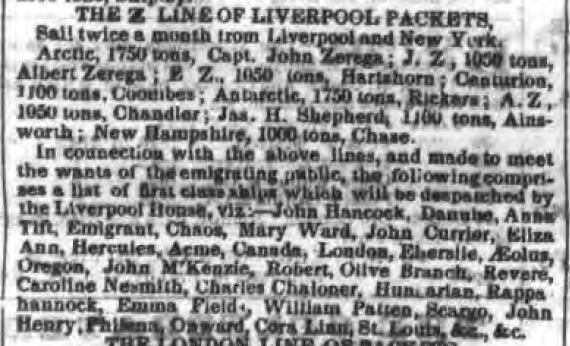
Shipping lines, including the Z Line, advertised in many newspapers to entice business and passenger trade. The following snippet advertises various packet ships, size of ships, name of Captains, and in this case informs the public their desire to transport immigrants. The Centurion is listed below.
Troy Budget; Troy, New York; April 7, 1851
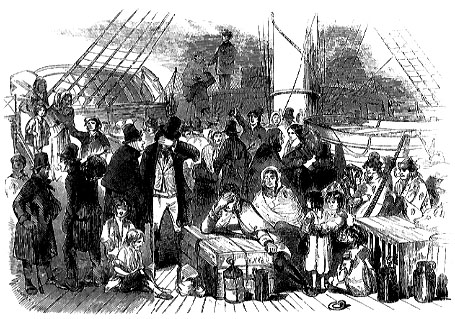
Immigrant Ships
During the mid Eighteen Forties to early Eighteen Fifties countless ships transported poor Irish men, women and children to America. Irish tenant farmers subsided on a meager diet of potatoes, oat cakes, milk or cheese and occasional meat. For a typical Irish family of six to eight children you needed 2 acres to plant your potatoes. Potatoes did not take much effort to grow, and you only needed a hoe to plant seeds. Once harvested, Irish farmers would bury their potatoes under dirt to keep them preserved. With luck your crop would feed your family until next season’s harvest. Potatoes were the Irish cottier’s main source of food.
Unfortunately for the Irish, a potato blight hit the Emerald Isle in the mid Eight Forties, which caused much strife, and lasted several years. Millions starved, numerous Irish died, and many were weakened by the ravages of hunger and illness. Countless Irish were evicted from their land, and many were forced to emigrate from Ireland to the USA, Canada, Caribbean or Australia. Immigrant ships were noisy, packed and by the end of the trip somewhat foul.
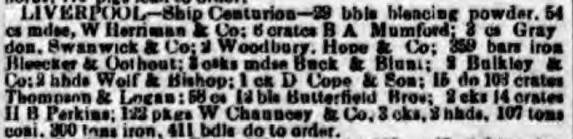
Centurion Arrives in New York - July 18, 1850
When ships arrived in New York they had to submit documents to the ‘Collector of the Customs for the District of New York’ showing who was on board, where the immigrant was from, age, any deaths and other pertinent information. Uncle Terry Greenan and the three young Smith siblings all arrived in America on July 18, 1850. Master Edward Coombs submitted his manifest details to port authorities after his passengers disembarked from his ship.
Boston Evening Transcript; Boston, Massachusetts; July 22, 1850

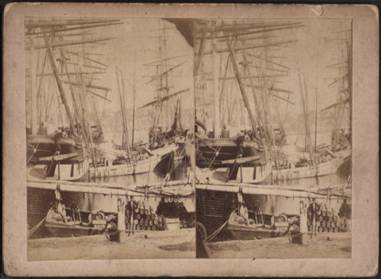
Several newspaper accounts suggested the Centurion docked at Pier 19 in New York City. ‘Z Line’ packet ships from Liverpool normally disembarked on Pier 13, including the Centurion. It is possible the Centurion docked elsewhere if there was no room on Pier 13. Below is an old stereo view card showing Pier 19 in New York City.
The 1858 map below shows New York City Piers. Pier 13 is listed as the normal Pier used by the ‘Z Line’ Packet ships. Pier 13 is circled in red, and Pier 19 is circled in blue. Battery Park is nearby.

This Ship’s Master Coombs detailed 394 passengers, with four deaths on this trip:
Albert Strange, age 6, died July 14, 1850
Sarah Corrley, age 4, died July 4, 1850
James Strange, age 4, died July 10, 1850
Margaret Wiley, aged 11, died June 28, 1850
This ship was relatively safe for its time, and many of its voyages reported no deaths. However, death was common on transatlantic voyages. Many Irish already weakened from the effects of famine and disease, succumbed from their weakened state during their trip to America. One particular Centurion voyage in
1853 showed 15 deaths out of 392 passengers, all due to cholera. In November of that year 28 ships carrying 13,762 passengers reported 1,141 deaths due to cholera. The Captains reported 4 to 5000 people were afflicted. Another ship, The Constellation, with over 900 passengers reported 100 deaths from cholera.
Wisconsin Sentinel; Milwaukee, Wisconsin; November 19, 1853; page 2; Volume IX

Cholera is an infection in the small intestine caused by the bacteria Vibrio cholerae. The main symptoms are watery diarrhea and vomiting. Transmission occurs primarily by drinking water or eating food that has been contaminated by the feces (waste product) of an infected person, including one with no apparent symptoms. The severity of the diarrhea and vomiting can lead to rapid dehydration and electrolyte imbalance, and death in some cases.
Selected Centurion News Accounts
You might be interested in these two old newspaper accounts. One advertisement was placed in July 1850 drumming up business, and the other shows the Centurion arrival at port.
July 1850; New York Morning Courier & Express; New York, New York

July 1859; New York Morning Courier; New York, New York
OBITUARY - Augustus Zerega
Augustus Zerega Dead.
The New York Times; December 24, 1888
STIRRING AND ADVENTUROUS CAREER OF A WELL-KNOWN SHIPOWNER.
Augustus Zerega, an old coffee merchant and ship owner, died yesterday at the residence of his son-in-law, Horace Barnard, 26 East Thirty-fifth-street, of pneumonia and heart failure after an illness of 10 days. Mr. Zerega was born Dec. 4, 1803, in Martinique, where his father was a wealthy ship owner. After finishing his education in England and France the boy was sent on a number of voyages as supercargo, and at the age of 17 bought a ship and went into business for himself. While lying desperately ill on board his own boat in the harbor of St. Thomas, he was found and cured by Baron Von Bretton, a physician, whose 15-year old daughter he married. Subsequently he led a venturesome and romantic career as Captain of sailing vessels, plying the Spanish Main when it was scoured by countless pirates and buccaneers.
When married, at the age of 21, he was worth $25,000, and before giving up the sea he had accumulated and lost three fortunes in the West India and South American trade. He won a wide acquaintanceship, and was an intimate friend of Simon Bolivar and other Spanish American patriots, for whom he filled large contracts in munitions of war. Philadelphia and New-Orleans were his trading centers till 1835. In the following year he established himself in New-York as a coffee merchant, but soon went into the shipping business, owning and managing the Z Line of general ships till 1855, when the boats were disposed of. Among his thirty boats were the Queen of Clippers, the Arctic, Baltic, Antarctic, and other famous sailing vessels. The rescue of 300 United States soldiers from the foundering San Francisco, by Capt. Steaffer of the Antarctic, made a great stir when Jefferson Davis was Secretary of War.
From 1855 to 1863 Mr. Zerega lived at Thogg's Neck, engaging in no business. Since then he has spent his Winters quietly in New York, but has been a familiar figure while looking after private interests down town. He was a genial, charitable, and generous man. Chess was his hobby, and he was one of the founders of the New-York Chess Club, where he played a good second to Capt. MacKenzie. A widow and nine children survive him.