Book of Ryans - The Catholic Church
Catholic Church in the United States
The Irish are our natural enemies, not because they are Irishmen but because they are the truest guards of Popery.
Bernhard Demschke
Wisconsin Democrat, 1854
Many factors influenced the direction of the Catholic Church in the United States, but one of the most influential sources came from Irish-Americans. This persuasion grew especially strong with the arrival of Irish immigrants after the Great Famine. They brought with them a brand of Catholicism which was devout in their beliefs and conservative in their attitudes towards church doctrines. The Irish church modeled parish life which stressed cohesive community life over individualism, and because of the centuries of racial differences developed a sense of community that was built on relationships. This same sense of community was brought to America which became the center piece of religious thought during the late 19th and early 20th centuries in Catholic America.
The early American church was focused in major populated cities, and as the country expanded, priests traveled great distances to say Mass, usually in the homes of the parishioners they served. Even though visits by priests were infrequent, the Irish Catholic tenaciously clung to the faith of their fathers. As the Catholic Church continued to grow in the American frontiers, requests were sent to Europe for Roman Catholic priests, particularly Ireland and France, to serve the growing needs of immigrants arriving from these two major Catholic countries.
A number of factors influenced the direction of the church throughout the 19th century in areas of dogma, particularly the doctrine of the Immaculate Conception in 1854; but predominate among these pressures was the anti-Catholic prejudices existing within the United States. These prejudices were often violent in its expression, and groups like the Know-Nothing Movement led by the fanatically anti-Catholic William Brownlow merely legitimized atrocities against Irish Catholics. Later these anti-Catholic feelings were resurrected by the Ku Klux Klan who were responsible for driving many Catholic families further west. As the immigrants moved further west, the early towns like St. Louis became heavily populated by Catholic men and women, and in the American west's early years religious toleration seemed to be accepted. The situation changed after 1840 when Irish immigration peaked, and as these refugees flooded the North American continent, anti-immigrant feelings began to increase. The Irish and German Catholics were targeted by hate groups, and as the United States filled with Catholic refugees from Europe, newspapers protested the large influx of poor unskilled persons which eventually culminated in several riots across the American landscape.
These stressful times touched many Irish Catholics and persuaded them to serve their church in various capacities. This period also represented a "Golden Age" for the Ryans because they served the church in many capacities as many became well-known priests, bishops, and archbishops. The late 19th century was known as a time when the church was formulating its philosophy, and because so many Ryans were influential during this period, the policies they incorporated helped drive the church's philosophy of social responsibility in the 20th century.
|
|
|
|
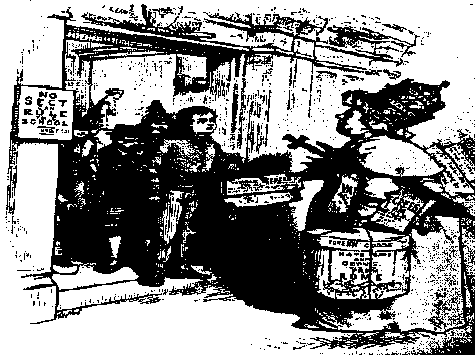
The establishment of Catholic schools was unpopular among American Protestants during the 19th century. Source: New York Public Library Picture Collection. |
|
Patrick J. Ryan
Patrick John Ryan was born in Cloneyharp, County Tipperary, Ireland in 1831 (His official biography notes his birthplace to be Thurles.)[1] He was regarded as one of the foremost ecclesiastical thinkers during the 19th century, and was credited with many major accomplishments particularly those related to social concerns. He was described as "handsome, urbane, eloquent, and powerfully committed to the welfare of his congregation, he was a confident exponent of his views, the views of his church, and the needs of the immigrant poor."[2]
He was educated at Christian Brothers, and later was schooled at J.L. Naughton in Dublin where he was taught Latin and Greek. He later attended secondary school in Carlow and graduated from St. Patrick's in Carlow in 1852. Because America was desperately seeking priests to minister to its growing population, he left Ireland in pursuit of a parish in St. Louis, Missouri. He arrived as a deacon and performed many functions in the archdiocese including teaching at Carondelet seminary, Missouri, and preaching sermons at Mass. He was later ordained into the priesthood by Archbishop Peter Kenrick, himself a native born Irishman. Besides Reverand Peter Donnelly, an Irishman from County Roscommon, Father Ryan was the only Catholic minister in Missouri to hear confessions and perform the Catholic sacraments.
During his career at the St. Louis diocese, Father Ryan served as curate for the St. Louis cathedral and pastor for several parishes surrounding St. Louis. As the number of Catholics into the Missouri territory increased, Reverend Patrick Ryan recognized a need for more ministers of the faith, and wrote to his friend, Father Thomas Butler, to come to America. Reverend Butler accepted Ryan's offer and came to the United States in 1866, and he brought with him 600 Irish men, women and children from his parish in Ireland. Father Ryan formed a new community in Missouri called Butler City.
The American Civil War erupted a few years after his arrival in St. Louis. The tensions were more pronounced in Missouri, a border state, which had sympathizers supporting both sides of the conflict. Although Missouri and other border states held mixed emotions regarding the slavery issue, the Irish enlisted in smaller numbers within the Confederate armies as compared to the armies of the North. Some historians speculated that Irish enlistment in the Confederate army was small because the Irish disliked slavery, a condition which their ancestors experienced while living under English rule. This is perhaps fanciful guesswork - the new immigrants were more concerned about developing financial security rather than questioning the need for slave labor.
Father Patrick John Ryan, along with others in the Missouri diocese, assisted soldiers on both sides of the war during the conflict. They housed war orphans at Guardian Angels in St. Louis, provided medical attention at Guardian Angels for the injured, and Father Ryan personally ministered to the prisoners of war housed at Gratiot Street prison. Along with these duties, Father Ryan also provided ministerial aid to the Confederate soldiers, and was credited with converting many Confederates to the Catholic faith. The number of priests serving the Confederate armies was small; and using Tennessee as a basis, only two priests were mentioned in the records as Confederate chaplains: Father Bliemel and Father Abram Ryan. Another Ryan, Patrick, was recognized informally as a chaplain to the Eighth Tennessee Regiment, but there is no trace of his activities in the official Confederate war records. Other priests such as Father Patrick John Ryan ministered to the southern armies, but they were not exclusively associated with the rebel armies.
The growth of the Catholic population in Missouri further increased Father Ryan's influence in the Catholic frontier. The size of his parish brought him to the attention of the Catholic hierarchy, and in time, became the Titular Bishop of Tricoma with the right of succession:
He was Bishop Kenrick's theologian at the second Plenary Council in Baltimore in 1866, became vicar general of St. Louis, preached Lenten sermons in Rome in 1868, and in 1872 was consecrated titular Bishop of Tricomia and Coadjutor of St. Louis.[3]
He was widely known as a great orator, and this great ability allowed him to address the Second Plenary Council in Baltimore as well as deliver the dedication address at St. Patrick's Cathedral in New York City.
In 1879 he addressed the congregation at the dedication of St. Patrick's Cathedral in New York, that edifice of Gothic grandeur built on Fifth Avenue by immigrants who only a generation before were hardly permitted access to that fashionable thoroughfare.[4]
Father Ryan owed much of his success to Archbishop Peter Kenrick; nevertheless, as a result of Kenrick's opposition to papal infallibility, he lost considerable influence in the church hierarchy. Because of Kenrick's decreasing prestige, Ryan began to assume greater responsibilities and duties within the Archdiocese. His dedication and hard work was later recognized in 1884 when he was appointed as titular Archbishop of Salamis, and again later that year was appointed archbishop of Philadelphia becoming only the second person to hold that title. His appointment to the See of Philadelphia was politically important to Bishop Ryan because Philadelphia was the second largest diocese in the country, and it would provide him tremendous visibility in the American church. He served this diocese for 12 years.
During his lifetime he was regarded as one of the leading orators of theological and social thought, and for his leadership in religious and moral issues he was given the nickname 'Chrysotom of the West.' He lectured widely and one of his most famous addresses, 'What Catholics Do Not Believe', was written to correct distortions claimed by anti-Catholic segments of American society. J. T. Durkin further described Ryan as "expert, tactful, and vigorous in handling the archdiocesan matters placed under his charge."[5]
As Archbishop, he erected over 60 parishes to meet the growing immigrant population consisting mainly of eastern Europeans. While many criticized the creation of parishes based upon ethnic diversity; Reverend Ryan "argued with other bishops that ethnic identity plus civic participation must guide catholic relations."[6] Ethnic groups endorsed the development of parishes to meet their social customs, and the Germans in particular sought the development of German speaking parishes. In addition, other 19th century social issues caused him to focus increasing attention to the growing poverty in the United States. He fought for improved working conditions for immigrant workers, and the creation of social institutions such as hospitals, schools, and orphanages to meet the physical and spiritual needs of his archdiocese.
Archbishop Ryan was also interested in women's issues, and he was one of the first to address their needs in education. He was "keenly interested in education and pressed for the education of women in a time when that was not especially popular."[7] He was credited with opening the first diocesan high school for boys, the Roman Catholic High School, and Hallahan High School for girls. He also financed the activities of the Missionary Sisters of the Third Order of St. Francis who built kindergartens and day care centers for Italian immigrant mothers. While he was Archbishop, the number of churches and schools within the Philadelphia archdiocese more than tripled, and because he sought improving the educational and social conditions of his Catholic flock, he was credited with building 58 schools by 1884. This was an astounding figure in his day, and by 1903 he could claim the development of over 100 schools in Philadelphia alone.
The Archbishop also pressed for improved labor rights in a time when big business was very powerful. He wrote many articles regarding the exploitation of worker's rights, and when transit authority bosses locked out their workers, "The archbishop had the parishes feed the wageless families while he strove to settle the strike."[8] He was active in protecting minority rights, and worked to increase the African-American and Indian missions throughout the country. Because of his strong social philosophies, President Theodore Roosevelt appointed him to the Federal Indian Commission. Because he understood the need to create parishes based upon ethnic diversity, he created two African-American parishes in the Philadelphia archdiocese. Ryan also applied this philosophy in the development of new parishes as immigrants from eastern Europe flowed into the Philadelphia area. By the time he died in 1911, 82 new parishes had been founded based upon ethnic differences.
Reverend Patrick John Ryan's commitment to social issues was influenced by the great poverty he experienced during the Great Famine. His strong commitment to social issues, his increasing political influence and his abilities as a popular speaker made him one of the most formidable social leaders of the late 19th century. His powerful presence in domestic affairs allowed him the opportunity to open the Republican party's convention in 1900. Because of his strong humanitarian convictions and his emphasis on ethnic pride, he helped reduce anti-Catholic sentiments in the United States. By the time he died in 1911, he left a legacy of schools, churches, and other institutions in the Archdiocese of Philadelphia.