Book of Ryans - The 20th Century
Crime
Get six gamblers to carry my coffin,
Six whores to sing my song.
Put a jazz band on my tail-gate,
To raise hell as we go along.
St. James Infirmary
The Irish were viewed as an ignorant race on par with `the coloureds' by the early colonists. American colonists, whom were predominately Protestant, pictured the Irish as lazy, shiftless, addicted to alcohol, and prone to criminal activities. Their views were easily reinforced because most colonists only knew the Irish either as indentured servants or convict laborers. When a crime was committed in the colonies, the Irishman or Negro were the first to be questioned, and often received severe sentences if convicted of the crime. One of the early colonial cities, Philadelphia, recorded that between the years 1794 and 1800 68% of criminals convicted were either born in Ireland or were blacks.[1] The majority of crimes were committed against others of similar racial backgrounds, as the case of William Shields demonstrated. Shields murdered Thomas Ryan, and in 1802 his case was heard before the Court of Appeals. The outcome of his appeal was a clarification of the defendant's right to comprehend the legal implications of his case. The Court believed that Mr. Shields did not understand the charges against him, and that the lower courts failed to communicate the charges against him; consequently, his conviction was ruled unconstitutional which yielded his freedom.
The early newspapers meticulously reported the criminal court proceedings; and even though many were of Irish heritage, few were Ryans. Among the earliest newspaper announcements which identified a Ryan as having committed a crime occurred in 1770, and although his crime was not serious, the sentence he received was:
Ryan Thomas, tried in Supreme Court in New York City and found guilty of burglary - sentenced to be executed Feb 16.[2]
The face of criminal operations would change after the American Civil War. This conflict produced guerrilla fighters which learned new ways to terrorize the local citizenry, especially in border states like Missouri. The guerrilla infantrymen harassed and raided small towns along the Union borders, and one of the more barbarous assaults was led by William Clarke Quantrill at Lawrence, Kansas. Lawrence was known to be a stronghold for Union sympathizers, and one August morning he led his men into the city and killed every man, woman and child they saw. Among his band of marauders was Frank James, an American of Irish descent, whom would later become one of America's most infamous outlaw leaders.
Frank James left Quantrill's regiment to join another guerrilla regiment led by Bloody Bill Anderson, and shortly after enlisting, his 17 year old brother Jesse joined Anderson's detachment also. Besides terrorizing Union supporters in Kansas and Missouri, Anderson taught the James boys sinister tactics which they would embrace throughout their iniquitous career. Bloody Bill's gang ransacked Centralia, Missouri, in 1864; and then preceded to stop a Wabash, St. Louis and Pacific Railroad train where they stole $3,000 and killed 25 Union soldiers. The Union army sent out 200 soldiers later that day, but Anderson ambushed his pursuers and slaughtered nearly every last Union soldier. Frank James would later comment that "the only battles in the world's history to surpass Centralia are Thermopylae and the Alamo."[3]
At the conclusion of the war, the Confederate soldiers received general amnesty for their involvement in revolutionary activities, but the Missouri guerrillas were denied pardons. The Union army felt that their war crimes were unpardonable, therefore, his detachment disbanded and went into hiding. The James brothers were not afraid of the Union army, so they assembled a gang which for 15 years, between 1866 and 1881, executed 26 raids which netted about $500,000.
The gang's membership constantly changed over the years, and among its numbers was William Ryan who played a minor, albeit colorful, role. Ryan is known to have participated in at least two of the gang's criminal pursuits: "riding with the gang when they staged a train robbery at Glendale, Missouri, on October 7, 1879, and being identified as the bottle-waving and inebriated partner of Jesse when the latter held up a stagecoach traveling between Cave and Cave City in Kentucky on September 3, 1880."[4]
The James Gang had temporarily suspended its criminal activities in the late 1870s, but Jesse grew restless of family life in Nashville. He left his wife Zee and daughter Mary for Missouri hoping to reassemble his legendary James Gang, so he hastily hired a gang providing them with masks and guns. This is when William Ryan joined the James Gang, and their first robbery was holding up the Chicago & Alton Railroad at Glendale. They made off with $6,000, but one of his hastily recruited highwaymen, a dirt-poor farmer, was captured. The farmer, obviously frightened by a potential long-term sentence, identified Jesse and his other gang members. This lack of loyalty marked a turning point for the Jameses because the gang's reputation was seriously tarnished, and the 'Robin Hood' image the gang once held rapidly faded.
A few years later William Ryan, hiding under the assumed name of Tom Hill, was arrested for intoxication after he caused an incident at White Creek, Tennessee. The police at White Creek realized that he was wanted for the robbery of the Chicago & Alton Railroad, and after his jury trial was sentenced to 25 year's imprisonment. Ryan was released in 1889 after serving only a small portion of his sentence because it was reported that he was dying of tuberculosis. William Ryan had a well-known addiction to alcohol, and it is ironic that he would die during one of his alcoholic binges.[5]
'Shortly after his release he went on a drunken riding spree during which he fell from his mount and cracked his head against a rock with fatal consequences.'
The American West was not the only place where Irish American bandits such as William Bonney (Billy the Kid), Butch Cassidy, and Bill McCarty lived - the eastern United States also saw their rise in the American urban centers. After 1840 the Irish population in major American cities swelled with most new immigrants, the vast majority penniless, congregating in the more depressed areas of these urban centers. By the end of the century the Irish were the largest ethnic group living in the American ghettos, and remarkably they assimilated rapidly into urban life. When the Irish began their mass exodus from Ireland following the Great Famine, only a fifth lived in anything which could be described as a city or town in Ireland. Their rapid transformation and assimilation into an urban environment was one of the more remarkable events to occur during the 19th century.
In the American cities emerged sprawling ghettos with its dismal tenements, and inside its interiors criminal gangs such as the Plug Uglies, Whyos, and Shirt-Tailed gangs evolved. Many of these rogues, especially in New York City, were composed mainly of young Irish men, and occasionally its rosters also included women whom were considered just as dangerous. The large concentration of Irish in these New York City gangs should come to no surprise when one considers the percentage of Irish living in Manhattan island. The census of 1860 showed that of the island's population of 813,669 residents, 203,740 were of Irish descent,[6] and most of them settled the densely crowded Irish ghettos of the Five Points and Mulberry Bend districts where crime, including gang development, was at its highest intensity.
The New York City gangs terrorized the city's residents throughout most of the century; however, their activities became more malicious after the Irish potato famine of the 1840s. Before this time, street gangs were often loosely knit groups of young men whom were regularly employed and active in municipal affairs. As the century progressed, groups such as the Chichesters and Roach Lords dawned as virulent hooligans terrorizing the surrounding districts of the Five Points, and became involved in many of the sinister pursuits that gave the district its lawless reputation. Prostitution, burglary, muggings, and fencing of stolen property became commonplace. The end of the Civil War brought a new criminal philosophy to the Irish ghettos - it became more evil in its nature and seemingly indifferent to human life. The most disreputable of these gangs was the Whyos, whose origins are uncertain, and they concentrated their criminal energies in Greenwich Village and along the lower West Side. The Whyos' reputation was so well known that even the most loathsome gangs of the Five Points feared tangling with any of its members. The Whyos list of celebrated hoodlums included many men of Irish heritage such as Bull Hurley, Googy Corcoran, Baboon Connolly, Red Rocks Farrell, and others. Admission to the Whyos, it was rumored, was not easily obtained as one of its initiation requirements was to murder someone. Whether this was true or not, they were considered one of the most dreaded criminal organizations in 19th century Manhattan.
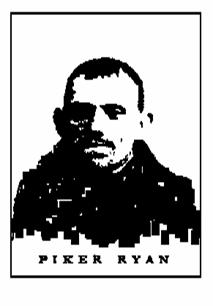
The Whyos readily accepted commissions to murder, steal or commit bodily harm. Although other gangs immersed themselves in similar criminal pursuits, the Whyos differentiated themselves by advertising their skills to potential clients. Herbert Asbury wrote that the pioneer of this enterprising practice was Piker Ryan, and after his apprehension by the police, they found a list in his shirt pocket that outlined various crimes and their associated prices. This note, headed by the word 'Jobs', also contained a list of names with check marks next to them. Ryan explained that these were jobs, and that they were completed to his customer's satisfaction.[7]
|
|
Jobs
Punching $ 2 Both eyes blacked 4 Nose and Jaw broke 10 Jacked out 15 Ear chewed off 15 Leg or arm broke 19 Shot in leg 25 Stab 25 Doing the big job 100 and up
|
A Book was written in 1887 called 'The Capture of the Paddy Ryan Gang and Burglers" which detailed the gang's criminal activities and its accomplices. Paddy's gang focused on Post Office burglaries in the states of Connecticut and New York, and reads like a sensationalized detective mystery. Paddy, whose common alias was Paddy Byron, was employed by the Stern Brothers Silk Thread Manufactury, and although common laborers earned 'sweat shop' wages, Paddy was always dressed in the latest styles. He was described as a "church going man"[8], and many of his neighbors found it hard to believe that he was involved in underworld activities. He eluded authorities even after he was identified as the gang's leader, but following his capture he was sentenced to three years at Wethersfield State Prison. His imprisonment reduced the gang's activities in Connecticut. L.A. Newcome wrote that after his arrest, "No depredations of a serious nature was committed within the borders of Connecticut"[9]; however, several offshoots of the gang were known to have been operating in several New York cities.
Criminal gangs' activities accelerated into the next century, and the New York City newspapers regularly cited misdeeds like Scott Ryan's who was "convicted as a fourth offender for pick pocketing in 1914 and sentenced to life imprisonment."[10] However, the original Irish gangs were being replaced by more dangerous mobsters who dealt in illegal drugs, alcohol, racketeering, and gambling. The New York gangs eventually became dominated by men of Italian descent, many of whom were descendants of Italian boys apprenticed in Fagin gangs to learn the pick-pocket trade. Its membership was not exclusively limited to Italians, as criminal indictments of its members showed surnames of many ethnic origins. In recent years New Jersey, for example, indicted 53 members and associates of the Lucchese and Scarfo-Bruno organized crime families for murder and extortion, and among those arrested was Michael Ryan whom was no stranger to the police. He was among those indicted in 1975 for the slaying of Albert Meglia, Scarfo family associate and Michael White, who was an innocent bystander.[11] While the violent and corrupt activities of the Irish gangs reinforced the poor image of the Irish in general, there were many who viewed the Irish criminal as somewhat of a romantic folk hero. The venerable Old West had many to select from such as William Bonney (Billy the Kid), Butch Casidy, and Bill McCarty, but among the more colorful bandits of Irish descent was Norman Ryan, or Red, nicknamed Canada's Jesse James.
Red Ryan was born in Toronto, Canada in 1895. His escapades were daily dinner discussions throughout Canada during the early 20th century. He committed many robberies in the two Canadian provinces of Ontario and Quebec, and occasionally he made his way into the United States to plunder banks and businesses. He was eventually captured during one of his holdups; however, he made a remarkable prison escape from Kingston Penitentiary which made him into a living legend. He wasted no time in resuming his illegal pursuits, and after another string of robberies was captured at Minneapolis, Minnesota, in 1923. The local circuit judge sentenced him to life imprisonment, and part of his sentence included "30 lashes to be given at the rate of ten a month for three months."[12] He initially plead guilty, but after reading a letter from his brother, he grew increasingly irritated and according to witnesses said:
"Take me back. I want to change my plea to 'guilty'.
Gimme a quick trial and send me up. That's all I want
now."[13]
While in prison he became a model prisoner, and this attracted several newspapers' attention who began writing details of his criminal career. Norman Ryan was pardoned in 1935, and for the first few months after his release he became a national spokesman for prison reform. This proved to be a sham because he was re-establishing his old underworld contacts. Ten months after his release, he was killed in a shoot-out with police after an attempted robbery.
Criminal violence was not solely centered in the eastern United States metropolitan areas. By the 1920s, Chicago had become a centerpiece for organized crime, especially after the introduction of Prohibition, and men like Al Capone became infamous in their attempts to consolidate the Chicago criminal elements under a single command. The Chicago gangland consisted of gangs such as Genna's and the Saltis-McErlane gang which controlled the Southwest side, but one of the city's oldest was the Valley Gang which had its beginnings before the turn of the 20th century. The Valley gang, which specialized in burglary, bragged that its membership claimed some of the most ferocious leaders in the criminal underworld beginning with Hinie Miller and Jimmy Farley who were sent to prison in 1905. Red Bolton assumed its leadership until he was sent to prison for a murder charge. Bolton's prison sentence left the gang leaderless, and a new mob chieftain was chosen to carry on in Bolton's absence - "Paddy the Bear" Ryan. Paddy described as a "round, rough, little ball of a man - just five feet tall, over two hundred pounds in weight"[14] was a well known brawler, and he used his saloon for the base of his operations until he met a violent end in 1920 during one of Chicago's many gang wars:[15]
8 Now Dead in Gang War
"Paddy the Bear" Ryan is killed by
5 Chicago Gunmen
Chicago, June 17 - Chicago's gang was renewed this morning with the shooting of "Paddy the Bear" Ryan by five gunmen, who fled in an automobile. Ryan died on the operating table.
"Paddy the Bear" owned a saloon in which a policeman was violently killed by a gunman, and was also one of those held in connection with a recent murder of Edward Coleman, labor leader.
Police believe the shooting is a direct outgrowth of the Coleman murder, which has never been cleared up. Ryan was a brother-in-law of one of the men Coleman named in an ante-mortem statement.
Ryan is the eighth victim of the gang war which broke out with the killing of Maurice "Moss" Enright, 'King of the Gunmen', o February 3.
Initially the police suspected labor union involvement in the murder, but it was general understanding in the criminal underworld that Paddy's successor, Walter "the runt" Quinlan was responsible for his assassination. A few years later when bootlegging was at its peak, Quinlan was murdered in gangland style, also. His executioner not unsurprisingly was the son of Paddy the Bear: Paddy the Fox Ryan.
The Chicago Tribune reported the city's criminal activities in great detail during the early 20th century, and escalated their attacks after an informer for the Moral's Squad was killed by Jim "Duffy the Goat" Franch, a member of the Colosimo mob at Roy Jones' saloon. Jones had his license revoked in 1914, and believing that he had been 'framed', brutally murdered a Morals Squad police sergeant who was investigating the informer's death. A few months later, as the police raided a brothel, a gunfight erupted between the police and the mob in which one policeman was killed and three were left seriously wounded. The public, led by the Chicago Tribune, chastized the Chief of Police for the First Ward for hindering the investigation, and allegations were made that the Captain was a pawn of the First Ward Alderman "Hinky Dink" Kenna and John "Bathhouse" Coughlin who had ties to organized crime. The newspaper spelled out three reasons for the crime problems in the First Ward, but clearly noted that Captain Michael Ryan was an important link to this violence[16]
Third, is Captain Michael Ryan of the Twenty-second Street Police Station. He is the Chief of Police of the First Ward. The "Hink" put him there. The "Hink" and the "Bath" keep him there. He has been denounced as either notoriously corrupt or incompetent."
The newspaper denounced Ryan's control of the police force. He prevented them from closing up the local brothels and gambling halls. He also prevented his men from making unexpected raids on these establishments, and attempts to remove him from the precinct proved fruitless. The Chicago chief of Police and the State's attorney had already previously tried. The Tribune further blasted Ryan by insinuating that he was tied to the mob itself:[17]
Ryan is the hub. His plainclothes policemen, his confidential men, are the spokes, and sections of the rim are the "Big Four" or the "Big Five" as conditions happen to be at the time, the dive owners and keepers controlling strings of saloons and resorts that travel along without interruption.
The Chicago Tribune's crusade to clean up the levees in the First Ward forced Ryan out of the police force. "Hinky Dink" Kenna and his other henchmen lost significant support in the political machines, and an attempt was also made to reduce the illegitimate activities in his Chicago district. In recent years organized crime has continued to maintain a foothold in certain sectors of Chicago life, most notably in illegal gambling, prostitution, and drugs. The New York Times in 1992 wrote a series of articles concerning one of the major illegal activities still prospering in this Illinois city: illegal weapons sales. It noted that these unlawful sales came from many sources ranging from small gun dealers to organized gunrunners. They cited the most notorious gunrunner to be James Ryan, a resident of Chicago, who used an easily "obtainable $30 Federal license to sell hundreds of guns go street gang members until he was caught by undercover agents."[18]