

Book of Ryans - Dynasty
The Templars
Contained within the Plea Rolls of Edward I, in the years of 1305 and 1306, a record describes the presbytery of Knights Templars of Clonaul <Clonoulty> where the Master of the Templars paid 10 Pounds for himself and all his men for trespasses. On the list appears the names of William Boy O'Molryan, Tathing carrach O'Mulryan, Dermod lech O'Molryan, Meloghelyn O'Molryan and others associated with the Templars. Even though the records indicated that they were `servientes or armigeri and probably accompanied the Templars in the Crusades"[1] , the fact that they were described as servientes or sergeants in the Templars indicated that they probably did not participate directly in the Crusades.
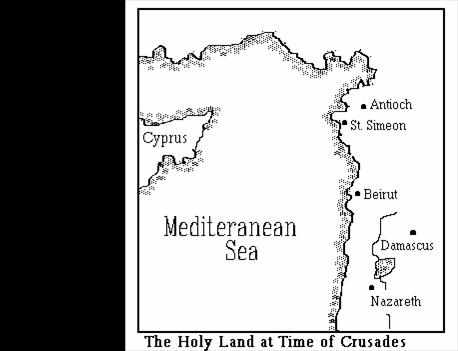
The Templars were created after the first Crusades to defend Palestine from the Moslem infidels. Throughout Europe, a considerable number of knights showed themselves ready to service in this strict order. The rule was very strict, and men measured an association's importance by the demands placed upon its members. While many orders promised salvation through prayer or service to the poor, only "the Temple held out the assurance of heaven through fighting, and it was an age in which every man was trained for war."[2]
Originally the Temple only allowed Knights into its order; but after 1128 three classes of the Order were developed to expand membership-knights, chaplains and sergeants. The regular knights surrendered all their property, could not withdraw from the brotherhood once they entered, and were not allowed to marry. The rules were so strict that the knight could never kiss his own mother, aunt, sister or any other woman. The rules further stated that a knight could not hold a female child even during a baptism. A Chaplain, the next level of knight, could be inducted into the Temple, but was not required to remain with them for life, although many did do so. The final class of knights were the sergeants or servientes who were principally composed of rich bourgeois and large landowners. They held a lower standing than knights; however, the servientes were men of considerable standing who commanded large bodies of men which the Temple could draw upon for the defense of Palestine. Although the O'Mulryans regarded as Servientes in the Rolls may not have served in the Crusades, it is probable that other O'Mulryans through the septs association with the Templars marched in the Crusades as foot soldiers.
The Plea Rolls from Edward I should be seen for what it truly was: a resolution to the excesses of the Templars. The Order was criticized for its arrogance, greed and extravagance. For several centuries, Europe idolized the Templars, but they fell into disfavor after they ambushed the Hospitaliers, another Crusades Order, over a petty dispute. This act of violence was denounced by the nobility and clergy throughout Europe, and executions of those associated with the Templars became widespread on the continent. Later a conspiracy theory floated throughout Europe that the Templars were agents of the devil, however, Edward doubted the rumor's credibility even though it was supported by Pope Clement V, a known proponent of the Hospitaliers order. The Templar's greatest undoing was its pride and great wealth which eventually created many enemies among the secular and lay elements throughout Europe.
The Templars in Ireland shared the betrayal of the Order elsewhere. They had indeed made little mark in the history of the country, but the position of the order, under the continued favor of the king and pope, was one of extraordinary privilege. They were freed from all kinds of tolls, taxes, and onerous customs, and tithes, and even from the terrors of excommunication and interdict locally pronounced, while they exercised complete civil and criminal jurisdiction over their own vassals and tenants. Their privileges indeed attracted to their lands the tenants of others to the detriment of their neighbours.[3]
If the Templars in Ireland received special privileges for financing the war against Moslem infidels, then the O'Mulryan's motives were not completely altruistic. They may have viewed their financial patronage in much the same way modern society views investments or tax deductions. Even though the charges of idolatry leveled against the Templars were not supported, this did not prevent Edward I from imposing harsher punishments later. The annals of Duald McFirbis stated that in 1307 "The Templars in Ireland are taken prisoners the day of the purification of the Virgin <February 3rd>.[4] It was likely that all those mentioned in the plea rolls were imprisoned. In another entry written in 1314, McFirbis wrote that the "Hospitaliers receive lands of Templars"[5] , and by 1314 the Templars no longer existed in Ireland.
The New Generation
Ever since the English first appeared upon our coasts, they entered our territories under a certain specious pretence of charity, and external hypocritical show of religion, endeavoring at the same time, by every artifice malice could suggest, to extirpate us root and branch; and, without any other right than that of the strongest, they have so far succeeded by base fraudulence and cunning, that they have forced us to quit our fair and ample habitations and inheritances, and to take refuge, like wild beasts, in the mountains, the woods, and the morasses of the country...
Memorial of the Irish to Pope
John <XII in the reign of
Edward II>
Early in 1315 Edward Bruce landed in Ireland at Loch Ryan in an attempt to conquer the country and proclaim himself King of Erinn. The journals do not implicate the Ryans, particularly the O'Mulrians, in participating in Bruce's intervention into Ireland, but the incursion of Bruce into their lands was obviously felt. As these events unfolded, tremendous devastation occurred within the O'Mulryan kingdom and their neighbor's lands.
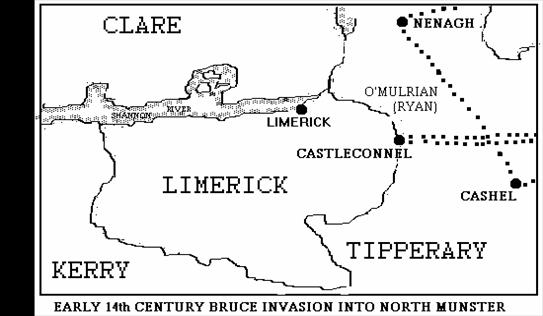
<February 24, 1317>. Guided again by the Lacys, and in a long march through Callan to Limerick and Castleconnel and back through Cashel to Kells in Ossory, Bruce terribly wasted the lands of Butlers and Fitzgeralds.[6]
Bruce was unpopular in most of Ireland, yet he managed to win the favor of O'Neill in the North. Much of this resentment Bruce brought upon himself as he methodically destroyed the Irish countryside, and the Gaelic rage flared when Bruce's army burned down a Catholic church full of people at Ardee. Edward Bruce cared little for the inhabitants of Ireland, and his indifference resulted in his army devastating anything in its path. According to the Annals of Ulster:
Edward Bruce, the destroyer of all Erinn in general both of English and Gael was slain by the English of Erinn...for theft, and famine and destruction of men occurred throughout Erinn during his time for the space of three years and a half, and people used actually to eat one another throughout Erinn.[7]
The Irish frontier exhibited few signs of problems against the English, and after the major defeat at Atherny, even Thomond's Murtough O'Brien, a fiercely independent Gaelic chieftain, had thrown his lot in with Richard de Clare. Many Gaelic septs joined the English armies of Edmund Butler, Thomas FitzJohn, and Maurice FitzThomas to stop Bruce's reckless excursions into the Irish wilderness. Bruce's army was a professional one, and as his army penetrated Ireland, they were able to roll over the light forces of the colony. Edward Bruce also allied himself with several northern tribes, but in his chronicles he "accuses some of them of treachery, and of waiting to see which of the combatants was likely to prevail ."[8]
The political and social framework of Irish society was thrown into disarray as a result of the Bruce invasion. Because England could not suppress Bruce's advances in England, Norman law was soon disbanded by the Anglo-Irish lords, and as a result, the arbitrary power of the local chiefs over their dependents was enormously increased. It was at this point the Anglo-Irish nobles began adopting the customs, dress, and laws of the Irish.
Apart from the ravages resulting from the Bruce Invasion, severe famine in the years 1315 and 1316 caused widespread depredations. The source was excessive rains which caused the "corn" not to ripen. In 1321, 1324, and 1325 the annalists described a severe murrain among the cattle. In 1327 a smallpox epidemic spread throughout Ireland, and finally the journals recorded a "great dearth of corn in 1328, 1330, and 1331."[9] The impact of these plagues was especially hard on the English settlers who typically lived in the populated areas where illnesses transmitted quickly.
The 14th century was also a time of increased Gaelic influence, and their military intentions were aimed at ridding the frontiers of Norman settlers. In 1325 the O'Carrolls burned English colonists' homes and banished local settlers which occupied their ancestral lands; and in 1342 the O'Mores of Leix stirred up the anxieties of the Irish of Munster and Leinster with an intent to expel the English living in Ireland. A few years after the O'Carrolls razed English settlements; MacMurrough Kavanagh, a descendent of Donal Kavanagh, assumed the leadership of Hy Kinsella in Leinster by displacing Strongbow's descendants, the Bigods. The armed struggle between the Gaelic Kings and the settlers destroyed vast areas of Ireland, and kingdoms conquered and colonized by the Norman invaders fell into turmoil. The settlers complained bitterly of the losses, depredations, and waste which afflicted the countryside; and the protests from English settlers of personal damages was common especially from those living near the frontier of the pale.