Book of Ryans - Late Medieval Period
The Anti-Christ's Agent
Last night as I lay in my bed, enfeebled and faint,
I uttered (unthinking a while) complains to Christ
that he handed the lime-fields of Flann, every one, to the stranger
While the Gael was laid low and ceaselessly robbed and tormented.
They were gentle, alms-giving and friendly in their time,
their bishops, their monks and their clergy melodious at prayer...
If it's true that their sins fell upon them and turned them to wolves
- show me, O Christ, a snug Saxon didn't mangle Thy law
Donncha Dall O' Laoghaire (c.1720)
On the translation of Bishop Malachy O'Moloney from the See of Killaloe to that of Kilmacduagh in 1576, Cornelius O'Mulryan, 0.S.F. of Owney was appointed bishop of Killaloe, and for the next 41 year until his death acted as Bishop of this ancient See. His installation was entangled in the major rebellions in Ireland in 1578 and 1579, and he was to play an important role among the Desmond Chieftains in soliciting their support.
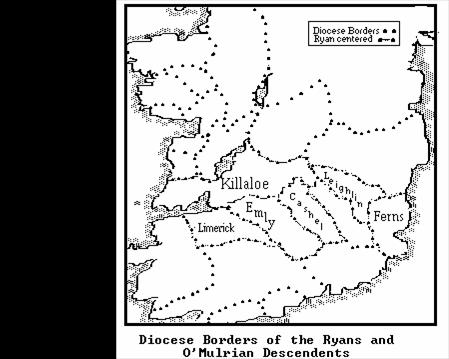
Maurice O'Brien was appointed by the King of England, and was regarded as the only authorized Bishop of Killaloe in 1576. O'Mulryan was the Pope's recognized bishop of Killaloe, and therefore O'Brien held only marginal influence among the local Catholic population in the diocese. Maurice, anti-Catholic and staunchly Episcopalian, once stated "how he greatly and unfeignedly he did detest the Antichrist of Rome - how he would write a book against the Pope; and he told about the plots and machinations of the Pope against England and the Queen."[1] O'Mulryan, on the other hand, was avowedly opposed to English rule. It was said of him that he was "a bitter opponent of Elizabeth and a frequent correspondent of the Roman Court."[2] Perhaps much of O'Brien's bitterness resulted from the Pope's opposition to him as legal heir of Killaloe.
Maurice O'Brien's accession to the see of Killaloe clearly represented the types of abuses the hereditary pre-Reformation clerical profession created. The See of Killaloe became the inherited title for the Mac I Briens of Ara, and because they allied themselves with England throughout much of this period, it allowed Maurice to succeed Terence O'Brien of Ara who died in 1569. Terence was apostatized to the Protestant religion, and his conversion created a great controversy among the dominant Catholic clergy in Ireland and Rome. His conversion to the Protestant faith aligned the O'Briens with England, and subsequently were granted special favors from Queen Elizabeth.
Desmond Rebellions
There's wine from the royal Pope
Upon the Ocean green,
And Spanish ale shall give you hope,
My dark Rosaleen
Dark Rosaleen, Tr. Mangan from Irish Bard
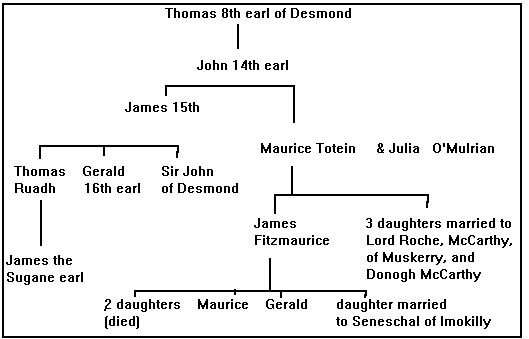
The revolution in 1579, also described as the "Second Desmond" rebellion, involved many descendants of the O'Mulryans including the most prominent leader of this insurrection, and grandson of lord O'Mulryan, the earl of Desmond. James Fitz Maurice, earl of Desmond, was the son of Julia, second daughter of Dermot 0'Mulryan and Maurice Dubh Fitz John, son of Sir John of Desmond. James Fitzmaurice Fitzgerald's father was a legendary military leader whose illustrious career awarded him the epithet of Maurice 'totane', or Maurice of the "burnings or incendiary". Maurice was a fierce warrior, but according to O'Daly, a Munster court poet, his "nature gave him a fiendish character and that he was hated by everyone."[3] James was also a skilled soldier who learned his trade in various continental armies, and his personal papers contained numerous commendations from the kings of France, Germany and Poland expressing their appreciation for his service. Because Fitz Maurice's grandfather was Dermot O'Mulryan, lord of Owney, he was able to convince the Ryans to aid him in his revolution, and one of his strongest backers was lord Dermot's brother, Cornelius O'Mulryan, the bishop of Killaloe. Both Fitzmaurice and bishop O'Mulryan would play pivotal roles during this uprising, and O'Mulryan's role was enhanced after the Pope had him transferred to the See of Cork and Cloyne with the object, as many of his enemies felt, to be in a position of stirring up the country when the Spaniards and Italians landed.
Fitzmaurice's opportunity to guide a rebellion transpired after his cousin, the Earl of Desmond was imprisoned by Queen Elizabeth. This left a political void, and the extremely popular James Fitzmaurice convinced the Fitzgeralds to elect him Desmond's heir. His countrymen acknowledged him as ruler of his cousin's land, and he was accepted as chief of the Ryans of Owney which had so often been described by the chroniclers as a wild and fast country bordering the Shannon River and the Galtee Mountains. Fitzmaurice combined his religious ferver with a nationalist zeal which Desmond lacked, and his leadership inspired other captains in Munster to begin openly resisting the Queen of England. From 1568 to 1573 there were five militant conflicts in Ireland; the Butler rebellion of 1569; one led by James Fitzmaurice Fitzgerald starting from 1568 to 1573; warlike violence led by the Earl of Thomond <O'Brien>; and two other rebellions started by the Burkes. The Fitzmaurice revolution caused the most devastation and death, and Gerald hoped to displace Desmond as head of the Fitzgerald house and highlight the incompetence of both his cousins the earl and his brother, Sir John of Desmond. The Fitzgeralds accepted him as their leader and as letters of correspondence between both families confirmed, he was seen "with one voyce, cried him to be their captain, and him they vowed to follow, and obey his comandment."
Fitzmaurice's rebellion was strikingly different from previous uprisings. He saw his revolution as a counter reformation to forcibly evict the anti-Catholic English and Anglo-Irish from Ireland, and this was clearly outlined in his proclamation at Cork as noted by personal letters and family archives:
ys not contented to dispose all our worldly goods, our bodyes and lyves as she lyst, butt must compell us to forgoo the Catholyck faith by God unto his Church given and by the see of Rome hitherto preserved to all Christian men.
He plainly expressed to the residents of Cork, that the government intended to force them to adopt a new religion, the Episcopalian faith, and therefore called on all
that profess to be Christian men to abolish oute of that cittie that old heresy newly raised and invented, and namely Barnaby Daly and all therein that be Hugnettes booth men and women, and Greinvyles wife and children and to sett upp the service after in due forme and manner which ys used in Rome and throughout all Chirstendom.
Fitzmaurice's assertion that the English intended to destroy their religious freedoms was not without merit, and although unknown to many men of women of Irish birth, Queen Elizabeth had already met with her advisors and stated that it was her intent to annihilate the original Gaelic population whom were unwavering Roman Catholic. As Fitzmaurice continued to agitate the native population against English rule, his armies grew considerably with the addition of men provided by the local gentry. The Queen sent in a large army to suppress and destroy this renegade horde, but when the earl of Essex began his expeditions into Ireland, he stated that "battles were useless for the purpose; but famine, produced by destroying the crops, would be more effectual."[4]
James Fitzmaurice's underlying intent was to create an alliance with Catholic Europe; however, his nationalistic zeal appealed primarily to the populace of the west and south. Because the northern provinces were controlled by Roman Catholic lords, they viewed Fitzmaurice's crusade against Elizabeth's pro-Protestant faction as unimportant; consequently, his anti-English rhetoric failed to develop a widespread appeal except among a few Captiaincies of the Gaelic south. His messages for the most part also went unheeded by the majority of gentry with the exception of a few landowners in Munster whom were willing to identify with his extreme opinions; and as so often been quoted so did the "young and loose people went to him."[5] In 1569 he sent the Archbishop of Cashel, Maurice Reagh Fitzgibbon, another Geraldine to Spain to make an urgent appeal to Phillip II for assistance. Phillip made promises to support Fitzmaurice's military ventures against Elizabeth, but his verbal commitments never materialized into timely support, and when help was provided it was often not enough. In many cases the planned assistance met with catastrophic tragedies.
For several years the supporters of Fitzmaurice's rebellion continued their opposition to Elizabeth's anti-Catholic government, and although it appeared that the momentum was favorable to the Irish, he received crushing news in 1571. In this year he lost his strongest ally, the earl of Clancar, McCarthy Mor, and this left Fitsmaurice with a small army to fight the English. McCarthy Mor's departure convinced others to abandoned the rebellion including several of the earl of Ormond's brothers who claimed that they entered the revolution because lord Sidney mistreated them. Sir Edmund Butler, one of Ormond's brothers, originally collaborated with Fitzmaurice after Sir Peter Carew confiscated old land titles in Cork which the Butlers claimed were their ancient hereditary lands. Butler justified his actions by suggesting that he had no revolutionary intent towards Queen Elizabeth, but that his actions were designed to banish her enemies from Ireland. Initially the O'Carroll's of Ely, the O'Briens of Ara and the O'Kennedys remained neutral; however, they later joined in this rebellion, much of it in response to the indiscriminate destruction caused by the English armies. Eventually, Fitzmaurice was captured, and as punishment was forced to wear a halter around his neck throughout many towns of Munster. Humiliated by the crown and stripped of his lordship, he was forced from Ireland penniless. He was exiled to Europe, and bristled with great bitterness towards the Queen's treatment while held captive.
Strong with resentment, he traveled to Paris, Rome, and Madrid, representing to these rulers the Irish cause and how conquest might be achieved. In France he received no support or encouragement, and in Rome he only received papal promises and good wishes from Gregory the Thirteenth. While in Rome, "He met with Cornelius O'Moel Ryan, titular Bishop of Killaloe, and Thomas Stukely."[6] In the "Calendar of State Papers, Ubi Supra" O'Mulrian was recognized as a statesman visited by both English Ambassadors and other foreign statesmen. In these state papers, his country noted as either South Tipperary or Limerick, and it was also observed that "he is the pretended Bishop of Killaloe and nominally of Cork and Ross."[7]
The negotiations between Fitzmaurice and Gregory's papal representatives were successfully concluded in 1578, and Pope Gregory immediately assembled two thousand Italian men, mostly from the overcrowded prisons, and left them under the command of Hercule de Pise, an experienced general. These criminals were formed into battalions under de Pisa's disposal accompanied by Nicholas Sanders, an English Jesuit, and Cornelius O'Mulrian, Bishop of Killaloe. Before sailing to Spain, the Pope appointed O'Mulrian as Bishop of Cork which being a more prestigious position provided him greater political influence in Ireland. It was conceivable that the Bishop of Rome also had other motives to assist Ireland. In early documents, it appeared that "Pope Gregory III was amusing himself with the dream of making his son, "Signor Iacomo, King of Ireland."[8]
After Fitzmaurice's ill-trained fighting unit boarded the warships, they were placed directly under the command of Thomas Stukely. Upon reaching Lisbon, Stukely found Sebastian, the King of Portugal, preparing for a war in Africa to fight the infidels who supported Mohammadism. Sebastian persuaded Stukely to accompany his Portuguese armies to Africa, and he promised him rich rewards and royal title in return. This combined armies of Sebastian and Stukely sailed into north Africa, but met a shattering defeat leaving few survivors with the majority, including Stukely, dead on the battlefield. Not until Sanders and O'Mulrian reached Rome late in 1570 did Fitzmaurice learn of this tragedy. Fitzmaurice knew that Rome could not provide additional support, so he decided to solicit aid from Portugal, perhaps because it was a Catholic country and perhaps also an excuse to place guilt on its emissaries for taking the Pope's recruits into Africa rather than to Ireland as originally planned.
Before setting sail for Lisbon, he wrote to the Archbishop of Toledo, "Acquainting him with the disaster which had befallen our Bishop Cornelius, who a little while before, having sailed from Rochelle for the Irish coast, was captured by pirates, and being despoiled of all he possessed, was obliged to return to the Continent."[9] Fitzmaurice added:
He is most devoted to us, and we confide to him all the secrets which are to be communicated to you connected with the succour which is sent to us. It would be most useful that he should accompany the expedition of troops to instruct them as to the place of landing as well as to conduct them to our quarters."[10]
Fitzmaurice with greater resolve to assemble an army sailed for Lisbon, and there gathered 800 trained soldiers to replace the men he lost during Sebastian's fight. He was accompanied by Cornelius O'Mulrian and Doctor Nicholas Sanders, an English Jesuit, who acted as legate from the Pope. Although O'Mulrian was an ecclesiastic, his role was more that of a General commanding this army of foreigners. In addition, Dr. Sanders skills were employed to assist Fitzmaurice in persuading the Irish nobility to rise up against the Queen. Through their efforts, they pictured her as an enemy of the Pope and the Catholic Church.
Fitmaurice's armies finally reached Ireland at County Kerry in July, 1579, in an area near Dingle Bay, and he used the natural barriers of the coast to protect the ammunition he delivered from Lisbon. Word of this landing was passed by James Golde, Attorney General for Munster, to the Mayor of Limerick on July 22nd. Golde wrote of Fitzmaurice:
"The traitor upon Saturday last came out of his ship. Two friars were his ensign-bearers, and they went before with two ensigns. A bishop, with a crozier-staff and his mitre, was next the friars. After came the traitor himself at the head of his company, about 100 ships, and went to seek for flesh and kine, which they found, and so returned to his ships."[11]
Shortly after his arrival, he along with a few friends marched towards Connaught to assemble an army among his old acquaintances; but on the way he was attacked by Theodore Burke, eldest son of Sir William Burke from Castle Connel. In Theodore's desire to please Queen Elizabeth, he sacrificed the interests of his religion and his country to engage Fitzmaurice in battle. Finding it impossible to avoid an engagement, Fitzmaurice was resolved to conquer or die. His decision to fight the Butlers would have mortal consequences as he was wounded in the breast by a musket ball:
"and roused to a last effort, he cleared a passage through the enemy, and cut off the head of Theobald Burke with a single blow. The brothers of that captain fell also, and their entire force was routed. The victory, however, proved a dear one to Fitz-Maurice. His wound being mortal, he died in six hours after the action."[12]
The people of Desmond worshipped Fitzmaurice, and a great sorrow swept through the South when they learned of their Captain's fate. He was a revered hero, and soon writers, including former enemies, eulogized the charismatic leader for his bravery and religious resolve. These writers shared a universal sentiment in their assessment of Fitzmaurice's life, and one author certainly summed up his life when he wrote that, "hee was a noble and gallant gentleman - graue, affable, wise, learned, and religioius, a man of farr reaching witt, of a voluble sweete tonge, and have a comely behauior."[13]
James Fitzmaurice left behind two sons and two daughters. His eldest son, Maurice, died as a young man; and Gerald, his other son, drowned off the western coast of Ireland while on board an Armada ships which sank. James' wife and two young daughters were discovered by lords Pelham and Ormond in 1580 as they went through Aherlow burning pastures and killing everyone they saw. They uncovered Fitzmaurice's widow and daughters hiding in a cave, and while the state papers are not specific, it is likely they were put to death as no further information survives them. The family of Fitzmaurice's murderers fared better: the elder Burke received an annual pension from Queen Elizabeth of 200 marks as a reward for Fitzmaurice's death. She also created an heriditary peerage for the Burkes bearing the title 'Lord Baron of Castleconnel'.
Fitzmaurice's death left a void in the Geraldine leadership, and in an attempt to keep the revolution alive his cousin Sir John FitzEdmond Desmond assumed the command of his insurgent army. He ventured into Connaught to solicit military support, and along the way burned Nenagh and twelve towns belonging to the lord of Ormond. These actions prompted Lord Pelham to march from Waterford to Limerick to confront Desmond. On the way, he burned and wasted the "victuals" of the local people. As the Four Masters stated, "it was not wonderful that they should kill men fit for action, but they killed blind and feeble men, women, boys, and girls, sick persons, idiots, and old people. They carried their cattle and other property away to the Lord Justice's camp."[14] Pelham's destructive appetite found its way into the territorial domain of the Ryans where he plundered their kingdom as well.
Father Sanders died in the spring of 1581; but it was not until some fifty years later was it revealed how he had died. According to O'Sullivan, "In the beginning of the night, Dr. Sanders, whose naturally strong frame was worn out by dysentery, thus addressed the Bishop of Killaloe, `Anoint me, illustrious lord, with extreme unction, for my Creator calls me, and I shall die tonight.' `You are wrong,' answered the bishop, `and your case is not bad, and I think that there will be no dying or anointing just now.'[15] Sanders died later that evening, and his body was buried secretly so that his remains would not be mutilated. A bounty was placed on Sanders capture, however, the return of a severed head was also a legitimate claim to the money. This practice of redeeming severed heads for reward money was later brought to colonial America; but because the dismembered heads of savages proved difficult to transport, the early colonial governments passed bounty laws that required only an Indian's scalp to be turned in for a bounty. This practice angered the Indians who, tit-for-tat, began scalping the early settlers in retaliation.
Bishop O'Mulryan, on the other hand, became a wanted man and was forced to leave Ireland. Gerald Desmond who by now returned to Ireland, resented the bishop and wrote to the Pope: "though O'Mulryan was found useful as a military man and ambassador, he would be much more useful as such by following the Army into any other diocese than his own and there discharging Episcopal duties for the Army as a military chaplain of the Episcopal order."[16] Still these feelings seem to be contradictory with other letters he also wrote to the Pope. In these letters he urges the Pope to provide a person with the authority of a Nuncio "and that the Bishop of Killaloe, according to universal consent, would be the fittest person for this."[17] St. Leger, president of Munster also wrote a letter to the Queen dated 1582 which said, "There is I am credibly informed come of late out of Rome a traitor called O'Mulrian, a man born in the County Limerick, brother to O'Mulrian, chieftain of the county he beareth name, which traitor usurpeth the name of bishop of Cork and Cloyne, authorized so to do by the Pope. This traitor as it is given out hath brought assured promises from the Pope to the Earl that he shall have relief both of men, money, and munition by mid-summer next at the farthest; upon whose arrival the traitor the Earl calls all his followers before him and caused this lewd prelate to deliver them this news - which done the said traitor the Earl told his followers that there were some amongst them that sought to betray him for that he could not go through with the enterprise he had begun, requiring them to be true and faithful to him, till the time pronounced by the prelate, and then if they found not his sayings true, no longer to trust him, but seek means for their safeties. Whereupon they all swore to be true and faithful unto him. (Lxxxvi i.p. ubi supra.) [18]
Bishop O'Mulryan had been declared a traitor by the English authority, and he and the Irish gentry gathered their possessions and left Ireland on ships provided by Spain. This voyage to Catholic Spain would have tragic consequences because many of their ships sank and never reached Spain. A rumor surfaced in western Ireland that bishop O'Mulryan was among those drowned at sea, and when this misinformation was received many of his supporters at Killaloe began assisting the King's Sheriff in repelling Spanish invaders attempting to land on Ireland's western shores.
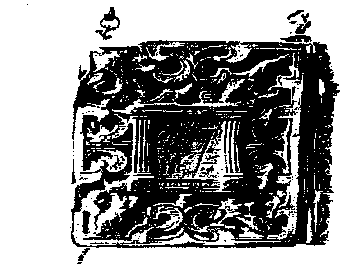
O'Mulryan's ship, the Girona, a big galleass from Naples, sank off Port Spaniagh near County Antrim, October 26, 1588. After being repaired by the MacSweenys in Ulster, the vessel masters knew that it would not make it to Spain, so they set sail for Scotland. This unseaworthy vessel wrecked on a rock near Dunluce castle, and nearly everyone drowned on board, with the exception of a few prominent noblemen including bishop O'Mulryan. Apparently a great deal of wealth accompanied this vessel's journey to Spain, mostly in personal jewelry and silver tableware that the Irish gentlemen owned. Four other ships in the armada also sank including the Don Alonso de Leiva which had most of the noblemen aboard. From the artifacts collected from this ship, one of the pieces was identified as belonging to the Bishop of Killaloe: a reliquary in the shape of a book. This relic has been speculated to have been a papal gift.
|
|
The religuary that was found on the Girona which was speculated to have been owned by bishop Cornelius O'Mulryan. This holy object was made of gold, and contained a votive offering blessed by the Pope. Source: The Armada |
There were other ecclesiastics like O'Mulryan who acted as military agents acting under the guise of Bishop. Other military Catholic ministers supporting the uprising and fleeing to Europe after the revolution included bishops Oviedo and MacEggan. These bishops found their way to either Spain or Portugal because these countries, like Ireland, had strong bonds to the Roman Catholic church.
Among those who claimed were in exile in Portugal and Spain included the Bishop of Kildare, name unknown; the Bishop of Limerick, Conor O'Bayll; the Bishop of Ross, Phillip Naghten (Seville) ; the Bishop of Ossory, `a man of Waterford' (St James); while `there is a bishop of Dublin in the Groyne (Corunna).[19]